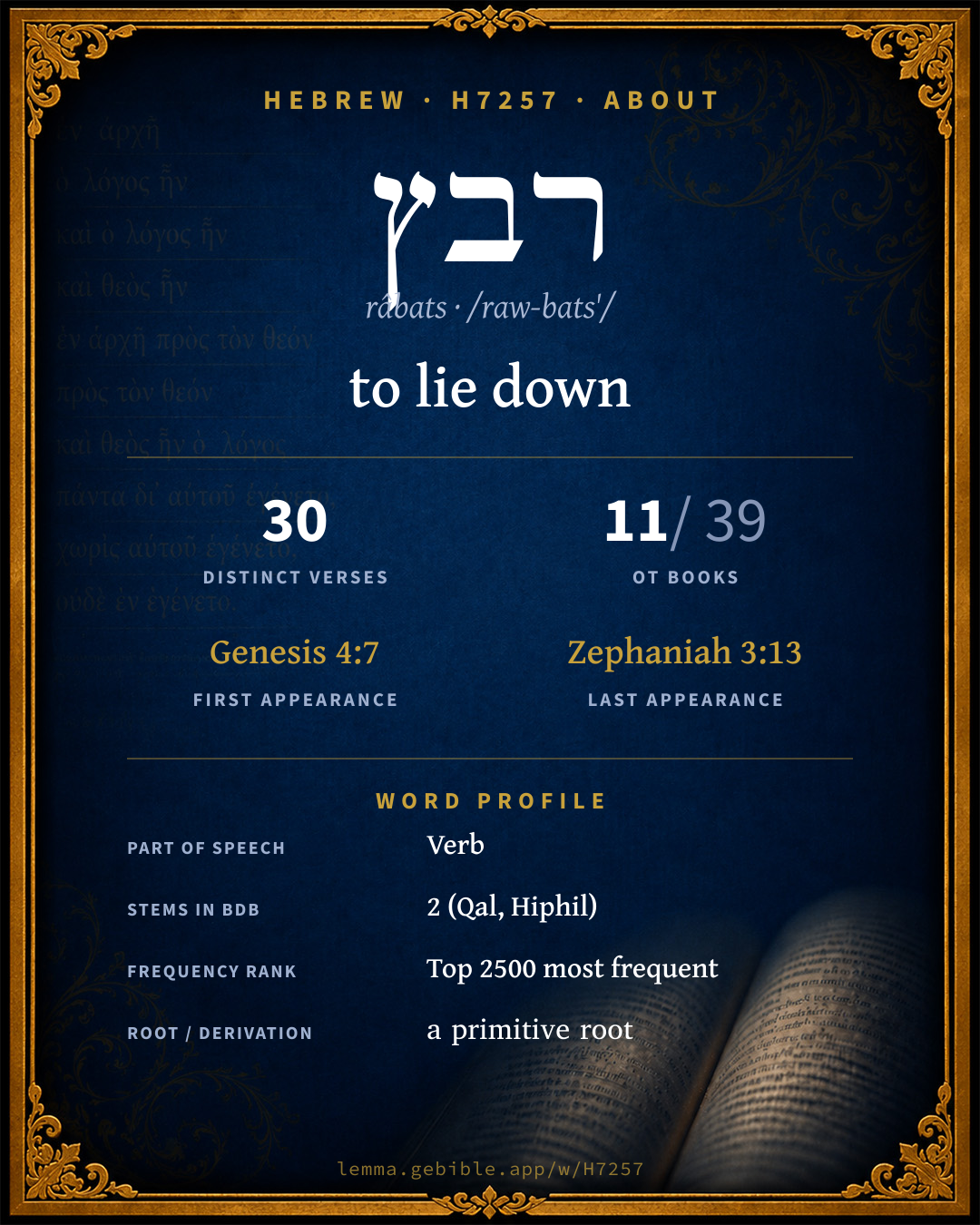
רָבַץ
to lie down
‘to lie down’ is one of 3 main senses fuller range ↓
Full lexicon entry — Brown-Driver-Briggs (BDB)
From Brown-Driver-Briggs (BDB)
Where this word appears
See every Qal verb in the Hebrew Bible →
Grammar key — what these labels mean
Part of speech
- Verb
- An action or state-of-being word.
Stem
- Qal
- The basic, simple active stem — the plain form of the verb (“he wrote”).
- Hiphil
- The causative active stem (“he caused / brought about”).
Form
- Sequential Perfect
- A perfect with prefixed waw continuing a preceding imperfect or command (waw-consecutive perfect).
- Participle Active
- A verbal adjective expressing ongoing or characteristic action (“writing / one who writes”).
- Imperfect
- An incomplete, ongoing, or future action (“he will / would write”).
- Sequential Imperfect
- An imperfect with prefixed waw — the standard past-narrative form (waw-consecutive imperfect).
- Perfect
- A completed action or state — Hebrew marks aspect (completeness) more than strict tense (“he wrote”).
State
- Absolute
- The independent form of a noun, not bound to a following word.
Person
- 3rd Person
- The one spoken about (“he / she / it / they”).
- 2nd Person
- The one addressed (“you”).
- 1st Person
- The speaker (“I / we”).
Gender
- Common
- Either gender — not distinguished for this form.
- Feminine
- Grammatically feminine.
- Masculine
- Grammatically masculine.
Number
- Plural
- More than one (in Hebrew, generally three or more).
- Singular
- One.
6 verses where H7257 appears in the Qal stem in the Book of Isaiah. Filtered view — show all forms. Click any verse to open its interlinear word-by-word view. Verse text shown in the World English Bible for context — . Each verse’s Hebrew form is shown with its reference; the English is not keyword-highlighted, since the data carries no word-level English alignment. Use “Compare translations” on any verse to read it across multiple English versions. This concordance covers the Hebrew Bible; Septuagint (Greek Old Testament) occurrences are not indexed here.
Isaiah
- Isaiah 11:6 יִרְבָּ֑ץ Qal impf 3ms The wolf shall dwell with the lamb, and the leopard shall lie down with the kid; and the calf and the young lion and the fattened calf together; and a little child shall lead them.
- Isaiah 11:7 יִרְבְּצ֣וּ Qal impf 3mp The cow and the bear shall feed; their young ones shall lie down together; and the lion shall eat straw like the ox.
- Isaiah 13:21 וְ/רָבְצוּ conj + Qal wpf 3cp But wild animals of the desert shall lie there; and their houses shall be full of doleful creatures; and ostriches shall dwell there, and wild goats shall dance there.
- Isaiah 14:30 יִרְבָּ֑צוּ Qal impf 3mp The firstborn of the poor shall feed, and the needy shall lie down in safety; and I will kill your root with famine, and your remnant shall be killed.
- Isaiah 17:2 וְ/רָבְצ֖וּ conj + Qal wpf 3cp The cities of Aroer are forsaken; they shall be for flocks, which shall lie down, and none shall make them afraid.
- Isaiah 27:10 יִרְבָּ֖ץ Qal impf 3ms For the fortified city is solitary, a habitation deserted and forsaken, like the wilderness: there shall the calf feed, and there shall he lie down, and consume the branches of it.
About this entry
At a glance — auto-summarized from this page’s data, not written by a person. Every figure links to its source below. This summary describes the numbers; it doesn’t interpret them.
רבץ (râbats) is a Hebrew verb most often rendered “to lie down.” The King James Version usually renders it “shall lie down,” while modern versions prefer “will lie down” (Berean Standard Bible) — see the renderings breakdown. Spanning 30 verses in 11 books, it ranks among the moderately common words of the Hebrew Bible. Isaiah dominates its distribution — 8 of 30 verses. Across 2 stems, its meaning turns on the binyan (Qal, Hiphil). The sections below give every sense, occurrence, and version rendering.
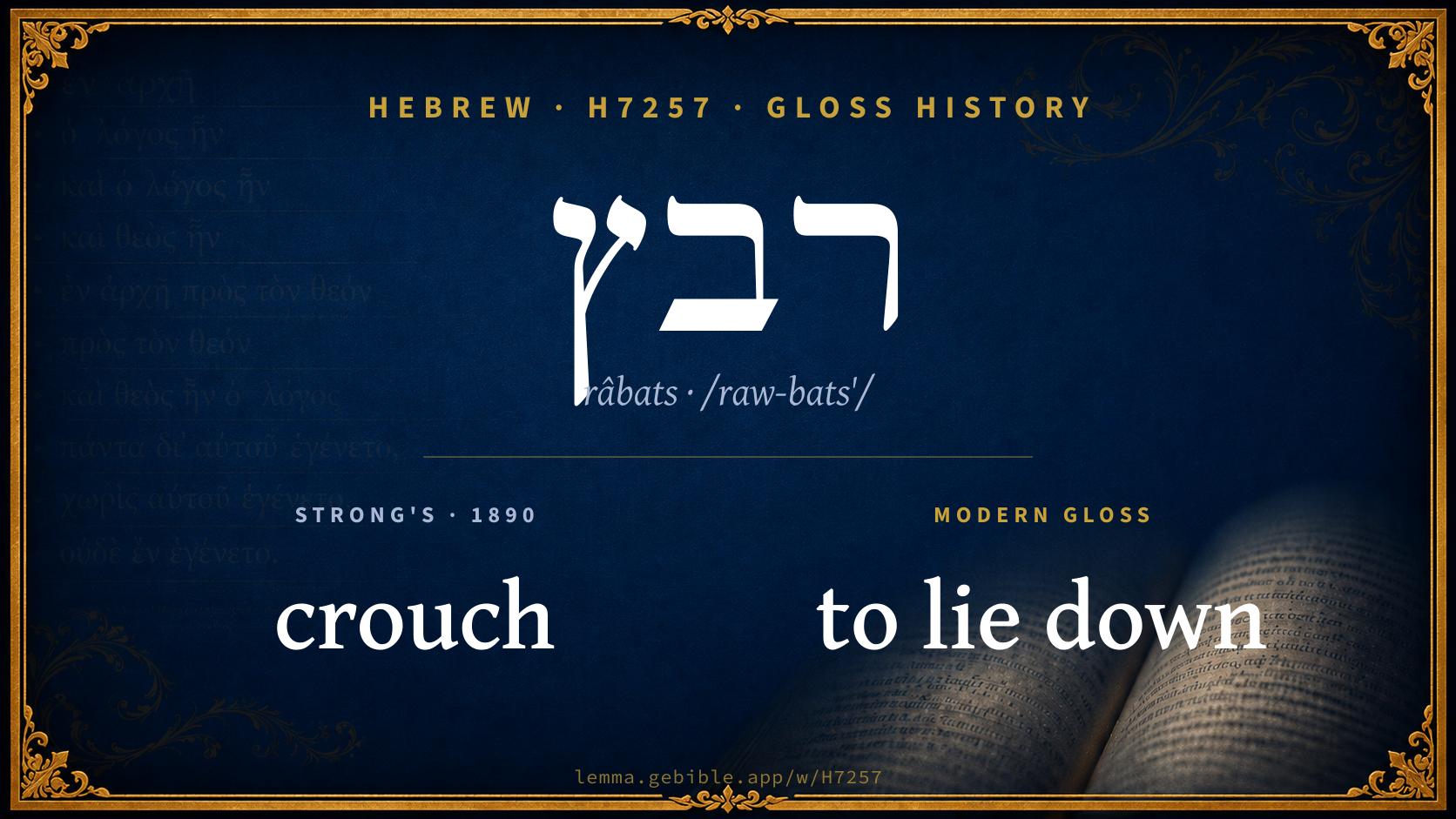
Gloss history
Strong's 1890 vs modern scholarship
About this word
Strong's H7257 catalogs a Hebrew word from the Hebrew Old Testament.
These counts are not copied from any lexicon or concordance. They are computed here, from the morphology-tagged Hebrew Old Testament. What Lemma adds →
- 30
- distinct verses
- The word appears in 30 distinct verses.
- 11 / 39
- OT books
- The word appears in 11 of 39 Old Testament books.
- #1,139
- by frequency
- Top 2500 most frequent Hebrew words (rank 1,139 of 8,640 Hebrew words by occurrence).
View all 30 occurrences in the concordance →
By section of the Old Testament
By traditional corpus
Conventional, traditional groupings — biblical authorship is debated, so this is a traditional corpus grouping, not an authorship claim. Each share is this word’s portion of its verses in that division of the Hebrew canon. Each figure is a share of the word’s 30 distinct verses.
- Prophets (Nevi'im) 16 verses · 53%
- Torah (Pentateuch) 10 verses · 33%
- Writings (Ketuvim) 4 verses · 13%
How translations render this word
Counts come from each version’s own published word-to-Strong’s tagging or interlinear alignment — an approximate guide to how each version renders this word, not a word-level alignment the data otherwise carries. Because each total is that version’s own tagged count, the per-version totals vary from one another and need not match the appearance or distinct-verse counts above. These counts may also differ from a printed concordance because Lemma counts each distinctly tagged rendering and does not collapse phrase taggings into a single head-word total. This is a fixed set of word-tagged versions (KJV, ASV, BSB, ULT) and does not change with the reading translation you choose elsewhere. Each version’s license is shown beside its name below (and on Sources).
- King James Version: Shall lie down 5×, Lieth 3×, Lie down 2×
- American Standard Version: Shall lie down 5×, Coucheth 2×, Lie down 2×
- Berean Standard Bible: Will lie down 6×, She lay down 2×, They lie down 2×
- unfoldingWord Literal Text: Will lie down 5×, They will lie down 3×, And 2×
King James Version Public Domain
Renders H7257 across 30 tagged occurrences — most commonly:
Plus 18 renderings that appear only once — usually multi-word phrases or single function words the recovered tagging swept in, not distinct renderings.
American Standard Version Public Domain
Renders H7257 across 30 tagged occurrences — most commonly:
Plus 19 renderings that appear only once — usually multi-word phrases or single function words the recovered tagging swept in, not distinct renderings.
Berean Standard Bible Public Domain
Renders H7257 across 29 tagged occurrences — most commonly:
Plus 17 renderings that appear only once — usually multi-word phrases or single function words the recovered tagging swept in, not distinct renderings.
unfoldingWord Literal Text CC BY-SA 4.0
Renders H7257 across 34 tagged occurrences — most commonly:
Plus 18 renderings that appear only once — usually multi-word phrases or single function words the recovered tagging swept in, not distinct renderings.
Senses in the full BDB
Hebrew verbs can shift meaning by stem (binyan): Qal is the basic action, Niphal is often passive or reflexive, Piel often intensifies or makes it factitive, and Hiphil is typically causative. The senses below are grouped under the stem BDB assigns to each.
What do BDB’s symbols mean?
BDB uses these scholarly abbreviations:
| Symbol | Meaning |
|---|---|
| 𝔊 | the Septuagint (the ancient Greek translation, LXX) |
| 𝔙 | the Vulgate (the Latin translation) |
| 𝔖 | the Syriac version (the Peshitta) |
| 𝔗 | the Targum (the Aramaic translation) |
| ψ | the Psalms |
| √ | root (the underlying root or stem) |
| ‖ | parallel passage (a synonymous or contrasted parallel) |
| † | the dagger: every passage where the word occurs is cited |
The 2 senses and sub-senses the full Brown-Driver-Briggs lexicon distinguishes for this word, in lexicon order (not ranked by frequency), with BDB’s own verbatim wording and sub-sense lettering. Shown in Hebrew script with BDB’s own scholarly abbreviations. The condensed entry is in the Lexicon Entry tab. See also the Forms in the corpus table below.
Qal
- Pf. 3 ms. ר׳ Gn 49:9, 3 fs. consec. וְרָֽבְצָה Dt 29:19, רָבָ֑צָה Ez 19:2, etc.; Impf. 3 ms. יִרְבָּ֑ץ Is 11:6; 27:10; 3 fs. וַתִּרְבַּץ Nu 22:27; 3 mpl. יִרְבְּצוּ 11:7, יִרְבָּ֑צוּ 14:30, יִרְבָּצ֑וּן Zp 2:7 ψ 104:22; 3 fpl. תִּרְבַּצְנָה Ez 34:14; Pt. רֹבֵץ Ex 23:5 + 3 times; f. רֹבֶ֫צֶת Gn 49:25 + 2 times; mpl. רֹבְצִים 29:2;—lie down, lie: of domestic animals, ass Ex 23:5 (E; under heavy burden), Nu 22:27 (Je; in obstructed path), Gn 49:14 (at ease; poet., in sim.); sheep, in repose, 29:2 (J), Is 17:2; Zp 2:14; fig. of people Ez 34:14; calf, in repose Is 27:10; of wild beasts, lion, in lair, Gn 49:9 (poem in J; fig.), ψ 104:22; = make lair, abode Ez 19:2 (fig.), so of צִיִּים Is 13:21, תַּנִּין Ez 29:3 (fig.); leopard (with kid) Is 11:6, cf. v 7; = brood, of mother-bird Dt 22:6 (עַל־הָאֶפְרֹחִים); of man, in repose Is 14:30; Jb 11:19, cf. Zp 2:7; 3:13 (fig. of flock perhaps impl., cf. Ez 34:14 supr.); of the deep, רֹבֶצֶת תָּ֑חַת Gn 49:25; Dt 33:13; fig. of curse Dt 29:19 (ב pers.); of sin, לַפֶּתַה חַטָּאת רֹבֵץ Gn 4:7 at the door sin makes its lair. e.g. Genesis 49:9
Hiphil
- Impf. 3 ms. sf. יַרְבִּיצֵנִי ψ 23:2, 2 ms. תַּרְבִּיץ Ct 1:7, etc.; Pt. מַרְבִּיץ Is 54:11, pl. מַרְבֹּצֹים Je 33:12;—cause to lie down, or lie, acc. of flock (for repose) Je 33:12, also (fig.) ψ 23:2 Ez 34:15; acc. of flock om. Is 13:20 Ct 1:7; of laying stones Is 54:11. e.g. Psalms 23:2
Senses from the full Brown-Driver-Briggs lexicon (Brown, Driver, Briggs; Oxford 1906 — public domain), digitized via Sefaria, supplemented by the OpenScriptures HebrewLexicon (CC BY 4.0). Full attribution on Sources.
Word origin
vb. stretch oneself out, lie down, lie stretched out (NH = BH; Assyrian rabâṣu, lie, dwell; rubṣu (in word-lists), stall, also womb (cf. II. רבע supr.); Arabic رَبَضَ lie down on the breast, stretch oneself out, مرابض, Sab. מרבצֿן CIS iv, no. 5, 2; 𝔗 רְבַע lie stretched out, Syriac ܪܒܰܥ, Chr. Pal ܪܒܥ recline at meals, SchwallyIdiot. 87);—
— Brown-Driver-Briggs (Oxford 1906, public domain), digitized via Sefaria, supplemented by the OpenScriptures HebrewLexicon (CC BY 4.0). See Sources.
Origin: a primitive root
Jastrow Dictionary
A second Hebrew/Aramaic lexicon for comparison, covering Aramaic and post-biblical (Talmudic, Targumic, Midrashic) usage that the biblical-Hebrew BDB does not. Matched by lemma rather than by Strong’s number, so a lemma may carry more than one Jastrow headword (shown separately below), and the entries cover usage well beyond the Bible.
רָבַץ
- to lie down, esp. to break down under a load. B. Mets. 33ᵃ, v. רַבְצָן.—Part. pass. רָבוּץ; f. רְבוּצָה &c. a) lying. Y. B. Kam. VII, end, 6ᵃ שמא ראוהו ר׳ perhaps they saw him in the act of slaughtering after the ox was laid down, opp. ראוהו מושך they saw him pull the ox into the woods to kill him. Y. Naz. V, 54ᶜ ר׳ lying, opp. עומד. Ab. Zar. 54ᵃ; Ḥull. 40ᵃ היתה … ר׳ וכ׳ if his neighbor’s beast was laid down before an idol (to be sacrificed). Y. R. Hash. II, beg. 57ᵈ ראיתיו ר׳ בין וכ׳ I saw it (the moon, like an animal) lying between two rocks; Tosef. ib. I, 15 רוֹבֵץ; Bab. R. Hash. 22ᵇ. Num. R. s. 1, beg., v. infra.—b) horizontal. Lev. R. s. 14 בהמה … ר׳ וכ׳ the quadruped walks with her body in a horizontal position, … but woman walks erect; Yalk. Lev. 546; Tanḥ. Thazr. 3 הבהמה … והולד ר׳ וכ׳ the animal walks and her embryo lies horizontally &c., opp. זקוף.
- 1. (cmp. (cmp. רְבִיעָה) to irrigate by sprinkling, contrad. to השקה. Y. Peah V, 19ᵃ top; Tosef. ib. II, 20 המְרַבֵּץ את שדהו וכ׳ (ed. Zuck. המַרְבִּיץ) if one irrigates his field, before the poor have entered it. Shebi. II, 10 מְרַבְּצִין בעפר לבן Y. ed. (Mish. a. Bab. ed. מַרְבִּיצִין) you may (in the Sabbatical year) irrigate ‘blank’ soil (a vegetable or grain field, v. לָבָן); Y. ib. 34ᵇ; Y. M. Kat. I, 80ᶜ; Bab. M. Kat. 6ᵇ מרביצין שדה וכ׳. Tosef. ib. I, 2 מרצפין (corr. acc.); a. e.—Esp. to sprinkle (a floor in order to lay the dust &c.). Snh. VII, 6 המכבד והמרבץ he who sweeps or sprinkles (before an idol); Yalk. Ex. 348 והמרביץ. Y. Sabb. II, end, 5ᶜ; Bab. Sabb. 95ᵃ מְרַבֶּצֶת ביתה וכ׳ may contrive to sprinkle her room on the Sabbath. Ib. הרוצה לרַבֵּץ וכ׳ he who desires to sprinkle &c. Y. Ber. VI, 10ᵈ, v. אֲלוּנְטִית II; a. fr.—Tosef. Ab. Zar. IV (V), 11 ולא רִיבַּצְתִּי עליהם וכ׳ I sprinkled no liquids on them (the herbs, to keep them fresh).
- 2. (with תורה) to spread the Law, to teach. Y. Keth. XII, 35ᵃ bot. ר׳ … יותר וכ׳ he spread the Law more (has had more pupils) than thou; Y. Kil. IX, 32ᵇ bot. B. Mets. 85ᵇ לא רִיבַּצְתָּ, v. פִּלְפֵּל. Tem. 16ᵃ (play on י̇ע̇ב̇ץ̇, v. יַעְבֵּץ) שי̇ע̇ץ וריב̇ץ וכ׳ he (Othniel) gave advice and taught the Law in Israel. M. Kat. 25ᵃ; a. fr.
- 1. to sprinkle, v. supra. Pesik. Par., p. 40ᵇ; Pesik. R. s. 14; Tanḥ. Ḥuck. 6 ומַרְבִּיצִין עליו וכ׳ and they sprinkle water upon him, v. תְּזָוִית.
- 2. to cause to lie down. Pesik. R. s. 3 נפל … והִרְבִּיצָם וכ׳ he fell upon his face, and made them (his sons) lie down on their faces, and prayed. Gen. R. s. 41; s. 69, a. e., v. פְּלַטְיָא II h. Num. R. s. 1 (expl. ויסב, Ex. XIII, 18, cmp. סָבַב Hif.) שהִרְבִּיצָם … רבוצין וכ׳ he made them recline (at meals) like kings lying on their couches. Ib. הִרְבַּצְתִּי וכ׳, v. סִיגְמָטִין; Tanḥ. B’midbar 2; a. e. e.g. Exodus 13:18
- to be besprinkled. Sabb. l. c. ונמצא … מִתְרַבֵּץ מאליו and thus the room is sprinkled of itself.
רֵבֶץ
- resting place. Pirké d’R. El. ch. XX, end (ref. to Job XXX, 23) אמר … בית מלון לרִבְצִי Adam said, while I am yet in this world, I will build myself a lodging for my rest (in death); וחצב … לרִבְצוֹ and he hewed, and built himself &c. e.g. Job 30:23
A Dictionary of the Targumim, the Talmud Babli and Yerushalmi, and the Midrashic Literature (Marcus Jastrow; London, Luzac, 1903) — Public Domain. Digitized via Sefaria. Digitized via Sefaria. Full attribution on Sources.
Forms in the corpus
The 29 distinct written forms H7257 takes in the Hebrew Bible, most frequent first — each parse links to that stem’s occurrences in the concordance. Hebrew forms include their vowel points and cantillation, so a single lemma takes many written forms.
Same root — word family
Other BDB entries built from the same root as H7257, grouped by Strong’s listed origin. These share a root / origin per the lexicon — not necessarily a shared meaning. Each links to that word’s own entry.
Derived from this word
Compare all same-root words → They share a root, not necessarily a meaning.
Septuagint verse parallels
This word appears in 30 verses that also exist in the Greek Old Testament (Septuagint), out of the 30 Hebrew verses it occurs in. You can read those verses in Greek by switching the Old Testament edition to the Septuagint.
Read these verses in the Septuagint
- Genesis 4:7
- Exodus 23:5
- Numbers 22:27
- Deuteronomy 22:6
- Job 11:19
- Psalms 23:2
- Song of Solomon 1:7
- Isaiah 11:6
- Jeremiah 33:12
- Ezekiel 19:2
- Zephaniah 2:7
This is a verse-level parallel only — the same verses exist in both the Hebrew and Greek Old Testaments. No word-level Hebrew↔Greek correspondence is claimed: the data carries no such alignment, so no Greek word is shown as this Hebrew word’s translation. Coverage is not total — the Septuagint omits the deuterocanon and renumbers the Psalms, so some Hebrew verses have no direct Greek parallel.