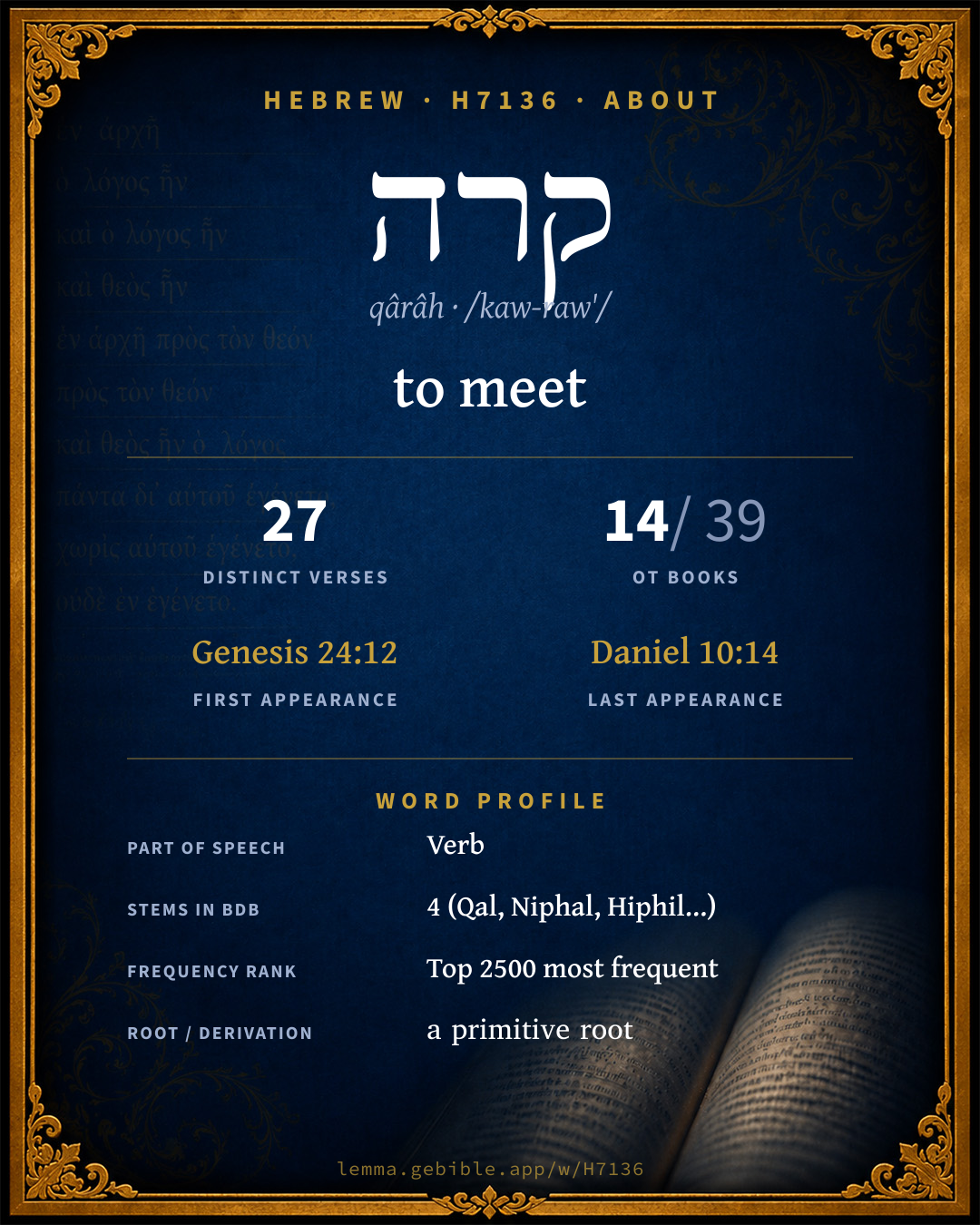
קָרָה
to meet
‘to meet’ is one of 2 main senses fuller range ↓
Full lexicon entry — Brown-Driver-Briggs (BDB)
From Brown-Driver-Briggs (BDB)
Where this word appears
See every Hiphil verb in the Hebrew Bible →
Grammar key — what these labels mean
Part of speech
- Verb
- An action or state-of-being word.
Stem
- Qal
- The basic, simple active stem — the plain form of the verb (“he wrote”). Here: ‘encounter’
- Niphal
- Usually the simple passive or reflexive of the Qal (“he was written”). Here: ‘encounter’
- Piel
- An intensive or resultative active stem. Here: ‘lay the beams of’
- Hiphil
- The causative active stem (“he caused / brought about”). Here: ‘of’
Form
- Imperfect
- An incomplete, ongoing, or future action (“he will / would write”).
- Sequential Imperfect
- An imperfect with prefixed waw — the standard past-narrative form (waw-consecutive imperfect).
- Perfect
- A completed action or state — Hebrew marks aspect (completeness) more than strict tense (“he wrote”).
- Infinitive Construct
- A bound verbal noun, frequently with prepositions (“to write / in writing”).
- Sequential Perfect
- A perfect with prefixed waw continuing a preceding imperfect or command (waw-consecutive perfect).
- Participle Active
- A verbal adjective expressing ongoing or characteristic action (“writing / one who writes”).
- Imperative
- A direct command (“write!”).
State
- Absolute
- The independent form of a noun, not bound to a following word.
Person
- 3rd Person
- The one spoken about (“he / she / it / they”).
- 2nd Person
- The one addressed (“you”).
- 1st Person
- The speaker (“I / we”).
Gender
- Masculine
- Grammatically masculine.
- Common
- Either gender — not distinguished for this form.
- Feminine
- Grammatically feminine.
Number
- Singular
- One.
- Plural
- More than one (in Hebrew, generally three or more).
2 verses where H7136 appears in the Qal stem in the Book of Genesis. Filtered view — show all forms. Click any verse to open its interlinear word-by-word view. Verse text shown in the World English Bible for context — . Each verse’s Hebrew form is shown with its reference; the English is not keyword-highlighted, since the data carries no word-level English alignment. Use “Compare translations” on any verse to read it across multiple English versions. This concordance covers the Hebrew Bible; Septuagint (Greek Old Testament) occurrences are not indexed here.
Genesis
- Genesis 42:29 הַ/קֹּרֹ֥ת ptcl def.art + Qal ptcp.act fp They came to Jacob their father to the land of Canaan, and told him all that had happened to them, saying,
- Genesis 44:29 וְ/קָרָ֣/הוּ conj + Qal wpf 3ms + sfx pers 3ms If you take this one also from me, and harm happens to him, you will bring down my gray hairs with sorrow to Sheol.'
About this entry
At a glance — auto-summarized from this page’s data, not written by a person. Every figure links to its source below. This summary describes the numbers; it doesn’t interpret them.
קרה (qârâh) is a Hebrew verb most often rendered “to meet.” Different stems carry different senses — BDB groups them under 4 stems, among them Qal and Niphal. Spanning 27 verses in 14 books, it ranks among the moderately common words of the Hebrew Bible. Scripture first uses it in Genesis 24:12. Sharing its root, it stands alongside מקרה, מקרה and קרה. For the data behind this summary, explore the sense tree and the renderings breakdown below.
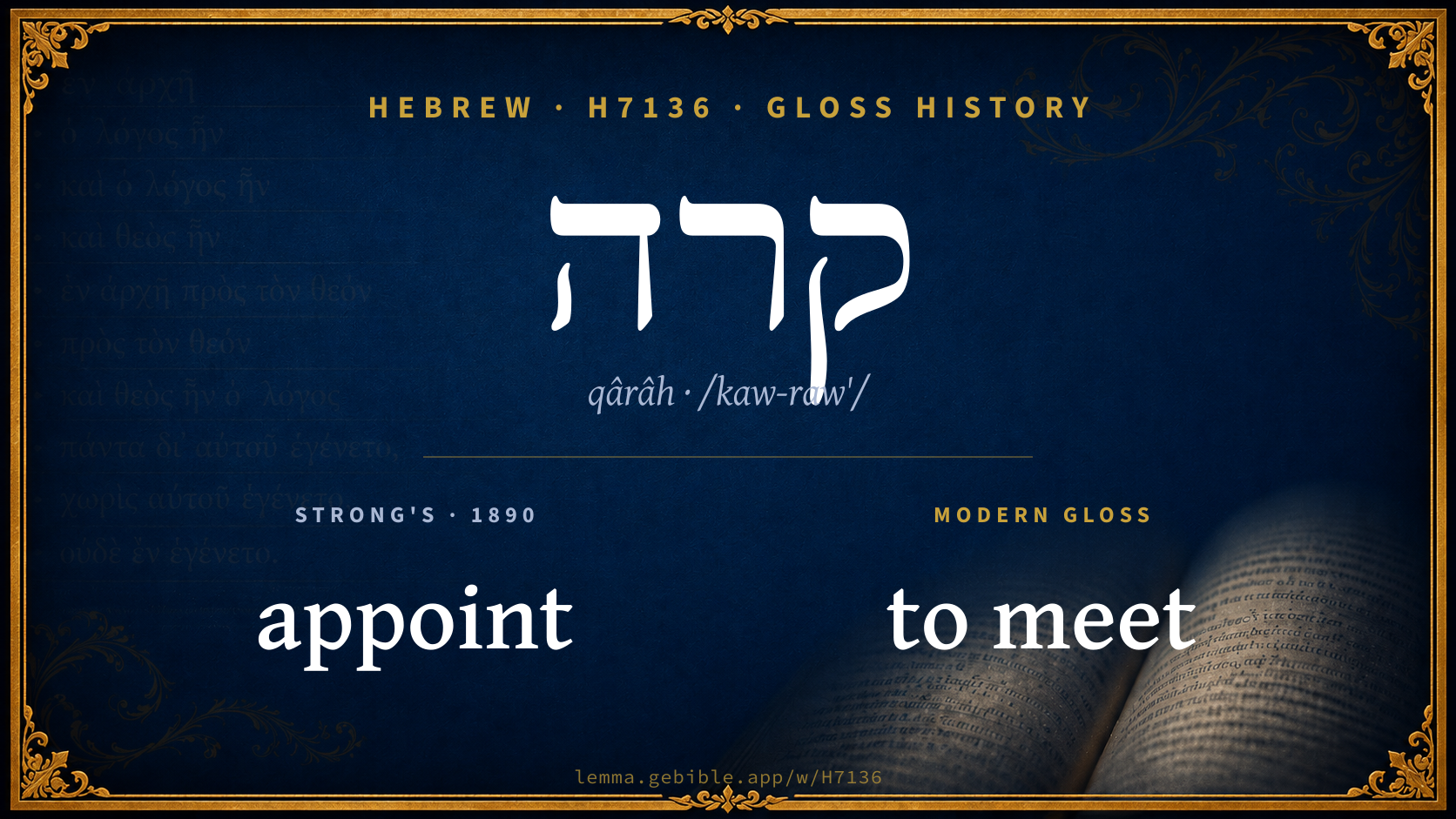
Gloss history
Strong's 1890 vs modern scholarship
About this word
Strong's H7136 catalogs a Hebrew word from the Hebrew Old Testament.
These counts are not copied from any lexicon or concordance. They are computed here, from the morphology-tagged Hebrew Old Testament. What Lemma adds →
- 27
- distinct verses
- The word appears in 27 distinct verses.
- 14 / 39
- OT books
- The word appears in 14 of 39 Old Testament books.
- #1,226
- by frequency
- Top 2500 most frequent Hebrew words (rank 1,226 of 8,640 Hebrew words by occurrence).
View all 27 occurrences in the concordance →
By section of the Old Testament
By traditional corpus
Conventional, traditional groupings — biblical authorship is debated, so this is a traditional corpus grouping, not an authorship claim. Each share is this word’s portion of its verses in that division of the Hebrew canon. Each figure is a share of the word’s 27 distinct verses.
- Torah (Pentateuch) 12 verses · 44%
- Writings (Ketuvim) 12 verses · 44%
- Prophets (Nevi'im) 3 verses · 11%
How translations render this word
Counts come from each version’s own published word-to-Strong’s tagging or interlinear alignment — an approximate guide to how each version renders this word, not a word-level alignment the data otherwise carries. Because each total is that version’s own tagged count, the per-version totals vary from one another and need not match the appearance or distinct-verse counts above. These counts may also differ from a printed concordance because Lemma counts each distinctly tagged rendering and does not collapse phrase taggings into a single head-word total. This is a fixed set of word-tagged versions (KJV, ASV, BSB, ULT) and does not change with the reading translation you choose elsewhere. Each version’s license is shown beside its name below (and on Sources).
BDB lists this Strong’s number as 4 distinct words (homographs). Each count above pools all of them and is not split by sense — see the Senses section below. A low-frequency rendering may belong to a different one of those words, not the primary meaning.
- King James Version†: Happeneth 3×, Met 2×
- American Standard Version†: Happeneth to them all 2×, Make beams 2×, Met 2×
- Berean Standard Bible†: Laid its beams 2×, Met 2×, Will happen 2×
- unfoldingWord Literal Text†: And 4×, Will happen 3×, Had happened to him 2×
King James Version Public Domain
Renders H7136 across 27† tagged occurrences — most commonly:
Plus 22 renderings that appear only once — usually multi-word phrases or single function words the recovered tagging swept in, not distinct renderings.
American Standard Version Public Domain
Renders H7136 across 27† tagged occurrences — most commonly:
Plus 19 renderings that appear only once — usually multi-word phrases or single function words the recovered tagging swept in, not distinct renderings.
Berean Standard Bible Public Domain
Renders H7136 across 25† tagged occurrences — most commonly:
Plus 19 renderings that appear only once — usually multi-word phrases or single function words the recovered tagging swept in, not distinct renderings. Not rendered by a distinct English word in 2 further occurrences.
unfoldingWord Literal Text CC BY-SA 4.0
Renders H7136 across 36† tagged occurrences — most commonly:
Plus 19 renderings that appear only once — usually multi-word phrases or single function words the recovered tagging swept in, not distinct renderings.
9 senses and sub-senses in the full BDB
Hebrew verbs can shift meaning by stem (binyan): Qal is the basic action, Niphal is often passive or reflexive, Piel often intensifies or makes it factitive, and Hiphil is typically causative. The senses below are grouped under the stem BDB assigns to each.
What do BDB’s symbols mean?
BDB uses these scholarly abbreviations:
| Symbol | Meaning |
|---|---|
| 𝔊 | the Septuagint (the ancient Greek translation, LXX) |
| 𝔙 | the Vulgate (the Latin translation) |
| 𝔖 | the Syriac version (the Peshitta) |
| 𝔗 | the Targum (the Aramaic translation) |
| ψ | the Psalms |
| √ | root (the underlying root or stem) |
| ‖ | parallel passage (a synonymous or contrasted parallel) |
| † | the dagger: every passage where the word occurs is cited |
The 9 senses and sub-senses the full Brown-Driver-Briggs lexicon distinguishes for this word, in lexicon order (not ranked by frequency), with BDB’s own verbatim wording and sub-sense lettering. Shown in Hebrew script with BDB’s own scholarly abbreviations. The condensed entry is in the Lexicon Entry tab. See also the Forms in the corpus table below.
קרה I cold, v. קרר.
קרה II encounter, meet, befall (‖ II. קָרָא
Qal
- Pf. 3 ms. sf. קָֽרְךָ Dt 25:18, (ו)קָרָהוּ Gn 44:29 +; Impf. 3 ms. יִקְרֶה Ec 9:11 + Dn 10:14 Kt (Qr יִקְרָא), וַיִּ֫קֶר Ru 2:3, sf. יִקְרְךָ Nu 11:23, יִקְרֵךְ 1 S 28:10 (d. f. dirim.); Pt. fpl. קֹרֹת Gn 42:29;— e.g. Deuteronomy 25:18
- 1. encounter, meet, acc. pers. Dt 25:18, cf. (acc. rei) וַיִּ֫קֶר מִקְרֶהָ חֶלְקַת וגו׳ Ru 2:3 her chance lighted upon a field, etc. e.g. Deuteronomy 25:18
- 2. befall, acc. pers., subj. evil Gn 44:29 (J) 1 S 28:10, י׳’s word Nu 11:23 (JE), indef. Gn 42:29 (J) Is 41:22 (abs.) Est 4:7; 6:13 Dn 10:14 (ל pers.); עֵת וָפֶגַע יִק׳ אֶת־כֻּלָּם Ec 9:11; subj. מִקְרֶה 2:14, cf. v 15. e.g. Genesis 44:29
Niphal
- Pf. 3 ms. נִקְרָה Ex 3:18; 1 s. נִקְרֵיתִי 2 S 1:6; Impf. 3 ms. יִקָּרֶה Nu 23:3, וַיִּקָּר v 4, 16; 1 s. אִקָּרֶה v 15;— e.g. Exodus 3:18
- 1. encounter, meet without pre-arrangement, usually of י׳ (God): c. עַל pers. Ex 3:18 (J), אֶל pers. Nu 23:4, 16; יִקּ׳ י׳ לִקְרָתִי v 3 (all JE); obj. י׳ (om.) v 15. e.g. Exodus 3:18
- 2. chance to be present, ב loc., 2 S 1:6 (+ Inf. abs. נִקְרֹא). e.g. 2 Samuel 1:6
Hiphil
- 1. of י׳, cause (the right thing, good fortune) to occur, c. לִפְנֵי pers.; Pf. 3 ms. הִקְרָה Gn 27:20; Imv. ms. הַקְרֵה 24:12 (both J). e.g. Genesis 27:20
- 2. of Israel, Pf. 2 mpl. consec. וְהִקְרִיתֶם לָכֶם עָרִים Nu 35:11 ye shall (cause cities to occur rightly for yourselves, i.e.) select cities as suitable. e.g. Numbers 35:11
קרה III denom.
Piel
- lay the beams of, furnish with beams;—c. acc. of the building: Pf. 3 pl. sf. קֵרוּהוּ Ne 3:3, 6; Inf. cstr. לְקָרוֹת Ne 2:8; 2 Ch 34:11; Pt. הַֽמְקָרֶה ψ 104:3 (fig.). e.g. Nehemiah 3:3
Senses from the full Brown-Driver-Briggs lexicon (Brown, Driver, Briggs; Oxford 1906 — public domain), digitized via Sefaria, supplemented by the OpenScriptures HebrewLexicon (CC BY 4.0). Full attribution on Sources.
Word origin
II. vb. encounter, meet, befall (‖ II. קָרָא; NH קָרָה meet (rare), קְרִי misfortune, specif. (nocturnal) pollution, and so Aramaic קִרְיוּתָא, ܩܶܪܝܳܐ; Arabic قَرَا (و) is go, seek earnestly, قَرَى receive hospitably as guest; Ethiopic ii. 3, አቃረየ: present, offer as sacrifice);—
IV. n.f. id.;—abs. בְּיוֹם ק׳ Na 3:17 a day of coldness, cold day, so Pr 25:20; ק׳ alone, cold of night Jb 24:7; in gen., due to winds 37:9 (מִמְּזָרִים v. זרה Pi.; yet Voigt Bu, attractively, מִמְּזָוִים (cf. ψ 144:13) out of storehouses [‖ חֶדֶר]); לִפְנֵי קָרָתוֹ מִי יַעֲמֹד ψ 147:17, + pl. Zc 14:6 (read וְקָרוֹת, v. יָקָר).
— Brown-Driver-Briggs (Oxford 1906, public domain), digitized via Sefaria, supplemented by the OpenScriptures HebrewLexicon (CC BY 4.0). See Sources.
Origin: a primitive root
Jastrow Dictionary
A second Hebrew/Aramaic lexicon for comparison, covering Aramaic and post-biblical (Talmudic, Targumic, Midrashic) usage that the biblical-Hebrew BDB does not. Matched by lemma rather than by Strong’s number, so a lemma may carry more than one Jastrow headword (shown separately below), and the entries cover usage well beyond the Bible.
קָרָה
- , v. קרי
קָרֶה
- , constr. קְרֵה, v. קַרְיָא I
קרי ⁴
- , Pi. קֵרָה (b. h.)
- 1. (denom. of קוֹרָה, q. v.) to lay beams; to cover.
- 2. (denom. of קִיר I, q. v.) to wall up, close. Ber. 10ᵇ (ref. to II Kings IV, 10) עלייה … וקֵירוּהָ it was an open upper room (a balcony), and they closed it up. M. Kat. I, 4 מְקָרִין את הפירצה וכ׳ you may close up a breach during the festive week. Ib. 7ᵃ כיצד מקרין וכ׳ in what way is it to be done?… With shrubbery or bay-trees. Succ. I, 8 המְקָרֶה סוכתו וכ׳ he who covers his Succah with spits or boards of a bed-side. Lev. R. s. 1 היה מקרה בקורות וכ׳ he covered the building with joists, and wrote the name of the king on them; a. e.—Part. pass. מְקוֹרֶה; f. מְקוֹרָה. Y. Succ. I, 51ᵈ top סוכה מ׳ פסולה a Succah covered with beams is ritually unfit; מבוי מ׳ כשר a covered alley is fit (for Sabbath movements). Y. Naz. IX, 57ᵈ מערה מ׳ a vaulted cave. Sabb. 5ᵃ; a. fr. e.g. 2 Kings 4:10
A Dictionary of the Targumim, the Talmud Babli and Yerushalmi, and the Midrashic Literature (Marcus Jastrow; London, Luzac, 1903) — Public Domain. Digitized via Sefaria. Digitized via Sefaria. Full attribution on Sources.
Forms in the corpus
The 24 distinct written forms H7136 takes in the Hebrew Bible, most frequent first — each parse links to that stem’s occurrences in the concordance. Hebrew forms include their vowel points and cantillation, so a single lemma takes many written forms.
Same root — word family
Other BDB entries built from the same root as H7136, grouped by Strong’s listed origin. These share a root / origin per the lexicon — not necessarily a shared meaning. Each links to that word’s own entry.
Derived from this word
- מקרה miqreh H4745 chance
- מקרה mᵉqâreh H4746 beam work
- קרה qâreh H7137 chance
- קרי qᵉrîy H7147 opposition
- קריה qiryâh H7151 city
- קרת qereth H7176 city
Compare all same-root words → Showing 4 of 7 — not the complete family. They share a root, not necessarily a meaning.
Septuagint verse parallels
This word appears in 24 verses that also exist in the Greek Old Testament (Septuagint), out of the 27 Hebrew verses it occurs in. You can read those verses in Greek by switching the Old Testament edition to the Septuagint.
Read these verses in the Septuagint
- Genesis 24:12
- Exodus 3:18
- Numbers 11:23
- Deuteronomy 25:18
- Ruth 2:3
- 1 Samuel 28:10
- 2 Samuel 1:6
- 2 Chronicles 34:11
- Esther 4:7
- Psalms 104:3
- Ecclesiastes 2:14
- Isaiah 41:22
This is a verse-level parallel only — the same verses exist in both the Hebrew and Greek Old Testaments. No word-level Hebrew↔Greek correspondence is claimed: the data carries no such alignment, so no Greek word is shown as this Hebrew word’s translation. Coverage is not total — the Septuagint omits the deuterocanon and renumbers the Psalms, so some Hebrew verses have no direct Greek parallel.