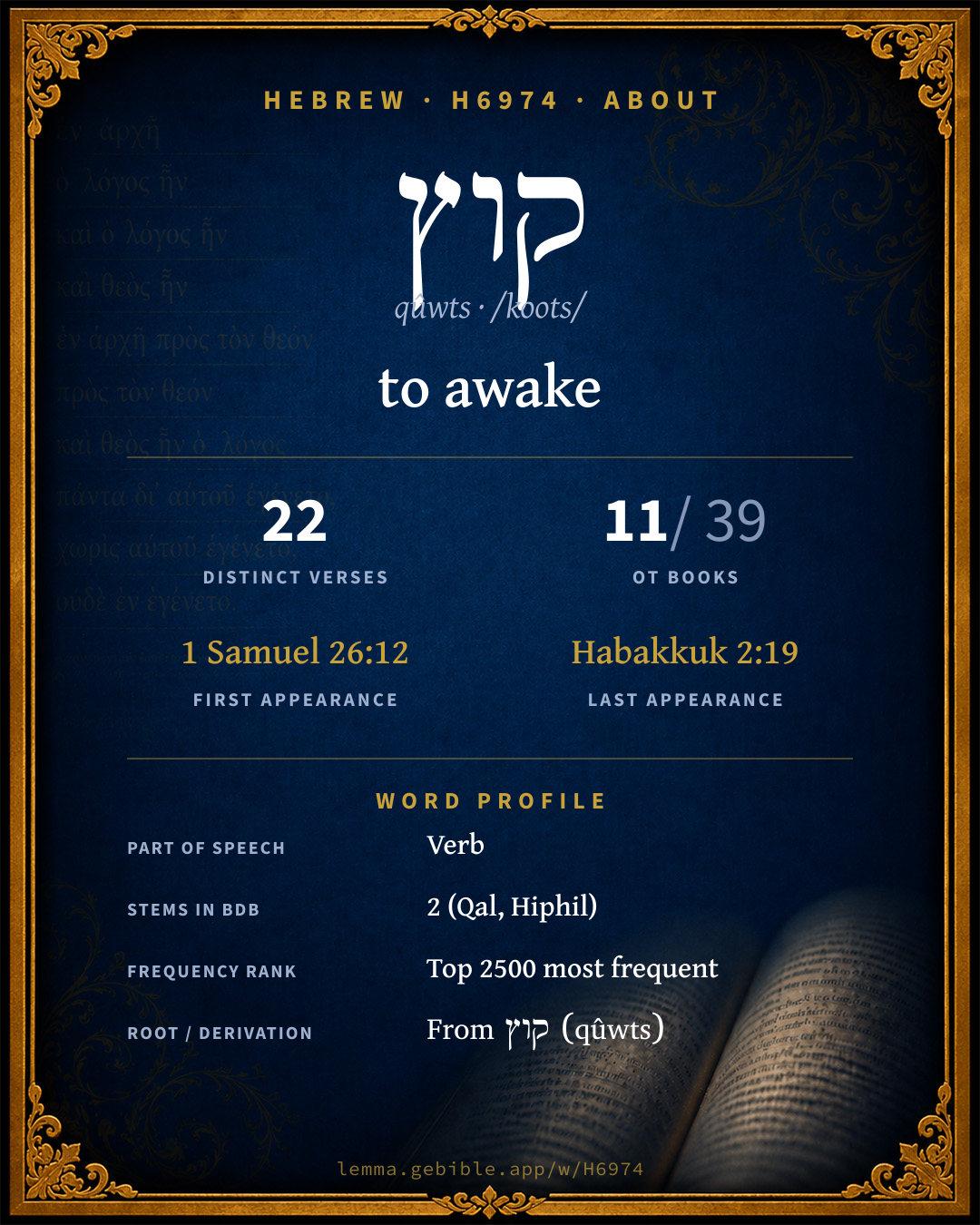
קִיץ
to awake
‘to awake’ is one of 2 main senses fuller range ↓
Full lexicon entry — Brown-Driver-Briggs (BDB)
From Brown-Driver-Briggs (BDB)
Where this word appears
See every Hiphil verb in the Hebrew Bible →
Grammar key — what these labels mean
Part of speech
- Verb
- An action or state-of-being word.
Stem
- Hiphil
- The causative active stem (“he caused / brought about”). Here: ‘awake’
- Qal
- The basic, simple active stem — the plain form of the verb (“he wrote”). Here: ‘feel a loathing at’
Form
- Imperfect
- An incomplete, ongoing, or future action (“he will / would write”).
- Perfect
- A completed action or state — Hebrew marks aspect (completeness) more than strict tense (“he wrote”).
- Imperative
- A direct command (“write!”).
- Sequential Perfect
- A perfect with prefixed waw continuing a preceding imperfect or command (waw-consecutive perfect).
- Infinitive Construct
- A bound verbal noun, frequently with prepositions (“to write / in writing”).
- Participle Active
- A verbal adjective expressing ongoing or characteristic action (“writing / one who writes”).
State
- Absolute
- The independent form of a noun, not bound to a following word.
Person
- 3rd Person
- The one spoken about (“he / she / it / they”).
- 1st Person
- The speaker (“I / we”).
- 2nd Person
- The one addressed (“you”).
Gender
- Masculine
- Grammatically masculine.
- Common
- Either gender — not distinguished for this form.
Number
- Plural
- More than one (in Hebrew, generally three or more).
- Singular
- One.
Every verse where H6974 appears in the Book of Habakkuk — 2 distinct verses. Click any verse to open its interlinear word-by-word view. Verse text shown in the World English Bible for context — . Each verse’s Hebrew form is shown with its reference; the English is not keyword-highlighted, since the data carries no word-level English alignment. Use “Compare translations” on any verse to read it across multiple English versions. This concordance covers the Hebrew Bible; Septuagint (Greek Old Testament) occurrences are not indexed here.
Habakkuk
- Habakkuk 2:7 וְ/יִקְצ֖וּ conj + Qal impf 3mp Won't your debtors rise up suddenly, and wake up those who make you tremble, and you will be their victim?
- Habakkuk 2:19 הָקִ֔יצָ/ה Hiphil impv 2ms + sfx h Woe to him who says to the wood, 'Awake!' or to the mute stone, 'Arise!' Shall this teach? Behold, it is overlaid with gold and silver, and there is no breath at all in the midst of it.
About this entry
At a glance — auto-summarized from this page’s data, not written by a person. Every figure links to its source below. This summary describes the numbers; it doesn’t interpret them.
קוץ (qûwts) is a Hebrew verb most often rendered “to awake.” Debuting at 1 Samuel 26:12, it then recurs through the corpus. The Hebrew Bible uses it across 22 verses — uncommon. Psalms dominates its distribution — 7 of 22 verses. Read the stem: it spans 2 stems, including Qal and Hiphil. The sections below give every sense, occurrence, and version rendering.
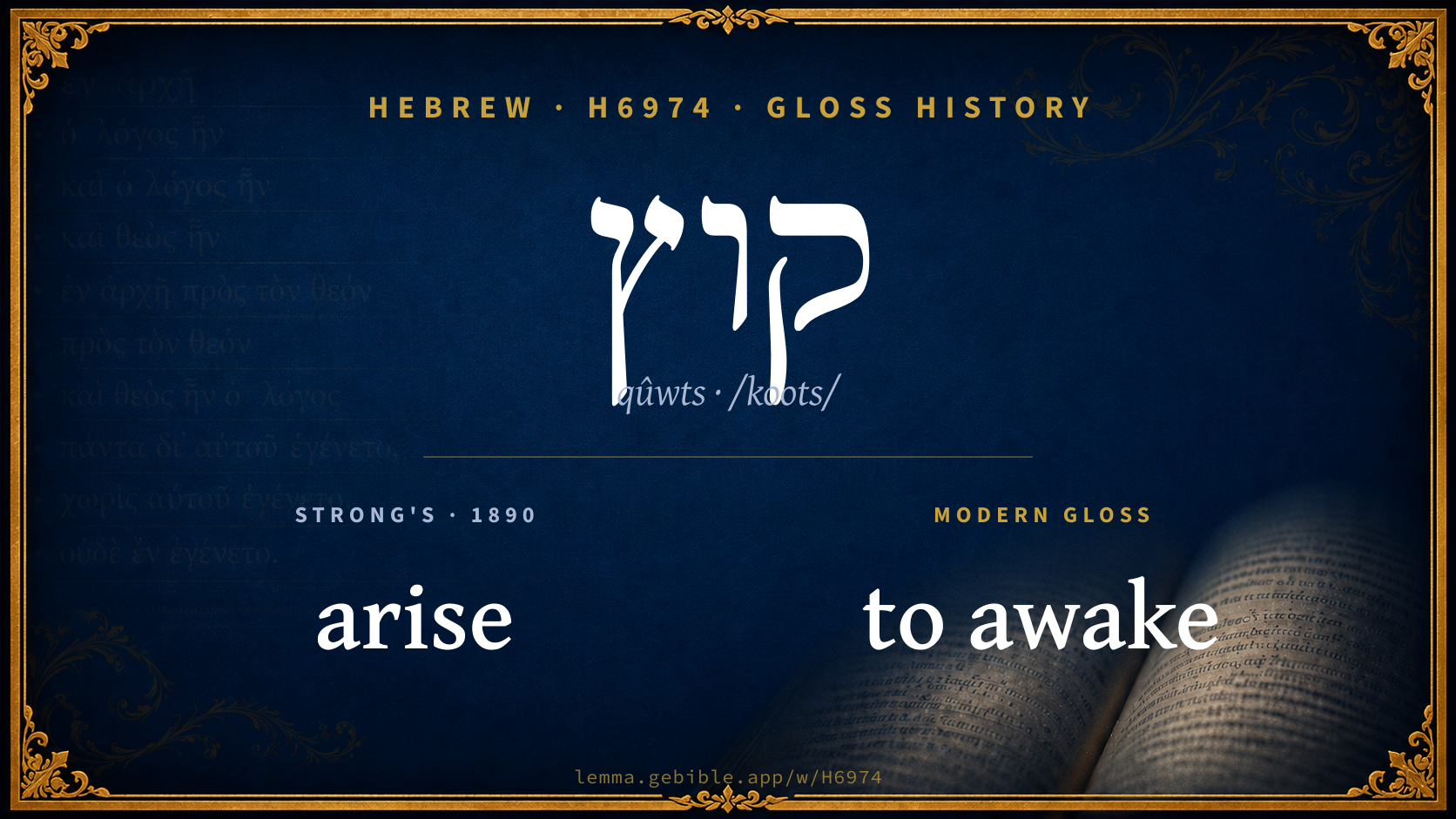
Gloss history
Strong's 1890 vs modern scholarship
About this word
Strong's H6974 catalogs a Hebrew word from the Hebrew Old Testament.
These counts are not copied from any lexicon or concordance. They are computed here, from the morphology-tagged Hebrew Old Testament. What Lemma adds →
- 22
- distinct verses
- The word appears in 22 distinct verses.
- 11 / 39
- OT books
- The word appears in 11 of 39 Old Testament books.
- #1,368
- by frequency
- Top 2500 most frequent Hebrew words (rank 1,368 of 8,640 Hebrew words by occurrence).
View all 22 occurrences in the concordance →
By section of the Old Testament
By traditional corpus
Conventional, traditional groupings — biblical authorship is debated, so this is a traditional corpus grouping, not an authorship claim. Each share is this word’s portion of its verses in that division of the Hebrew canon. Each figure is a share of the word’s 22 distinct verses.
- Prophets (Nevi'im) 11 verses · 50%
- Writings (Ketuvim) 11 verses · 50%
How translations render this word
Counts come from each version’s own published word-to-Strong’s tagging or interlinear alignment — an approximate guide to how each version renders this word, not a word-level alignment the data otherwise carries. Because each total is that version’s own tagged count, the per-version totals vary from one another and need not match the appearance or distinct-verse counts above. These counts may also differ from a printed concordance because Lemma counts each distinctly tagged rendering and does not collapse phrase taggings into a single head-word total. This is a fixed set of word-tagged versions (KJV, ASV, BSB, ULT) and does not change with the reading translation you choose elsewhere. Each version’s license is shown beside its name below (and on Sources).
BDB lists this Strong’s number as 3 distinct words (homographs). Each count above pools all of them and is not split by sense — see the Senses section below. A low-frequency rendering may belong to a different one of those words, not the primary meaning.
- King James Version†: Awake 4×, He awaketh 2×, I awake 2×
- American Standard Version†: Awake 3×, I awake 2×, I awaked 2×
- Berean Standard Bible†: Wake up 4×, Awake 2×, Awakens 2×
- unfoldingWord Literal Text†: Awake 3×, Wake up 3×, Awaken 2×
King James Version Public Domain
Renders H6974 across 22† tagged occurrences — most commonly:
Plus 10 renderings that appear only once — usually multi-word phrases or single function words the recovered tagging swept in, not distinct renderings.
American Standard Version Public Domain
Renders H6974 across 22† tagged occurrences — most commonly:
Plus 13 renderings that appear only once — usually multi-word phrases or single function words the recovered tagging swept in, not distinct renderings.
Berean Standard Bible Public Domain
Renders H6974 across 22† tagged occurrences — most commonly:
Plus 12 renderings that appear only once — usually multi-word phrases or single function words the recovered tagging swept in, not distinct renderings.
unfoldingWord Literal Text CC BY-SA 4.0
Renders H6974 across 25† tagged occurrences — most commonly:
Plus 13 renderings that appear only once — usually multi-word phrases or single function words the recovered tagging swept in, not distinct renderings.
12 senses and sub-senses in the full BDB
Hebrew verbs can shift meaning by stem (binyan): Qal is the basic action, Niphal is often passive or reflexive, Piel often intensifies or makes it factitive, and Hiphil is typically causative. The senses below are grouped under the stem BDB assigns to each.
What do BDB’s symbols mean?
BDB uses these scholarly abbreviations:
| Symbol | Meaning |
|---|---|
| 𝔊 | the Septuagint (the ancient Greek translation, LXX) |
| 𝔙 | the Vulgate (the Latin translation) |
| 𝔖 | the Syriac version (the Peshitta) |
| 𝔗 | the Targum (the Aramaic translation) |
| ψ | the Psalms |
| √ | root (the underlying root or stem) |
| ‖ | parallel passage (a synonymous or contrasted parallel) |
| † | the dagger: every passage where the word occurs is cited |
The 12 senses and sub-senses the full Brown-Driver-Briggs lexicon distinguishes for this word, in lexicon order (not ranked by frequency), with BDB’s own verbatim wording and sub-sense lettering. Shown in Hebrew script with BDB’s own scholarly abbreviations. The condensed entry is in the Lexicon Entry tab. See also the Forms in the corpus table below.
קוץ I feel a loathing, abhorrence, sickening dread (‖ √ of קוט
Qal
- Pf. 3 fs. קָ֫צָה Nu 21:5; 1 s. קַ֫צְתִּי Gn 27:46; Impf. 3 ms. וַיָּ֫קָץ Nu 22:3; 1 K 11:25 (but v. infr.); 2 ms. juss. תָּקֹץ Pr 3:11; 1 s. וָאָקֻץ Lv 20:23; 3 mpl. וַיָּקֻצוּ Ex 1:12; Pt. קָץ Is 7:16;— e.g. Numbers 21:5
- 1. feel a loathing at, abhor, c. ב rei Nu 21:5 (JE), Gn 27:46 (P), Pr 3:11 (‖ מָאַס); c. ב pers. Lv 20:23 (H; subj. י׳); so 1 K 11:25, but Kit (after 𝔖, cf. 𝔊) proposes וַיָּ֫צֶק (√ צוק Hiph. distress). e.g. Numbers 21:5
- 2. feel a sickening dread, c. מִפְּנֵי pers. Ex 1:12 (J), Nu 22:3 (E), Is 7:16. e.g. Exodus 1:12
Hiphil
- Impf. 1 pl. sf. נְקִיצֶנָּה Is 7:6 (sf. of Judah) let us cause her sickening dread, but weak, read נְצִיקֶנָּה (√ צוק) Thes Che Du Gr Marti.—Other Hiph. forms v. קיץ. e.g. Isaiah 7:6
קוץ II
Hiphil
- awake (‖ form of יקץ; NH in Hiph. (rare));—Pf. 3 ms. הֵקִיץ 2 K 4:31 Ez 7:6; 2 ms. וַהֲקִיצ֫וֹתָ consec. Pr 6:22, etc.; Impf. 1 s. אָקִיץ Pr 23:35; 3 mpl. יָקִ֫יצוּ Je 51:39 +; Imv. ms. הָקִ֫יצָה Hb 2:19 +; mpl. הָקִ֫יצוּ Is 26:19; Jo 1:5; Inf. cstr. הָקִיץ ψ 17:15; 73:20; Pt. מֵקִיץ 1 S 26:12;—shew signs of waking, awake: e.g. 2 Kings 4:31
- 1. from sleep,
- a. 1 S 26:12 Is 29:8(×2) ψ 3:6; 73:20; 139:18; Pr 6:22 (doubtful line, v. Toy). e.g. 1 Samuel 26:12
- b. of י׳ ψ 44:24 awake [from sleep] to activity, so 35:23 (c. ל rei), 59:6 (c. inf. purpose). e.g. Psalms 44:24
- c. from ecstatic sleep of proph. Je 31:26. e.g. Jeremiah 31:26
- 2. from sleep of death, c. neg. 2 K 4:31; Je 51:39, 57; Jb 14:12; of resurrection Is 26:19; Dn 12:2. e.g. 2 Kings 4:31
- 3. from stupor (of drunkenness) Jo 1:5; Pr 23:35. e.g. Joel 1:5
- 4. of inanimate thing Hb 2:19; cf. בָּא הַקֵּץ הֵקִיץ אֵלָ֑יִךְ Ez 7:6 the end cometh, it hath awaked unto thee (Co del. הֵקִיץ, but the word-play favours it).—ψ 17:15 is put by Thes Ol Hup Du al. sub 1 a; Ew De Che sub 2; We sub 1 b; Calv Now: from night of distress and helplessness, and so Bae (psalmist representing Isr.). e.g. Habakkuk 2:19
קוץ III 3 ms. קָץ spent the summer Is 18
Senses from the full Brown-Driver-Briggs lexicon (Brown, Driver, Briggs; Oxford 1906 — public domain), digitized via Sefaria, supplemented by the OpenScriptures HebrewLexicon (CC BY 4.0). Full attribution on Sources.
Word origin
I. vb. feel a loathing, abhorrence, sickening dread (‖ √ of קוט; 𝔗 קוּץ id.; for connex. of meanings cf. Aramaic קְנַט loathe, ܩܢܰܛ fear);—
II. Pf. 3 ms. קָץ spent the summer Is 18:6.
— Brown-Driver-Briggs (Oxford 1906, public domain), digitized via Sefaria, supplemented by the OpenScriptures HebrewLexicon (CC BY 4.0). See Sources.
Derived from קוץ (qûwts) (H6972) — to summer.
Jastrow Dictionary
A second Hebrew/Aramaic lexicon for comparison, covering Aramaic and post-biblical (Talmudic, Targumic, Midrashic) usage that the biblical-Hebrew BDB does not. Matched by lemma rather than by Strong’s number, so a lemma may carry more than one Jastrow headword (shown separately below), and the entries cover usage well beyond the Bible.
קָוַץ
- (cmp. כְּוֵץ)
- 1. to shrink, be dried up. Ḥull. 43ᵇ שחותכו וקווֵֹץ Ar., v. כְּוֵץ.—Part. pass. קָווּץ. Succ. 32ᵃ top ק׳ (לולב) a Lulab which is shrunk (Rashi: thorn-like, v. קוֹץ).—V. קָווּץ.—Denom. קוֹץ, קַיִץ.
- 2. to curl. Denom. קִיוֵּוץ, קְווּצּוֹת.
- (denom. of קוֹץ) to clear of thorns, weed. M. Kat. 6ᵃ יוצאין לקַוֵּוץ וכ׳ they go out to clear the roads (for the Passover pilgrims). Tosef. Shebi. III, 7 מְקַוְּצִין וכ׳ Var. ed. Zuck. (ed. Zuck. מְקַוְּסִין; oth. ed. מקומין, corr. acc.) you may remove the stones, thorns &c.
- to be cleared. Shebi. IV, 2 שדה שנִתְקַוְּצה (Y. ed. שנִתְקַוְּו׳) a field that has been cleared; Bekh. 34ᵇ; M. Kat. 13ᵇ; Gitt. 44ᵇ
קְוַץ
- Succ. 23ᵇ קַוְוצָא Ar. (ed. כוו׳), v. כְּוֵץ
- to curl. —Part. pass. מְקַוַּוץ dishevelled, unkempt. Lev. R. s. 5 שעריה מק׳ (not מקצץ) with unkempt hair, opp. סריק, v. סְרַק II.
קוּץ I
- v. preced.) to shrink; to feel aversion, loathe, fear &c. Yalk. Deut. 863 אל תָּקוּצוּ בדברי וכ׳ be not wearied of studying the words of the Law, but let the last day be like the first. Sifra K’dosh., Par. 4, ch. XI (ref. to ואקץ, Lev. XX, 23) כאדם שהוא קָץ ממזונו like a man that is sick of his food (and vomits; Yalks. Lev. 626 קָמֵט במזונו). Meg. 28ᵃ קַצְתָּ בחיי art thou wearied of my long life?; a. e. e.g. Leviticus 20:23
קוּץ
- Targ. Jud. IX, 38. Targ. Hos. IV, 6. Targ. Lam. II, 1 (h. text יעיב); a. fr.
קוּץ II
- to summer (v. Is. XVIII, 6). e.g. Isaiah 18:6
- 1. to cause to summer. Gen. R. s. 34 (play on קַיִץ, Gen. VIII, 22) מְקַיֵּיץ אני עליהם את העוף I shall make the birds feed on them in the summer (with ref. to וקץ, Is. l. c.).—2) (v. קַיִץ) to supply the altar during the dull season. Y. Yoma V, beg. 42ᵇ מְקַיְּיצִים בה וכ׳ they supply the altar with it, i.e. use it for sacrifices when the altar is otherwise unemployed; Y. Shek. I, 48ᵃ bot.; Shebu. 12ᵃ מְקַיְּצִין בהן וכ׳. Ib. אין מקיצין בגופן וכ׳ we do not use them bodily as sacrifices, but what we buy with their value. Ib.ᵇ אין מקיצין בעולת העוף you must not buy birds for burnt offerings out of the funds designated for public free-will offerings. Tosef. Men. X, 8 (expl. קַיִץ המזבח) לוקחין … ומקיצין וכ׳ they buy therewith burnt offerings to supply the altar &c. e.g. Genesis 8:22
קוּץ III
- to cut, v. קָצַץ.
קוּץ ²
- Targ. O. a. Y. I Num. XIII, 23 (Y. II קטעו). Targ. O. ib. 24 (Y. קציצו); a. fr.—Part. קָיִץ, קָיִיץ. Targ. Jer. X, 3.—B. Mets. 107ᵇ נֵיקוּץ מר cut the forest, sir (to allow a tow-path along the river). Ib. קָיִיצְנָא, v. infra; a. e. [Ib. קוצו עילאי וכ׳, v. infra].—Trnsf. (cmp. פָּסַק) to determine, agree, appropriate. Targ. Y. Num. V, 15 דקָיִץ עלה וכ׳ (not דקַיִץ) for which he makes an appropriation in her behalf out of her property.—B. Mets. 67ᵃ לא קָץ ליה he did not explicitly allow him the usufruct of the mortgaged property (מַשְׁכַּנְתָּא), v. קִיצוּתָא.—Part. pass. קִיץ q. v. e.g. Numbers 13:23
- same. [Targ. Y. Num. l. c., v. supra.]—B. Mets. 107ᵇ נִיקַיְּיצוּ עילאי … והדר ניקוץ אנא Rashi (ed. קוצו, incorr.; Ms. M. ניקצו … וקציינא, fr. קְצֵי) let the owners of the upper and those of the lower parts of the forest cut (a path), and then I shall do likewise. Ib. אי קיְּיצוּ קָיִיצְנָא וכ׳ had they cut (their part), I should cut, but as they have not, why should I? Ib. 108ᵃ מאן קַיְּיצֵיה להאי לִיקּוֹץ ענפיה Ms. H. (ed. מַאן קַצְיֵיה תִּקּוֹץ וכ׳) who ordered the cutting of this (my forest)? may his branch (offspring) be cut off; a. e.
- (fr. קְצַץ) to be cut off, v. supra.—V. קְצַץ, קְצִי.
קוּץ IV
- , Hif. הֵקִיץ to awake, v. קִיץ.
קוֹץ I
- 1. thorn. R. Hash. 17ᵃ bot. (ref. to Mic. VII, 18) אליה וק׳ בה וכ׳ a fat tail with a thorn in it (a consolation implying an evil prediction), ‘to the remnant of his inheritance’ (pardon will be granted), but not to his entire inheritance. Gen. R. s. 20 [read:] ק׳ זה קינרס by ‘thorn’ (Gen. III, 18) artichoke is meant. Midr. Till. to Ps. CXXXVI ישב לו ק׳ וכ׳ a thorn got into the foot of one of them (which prevented him from travelling); a. fr.—Y. Sabb. IX, 11ᵈ עין כוס עין קוץ if an idolatrous place is called ʿEn K’os (well of the cup) call it (cacophemistically) ʿEn Ḳots (well of the thorn); Y. Ab. Zar. III, 43ᵃ bot.—Pl. קוֹצִים, קוֹצִין. Gen. R. s. 45, v. נָכַשׁ; Y. Maasr. III, 50ᵈ bot., v. כּוֹס II. Ex. R. s. 1 (ref. to ויקצו, Ex. I, 12) שהיו דומין … כק׳ the Israelites were like thorns in their eyes; Yalk. ib. 162 שהם בעיניהם כק׳ they (the Egyptians) were in their own eyes like thorns (dwarfed and dry plants). Num. R. s. 20 (ref. to ויקץ, Num. XXII, 3) שהיו … כק׳ בפניהם they looked upon themselves as if they were thorns compared with them (the Israelites). Kidd. 75ᵇ (play on מקצותם, II Kings XVII, 32) מן הק׳ שבעם from the thorns (the basest) of the people, opp. הבחירים; Y. Ab. Zar. I, beg. 39ᵃ. B. Mets. 83ᵃ ק׳ … מן הכרם (in serving the Roman government as an executioner) I only destroy the thorns out of the vineyard; יבא … את קוֹצָיו let the owner of the vineyard (God) come and destroy his thorns; Y. Maasr. III, 50ᵈ bot.; (Pesik. B’shall., p. 92ᵃ כוסים וכ׳), v. כָּסח; a. fr.—Cant. R. to V, 11, v. infra.—Midr. Till. to Ps. XIV בתי ק׳ (cacophem.) idolatrous temples (v. supra); Yalk. Ps. 662.—2) (also קוֹצָה f.) prick, stroke on letters, apex. Tanḥ. B’resh. 1; Men. 29ᵇ לדרוש על כל ק׳ וק׳ וכ׳ to teach mounds of rules on every tip (of letters in the Torah). Ib.ᵃ קוֹצוֹ של יו"ד Ms. M. a. Rashi (ed. קוצה) the prick on the top of the letter Yod (Rashi: the foot of Yod); ib. 34ᵃ. Ex. R. s. 6, beg. שלמה … וקוצה ממך וכ׳ Solomon and a thousand like him shall pass away, but not a tittle of thee (the Torah) will I allow to be expunged; a. e.—Pl. as ab. Lev. R. s. 19 (ref. to קוצותיו, Cant. V, 11) אלו קוֹצֵי האותיות this means the strokes of the letters. Ib. אפי׳ דברים … שהן ק׳ וכ׳ even things which you consider to be merely strokes (ornamentations of letters), in the Torah they are mounds upon mounds (v. supra); Cant. R. to V, 11 בתורה הן קוצי ק׳ in the Torah these strokes are thorns of thorns (intimating thorny problems). e.g. Micah 7:18
קוֹץ II
- (קָצַץ) piece.—Pl. קוּצִּים, קוּצִּין. Y. Meg. III, 74ᵇ bot. (ref. to Mish. ib. III, 7, ‘you must not interrupt the reading of the curses’, with play on תָּקֹץ, Prov. III, 11) אל תַּעֲשֶׂהָ ק׳ ק׳ do not make it (the rebuke) appear cut up in pieces; Deut. R. s. 4; Treat. Sof’rim XII, 1. e.g. Proverbs 3:11
קִיץ
- , Hif. הֵקִיץ (b. h.) [to stir,]
- 1. (neut. verb.) to wake up. Gen. R. s. 21 (ref. to Ps. XVII, 15) לכשיָקִיץ אותו וכ׳ when he whom thou hast created in thine image shall wake up (arise from the dead); Yalk. Ps. 671 לכשיָקוּץ; a. e. e.g. Psalms 17:15
- 2. to awaken. Num. R. s. 10 היו מתיראים לַהֲקִיצוֹ they were afraid to wake him (Solomon) up; והלכה היא והֱקִיצַתּוֹ וכ׳ but she (Bethsheba) went and waked him up and rebuked him. Yalk. Ps. l. c. (ref. to Ps. l. c.) אלו … שמְקִיצִין שינה וכ׳ that means the scholars that chase the sleep from their eyes &c.; B. Bath. 10ᵃ Ms. M. (ed. שמנדדין); a. e.
A Dictionary of the Targumim, the Talmud Babli and Yerushalmi, and the Midrashic Literature (Marcus Jastrow; London, Luzac, 1903) — Public Domain. Digitized via Sefaria. Digitized via Sefaria. Full attribution on Sources.
Forms in the corpus
The 20 distinct written forms H6974 takes in the Hebrew Bible, most frequent first — each parse links to that stem’s occurrences in the concordance. Hebrew forms include their vowel points and cantillation, so a single lemma takes many written forms.
Same root — word family
Other BDB entries built from the same root as H6974, grouped by Strong’s listed origin. These share a root / origin per the lexicon — not necessarily a shared meaning. Each links to that word’s own entry.
Derives from
Shares the same root
- קוץ qûwts H6973 to abhor
- קוץ qôwts H6975 thorn
- קוצה qᵉvutstsâh H6977 lock
- קיץ qayits H7019 summer
- קיצון qîytsôwn H7020 outermost
Proper names from this root
People and places named from this root — a name, not an additional meaning of the word.
Compare all same-root words → Showing 4 of 8 — not the complete family. 1 of the same-root words is a proper name (a person or place). They share a root, not necessarily a meaning.
Septuagint verse parallels
This word appears in 17 verses that also exist in the Greek Old Testament (Septuagint), out of the 22 Hebrew verses it occurs in. You can read those verses in Greek by switching the Old Testament edition to the Septuagint.
Read these verses in the Septuagint
- 1 Samuel 26:12
- 2 Kings 4:31
- Job 14:12
- Psalms 3:5
- Proverbs 6:22
- Isaiah 26:19
- Jeremiah 31:26
- Ezekiel 7:6
- Daniel 12:2
- Joel 1:5
- Habakkuk 2:7
This is a verse-level parallel only — the same verses exist in both the Hebrew and Greek Old Testaments. No word-level Hebrew↔Greek correspondence is claimed: the data carries no such alignment, so no Greek word is shown as this Hebrew word’s translation. Coverage is not total — the Septuagint omits the deuterocanon and renumbers the Psalms, so some Hebrew verses have no direct Greek parallel.