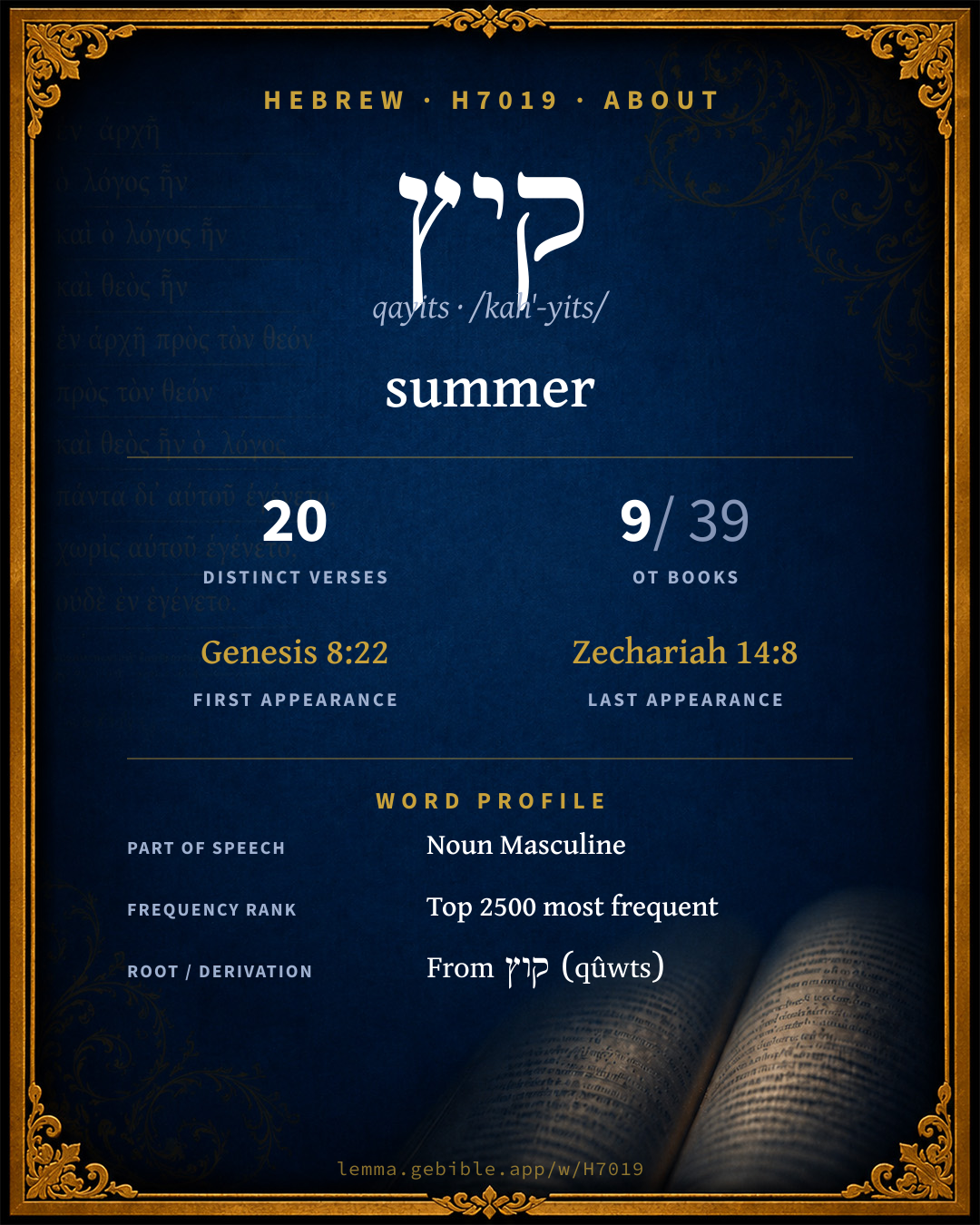
קַ֫יִץ
summer
‘summer’ is one of 3 main senses fuller range ↓
Full lexicon entry — Brown-Driver-Briggs (BDB)
From Brown-Driver-Briggs (BDB)
Where this word appears
See every Absolute-state word in the Hebrew Bible →
Grammar key — what these labels mean
Part of speech
- Noun
- A naming word — a person, place, thing, or idea.
Noun type
- Common
- A common noun — a general class of person, place, or thing (“king,” “city,” “water”), not a specific name.
State
- Absolute
- The independent form of a noun, not bound to a following word.
- Construct
- A noun bound to a following noun in a possessive / “of” relationship (the construct chain).
Gender
- Masculine
- Grammatically masculine.
Number
- Singular
- One.
Grammatical forms
- Noun, Common, Masculine, Singular, Absolute 18 times (90%)
- Noun, Common, Masculine, Singular, Construct 2 times (10%)
Parsed forms decoded from the imported morphology (morphhb / Westminster Leningrad Codex — WLC text public domain, morphhb tagging CC BY 4.0), counted across 20 parsed occurrences — not distinct verses.
Every verse where H7019 appears — 20 distinct verses across 9 books. Click any verse to open its interlinear word-by-word view. Verse text shown in the World English Bible for context — . Each verse’s Hebrew form is shown with its reference; the English is not keyword-highlighted, since the data carries no word-level English alignment. Use “Compare translations” on any verse to read it across multiple English versions. This concordance covers the Hebrew Bible; Septuagint (Greek Old Testament) occurrences are not indexed here.
Genesis 1 verse
2 Samuel 2 verses
- 2 Samuel 16:1 קַ֖יִץ n c ms When David was a little past the top [of the ascent], behold, Ziba the servant of Mephibosheth met him, with a couple of donkeys saddled, and on them two hundred loaves of bread, and one hundred clusters of raisins, and one hundred summer fruits, and a bottle of wine.
- 2 Samuel 16:2 וְ/הַ/קַּ֨יִץ֙ conj + ptcl def.art + n c ms The king said to Ziba, What do you mean by these? Ziba said, The donkeys are for the king's household to ride on; and the bread and summer fruit for the young men to eat; and the wine, that such as are faint in the wilderness may drink.
Psalms 2 verses
Proverbs 4 verses
- Proverbs 6:8 בַּ/קַּ֣יִץ prep det + n c ms Provides her bread in the summer, And gathers her food in the harvest.
- Proverbs 10:5 בַּ֭/קַּיִץ prep det + n c ms He who gathers in summer is a wise son, But he who sleeps during the harvest is a son who causes shame.
- Proverbs 26:1 בַּ/קַּ֗יִץ prep det + n c ms Like snow in summer, and as rain in harvest, So honor is not fitting for a fool.
- Proverbs 30:25 בַ/קַּ֣יִץ prep det + n c ms The ants are not a strong people, Yet they provide their food in the summer;
Isaiah 2 verses
- Isaiah 16:9 קֵיצֵ֛/ךְ n c ms cs + sfx pers 2fs Therefore I will weep with the weeping of Jazer for the vine of Sibmah; I will water you with my tears, Heshbon, and Elealeh: for on your summer fruits and on your harvest the [battle] shout is fallen.
- Isaiah 28:4 קַ֔יִץ n c ms and the fading flower of his glorious beauty, which is on the head of the fat valley, shall be as the first-ripe fig before the summer; which when he who looks on it sees, while it is yet in his hand he eats it up.
Jeremiah 4 verses
- Jeremiah 8:20 קָ֑יִץ n c ms The harvest is past, the summer is ended, and we are not saved.
- Jeremiah 40:10 וְ/קַ֜יִץ conj + n c ms As for me, behold, I will dwell at Mizpah, to stand before the Chaldeans who shall come to us: but you, gather you wine and summer fruits and oil, and put them in your vessels, and dwell in your cities that you have taken.
- Jeremiah 40:12 וָ/קַ֖יִץ conj + n c ms then all the Jews returned out of all places where they were driven, and came to the land of Judah, to Gedaliah, to Mizpah, and gathered wine and summer fruits very much.
- Jeremiah 48:32 קֵיצֵ֥/ךְ n c ms cs + sfx pers 2fs With more than the weeping of Jazer will I weep for you, vine of Sibmah: your branches passed over the sea, they reached even to the sea of Jazer: on your summer fruits and on your vintage the destroyer is fallen.
Amos 3 verses
- Amos 3:15 הַ/קָּ֑יִץ ptcl def.art + n c ms I will strike the winter house with the summer house; And the houses of ivory will perish, And the great houses will have an end," says Yahweh.
- Amos 8:1 קָֽיִץ n c ms Thus the Lord Yahweh showed me: behold, a basket of summer fruit.
- Amos 8:2 קָ֑יִץ n c ms He said, "Amos, what do you see?" I said, "A basket of summer fruit." Then Yahweh said to me, "The end has come on my people Israel. I will not again pass by them any more.
Micah 1 verse
Zechariah 1 verse
About this entry
At a glance — auto-summarized from this page’s data, not written by a person. Every figure links to its source below. This summary describes the numbers; it doesn’t interpret them.
“summer” is the headline sense of the Hebrew noun קיץ (qayits). First canonically at Genesis 8:22, it enters the text early. It turns up in 20 verses across 9 books, an uncommon footprint. Carrying more than one sense, it rewards its full sense range. From the same root come קוץ, קוץ and קוץ. The sections below give every sense, occurrence, and version rendering.
Gloss history
Strong's 1890 vs modern scholarship
About this word
Strong's H7019 catalogs a Hebrew word from the Hebrew Old Testament.
These counts are not copied from any lexicon or concordance. They are computed here, from the morphology-tagged Hebrew Old Testament. What Lemma adds →
- 20
- distinct verses
- The word appears in 20 distinct verses.
- 9 / 39
- OT books
- The word appears in 9 of 39 Old Testament books.
- #1,513
- by frequency
- Top 2500 most frequent Hebrew words (rank 1,513 of 8,640 Hebrew words by occurrence).
View all 20 occurrences in the concordance →
By section of the Old Testament
By traditional corpus
Conventional, traditional groupings — biblical authorship is debated, so this is a traditional corpus grouping, not an authorship claim. Each share is this word’s portion of its verses in that division of the Hebrew canon. Each figure is a share of the word’s 20 distinct verses.
- Prophets (Nevi'im) 13 verses · 65%
- Writings (Ketuvim) 6 verses · 30%
- Torah (Pentateuch) 1 verse · 5%
How translations render this word
Counts come from each version’s own published word-to-Strong’s tagging or interlinear alignment — an approximate guide to how each version renders this word, not a word-level alignment the data otherwise carries. Because each total is that version’s own tagged count, the per-version totals vary from one another and need not match the appearance or distinct-verse counts above. These counts may also differ from a printed concordance because Lemma counts each distinctly tagged rendering and does not collapse phrase taggings into a single head-word total. This is a fixed set of word-tagged versions (KJV, ASV, BSB, ULT) and does not change with the reading translation you choose elsewhere. Each version’s license is shown beside its name below (and on Sources).
- King James Version: Summer 10×, Summer fruits 6×, Summer fruit 3×
- American Standard Version: Summer 10×, Summer fruits 5×, Summer fruit 2×
- Berean Standard Bible: Summer 10×, Summer fruit 8×
- unfoldingWord Literal Text: Summer 11×, Summer fruit 5×
King James Version Public Domain
Renders H7019 across 20 tagged occurrences — most commonly:
Plus 1 rendering that appears only once — usually multi-word phrases or single function words the recovered tagging swept in, not distinct renderings.
American Standard Version Public Domain
Renders H7019 across 20 tagged occurrences — most commonly:
Plus 3 renderings that appear only once — usually multi-word phrases or single function words the recovered tagging swept in, not distinct renderings.
Berean Standard Bible Public Domain
Renders H7019 across 20 tagged occurrences — most commonly:
Plus 2 renderings that appear only once — usually multi-word phrases or single function words the recovered tagging swept in, not distinct renderings.
unfoldingWord Literal Text CC BY-SA 4.0
Renders H7019 across 16 tagged occurrences — most commonly:
Senses in the full BDB
What do BDB’s symbols mean?
BDB uses these scholarly abbreviations:
| Symbol | Meaning |
|---|---|
| 𝔊 | the Septuagint (the ancient Greek translation, LXX) |
| 𝔙 | the Vulgate (the Latin translation) |
| 𝔖 | the Syriac version (the Peshitta) |
| 𝔗 | the Targum (the Aramaic translation) |
| ψ | the Psalms |
| √ | root (the underlying root or stem) |
| ‖ | parallel passage (a synonymous or contrasted parallel) |
| † | the dagger: every passage where the word occurs is cited |
The 2 senses and sub-senses the full Brown-Driver-Briggs lexicon distinguishes for this word, in lexicon order (not ranked by frequency), with BDB’s own verbatim wording and sub-sense lettering. Shown in Hebrew script with BDB’s own scholarly abbreviations. The condensed entry is in the Lexicon Entry tab. See also the Forms in the corpus table below.
- 1. summer-season, opp. חֹרֶף Gn 8:22 (J), Am 3:15; Zc 14:8 ψ 74:17; ‖ קָצִיר Je 8:20; Pr 6:8; 10:5; 26:1, also (without קָצִיר) 30:25; as fruit harvest Is 28:4; time of drought ψ 32:4 (fig.). e.g. Genesis 8:22
- 2. summer-fruit 2 S 16:1, 2; Am 8:1, 2; Je 40:10, 12 also, ‖ בָּצִיר, 48:32; Mi 7:1 (in sim.), but ‖ קציר Is 16:9 (assim. to ק of קַיִץ; read prob. בציר). e.g. 2 Samuel 16:1
Senses from the full Brown-Driver-Briggs lexicon (Brown, Driver, Briggs; Oxford 1906 — public domain), digitized via Sefaria, supplemented by the OpenScriptures HebrewLexicon (CC BY 4.0). Full attribution on Sources.
Word origin
n.m. Je 8:20 summer, summer-fruit (cf. Gk. θέρος in both meanings);—abs. ק׳ Gn 8:22 +; קָ֑יִץ Am 3:15 +; sf. קֵיצֵךְ Is 16:9 Je 48:32;—
— Brown-Driver-Briggs (Oxford 1906, public domain), digitized via Sefaria, supplemented by the OpenScriptures HebrewLexicon (CC BY 4.0). See Sources.
Derived from קוץ (qûwts) (H6972) — to summer.
Jastrow Dictionary
A second Hebrew/Aramaic lexicon for comparison, covering Aramaic and post-biblical (Talmudic, Targumic, Midrashic) usage that the biblical-Hebrew BDB does not. Matched by lemma rather than by Strong’s number, so a lemma may carry more than one Jastrow headword (shown separately below), and the entries cover usage well beyond the Bible.
קִיץ
- , Hif. הֵקִיץ (b. h.) [to stir,]
- 1. (neut. verb.) to wake up. Gen. R. s. 21 (ref. to Ps. XVII, 15) לכשיָקִיץ אותו וכ׳ when he whom thou hast created in thine image shall wake up (arise from the dead); Yalk. Ps. 671 לכשיָקוּץ; a. e. e.g. Psalms 17:15
- 2. to awaken. Num. R. s. 10 היו מתיראים לַהֲקִיצוֹ they were afraid to wake him (Solomon) up; והלכה היא והֱקִיצַתּוֹ וכ׳ but she (Bethsheba) went and waked him up and rebuked him. Yalk. Ps. l. c. (ref. to Ps. l. c.) אלו … שמְקִיצִין שינה וכ׳ that means the scholars that chase the sleep from their eyes &c.; B. Bath. 10ᵃ Ms. M. (ed. שמנדדין); a. e.
קַיִץ
- 1. heat, midsummer, harvest time for figs, grapes &c., contrad. to קציר harvest time for grains. B. Mets. 106ᵇ (ref. to Gen. VIII, 22 חצי ניסן … אב ק׳ וכ׳ half of Nisan, the whole of Iyar, and half of Sivan is ḳatsir (cutting season), half of Sivan to half of Ab is ḳayits (midsummer) &c.; Gen. R. s. 34. Ex. R. s. 15 עשיר … בשעת הק׳ a rich man who went out at harvest time (when grapes were cut). Ned. VIII, 4 עד הק׳ עד שיהא הק׳ וכ׳ if one vows abstinence ‘until harvest time’, it means until harvest begins, until people begin to bring fruits home in baskets (v. כַּלְכָּלָה); עד שיעבור הק׳ וכ׳ ‘until harvest is past’, it means &c., v. מַקְצוּעָה; a. fr. e.g. Genesis 8:22
- 2. summer fruits, figs, grapes &c. B. Bath. III, 1 (28ᵃ) כנס (קֵיצוֹ) את קַיְיצוֹ after storing up his fruits. Tosef. Ned. IV, 1 הנודר מן הק׳ אין אסור וכ׳ if one vows abstinence from ḳayits, he is forbidden figs only; ib. 2 (anoth. opin.) ענבים בכלל ק׳ grapes are included in ḳayits; Ned. 61ᵇ מפירות הק׳ from the fruits of midsummer; (ib. ענבים בכלל תאנים). Y. ib. VIII, 41ᵃ top ביכר ק׳ בעמקים if the first summer fruits are ripe in the valleys; (Bab. ib. 62ᵇ; Tosef. ib. IV, 7 הגיע הק׳ the harvest has begun). Naz. 8ᵇ כהילקטי ק׳, v. הֶילְקֵט; Tosef. ib. I, 3; Y. ib. I, 51ᵇ bot. (not כמלקטי); a. e.—Trnsf. ק׳ המזבח the altar’s summer time, a time when the altar was unemployed for private offerings, and free-will burnt-offerings had to be supplied from the Temple fund. Shek. IV, 4 מותר הפירות לק׳ המ׳ the net income from the sale of fruits (of the Sabbatical year) was applied to the purchase of sacrifices for the altar’s summer time; Y. ib. 48ᵇ top (not למזבח). Succ. 56ᵃ. Tosef. Men. X, 8, v. קוּץ II.
קַיָּץ
- , v. קַיָּיץ
קִיץ ²
- (קָצַץ) a clearly defined subject.—Pl. קִיצִין. Cant. R. to V, 11 אפי׳ דברִים … שהן ק׳ וכ׳ even things in the Law which you would consider clearly defined are piles upon piles (contain material for much discussion).
קִיץ ³
- (preced.) term, stipulation; (adj.) defined. Ned. 86ᵃ, v. קִיצוּתָא. Gitt. 30ᵇ כיון דק׳ the quantity being defined. Keth. 43ᵃ לא שביק אינש מידי דק׳ … דלא ק׳ a man will not forego the claim of a definite quantity, and demand something undefined (requiring appraisement); a. e.—Pl. קִיצֵי. B. Bath. 88ᵃ דק׳ דמיה (Rashb. דקָיְיצֵי) when its price is fixed; דק׳ דמיהו when their prices are fixed.
A Dictionary of the Targumim, the Talmud Babli and Yerushalmi, and the Midrashic Literature (Marcus Jastrow; London, Luzac, 1903) — Public Domain. Digitized via Sefaria. Digitized via Sefaria. Full attribution on Sources.
Forms in the corpus
The 18 distinct written forms H7019 takes in the Hebrew Bible, most frequent first — each parse links to that state’s occurrences in the concordance. Hebrew forms include their vowel points and cantillation, so a single lemma takes many written forms.
Same root — word family
Other BDB entries built from the same root as H7019, grouped by Strong’s listed origin. These share a root / origin per the lexicon — not necessarily a shared meaning. Each links to that word’s own entry.
Derives from
Shares the same root
- קוץ qûwts H6973 to abhor
- קוץ qûwts H6974 to awake
- קוץ qôwts H6975 thorn
- קוצה qᵉvutstsâh H6977 lock
- קיצון qîytsôwn H7020 outermost
Derived from this word
Proper names from this root
People and places named from this root — a name, not an additional meaning of the word.
Compare all same-root words → Showing 4 of 9 — not the complete family. 1 of the same-root words is a proper name (a person or place). They share a root, not necessarily a meaning.
Septuagint verse parallels
This word appears in 18 verses that also exist in the Greek Old Testament (Septuagint), out of the 20 Hebrew verses it occurs in. You can read those verses in Greek by switching the Old Testament edition to the Septuagint.
Read these verses in the Septuagint
- Genesis 8:22
- 2 Samuel 16:1
- Psalms 32:4
- Proverbs 6:8
- Isaiah 16:9
- Jeremiah 8:20
- Amos 3:15
- Micah 7:1
- Zechariah 14:8
This is a verse-level parallel only — the same verses exist in both the Hebrew and Greek Old Testaments. No word-level Hebrew↔Greek correspondence is claimed: the data carries no such alignment, so no Greek word is shown as this Hebrew word’s translation. Coverage is not total — the Septuagint omits the deuterocanon and renumbers the Psalms, so some Hebrew verses have no direct Greek parallel.