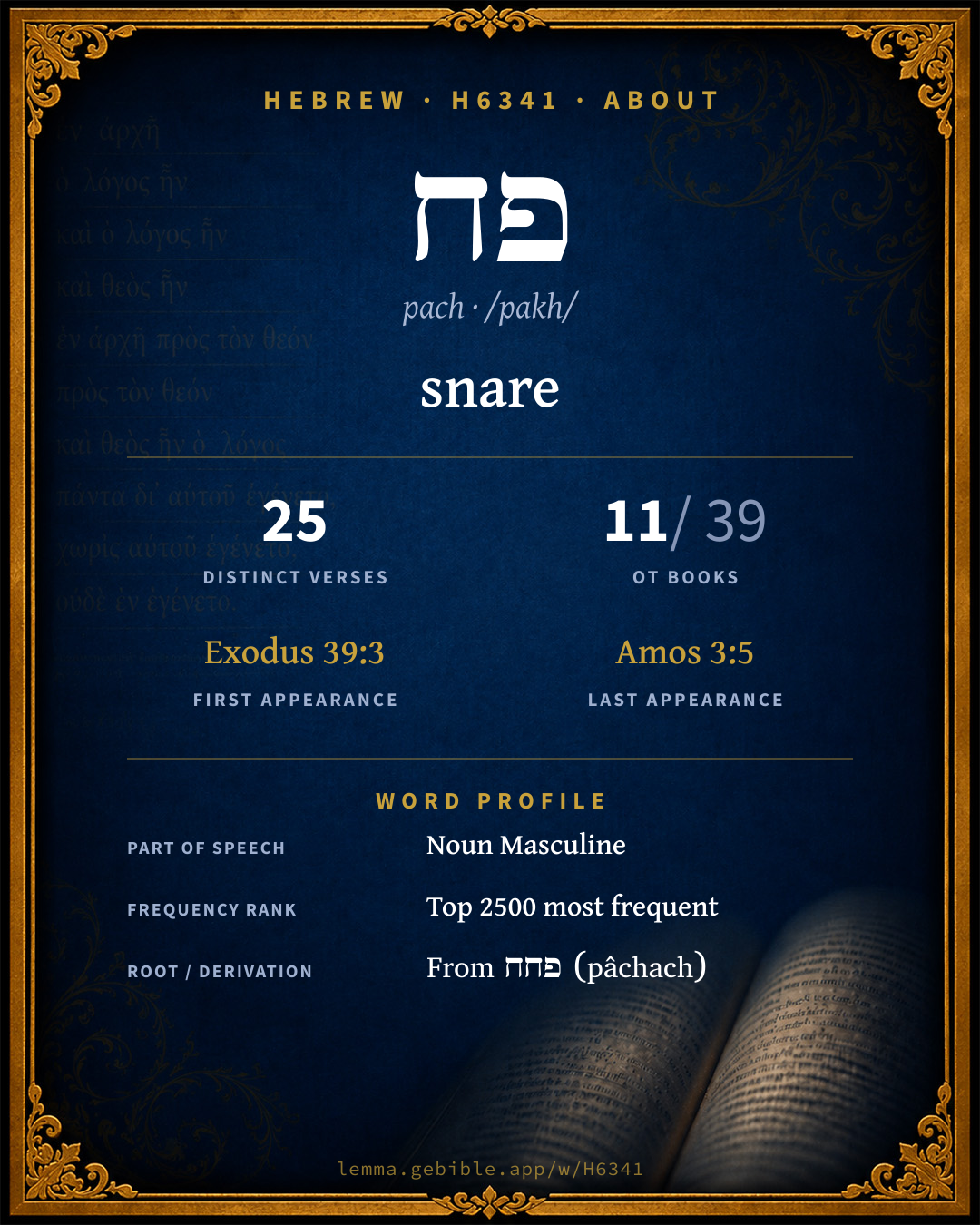
פַּח
snare
also: bird trap, trap fuller range ↓
Full lexicon entry — Brown-Driver-Briggs (BDB)
From Brown-Driver-Briggs (BDB)
Where this word appears
See every Absolute-state word in the Hebrew Bible →
Grammar key — what these labels mean
Part of speech
- Noun
- A naming word — a person, place, thing, or idea.
Noun type
- Common
- A common noun — a general class of person, place, or thing (“king,” “city,” “water”), not a specific name.
State
- Absolute
- The independent form of a noun, not bound to a following word.
- Construct
- A noun bound to a following noun in a possessive / “of” relationship (the construct chain).
Gender
- Masculine
- Grammatically masculine.
Number
- Singular
- One.
- Plural
- More than one (in Hebrew, generally three or more).
Grammatical forms
- Noun, Common, Masculine, Singular, Absolute 18 times (67%)
- Noun, Common, Masculine, Plural, Absolute 5 times (19%)
- Noun, Common, Masculine, Singular, Construct 3 times (11%)
- Noun, Common, Masculine, Plural, Construct 1 time (4%)
Parsed forms decoded from the imported morphology (morphhb / Westminster Leningrad Codex — WLC text public domain, morphhb tagging CC BY 4.0), counted across 27 parsed occurrences — not distinct verses.
Every verse where H6341 appears — 25 distinct verses across 11 books. Click any verse to open its interlinear word-by-word view. Verse text shown in the World English Bible for context — . Each verse’s Hebrew form is shown with its reference; the English is not keyword-highlighted, since the data carries no word-level English alignment. Use “Compare translations” on any verse to read it across multiple English versions. This concordance covers the Hebrew Bible; Septuagint (Greek Old Testament) occurrences are not indexed here.
Exodus 1 verse
Numbers 1 verse
Joshua 1 verse
Job 2 verses
Psalms 8 verses
- Psalms 11:6 פַּ֫חִ֥ים n c mp On the wicked he will rain blazing coals; Fire, sulfur, and scorching wind shall be the portion of their cup.
- Psalms 69:22 לְ/פָ֑ח prep + n c ms Let their table before them become a snare. May it become a retribution and a trap.
- Psalms 91:3 מִ/פַּ֥ח prep + n c ms cs For he will deliver you from the snare of the fowler, And from the deadly pestilence.
- Psalms 119:110 פַּ֣ח n c ms The wicked have laid a snare for me, Yet I haven't gone astray from your precepts.
- Psalms 124:7 מִ/פַּ֪ח הַ/פַּ֥ח prep + n c ms cs ptcl def.art + n c ms Our soul has escaped like a bird out of the fowler's snare. The snare is broken, and we have escaped.
- Psalms 140:5 פַּ֡ח n c ms The proud have hidden a snare for me, They have spread the cords of a net by the path. They have set traps for me. Selah.
- Psalms 141:9 פַ֭ח n c ms Keep me from the snare which they have laid for me, From the traps of the workers of iniquity.
- Psalms 142:3 פַ֣ח n c ms When my spirit was overwhelmed within me, You knew my path. In the way in which I walk, They have hidden a snare for me.
Proverbs 2 verses
Ecclesiastes 1 verse
Isaiah 3 verses
- Isaiah 8:14 לְ/פַ֣ח prep + n c ms He shall be for a sanctuary; but for a stone of stumbling and for a rock of offense to both the houses of Israel, for a gin and for a snare to the inhabitants of Jerusalem.
- Isaiah 24:17 וָ/פָ֑ח conj + n c ms Fear, and the pit, and the snare, are on you, O inhabitant of the earth.
- Isaiah 24:18 בַּ/פָּ֑ח prep det + n c ms It shall happen, that he who flees from the noise of the fear shall fall into the pit; and he who comes up out of the midst of the pit shall be taken in the snare: for the windows on high are opened, and the foundations of the earth tremble.
Jeremiah 3 verses
- Jeremiah 18:22 וּ/פַחִ֖ים conj + n c mp Let a cry be heard from their houses, when you shall bring a troop suddenly on them; for they have dug a pit to take me, and hid snares for my feet.
- Jeremiah 48:43 וָ/פָ֑ח conj + n c ms Fear, and the pit, and the snare, are on you, inhabitant of Moab, says Yahweh.
- Jeremiah 48:44 בַּ/פָּ֑ח prep det + n c ms He who flees from the fear shall fall into the pit; and he who gets up out of the pit shall be taken in the snare: for I will bring on him, even on Moab, the year of their visitation, says Yahweh.
Hosea 2 verses
- Hosea 5:1 פַח֙ n c ms "Listen to this, you priests! Listen, house of Israel, And give ear, house of the king! For the judgment is against you; For you have been a snare at Mizpah, And a net spread on Tabor.
- Hosea 9:8 פַּ֤ח n c ms cs A prophet watches over Ephraim with my God. A fowler's snare is on all of his paths, And hostility in the house of his God.
Amos 1 verse
About this entry
At a glance — auto-summarized from this page’s data, not written by a person. Every figure links to its source below. This summary describes the numbers; it doesn’t interpret them.
The Hebrew noun פח centers on the idea of “snare.” First canonically at Exodus 39:3, it enters the text early. The Hebrew Bible uses it across 25 verses — uncommon. Psalms dominates its distribution — 8 of 25 verses. Beyond “snare” it also covers “bird trap” and “trap” — see its full sense range. For the data behind this summary, explore the sense tree and the renderings breakdown below.
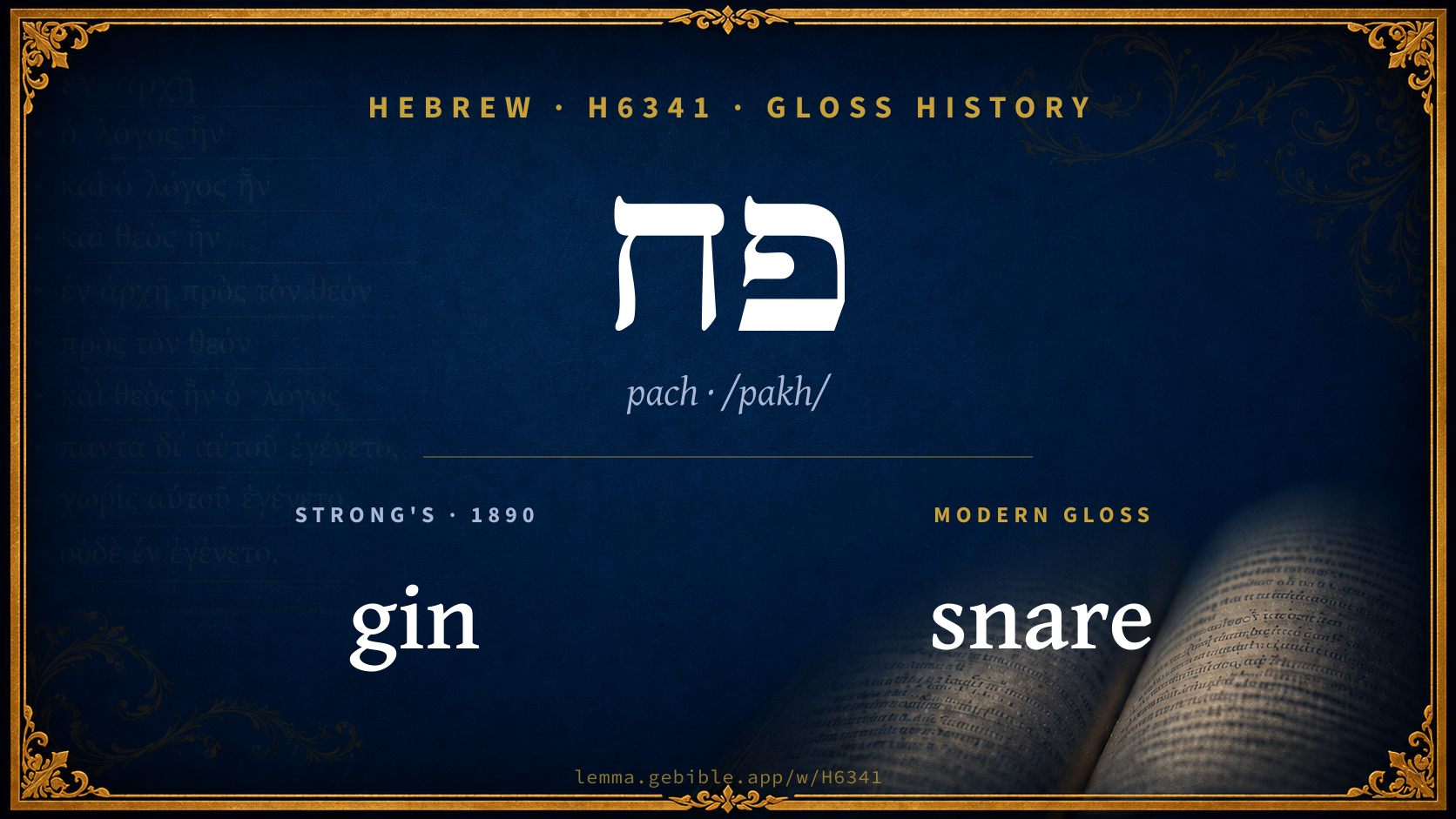
Gloss history
Strong's 1890 vs modern scholarship
About this word
Strong's H6341 catalogs a Hebrew word from the Hebrew Old Testament.
These counts are not copied from any lexicon or concordance. They are computed here, from the morphology-tagged Hebrew Old Testament. What Lemma adds →
- 25
- distinct verses
- The word appears in 25 distinct verses.
- 11 / 39
- OT books
- The word appears in 11 of 39 Old Testament books.
- #1,226
- by frequency
- Top 2500 most frequent Hebrew words (rank 1,226 of 8,640 Hebrew words by occurrence).
View all 25 occurrences in the concordance →
By section of the Old Testament
By traditional corpus
Conventional, traditional groupings — biblical authorship is debated, so this is a traditional corpus grouping, not an authorship claim. Each share is this word’s portion of its verses in that division of the Hebrew canon. Each figure is a share of the word’s 25 distinct verses.
- Writings (Ketuvim) 13 verses · 52%
- Prophets (Nevi'im) 10 verses · 40%
- Torah (Pentateuch) 2 verses · 8%
How translations render this word
Counts come from each version’s own published word-to-Strong’s tagging or interlinear alignment — an approximate guide to how each version renders this word, not a word-level alignment the data otherwise carries. Because each total is that version’s own tagged count, the per-version totals vary from one another and need not match the appearance or distinct-verse counts above. These counts may also differ from a printed concordance because Lemma counts each distinctly tagged rendering and does not collapse phrase taggings into a single head-word total. This is a fixed set of word-tagged versions (KJV, ASV, BSB, ULT) and does not change with the reading translation you choose elsewhere. Each version’s license is shown beside its name below (and on Sources).
BDB lists this Strong’s number as 2 distinct words (homographs). Each count above pools all of them and is not split by sense — see the Senses section below. A low-frequency rendering may belong to a different one of those words, not the primary meaning.
- King James Version†: Snare 13×, Snares 3×, Gin 2×
- American Standard Version†: Snare 11×, Gin 2×, Snares 2×
- Berean Standard Bible†: Snare 16×, Snares 4×, Trap 2×
- unfoldingWord Literal Text†: Snare 12×, Trap 5×, Snare of 2×
King James Version Public Domain
Renders H6341 across 26† tagged occurrences — most commonly:
Plus 8 renderings that appear only once — usually multi-word phrases or single function words the recovered tagging swept in, not distinct renderings. Not rendered by a distinct English word in 1 further occurrence.
American Standard Version Public Domain
Renders H6341 across 26† tagged occurrences — most commonly:
Plus 11 renderings that appear only once — usually multi-word phrases or single function words the recovered tagging swept in, not distinct renderings.
Berean Standard Bible Public Domain
Renders H6341 across 27† tagged occurrences — most commonly:
Plus 5 renderings that appear only once — usually multi-word phrases or single function words the recovered tagging swept in, not distinct renderings.
unfoldingWord Literal Text CC BY-SA 4.0
Renders H6341 across 26† tagged occurrences — most commonly:
Plus 3 renderings that appear only once — usually multi-word phrases or single function words the recovered tagging swept in, not distinct renderings.
Senses in the full BDB
What do BDB’s symbols mean?
BDB uses these scholarly abbreviations:
| Symbol | Meaning |
|---|---|
| 𝔊 | the Septuagint (the ancient Greek translation, LXX) |
| 𝔙 | the Vulgate (the Latin translation) |
| 𝔖 | the Syriac version (the Peshitta) |
| 𝔗 | the Targum (the Aramaic translation) |
| ψ | the Psalms |
| √ | root (the underlying root or stem) |
| ‖ | parallel passage (a synonymous or contrasted parallel) |
| † | the dagger: every passage where the word occurs is cited |
The 4 senses and sub-senses the full Brown-Driver-Briggs lexicon distinguishes for this word, in lexicon order (not ranked by frequency), with BDB’s own verbatim wording and sub-sense lettering. Shown in Hebrew script with BDB’s own scholarly abbreviations. The condensed entry is in the Lexicon Entry tab. See also the Forms in the corpus table below.
פח I
- 1. lit. יַעֲלֶה פ׳ Am 3:5 b (as metaph.; v a del. פ׳); Pr 7:23; Ec 9:12 (c. אָחוּז; both in sim.). e.g. Amos 3:5
- 2. usually fig. (sometimes ‖ מוֹקֵשׁ, רֶשֶׁת, צַמִּים):
- a. of calamities and plots, פ׳ יָקוֹשׁ Ho 9:8, cf. ψ 91:3; 124:7; פ׳ alone Je 48:43 = Is 24:17; Jb 22:10 ψ 124:7; Pr 22:5; טָמַן פ׳ לְ Je 18:22 ψ 140:6; 142:4; נָתַן פ׳ לְ 119:110, יָקַשׁ פ׳ לְ 141:9; יֹאחֵז בְּעָקֵב פ׳ Jb 18:9; יִלָּכֵד בַּפּ׳ Je 48:44 = Is 24:18. e.g. Hosea 9:8
- b. = source or agent of calamity Ho 5:1; Jos 23:13 (D), Is 8:14 ψ 69:23.—ψ 11:6 v. פֶּחָם. e.g. Hosea 5:1
פח II plate of metal
Senses from the full Brown-Driver-Briggs lexicon (Brown, Driver, Briggs; Oxford 1906 — public domain), digitized via Sefaria, supplemented by the OpenScriptures HebrewLexicon (CC BY 4.0). Full attribution on Sources.
Word origin
II. n.m. ψ 124:7 bird-trap (cf. Wilkinson Egyptians (1878) ii, 103, 109 f. Dr Am 3:5 HoffmZAW iii (1883), 101);* cf. also BaldenspergerPEF 1905, 38 (paḥ used now פ׳ abs. Ho 5:1 +, פָּ֑ח Je 48:44 +; cstr. פַּח Ho 9:8 +; pl. פַּחִים Je 18:22 +;—
III. plate of metal; pl. רִקֻּעֵי פַחִים Nu 17:3; cstr. וַיְרַקְּעוּ אֶת־פַּחֵי הַזָּהָב Ex 39:3.
— Brown-Driver-Briggs (Oxford 1906, public domain), digitized via Sefaria, supplemented by the OpenScriptures HebrewLexicon (CC BY 4.0). See Sources.
Derived from פחח (pâchach) (H6351) — to ensnare.
Jastrow Dictionary
A second Hebrew/Aramaic lexicon for comparison, covering Aramaic and post-biblical (Talmudic, Targumic, Midrashic) usage that the biblical-Hebrew BDB does not. Matched by lemma rather than by Strong’s number, so a lemma may carry more than one Jastrow headword (shown separately below), and the entries cover usage well beyond the Bible.
פַּח I
- v. פָּחַח) hole, trap, snare. Midr. Till. to Ps. XCI, 3 (expl. פח יקוש) מצודתא דציידא the hunter’s snare; Tanḥ. Naso 23.
פַּח II
- coal.—Pl. פַּחִים. Gen. R. s. 51 (expl. פחים, Ps. XI, 6) גימרין ומצדין coals and snares (v. preced.); Yalk. ib. 85. e.g. Psalms 11:6
פַּח III
- (נָפַח) blowing.—Pl. פַּחִים (only in connection with צנים), v. צִנָּה III.—[For פחי נפש, v. פְּחִי.]
A Dictionary of the Targumim, the Talmud Babli and Yerushalmi, and the Midrashic Literature (Marcus Jastrow; London, Luzac, 1903) — Public Domain. Digitized via Sefaria. Digitized via Sefaria. Full attribution on Sources.
Forms in the corpus
The 21 distinct written forms H6341 takes in the Hebrew Bible, most frequent first — each parse links to that state’s occurrences in the concordance. Hebrew forms include their vowel points and cantillation, so a single lemma takes many written forms.
Septuagint verse parallels
This word appears in 18 verses that also exist in the Greek Old Testament (Septuagint), out of the 25 Hebrew verses it occurs in. You can read those verses in Greek by switching the Old Testament edition to the Septuagint.
Read these verses in the Septuagint
- Exodus 39:3
- Joshua 23:13
- Job 18:9
- Psalms 11:6
- Proverbs 7:23
- Ecclesiastes 9:12
- Isaiah 8:14
- Jeremiah 18:22
- Hosea 5:1
- Amos 3:5
This is a verse-level parallel only — the same verses exist in both the Hebrew and Greek Old Testaments. No word-level Hebrew↔Greek correspondence is claimed: the data carries no such alignment, so no Greek word is shown as this Hebrew word’s translation. Coverage is not total — the Septuagint omits the deuterocanon and renumbers the Psalms, so some Hebrew verses have no direct Greek parallel.