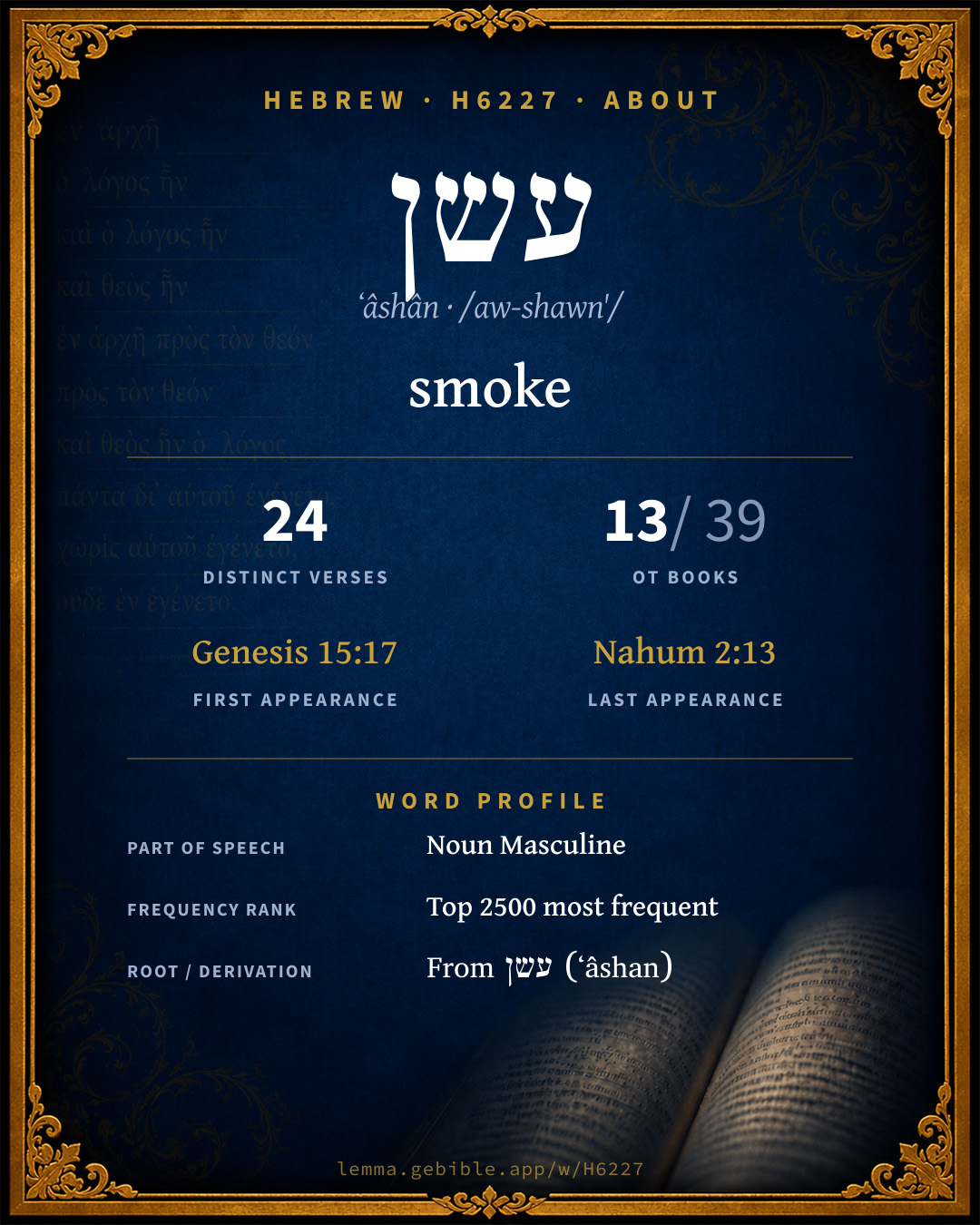
עָשָׁן
smoke
‘smoke’ is one of 3 main senses fuller range ↓
Full lexicon entry — Brown-Driver-Briggs (BDB)
From Brown-Driver-Briggs (BDB)
Where this word appears
Grammar key — what these labels mean
Part of speech
- Noun
- A naming word — a person, place, thing, or idea.
Noun type
- Common
- A common noun — a general class of person, place, or thing (“king,” “city,” “water”), not a specific name.
State
- Absolute
- The independent form of a noun, not bound to a following word.
- Construct
- A noun bound to a following noun in a possessive / “of” relationship (the construct chain).
Gender
- Masculine
- Grammatically masculine.
Number
- Singular
- One.
Every verse where H6227 appears in the Book of Nahum — 1 distinct verse. Click any verse to open its interlinear word-by-word view. Verse text shown in the World English Bible for context — . Each verse’s Hebrew form is shown with its reference; the English is not keyword-highlighted, since the data carries no word-level English alignment. Use “Compare translations” on any verse to read it across multiple English versions. This concordance covers the Hebrew Bible; Septuagint (Greek Old Testament) occurrences are not indexed here.
Nahum
About this entry
At a glance — auto-summarized from this page’s data, not written by a person. Every figure links to its source below. This summary describes the numbers; it doesn’t interpret them.
“smoke” is the headline sense of the Hebrew noun עשן (ʻâshân). Its earliest occurrence is Genesis 15:17. The Hebrew Bible uses it across 24 verses — uncommon. More than a quarter of its appearances fall in Isaiah. Its meaning spans more than one sense — see its full sense range. See the sense tree, 24-verse concordance, and the renderings breakdown below.
Gloss history
Strong's 1890 vs modern scholarship
About this word
Strong's H6227 catalogs a Hebrew word from the Hebrew Old Testament.
These counts are not copied from any lexicon or concordance. They are computed here, from the morphology-tagged Hebrew Old Testament. What Lemma adds →
- 24
- distinct verses
- The word appears in 24 distinct verses.
- 13 / 39
- OT books
- The word appears in 13 of 39 Old Testament books.
- #1,282
- by frequency
- Top 2500 most frequent Hebrew words (rank 1,282 of 8,640 Hebrew words by occurrence).
View all 24 occurrences in the concordance →
By section of the Old Testament
By traditional corpus
Conventional, traditional groupings — biblical authorship is debated, so this is a traditional corpus grouping, not an authorship claim. Each share is this word’s portion of its verses in that division of the Hebrew canon. Each figure is a share of the word’s 24 distinct verses.
- Prophets (Nevi'im) 15 verses · 63%
- Writings (Ketuvim) 7 verses · 29%
- Torah (Pentateuch) 2 verses · 8%
How translations render this word
Counts come from each version’s own published word-to-Strong’s tagging or interlinear alignment — an approximate guide to how each version renders this word, not a word-level alignment the data otherwise carries. Because each total is that version’s own tagged count, the per-version totals vary from one another and need not match the appearance or distinct-verse counts above. These counts may also differ from a printed concordance because Lemma counts each distinctly tagged rendering and does not collapse phrase taggings into a single head-word total. This is a fixed set of word-tagged versions (KJV, ASV, BSB, ULT) and does not change with the reading translation you choose elsewhere. Each version’s license is shown beside its name below (and on Sources).
BDB lists this Strong’s number as 2 distinct words (homographs). Each count above pools all of them and is not split by sense — see the Senses section below. A low-frequency rendering may belong to a different one of those words, not the primary meaning.
- King James Version†: Smoke 20×, Like smoke 2×
- American Standard Version†: Smoke 19×
- Berean Standard Bible†: Smoke 16×, Like smoke 4×
- unfoldingWord Literal Text†: Smoke 17×, Like smoke 3×, Smoke of 2×
King James Version Public Domain
Renders H6227 across 25† tagged occurrences — most commonly:
Plus 3 renderings that appear only once — usually multi-word phrases or single function words the recovered tagging swept in, not distinct renderings.
American Standard Version Public Domain
Renders H6227 across 25† tagged occurrences — most commonly:
Plus 6 renderings that appear only once — usually multi-word phrases or single function words the recovered tagging swept in, not distinct renderings.
Berean Standard Bible Public Domain
Renders H6227 across 25† tagged occurrences — most commonly:
Plus 5 renderings that appear only once — usually multi-word phrases or single function words the recovered tagging swept in, not distinct renderings.
unfoldingWord Literal Text CC BY-SA 4.0
Renders H6227 across 25† tagged occurrences — most commonly:
Plus 3 renderings that appear only once — usually multi-word phrases or single function words the recovered tagging swept in, not distinct renderings.
6 senses and sub-senses in the full BDB
What do BDB’s symbols mean?
BDB uses these scholarly abbreviations:
| Symbol | Meaning |
|---|---|
| 𝔊 | the Septuagint (the ancient Greek translation, LXX) |
| 𝔙 | the Vulgate (the Latin translation) |
| 𝔖 | the Syriac version (the Peshitta) |
| 𝔗 | the Targum (the Aramaic translation) |
| ψ | the Psalms |
| √ | root (the underlying root or stem) |
| ‖ | parallel passage (a synonymous or contrasted parallel) |
| † | the dagger: every passage where the word occurs is cited |
The 6 senses and sub-senses the full Brown-Driver-Briggs lexicon distinguishes for this word, in lexicon order (not ranked by frequency), with BDB’s own verbatim wording and sub-sense lettering. Shown in Hebrew script with BDB’s own scholarly abbreviations. The condensed entry is in the Lexicon Entry tab. See also the Forms in the corpus table below.
עשן I
- 1.
- a. of burning city Jos 8:20, 21; Ju 20:38, 40, cf. Na 2:14; heralding a foe Is 14:31. e.g. Joshua 8:20
- b. in fig. of destruction of Isr. Is 9:17, Edom 34:10. e.g. Isaiah 9:17
- c. sim. of dust-cloud Ct 3:6; of transitoriness Ho 13:3 Is 51:6 ψ 37:20 (reading בֶּע׳, as 𝔊 𝔖 𝔙), 68:3; 102:4; sim. of the unpleasant, Pr 10:26. e.g. Song of Solomon 3:6
- d. breath of crocodile Jb 41:12. e.g. Job 41:12
- 2.
- a. attending theoph., תַּנּוּר ע׳ Gn 15:17; of mt. Ex 19:18, cf. sim. כְּע׳ הַכִּבְשָׁן v 18; Is 6:4, also 4:5 Jo 3:3. e.g. Genesis 15:17
- b. of God’s anger, ע׳ בְּאַפּוֹ 2 S 22:9 = ψ 18:9; so prob. also Is 65:5. e.g. 2 Samuel 22:9
עשן II loc. in Shephelah of Judah Jos 15
Senses from the full Brown-Driver-Briggs lexicon (Brown, Driver, Briggs; Oxford 1906 — public domain), digitized via Sefaria, supplemented by the OpenScriptures HebrewLexicon (CC BY 4.0). Full attribution on Sources.
Word origin
I. n.m. Ex 19:18 smoke;—abs. ע׳ Ju 20:38 +, cstr. עֲשַׁן Jos 8:20, 21; עֶ֫שֶׁן Ex 19:18; sf. עֲשָׁנוֹ Ex 19:18, עֲשָׁנָהּ Is 34:10;—
II. n.pr.loc. in Shephelah of Judah Jos 15:42, in Simeon according to 19:7; 1 Ch 4:32, Levit. city 6:44; Ασαν, etc.; = בּוֹר עָשָׁן, q.v. p. 92 supr.
— Brown-Driver-Briggs (Oxford 1906, public domain), digitized via Sefaria, supplemented by the OpenScriptures HebrewLexicon (CC BY 4.0). See Sources.
Derived from עשן (ʻâshan) (H6225) — to smoke.
Jastrow Dictionary
A second Hebrew/Aramaic lexicon for comparison, covering Aramaic and post-biblical (Talmudic, Targumic, Midrashic) usage that the biblical-Hebrew BDB does not. Matched by lemma rather than by Strong’s number, so a lemma may carry more than one Jastrow headword (shown separately below), and the entries cover usage well beyond the Bible.
עָשָׁן
- v. עְשַׁן) [thick, cmp. עָב, אָבָק &c.,] smoke, soot. Ker. 6ᵃ מעלה ע׳ smoke-raiser (name of a plant). Yoma 21ᵇ עֲשַׁן המערכה the smoke rising from the pyre in the Temple; B. Bath. 147ᵃ; a. fr.—Pl. עֲשַׁנִּים. Sabb. 23ᵃ כל הע׳ יפין וכ׳ all soots are good for making ink, but that produced by burning olive oil is the best.
עָשַׁן
- denom. of preced.) to smoke.
- to generate smoke; to fumigate; to burn incense. Sabb. 23ᵃ (ref. to the use of oil for ink) לגבל או לעַשֵּׁן do you mean for kneading it with soot, or for making soot by burning it? Pesik. R. s. 12 והיו מְעַשְּׁנוֹת לפני עכו"ם they burnt incense before idols; Tanḥ. Tol’doth 8 מעשנות ומקטרות וכ׳ raised smoke and burnt perfumes &c. Yeb. 115ᵃ עִישֵּׁינוּ עלינו בית וכ׳ (Ar. עִישְּׁנוּ) they (robbers) filled our house with smoke, filled a cave in which we dwelt with smoke &c. Y. Ber. VI, 12ᵇ bot. במְעַשֵּׁין לפני וכ׳ (not במעשיו) when he burns spices in front of his shop; a. e.—Esp. to fumigate plants. Shebi. II, 2 מְעַשְּׁנִין עד וכ׳ you may fumigate until New Year (of the Sabbatical year). Y. Sabb. VII, 10ᵃ top המְעַשֵּׁן he who fumigates plants (on the Sabbath); a. fr.—Part. pass. מְעוּשָּׁן; f. מְעוּשֶּנֶת; pl. מְעוּשָּׁנִים, מְעוּשָּׁנִין; מְעוּשָּׁנוֹת. Men. VIII, 6 אין מביאין … מע׳ you must not use for libations sweet wine or smoked wine (of fumigated grapes). Y. Bicc. I, 63ᵈ bot. ענבים מאובקות ומע׳ וכ׳ (not מאונ׳) powdered (v. אָבַק) or smoked grapes should not be offered as first-fruits. Ḥull. III, 5 המע׳ an animal that has inhaled smoke; a. e.
- to be affected by smoke, taste of smoke. Zeb. 64ᵃ שמא יִתְעַשֵּׁנוּ lest the wine for libations may catch smoke (when carried past the altar pyre).
עֲשַׁן
- (cmp. אשן) to be substantial, strong (corresp. to h. עזז, v. עַז). Targ. Ps. LII, 9 עֲשַׁן Ms. (ed. עֲשִׁין). Ib. LXXXIX, 14 (ed. Wil. תַּעְשֵׁן Af.); a. e.
- to strengthen, make substantial. Targ. Prov. VIII, 28 (ed. Wil. אַעְשִׂין, corr. acc.); a. e.
- 1. to become strong. Targ. Y. Num. XXV, 8.
- 2. to exhibit one’s strength. Targ. Ps. LXVIII, 29 (h. text עוזה).
- 3. to boast of one’s strength, be impudent. Ib. IX, 20.
A Dictionary of the Targumim, the Talmud Babli and Yerushalmi, and the Midrashic Literature (Marcus Jastrow; London, Luzac, 1903) — Public Domain. Digitized via Sefaria. Digitized via Sefaria. Full attribution on Sources.
Forms in the corpus
The 19 distinct written forms H6227 takes in the Hebrew Bible, most frequent first — each parse links to that state’s occurrences in the concordance. Hebrew forms include their vowel points and cantillation, so a single lemma takes many written forms.
Same root — word family
Other BDB entries built from the same root as H6227, grouped by Strong’s listed origin. These share a root / origin per the lexicon — not necessarily a shared meaning. Each links to that word’s own entry.
Derives from
Shares the same root
Proper names from this root
People and places named from this root — a name, not an additional meaning of the word.
Compare all same-root words → 1 of the same-root words is a proper name (a person or place). They share a root, not necessarily a meaning.
Septuagint verse parallels
This word appears in 23 verses that also exist in the Greek Old Testament (Septuagint), out of the 24 Hebrew verses it occurs in. You can read those verses in Greek by switching the Old Testament edition to the Septuagint.
Read these verses in the Septuagint
- Genesis 15:17
- Exodus 19:18
- Joshua 8:20
- Judges 20:38
- 2 Samuel 22:9
- Job 41:20
- Psalms 18:8
- Proverbs 10:26
- Song of Solomon 3:6
- Isaiah 4:5
- Hosea 13:3
- Nahum 2:13
This is a verse-level parallel only — the same verses exist in both the Hebrew and Greek Old Testaments. No word-level Hebrew↔Greek correspondence is claimed: the data carries no such alignment, so no Greek word is shown as this Hebrew word’s translation. Coverage is not total — the Septuagint omits the deuterocanon and renumbers the Psalms, so some Hebrew verses have no direct Greek parallel.