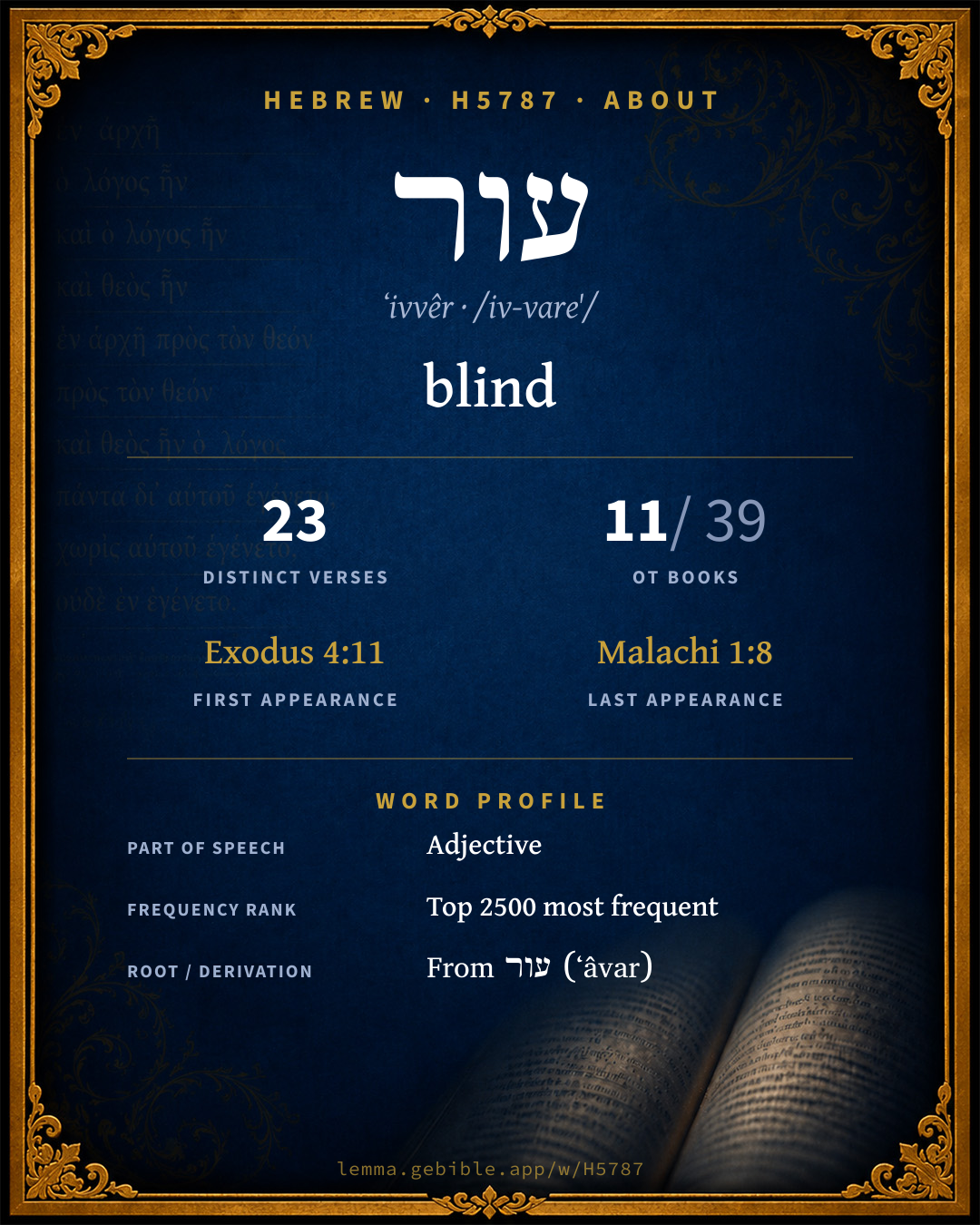
עִוֵּר
blind
‘blind’ is one of 3 main senses fuller range ↓
Full lexicon entry — Brown-Driver-Briggs (BDB)
From Brown-Driver-Briggs (BDB)
Where this word appears
Grammar key — what these labels mean
Part of speech
- Adjective
- A word that describes or qualifies a noun.
State
- Absolute
- The independent form of a noun, not bound to a following word.
Gender
- Masculine
- Grammatically masculine.
- Feminine
- Grammatically feminine.
Number
- Singular
- One.
- Plural
- More than one (in Hebrew, generally three or more).
Every verse where H5787 appears in the Book of Leviticus — 2 distinct verses. Click any verse to open its interlinear word-by-word view. Verse text shown in the World English Bible for context — . Each verse’s Hebrew form is shown with its reference; the English is not keyword-highlighted, since the data carries no word-level English alignment. Use “Compare translations” on any verse to read it across multiple English versions. This concordance covers the Hebrew Bible; Septuagint (Greek Old Testament) occurrences are not indexed here.
Leviticus
- Leviticus 19:14 עִוֵּ֔ר adj Adjective ms "'You shall not curse the deaf, nor put a stumbling block before the blind; but you shall fear your God. I am Yahweh.
- Leviticus 21:18 עִוֵּר֙ adj Adjective ms For whatever man he is that has a blemish, he shall not draw near: a blind man, or a lame, or he who has a flat nose, or any deformity,
About this entry
At a glance — auto-summarized from this page’s data, not written by a person. Every figure links to its source below. This summary describes the numbers; it doesn’t interpret them.
At its core, עור (ʻivvêr) means “blind.” First canonically at Exodus 4:11, it enters the text early. With 23 verses in 11 books, it is an uncommon word in the Hebrew Bible. Its uses concentrate in Isaiah (39% of all occurrences). Carrying more than one sense, it rewards its full sense range. Each statement above links to its evidence; the full detail follows below.
Gloss history
Strong's 1890 vs modern scholarship
About this word
Strong's H5787 catalogs a Hebrew word from the Hebrew Old Testament.
These counts are not copied from any lexicon or concordance. They are computed here, from the morphology-tagged Hebrew Old Testament. What Lemma adds →
- 23
- distinct verses
- The word appears in 23 distinct verses.
- 11 / 39
- OT books
- The word appears in 11 of 39 Old Testament books.
- #1,251
- by frequency
- Top 2500 most frequent Hebrew words (rank 1,251 of 8,640 Hebrew words by occurrence).
View all 23 occurrences in the concordance →
Most concentrated in
- Isaiah 9 verses 39%
- Deuteronomy 3 verses 13%
- Leviticus 2 verses 9%
By section of the Old Testament
By traditional corpus
Conventional, traditional groupings — biblical authorship is debated, so this is a traditional corpus grouping, not an authorship claim. Each share is this word’s portion of its verses in that division of the Hebrew canon. Each figure is a share of the word’s 23 distinct verses.
- Prophets (Nevi'im) 14 verses · 61%
- Torah (Pentateuch) 6 verses · 26%
- Writings (Ketuvim) 3 verses · 13%
How translations render this word
Counts come from each version’s own published word-to-Strong’s tagging or interlinear alignment — an approximate guide to how each version renders this word, not a word-level alignment the data otherwise carries. Because each total is that version’s own tagged count, the per-version totals vary from one another and need not match the appearance or distinct-verse counts above. These counts may also differ from a printed concordance because Lemma counts each distinctly tagged rendering and does not collapse phrase taggings into a single head-word total. This is a fixed set of word-tagged versions (KJV, ASV, BSB, ULT) and does not change with the reading translation you choose elsewhere. Each version’s license is shown beside its name below (and on Sources).
- King James Version: Blind 16×, Is blind 2×
- American Standard Version: Blind 14×, Is blind 2×, Or blind 2×
- Berean Standard Bible: Blind 14×, Is blind 3×, Are blind 2×
- unfoldingWord Literal Text: Blind 17×, Is blind 2×, Like the blind 2×
King James Version Public Domain
Renders H5787 across 26 tagged occurrences — most commonly:
Plus 8 renderings that appear only once — usually multi-word phrases or single function words the recovered tagging swept in, not distinct renderings.
American Standard Version Public Domain
Renders H5787 across 26 tagged occurrences — most commonly:
Plus 8 renderings that appear only once — usually multi-word phrases or single function words the recovered tagging swept in, not distinct renderings.
Berean Standard Bible Public Domain
Renders H5787 across 26 tagged occurrences — most commonly:
Plus 5 renderings that appear only once — usually multi-word phrases or single function words the recovered tagging swept in, not distinct renderings.
unfoldingWord Literal Text CC BY-SA 4.0
Renders H5787 across 26 tagged occurrences — most commonly:
Plus 5 renderings that appear only once — usually multi-word phrases or single function words the recovered tagging swept in, not distinct renderings.
Senses in the full BDB
What do BDB’s symbols mean?
BDB uses these scholarly abbreviations:
| Symbol | Meaning |
|---|---|
| 𝔊 | the Septuagint (the ancient Greek translation, LXX) |
| 𝔙 | the Vulgate (the Latin translation) |
| 𝔖 | the Syriac version (the Peshitta) |
| 𝔗 | the Targum (the Aramaic translation) |
| ψ | the Psalms |
| √ | root (the underlying root or stem) |
| ‖ | parallel passage (a synonymous or contrasted parallel) |
| † | the dagger: every passage where the word occurs is cited |
The 6 senses and sub-senses the full Brown-Driver-Briggs lexicon distinguishes for this word, in lexicon order (not ranked by frequency), with BDB’s own verbatim wording and sub-sense lettering. Shown in Hebrew script with BDB’s own scholarly abbreviations. The condensed entry is in the Lexicon Entry tab. See also the Forms in the corpus table below.
- 1. lit., physically blind:
- a. of men Ex 4:11 (J; opp. פִּקֵּחַ), 2 S 5:6, 8(×2); Lv 19:14 (H), Dt 27:18; Je 31:8 Jb 29:15; in sim. Dt 28:29; Zp 1:17; Is 59:10, cf. La 4:14 (appos.); as adj. attribute אִישׁ ע׳ Lv 21:18 (H). e.g. Exodus 4:11
- b. of sacrif. animal Dt 15:21; Mal 1:8. e.g. Deuteronomy 15:21
- 2. fig.,
- a. of the helpless, groping Is 29:18; 35:5; 42:16 ψ 146:8; as adj. attribute, עֵינַיִם עִוְרוֹת Is 42:7. e.g. Isaiah 29:18
- b. of the dull, unreceptive, Is 42:18, 19(×3) (but v 19 c read חֵרֵשׁ q.v.); as adj. attrib. עַם עִוֵּר 43:8; as predicate 56:10. e.g. Isaiah 42:18
Senses from the full Brown-Driver-Briggs lexicon (Brown, Driver, Briggs; Oxford 1906 — public domain), digitized via Sefaria, supplemented by the OpenScriptures HebrewLexicon (CC BY 4.0). Full attribution on Sources.
Word origin
adj. blind;—only abs. ע׳ Ex 4:11 +, pl. עִוְרִים 2 S 5:6 +, f. עִוְרוֹת Is 42:7; (c. art. הָעִוֵּר Dt 28:29, elsewhere הַע׳ Baer Ginsb; van d. H. לָעִוֵּר Jb 29:15, הָעִוְרִים 2 S 5:6, 8; Is 42:18);—blind, usually as subst. = the blind:
— Brown-Driver-Briggs (Oxford 1906, public domain), digitized via Sefaria, supplemented by the OpenScriptures HebrewLexicon (CC BY 4.0). See Sources.
Derived from עור (ʻâvar) (H5786) — to blind.
Jastrow Dictionary
A second Hebrew/Aramaic lexicon for comparison, covering Aramaic and post-biblical (Talmudic, Targumic, Midrashic) usage that the biblical-Hebrew BDB does not. Matched by lemma rather than by Strong’s number, so a lemma may carry more than one Jastrow headword (shown separately below), and the entries cover usage well beyond the Bible.
עוּר I
- (b. h.) [to be stirred up, v. עָרַר,] to wake (act. a. neut.). [Y. B. Bath. III, 14ᵃ וצריך לעורו, read לעורר, v. infra.]—Part. עֵר; f. עֵרָה; pl. עֵרִים; עֵרוֹת, עֵי׳. B. Kam. II, 5 בין ער בין ישן whether awake or asleep. Nidd. 12ᵃ. Sabb. 55ᵇ; Snh. 82ᵃ (ref. to Mal. II, 12) שלא יהיה לו ער … ועונה וכ׳ he shall have none awakening (teaching) among the teachers and none responding among the scholars. Cant. R. to V, 2 אני ישנה מן המצות ולבי ער לגמילת חסדים I am asleep (negligent) in ceremonies, but my heart is awake for charity; אני ישנה מן הצדקות ולבי ער לעשותן I am asleep (careless) about righteous deeds, but my heart awakens me (stirs me up) to do them; ib. ולבו של הקב"ה ער לגאלני but the heart of the Lord, is awake (anxious) to redeem me; Pesik. Haḥod. p. 46ᵇ; Pesik. R. s. 15 ולבי ער להקב"ה לגאלני but my heart is awake (waiting) for the Lord to redeem me; Yalk. Cant. 988; Tanḥ. ed. Bub., Tol’doth 18. Der. Er. Zuta ch. V לא יהא אדם ער … בין העי׳ one must not be awake among those sleeping, nor asleep among those awake. Nidd. l. c. בין ישנות בין ע׳ whether they are asleep or awake; a. fr. e.g. Malachi 2:12
- to be awake, wake up; to be stirred up, become active. B. Bath. 74ᵇ והוה ר"א ישן ור"י נעור (not ניער) R. E. was asleep, and R. J. awake. Gitt. VIII, 2 (78ᵃ) (נֵי׳) נֵעוֹרָה קוראה וכ׳ when she woke up, she read and found it was her letter of divorce. Ab. III, 4 הנ׳ בלילה he who is awake by night. Sifré Deut. 314 כדי שיעֵוֹרוּ בניו (not שיעירו) that his young brood may wake up; Yalk. ib. 944. Cant. R. to IV, 8 (read:] בתחלה הוא נעור וכ׳ (or נִנְעַר, v. נָעַר II) first he bestirs himself (and proceeds) from the Temple &c.; a. fr.—Ab. Zar. 73ᵃ, a. fr. מצא מין את מינו וניעור kind found its kind and was stirred up, i.e. the two equal elements in the mixture join to become working agents.—V. נָעַר II.
- to wake up; to stir up, instigate. Gen. R. s. 43 מי הוא זה שה׳ לבם של מזרחיים וכ׳ who was he that stirred up the heart of the eastsrn nations that they should come and fall &c.?; Yalk. Is. 311 שה׳ בלבם של אזרחיים (corr. acc.). Ib. ישנים … ומי הֵעִירָן לבא וכ׳ the nations were too indifferent to come under the wings of the Lord, and who waked them up to come under his wings? Snh. 25ᵇ (expl. מפריחי יונים, ib. III, 3) אלו שמְעִירִין וכ׳ Ms. M. (ed. שממרין) those who stir up the pigeons (on which they bet), v. מָרָה II.
- to be stirred up, be removed. Gen. R. s. 85 שה׳ מן העולם, v. עֵר II; Yalk. ib. 145.
- 1. to wake up. Y. Ber. I, 2ᵈ (ref. to Ps. LVII, 9) דרכן … להיות השחר מְעוֹרְרָן it is usual with kings that the dawn wakes them up; Tanḥ. B’ha‘ăl. 10 דרך השחר מְעוֹרֵר … מעורר וכ׳ usually the dawn wakes the sons of man, but I wake the dawn up. Y. Ber. IX, 13ᵈ bot. היודע … הוא יְעוֹרֵר אתכם he that knows your numbers wake you (from death); a. fr.—Y. Ter. V, end, 43ᵈ מעורר את מינו ליאסר stirs up its kind (makes it an agent) to become forbidden, v. supra.—Maas. Sh. V, 15 בטל את המְעוֹרְרִים abolished the wakers; Sot. IX, 10, expl. ib. 48ᵃ; Tosef. ib. XIII, 9 מעוררין אילו הלוים וכ׳ the wakers are the Levites, who … sang, Awake &c. (Ps. XLIV, 24). Lev. R. s. 7, beg. שנאה … היא עוֹרְרָה עליהן דיני דינין hatred … stirred up against them judgment upon judgment; a. fr. e.g. Psalms 57:9
- 2. to excite to lamentation, arrange a memorial service, engage a travelling wailer. M. Kat. I, 5 לא יְעוֹרֵר וכ׳ one must not arrange a memorial service &c., v. סַפְדָּנָא; ib. 8ᵃ לא יערער, v. עִרְעֵר.
- 3. to raise an objection; to contest the legality of. Y. B. Bath. III, 14ᵃ (interch. with עָרַר) מכיון שערר … צריך לעוֹרֵר עליו since he contested the right of possession in three successive years, he need no longer contest. Ib. צריך לעורו (corr. acc.); v. עָרַר a. עִרְעֵר.
- , Nithpol. נִתְעוֹרֵר
- 1. to be waked up; to bestir one’s self. Lev. R. l. c. עד שנה שנִתְעוֹרְרָה עליהן וכ׳ up to the year when it (hatred) was stirred up against them &c. Lev. R. s. 9 (ref. to Cant. IV, 16) לכשיִתְעוֹרְרוּ הגליות וכ׳ when the exiled colonies in the north are waked up (to be redeemed), they will come &c.; ib. לכשיִתְעוֹרֵר גוג וכ׳ when Gog bestirs himself (to war) &c. Ib. דבר שהוא ישן ונתע׳ a thing (the daily offering) which was asleep (during the captivity) and has been reawakened (reinstated); a. e. e.g. Song of Solomon 4:16
- 2. to be lively; to enjoy one’s self. Midr. Till. to Ps. CXLIX הִתְעוֹרְרוּ עלי וכ׳ enjoy yourselves with me at your pleasure.
עוּר
- , to stir up, awaken; to awake. Targ. Job XLI, 2 יְעוּרִ׳ (ed. Lag. a. oth. יְעִרִ׳ Af.).—Taan. 4ᵃ עוּרוּ, v. עוּרְפִּילָא.—Part. עָיֵיר, עָיֵר; f. עָיְירָא, עָיְרָא. Targ. Cant. V, 2.—Part. pass. עִיר, pl. עִירִין, עִירֵי awake. Y. Ber. I, 2ᵈ עד כדון ברייתא ע׳ until then (the end of the first night-watch) men are awake. Snh. 29ᵇ ע׳ ושכבי ליהוי וכ׳ shall those awake and those asleep be witnesses against thee (i.e. wouldst thou say so within the hearing of &c.)?
- 1. to stir up, awaken. Targ. Is. XIV, 9 אֲעִירַת (ed. Lag. אעדת, read אֲעָרַת). Targ. Zech. IV, 1.
- 2. to wake, watch; to wake up. Targ. Y. II, Deut. XXXII, 11 (not מֵעִיד); a. e.—Midr. Till. to Ps. XXII (ref. to ib. LVII, 9) אֲעִיר יקרי וכ׳ wake up, my dignity (soul), before the dignity of my Maker (v. infra).
- to stir up, awaken. Targ. Ps. LXXX, 3. Targ. Y. I Deut. l. c.—Y. Ber. I, 2ᵈ (ref. to Ps. LVII, 9) אנא הוינא מְעוֹרֵר שחרה וכ׳ I am wont to wake up the dawn, the dawn never wakes me up; Pesik. Vayhi, p. 63ᵃ; Pesik. R. s. 17 ושחרה לא עוֹרְרַתְנִי; Midr. Till. l. c.; Lam. R. to II, 18; a. e. e.g. Psalms 57:9
- , Ittaf. אִתָּעַר to be stirred up; to awake; to bestir one’s self. Targ. Job XIV, 12. Targ. Gen. XLI, 4. Targ. Hab. II, 19; a. e.—Y. Ber. l. c. אִתְעִיר יקרי wake up, my dignity (v. supra); Pesik. l. c. אִיתְּעַר; Pesik. R. l. c.; Lam. R. l. c.; Yalk. Ps. 776 יִתָּעַר יקרי וכ׳ let my dignity wake up. Ber. 4ᵃ לאִתְעוּרֵי משנתיה (Ms. M. לאִתְעוּרֵיה) for the purpose of (his) being waked up from his sleep; Yalk. Ex. 186. Lev. R. s. 12, beg. א׳ משנתיה וכ׳ when he woke up from his sleep, he saw &c.; a. fr.—Koh. R. to I, 8 כיון דא׳ בך חמרא וכ׳ since that wicked man’s ass has been stirred up against thee (as it will be a constant reproach to thee that that man has caused thee to ride on the Sabbath), thou canst no longer stay &c.; [Matt. K.: since that wicked man’s ass has brayed at thee, as if from נער, v. נָעַר I.] e.g. Habakkuk 2:19
עוּר II
- (v. next w.) husk, chaff. Y. Sabb. XIV, 14ᵈ, v. אוּר II.
עוֹר
- skin, hide. Bets. I, 5, v. דּוֹרְסָן. Kel. XXVI, 5 (6), v. חַמָּר II. Ib. ע׳ הרופא the surgeon’s leather apron; ע׳ העריסה the leather sheet in the cradle; a. v. fr.—Pl. עוֹרוֹת. Ib. 8 ע׳ בעל הבית the skins in the possession of a private man, opp. של עבדן, v. עַבְּדָן. Ab. Zar. II, 3, v. לָבַב; a. v. fr.
עִוֵּר I
- [white, blank,] blind. Bekh. 44ᵃ (ref. to Lev. XXI, 18) ע׳ בין סומא וכ׳ ‘ivver means both blind of one eye as well as of both; a. e.—B. Mets. V, 11, a. fr. משום ולפני ע׳ וכ׳ it comes under the category of the law (Lev. XIX, 14), ‘place no stumbling block before the blind’ (cause no man to sin).—Pl. עִוְּרִים. Midr. Till. to Ps. CXLVI, 8 ומי הן הע׳ הדורות … כע׳ who are the blind? These latter generations that walk in the Law like blind men; a. e.—[Usually סוּמָא].—Denom. e.g. Leviticus 21:18
עִוֵּר II
- (b. h.) to blind; to cause perversion of judgment. Sifré Deut. 144 (ref. to Deut. XVI, 19) כי השוחד יְעַוֵּר שאומר על וכ׳ ‘bribe blindeth’, that means, that (in old age) he will declare unclean what is clean &c.; Yalk. ib. 907; Keth. 105ᵃ (v. Peah VIII, 9); Mekh. Mishp., s. 20 (ref. to Ex. XXIII, 8) יעור עיני חכמים בתורה blinds the judgment of scholars of the Law. e.g. Deuteronomy 16:19
- to be blinded. Tanḥ. Aḥăré 1 נִתְעַוִּרוּ עיניו his eyes were put out.
עַוֵּר
- Targ. II Kings XXV, 7. Targ. O. Ex. XXIII, 8 מְעַוֵּר (ed. Berl. מְעַוַר); a. e.
- to get blind. Sabb. 77ᵇ מִתְעַוְּרָא would get blind.
A Dictionary of the Targumim, the Talmud Babli and Yerushalmi, and the Midrashic Literature (Marcus Jastrow; London, Luzac, 1903) — Public Domain. Digitized via Sefaria. Digitized via Sefaria. Full attribution on Sources.
Forms in the corpus
The 20 distinct written forms H5787 takes in the Hebrew Bible, most frequent first — each parse links to that state’s occurrences in the concordance. Hebrew forms include their vowel points and cantillation, so a single lemma takes many written forms.
| Form | Parsing | Example | Uses |
|---|---|---|---|
| עִוֵּר֙ | Adjective, Adjective, Masculine, Singular, Absolute | Isaiah 42:19 | 3 |
| עִוְרִ֗ים | Adjective, Adjective, Masculine, Plural, Absolute | Isaiah 42:16 | 2 |
| עִוֵּ֔ר | Adjective, Adjective, Masculine, Singular, Absolute | Deuteronomy 15:21 | 2 |
| עִוֵּ֖ר | Adjective, Adjective, Masculine, Singular, Absolute | Deuteronomy 27:18 | 2 |
| עִוֵּ֣ר | Adjective, Adjective, Masculine, Singular, Absolute | 2 Samuel 5:8 | 2 |
| הַ/עִוְרִ֤ים | Adjective, Adjective, Masculine, Plural, Absolute | 2 Samuel 5:6 | 1 |
| הַ֣/עִוְרִ֔ים | Adjective, Adjective, Masculine, Plural, Absolute | 2 Samuel 5:8 | 1 |
| הָ/עִוֵּר֙ | Adjective, Adjective, Masculine, Singular, Absolute | Deuteronomy 28:29 | 1 |
| וְ/הַ/עִוְרִ֖ים | Adjective, Adjective, Masculine, Plural, Absolute | Isaiah 42:18 | 1 |
| וְ/עִוֵּ֖ר | Adjective, Adjective, Masculine, Singular, Absolute | Isaiah 42:19 | 1 |
| כַֽ/עִוְרִים֙ | Adjective, Adjective, Masculine, Plural, Absolute | Isaiah 59:10 | 1 |
| כַּֽ/עִוְרִ֔ים | Adjective, Adjective, Masculine, Plural, Absolute | Zephaniah 1:17 | 1 |
| לַֽ/עִוֵּ֑ר | Adjective, Adjective, Masculine, Singular, Absolute | Job 29:15 | 1 |
| עִוְר֑וֹת | Adjective, Adjective, Feminine, Plural, Absolute | Isaiah 42:7 | 1 |
| עִוְרִ֑ים | Adjective, Adjective, Masculine, Plural, Absolute | Isaiah 35:5 | 1 |
| עִוְרִ֖ים | Adjective, Adjective, Masculine, Plural, Absolute | Isaiah 29:18 | 1 |
| עִוְרִ֤ים | Adjective, Adjective, Masculine, Plural, Absolute | Isaiah 56:10 | 1 |
| עִוְרִים֙ | Adjective, Adjective, Masculine, Plural, Absolute | Lamentations 4:14 | 1 |
| עִוֵּ֑ר | Adjective, Adjective, Masculine, Singular, Absolute | Exodus 4:11 | 1 |
| עִוֵּ֤ר | Adjective, Adjective, Masculine, Singular, Absolute | Malachi 1:8 | 1 |
Same root — word family
Other BDB entries built from the same root as H5787, grouped by Strong’s listed origin. These share a root / origin per the lexicon — not necessarily a shared meaning. Each links to that word’s own entry.
Derives from
Shares the same root
Derived from this word
Compare all same-root words → They share a root, not necessarily a meaning.
Septuagint verse parallels
This word appears in 23 verses that also exist in the Greek Old Testament (Septuagint), out of the 23 Hebrew verses it occurs in. You can read those verses in Greek by switching the Old Testament edition to the Septuagint.
Read these verses in the Septuagint
- Exodus 4:11
- Leviticus 19:14
- Deuteronomy 15:21
- 2 Samuel 5:6
- Job 29:15
- Psalms 146:8
- Isaiah 29:18
- Jeremiah 31:8
- Lamentations 4:14
- Zephaniah 1:17
- Malachi 1:8
This is a verse-level parallel only — the same verses exist in both the Hebrew and Greek Old Testaments. No word-level Hebrew↔Greek correspondence is claimed: the data carries no such alignment, so no Greek word is shown as this Hebrew word’s translation. Coverage is not total — the Septuagint omits the deuterocanon and renumbers the Psalms, so some Hebrew verses have no direct Greek parallel.