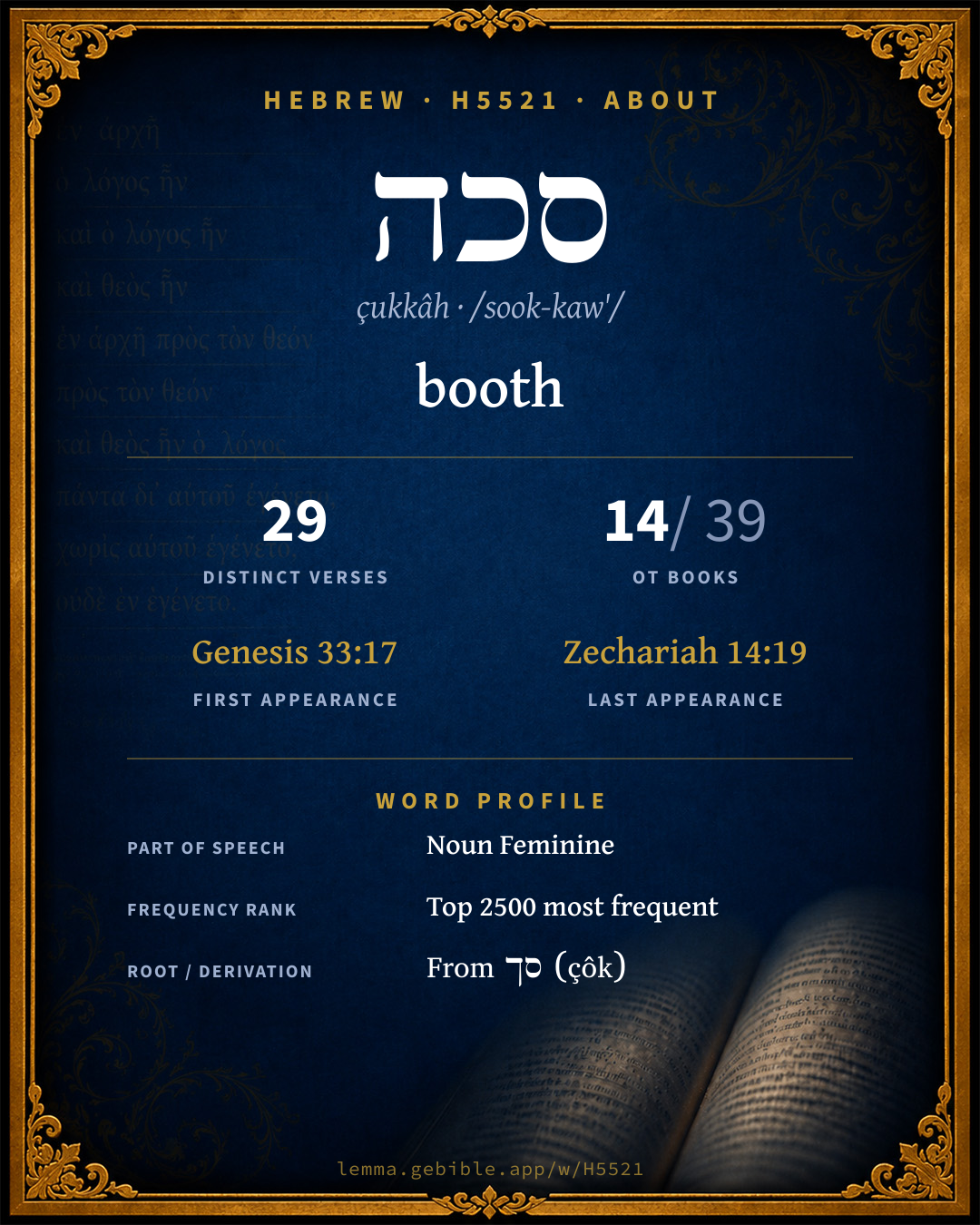
סֻכָּה
booth
also: thicket, covert fuller range ↓
Full lexicon entry — Brown-Driver-Briggs (BDB)
From Brown-Driver-Briggs (BDB)
Where this word appears
See every Absolute-state word in the Hebrew Bible →
Grammar key — what these labels mean
Part of speech
- Noun
- A naming word — a person, place, thing, or idea.
Noun type
- Common
- A common noun — a general class of person, place, or thing (“king,” “city,” “water”), not a specific name.
State
- Absolute
- The independent form of a noun, not bound to a following word.
- Construct
- A noun bound to a following noun in a possessive / “of” relationship (the construct chain).
Gender
- Feminine
- Grammatically feminine.
Number
- Plural
- More than one (in Hebrew, generally three or more).
- Singular
- One.
Grammatical forms
- Noun, Common, Feminine, Plural, Absolute 22 times (71%)
- Noun, Common, Feminine, Singular, Absolute 6 times (19%)
- Noun, Common, Feminine, Singular, Construct 3 times (10%)
Parsed forms decoded from the imported morphology (morphhb / Westminster Leningrad Codex — WLC text public domain, morphhb tagging CC BY 4.0), counted across 31 parsed occurrences — not distinct verses.
Every verse where H5521 appears — 29 distinct verses across 14 books. Click any verse to open its interlinear word-by-word view. Verse text shown in the World English Bible for context — . Each verse’s Hebrew form is shown with its reference; the English is not keyword-highlighted, since the data carries no word-level English alignment. Use “Compare translations” on any verse to read it across multiple English versions. This concordance covers the Hebrew Bible; Septuagint (Greek Old Testament) occurrences are not indexed here.
Genesis 1 verse
Leviticus 3 verses
- Leviticus 23:34 הַ/סֻּכּ֛וֹת ptcl def.art + n c fp "Speak to the children of Israel, and say, 'On the fifteenth day of this seventh month is the feast of tents for seven days to Yahweh.
- Leviticus 23:42 בַּ/סֻּכֹּ֥ת בַּ/סֻּכֹּֽת prep det + n c fp prep det + n c fp You shall dwell in booths seven days. All who are native-born in Israel shall dwell in booths,
- Leviticus 23:43 בַ/סֻּכּ֗וֹת prep det + n c fp that your generations may know that I made the children of Israel to dwell in booths, when I brought them out of the land of Egypt. I am Yahweh your God.'"
Deuteronomy 3 verses
- Deuteronomy 16:13 הַ/סֻּכֹּ֛ת ptcl def.art + n c fp You shall keep the feast of tents seven days, after that you have gathered in from your threshing floor and from your winepress:
- Deuteronomy 16:16 הַ/סֻּכּ֑וֹת ptcl def.art + n c fp Three times in a year shall all your males appear before Yahweh your God in the place which he shall choose: in the feast of unleavened bread, and in the feast of weeks, and in the feast of tents; and they shall not appear before Yahweh empty:
- Deuteronomy 31:10 הַ/סֻּכּֽוֹת ptcl def.art + n c fp Moses commanded them, saying, At the end of [every] seven years, in the set time of the year of release, in the feast of tents,
2 Samuel 2 verses
- 2 Samuel 11:11 בַּ/סֻּכּ֗וֹת prep det + n c fp Uriah said to David, The ark, and Israel, and Judah, abide in booths; and my lord Joab, and the servants of my lord, are encamped in the open field; shall I then go into my house, to eat and to drink, and to lie with my wife? as you live, and as your soul lives, I will not do this thing.
- 2 Samuel 22:12 סֻכּ֑וֹת n c fp He made darkness pavilions round about him, Gathering of waters, thick clouds of the skies.
1 Kings 2 verses
- 1 Kings 20:12 בַּ/סֻּכּ֑וֹת prep det + n c fp It happened, when [Ben Hadad] heard this message, as he was drinking, he and the kings, in the pavilions, that he said to his servants, Set [yourselves in array]. They set [themselves in array] against the city.
- 1 Kings 20:16 בַּ/סֻּכּ֗וֹת prep det + n c fp They went out at noon. But Ben Hadad was drinking himself drunk in the pavilions, he and the kings, the thirty-two kings who helped him.
2 Chronicles 1 verse
Ezra 1 verse
Nehemiah 4 verses
- Nehemiah 8:14 בַּ/סֻּכּ֛וֹת prep det + n c fp They found written in the law, how that Yahweh had commanded by Moses, that the children of Israel should dwell in booths in the feast of the seventh month;
- Nehemiah 8:15 סֻכֹּ֖ת n c fp and that they should publish and proclaim in all their cities, and in Jerusalem, saying, Go forth to the mountain, and get olive branches, and branches of wild olive, and myrtle branches, and palm branches, and branches of thick trees, to make booths, as it is written.
- Nehemiah 8:16 סֻכּ֜וֹת n c fp So the people went forth, and brought them, and made themselves booths, everyone on the roof of his house, and in their courts, and in the courts of the house of God, and in the broad place of the water gate, and in the broad place of the gate of Ephraim.
- Nehemiah 8:17 סֻכּוֹת֮ בַ/סֻּכּוֹת֒ n c fp prep det + n c fp All the assembly of those who were come again out of the captivity made booths, and lived in the booths; for since the days of Jeshua the son of Nun to that day the children of Israel had not done so. There was very great gladness.
Job 3 verses
- Job 27:18 וּ֝/כְ/סֻכָּ֗ה conj + prep + n c fs He builds his house as the moth, As a booth which the watchman makes.
- Job 36:29 סֻכָּתֽ/וֹ n c fs cs + sfx pers 3ms Yes, can any understand the spreading of the clouds, And the thunderings of his pavilion?
- Job 38:40 בַ/סֻּכָּ֣ה prep det + n c fs When they crouch in their dens, And lie in wait in the thicket?
Psalms 2 verses
- Psalms 18:11 סֻכָּת֑/וֹ n c fs cs + sfx pers 3ms He made darkness his hiding-place, his pavilion around him, Darkness of waters, thick clouds of the skies.
- Psalms 31:20 בְּ/סֻכָּ֗ה prep + n c fs In the shelter of your presence you will hide them from the plotting of man. You will keep them secretly in a dwelling away from the strife of tongues.
Isaiah 2 verses
- Isaiah 1:8 כְּ/סֻכָּ֣ה prep + n c fs The daughter of Zion is left like a shelter in a vineyard, Like a hut in a field of melons, Like a besieged city.
- Isaiah 4:6 וְ/סֻכָּ֛ה conj + n c fs There will be a pavilion for a shade in the daytime from the heat, and for a refuge and for a shelter from storm and from rain.
Amos 1 verse
Jonah 1 verse
Zechariah 3 verses
- Zechariah 14:16 הַ/סֻּכּֽוֹת ptcl def.art + n c fp It will happen that everyone who is left of all the nations that came against Jerusalem will go up from year to year to worship the King, Yahweh of Hosts, and to keep the feast of tents.
- Zechariah 14:18 הַ/סֻּכּֽוֹת ptcl def.art + n c fp If the family of Egypt doesn't go up, and doesn't come, neither will it rain on them. This will be the plague with which Yahweh will strike the nations that don't go up to keep the feast of tents.
- Zechariah 14:19 הַ/סֻּכּֽוֹת ptcl def.art + n c fp This will be the punishment of Egypt, and the punishment of all the nations that don't go up to keep the feast of tents.
About this entry
At a glance — auto-summarized from this page’s data, not written by a person. Every figure links to its source below. This summary describes the numbers; it doesn’t interpret them.
סכה (çukkâh) is a Hebrew noun most often rendered “booth.” Translators differ — “tabernacles” in the King James Version, then “huts” (unfoldingWord Literal Text), as the renderings breakdown shows. It turns up in 29 verses across 14 books, a moderately common footprint. It first appears in Genesis 33:17. It also covers “thicket” and “covert”, alongside “booth” — see its full sense range. For the data behind this summary, explore the sense tree and the renderings breakdown below.
Gloss history
Strong's 1890 vs modern scholarship
About this word
Strong's H5521 catalogs a Hebrew word from the Hebrew Old Testament.
These counts are not copied from any lexicon or concordance. They are computed here, from the morphology-tagged Hebrew Old Testament. What Lemma adds →
- 29
- distinct verses
- The word appears in 29 distinct verses.
- 14 / 39
- OT books
- The word appears in 14 of 39 Old Testament books.
- #1,120
- by frequency
- Top 2500 most frequent Hebrew words (rank 1,120 of 8,640 Hebrew words by occurrence).
View all 29 occurrences in the concordance →
Most concentrated in
- Nehemiah 4 verses 14%
- Leviticus 3 verses 10%
- Deuteronomy 3 verses 10%
By section of the Old Testament
By traditional corpus
Conventional, traditional groupings — biblical authorship is debated, so this is a traditional corpus grouping, not an authorship claim. Each share is this word’s portion of its verses in that division of the Hebrew canon. Each figure is a share of the word’s 29 distinct verses.
- Prophets (Nevi'im) 11 verses · 38%
- Writings (Ketuvim) 11 verses · 38%
- Torah (Pentateuch) 7 verses · 24%
How translations render this word
Counts come from each version’s own published word-to-Strong’s tagging or interlinear alignment — an approximate guide to how each version renders this word, not a word-level alignment the data otherwise carries. Because each total is that version’s own tagged count, the per-version totals vary from one another and need not match the appearance or distinct-verse counts above. These counts may also differ from a printed concordance because Lemma counts each distinctly tagged rendering and does not collapse phrase taggings into a single head-word total. This is a fixed set of word-tagged versions (KJV, ASV, BSB, ULT) and does not change with the reading translation you choose elsewhere. Each version’s license is shown beside its name below (and on Sources).
BDB lists this Strong’s number as 2 distinct words (homographs). Each count above pools all of them and is not split by sense — see the Senses section below. A low-frequency rendering may belong to a different one of those words, not the primary meaning.
- King James Version†: Tabernacles 9×, Booths 7×, Pavilions 3×
- American Standard Version†: Booths 9×, Tabernacles 9×, Booth 3×
- Berean Standard Bible†: Tabernacles 9×, Booths 7×, Shelter 3×
- unfoldingWord Literal Text†: Huts 11×, Booths 6×, Shelters 4×
King James Version Public Domain
Renders H5521 across 31† tagged occurrences — most commonly:
Plus 6 renderings that appear only once — usually multi-word phrases or single function words the recovered tagging swept in, not distinct renderings.
American Standard Version Public Domain
Renders H5521 across 31† tagged occurrences — most commonly:
Plus 4 renderings that appear only once — usually multi-word phrases or single function words the recovered tagging swept in, not distinct renderings.
Berean Standard Bible Public Domain
Renders H5521 across 31† tagged occurrences — most commonly:
Plus 8 renderings that appear only once — usually multi-word phrases or single function words the recovered tagging swept in, not distinct renderings.
unfoldingWord Literal Text CC BY-SA 4.0
Renders H5521 across 31† tagged occurrences — most commonly:
Plus 4 renderings that appear only once — usually multi-word phrases or single function words the recovered tagging swept in, not distinct renderings.
Senses in the full BDB
What do BDB’s symbols mean?
BDB uses these scholarly abbreviations:
| Symbol | Meaning |
|---|---|
| 𝔊 | the Septuagint (the ancient Greek translation, LXX) |
| 𝔙 | the Vulgate (the Latin translation) |
| 𝔖 | the Syriac version (the Peshitta) |
| 𝔗 | the Targum (the Aramaic translation) |
| ψ | the Psalms |
| √ | root (the underlying root or stem) |
| ‖ | parallel passage (a synonymous or contrasted parallel) |
| † | the dagger: every passage where the word occurs is cited |
The 3 senses and sub-senses the full Brown-Driver-Briggs lexicon distinguishes for this word, in lexicon order (not ranked by frequency), with BDB’s own verbatim wording and sub-sense lettering. Shown in Hebrew script with BDB’s own scholarly abbreviations. The condensed entry is in the Lexicon Entry tab. See also the Forms in the corpus table below.
סכה I [סֹךְ], סֻכָּה, סֻכּוֹת v. ii. סכך.
סכה II thicket, booth (proposes of interwoven boughs cf. Ne 8
- 1. thicket, lurking-place of lions Jb 38:40 (cf. [סֹךְ] 1). e.g. Job 38:40
- 2. booth, rude or temporary shelter, for cattle Gn 33:17 (J; distinct from בַּיִת), but also for warriors in the field 2 S 11:11 1 K 20:12, 16; for watchers in vineyards Is 1:8 (sim.) Jb 27:18 (sim. of frailty), for man’s shelter from sun Jon 4:5, cf. (fig.) Is 4:6 ψ 31:21, prob. also 27:5 (v. [סֹךְ]); poet. of fallen house (dynasty) of David Am 9:11; of clouds as (temporary) enclosure (AV ‘pavilion’) of י׳ in storm ψ 18:12 = 2 S 22:12 Jb 36:29. e.g. Genesis 33:17
- 3. specif. of booths, made of boughs, in which people lived at harvest-feast Lv 23:42(×2), 43 (H), Ne 8:14, 15, 16, 17(×2), hence called חַג הַסֻּכּוֹת Dt 16:13, 16; 31:10; Lv 23:34 (P), Zc 14:16, 18, 19; 2 Ch 8:13; Ezr 3:4. e.g. Leviticus 23:42
Senses from the full Brown-Driver-Briggs lexicon (Brown, Driver, Briggs; Oxford 1906 — public domain), digitized via Sefaria, supplemented by the OpenScriptures HebrewLexicon (CC BY 4.0). Full attribution on Sources.
Word origin
n.f. thicket, booth (proposes of interwoven boughs cf. Ne 8:15);—abs. ס׳ Is 1:8 +; cstr. סֻכַּת Am 9:11; sf. סֻכָּתוֹ Jb 36:29 ψ 18:12, and so read ‖ 2 S 22:12 (for MT סֻכּוֹת; De Hup-Now HPS); usually pl. סֻכֹּת Gn 33:17 +; סֻכּוֹת 2 S 11:11; +;—
— Brown-Driver-Briggs (Oxford 1906, public domain), digitized via Sefaria, supplemented by the OpenScriptures HebrewLexicon (CC BY 4.0). See Sources.
Derived from סך (çôk) (H5520) — thicket.
Jastrow Dictionary
A second Hebrew/Aramaic lexicon for comparison, covering Aramaic and post-biblical (Talmudic, Targumic, Midrashic) usage that the biblical-Hebrew BDB does not. Matched by lemma rather than by Strong’s number, so a lemma may carry more than one Jastrow headword (shown separately below), and the entries cover usage well beyond the Bible.
סָכָה
- , v. סכי
סֻכָּה
- , v. סוּכָּה.—[Cant. R. to II, 9 מסכה לסכה, some ed., v. סוֹכָה.]
סכי
- (cmp. זָכָה a. סְכוּכִית I) [to be clear; cmp. סָבַר,] to look, see, foresee. Meg. 14ᵃ (play on יסכה, Gen. XI, 29) שסָכְתָה ברוה"ק she looked into the future in holy inspiration. Ib. שהכל סוֹכִין ביפיה Ms. M. (ed. סכין, incorr.) all looked at her beauty. Lev. R. s. 1, beg. (ref. to סוכו = שׂוֹכוֹ, I Chr. IV, 18) the father of prophets שסוֹכִים ברוה"ק who see &c.—Part. pass. סָכוּי clear, transparent. Nidd. 24ᵇ עצמותיו סְכוּיִין his bones are transparent (v., however, סָבָא III). e.g. Genesis 11:29
A Dictionary of the Targumim, the Talmud Babli and Yerushalmi, and the Midrashic Literature (Marcus Jastrow; London, Luzac, 1903) — Public Domain. Digitized via Sefaria. Digitized via Sefaria. Full attribution on Sources.
Forms in the corpus
The 26 distinct written forms H5521 takes in the Hebrew Bible, most frequent first — each parse links to that state’s occurrences in the concordance. Hebrew forms include their vowel points and cantillation, so a single lemma takes many written forms.
Same root — word family
Other BDB entries built from the same root as H5521, grouped by Strong’s listed origin. These share a root / origin per the lexicon — not necessarily a shared meaning. Each links to that word’s own entry.
Derives from
Proper names from this root
People and places named from this root — a name, not an additional meaning of the word.
Compare all same-root words → 2 of the same-root words are proper names (people or places). They share a root, not necessarily a meaning.
Septuagint verse parallels
This word appears in 24 verses that also exist in the Greek Old Testament (Septuagint), out of the 29 Hebrew verses it occurs in. You can read those verses in Greek by switching the Old Testament edition to the Septuagint.
Read these verses in the Septuagint
- Genesis 33:17
- Leviticus 23:34
- Deuteronomy 16:13
- 2 Samuel 11:11
- 1 Kings 20:12
- 2 Chronicles 8:13
- Ezra 3:4
- Job 27:18
- Psalms 18:11
- Isaiah 1:8
- Amos 9:11
- Jonah 4:5
This is a verse-level parallel only — the same verses exist in both the Hebrew and Greek Old Testaments. No word-level Hebrew↔Greek correspondence is claimed: the data carries no such alignment, so no Greek word is shown as this Hebrew word’s translation. Coverage is not total — the Septuagint omits the deuterocanon and renumbers the Psalms, so some Hebrew verses have no direct Greek parallel.