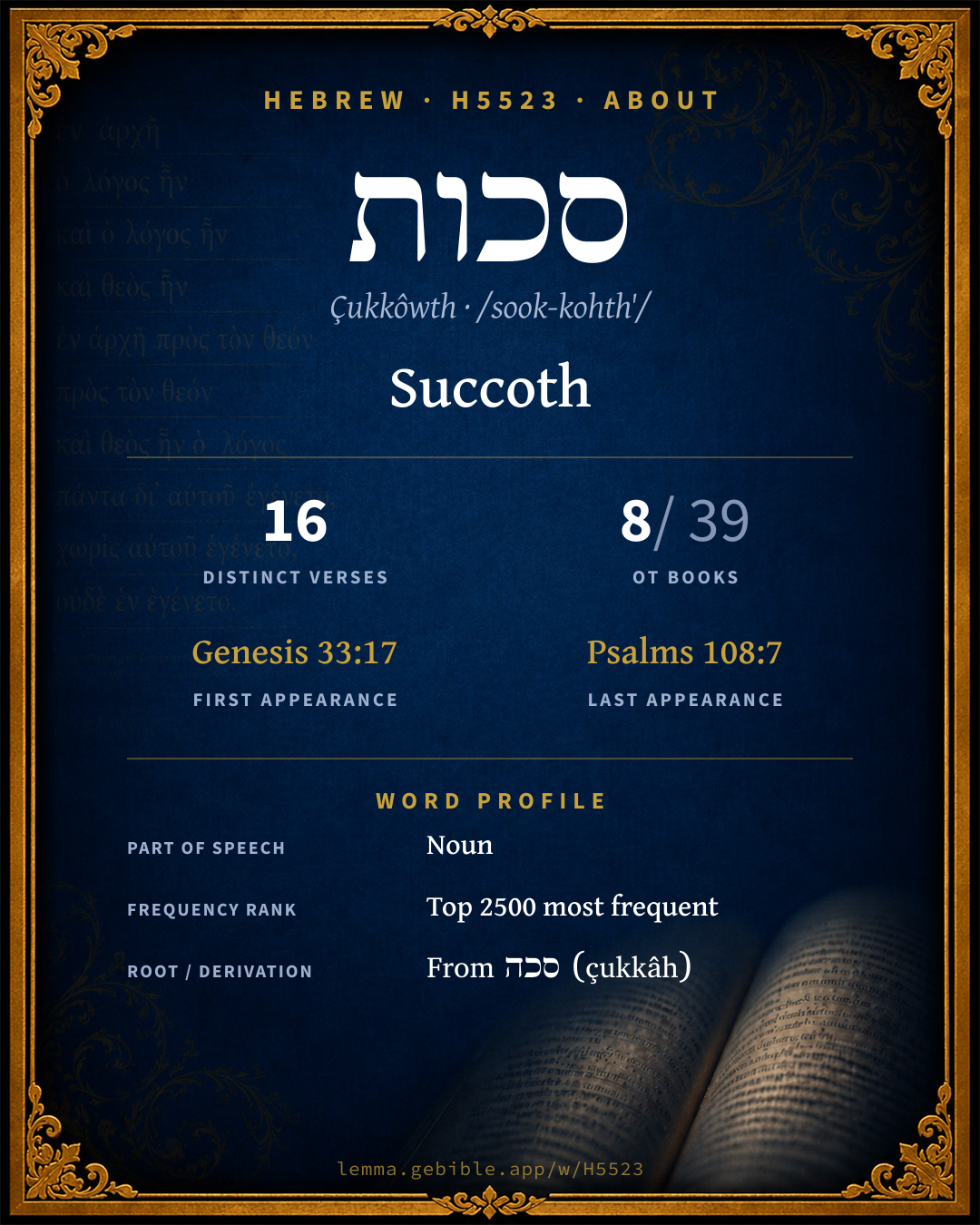
סֻכּוֹת
Succoth
BDB lists 3 entries for ‘Succoth’ fuller range ↓
Full lexicon entry — Brown-Driver-Briggs (BDB)
From Brown-Driver-Briggs (BDB)
Where this word appears
Grammar key — what these labels mean
Part of speech
- Noun
- A naming word — a person, place, thing, or idea.
Noun type
- Proper
- A name of a specific person, place, or people (e.g. Abraham, Zion, Israel).
Every verse where H5523 appears — 16 distinct verses across 8 books. Click any verse to open its interlinear word-by-word view. Verse text shown in the World English Bible for context — . Each verse’s Hebrew form is shown with its reference; the English is not keyword-highlighted, since the data carries no word-level English alignment. Use “Compare translations” on any verse to read it across multiple English versions. This concordance covers the Hebrew Bible; Septuagint (Greek Old Testament) occurrences are not indexed here.
Genesis 1 verse
Exodus 2 verses
Numbers 2 verses
Joshua 1 verse
Judges 6 verses
- Judges 8:5 סֻכּ֔וֹת n Proper He said to the men of Succoth, Please give loaves of bread to the people who follow me; for they are faint, and I am pursuing after Zebah and Zalmunna, the kings of Midian.
- Judges 8:6 סֻכּ֔וֹת n Proper The princes of Succoth said, Are the hands of Zebah and Zalmunna now in your hand, that we should give bread to your army?
- Judges 8:8 סֻכּֽוֹת n Proper He went up there to Penuel, and spoke to them in like manner; and the men of Penuel answered him as the men of Succoth had answered.
- Judges 8:14 סֻכּ֖וֹת סֻכּוֹת֙ n Proper n Proper He caught a young man of the men of Succoth, and inquired of him: and he described for him the princes of Succoth, and the elders of it, seventy-seven men.
- Judges 8:15 סֻכּ֔וֹת n Proper He came to the men of Succoth, and said, See Zebah and Zalmunna, concerning whom you did taunt me, saying, Are the hands of Zebah and Zalmunna now in your hand, that we should give bread to your men who are weary?
- Judges 8:16 סֻכּֽוֹת n Proper He took the elders of the city, and thorns of the wilderness and briers, and with them he taught the men of Succoth.
1 Kings 1 verse
2 Chronicles 1 verse
Psalms 2 verses
About this entry
At a glance — auto-summarized from this page’s data, not written by a person. Every figure links to its source below. This summary describes the numbers; it doesn’t interpret them.
“Succoth” is the headline sense of the Hebrew name סכות (Çukkôwth). First canonically at Genesis 33:17, it enters the text early. It turns up in 16 verses across 8 books, an uncommon footprint. It concentrates in Judges, which alone accounts for 38% of its uses. See 16-verse concordance and the renderings breakdown below.
Gloss history
Strong's 1890 vs modern scholarship
About this word
Strong's H5523 catalogs a Hebrew word from the Hebrew Old Testament.
These counts are not copied from any lexicon or concordance. They are computed here, from the morphology-tagged Hebrew Old Testament. What Lemma adds →
- 16
- distinct verses
- The word appears in 16 distinct verses.
- 8 / 39
- OT books
- The word appears in 8 of 39 Old Testament books.
- #1,612
- by frequency
- Top 2500 most frequent Hebrew words (rank 1,612 of 8,640 Hebrew words by occurrence).
View all 16 occurrences in the concordance →
By section of the Old Testament
By traditional corpus
Conventional, traditional groupings — biblical authorship is debated, so this is a traditional corpus grouping, not an authorship claim. Each share is this word’s portion of its verses in that division of the Hebrew canon. Each figure is a share of the word’s 16 distinct verses.
- Prophets (Nevi'im) 8 verses · 50%
- Torah (Pentateuch) 5 verses · 31%
- Writings (Ketuvim) 3 verses · 19%
How translations render this word
Counts come from each version’s own published word-to-Strong’s tagging or interlinear alignment — an approximate guide to how each version renders this word, not a word-level alignment the data otherwise carries. Because each total is that version’s own tagged count, the per-version totals vary from one another and need not match the appearance or distinct-verse counts above. These counts may also differ from a printed concordance because Lemma counts each distinctly tagged rendering and does not collapse phrase taggings into a single head-word total. This is a fixed set of word-tagged versions (KJV, ASV, BSB, ULT) and does not change with the reading translation you choose elsewhere. Each version’s license is shown beside its name below (and on Sources).
BDB lists this Strong’s number as 2 distinct words (homographs). Each count above pools all of them and is not split by sense — see the Senses section below. A low-frequency rendering may belong to a different one of those words, not the primary meaning.
- King James Version†: Succoth 16×, Between succoth 2×
- American Standard Version†: Succoth 16×, Between succoth 2×
- Berean Standard Bible†: Succoth 18×
- unfoldingWord Literal Text†: Succoth 17×
King James Version Public Domain
Renders H5523 across 18† tagged occurrences — most commonly:
American Standard Version Public Domain
Renders H5523 across 18† tagged occurrences — most commonly:
Berean Standard Bible Public Domain
Renders H5523 across 18† tagged occurrences — most commonly:
unfoldingWord Literal Text CC BY-SA 4.0
Renders H5523 across 18† tagged occurrences — most commonly:
Plus 1 rendering that appears only once — usually multi-word phrases or single function words the recovered tagging swept in, not distinct renderings.
Senses in the full BDB
What do BDB’s symbols mean?
BDB uses these scholarly abbreviations:
| Symbol | Meaning |
|---|---|
| 𝔊 | the Septuagint (the ancient Greek translation, LXX) |
| 𝔙 | the Vulgate (the Latin translation) |
| 𝔖 | the Syriac version (the Peshitta) |
| 𝔗 | the Targum (the Aramaic translation) |
| ψ | the Psalms |
| √ | root (the underlying root or stem) |
| ‖ | parallel passage (a synonymous or contrasted parallel) |
| † | the dagger: every passage where the word occurs is cited |
The 2 senses and sub-senses the full Brown-Driver-Briggs lexicon distinguishes for this word, in lexicon order (not ranked by frequency), with BDB’s own verbatim wording and sub-sense lettering. Shown in Hebrew script with BDB’s own scholarly abbreviations. The condensed entry is in the Lexicon Entry tab. See also the Forms in the corpus table below.
סכות I [סֹךְ], סֻכָּה, סֻכּוֹת v. ii. סכך.
סכות II loc.
- 1. סֻכֹּ֫תָה (ה loc.) Gn 33:17(×2) (J; expl. from Jacob’s making booths), elsewhere סֻכּוֹת;—city E. of Jordan Ju 8:5 + 6 times Ju 8, Jos 13:27 (P); prob. also 1 K 7:46 = 2 Ch 4:17 (reading מַעְבֶּרֶת אֲדָמָה ford of Adamah GFM Ju 7:22 cf. BuhlGeogr. 206 Benz 1 K 7:46); עֵמֶק ס׳ ψ 60:8 = 108:8 is Jordan-valley near Succôth; on identif. cf. GFM Ju 8:5 BuhlGeogr. 260, GASmGeogr. 585 and reff.; according to Talm Dêr ʿalla, 1 m. N. of Jabbok NbrGéogr; du Talm 248, so S. MerrillEast of Jordan 385 ff.; 𝔊 Σοκχωθ (Σκηναί Gn 33 cf. ψ). e.g. Genesis 33:17
- 2. סֻכֹּ֫תָה (ה loc.) Ex 12:37, elsewhere סֻכֹּת;—first station of Isr. at Exodus, Ex 12:37; 13:20; Nu 33:5, 6 (all P); = Egyptian Thku(t) WMMAs. u. Eur. 70, Thkw SteindorffBAS i. 603; on site v. NavillePithom (1885), especially pp. 6. 23 f. GutheZPV viii (1885), 219 f.; 𝔊 Σοκξωθ. e.g. Exodus 12:37
Senses from the full Brown-Driver-Briggs lexicon (Brown, Driver, Briggs; Oxford 1906 — public domain), digitized via Sefaria, supplemented by the OpenScriptures HebrewLexicon (CC BY 4.0). Full attribution on Sources.
Word origin
Derived from סכה (çukkâh) (H5521) — booth.
Jastrow Dictionary
A second Hebrew/Aramaic lexicon for comparison, covering Aramaic and post-biblical (Talmudic, Targumic, Midrashic) usage that the biblical-Hebrew BDB does not. Matched by lemma rather than by Strong’s number, so a lemma may carry more than one Jastrow headword (shown separately below), and the entries cover usage well beyond the Bible.
סוּכָּה
- cover of twigs; booth; esp. Succah, the booth covered with twigs &c. for the seven days of Succoth. Maasr. III, 7 סוּכַּת גינוסר the lodge of Genezareth gardens (inhabited during vintage); ס׳ היוצרים the potter’s hut (the outer compartment serving as a workshop, the inner as a dwelling); סֻכַּת החג the festive booth. Num. R. s. 4 (ref. to יֻסַּךְ, Ex. XXV, 29) שהיו מעמידין … כמין ס׳ they put the bread up in the shape of a hut; שכל חלה … ס׳ וכ׳ each cake forming a roof over that below (tubes being placed between them to allow the air to strike). Succ. I, 1 ס׳ שהיא גבוהה וכ׳ a Succah which is higher than twenty cubits is unfit for ritual use. Ib. 2 העושה סוּכָּתוֹ וכ׳ he who put up his Succah under a tree; a. v. fr.—Pl. סוּכּוֹת, סֻכּוֹת. Ib. 8ᵇ שתי ס׳ של יוצרים the two combined huts of the potters, v. supra; a. fr.—Succah, name of a treatise, of the Order of Moʿed, of the Mishnah, Talmud Babli a. Y’rushalmi, a. Tosefta. e.g. Exodus 25:29
סִכּוּת
- (b. h.) Siccuth, name of an idol. Targ. Am. V, 26 (ed. Lag. סִיכּ׳).
סֻכֹּות
- , v. סוּכּוֹת
A Dictionary of the Targumim, the Talmud Babli and Yerushalmi, and the Midrashic Literature (Marcus Jastrow; London, Luzac, 1903) — Public Domain. Digitized via Sefaria. Digitized via Sefaria. Full attribution on Sources.
Forms in the corpus
The 10 distinct written forms H5523 takes in the Hebrew Bible, most frequent first — each parse links to that state’s occurrences in the concordance. Hebrew forms include their vowel points and cantillation, so a single lemma takes many written forms.
| Form | Parsing | Example | Uses |
|---|---|---|---|
| סֻכּ֔וֹת | Noun, Proper | Judges 8:5 | 3 |
| סֻכּ֖וֹת | Noun, Proper | 1 Kings 7:46 | 3 |
| סֻכּֽוֹת | Noun, Proper | Genesis 33:17 | 3 |
| מִ/סֻּכֹּ֑ת | Noun, Proper | Exodus 13:20 | 2 |
| סֻכּ֣וֹת | Noun, Proper | Psalms 60:6 | 2 |
| בְּ/סֻכֹּֽת | Noun, Proper | Numbers 33:5 | 1 |
| וְ/סֻכּ֣וֹת | Noun, Proper | Joshua 13:27 | 1 |
| סֻכֹּ֑תָ/ה | Noun, Proper | Exodus 12:37 | 1 |
| סֻכֹּ֔תָ/ה | Noun, Proper | Genesis 33:17 | 1 |
| סֻכּוֹת֙ | Noun, Proper | Judges 8:14 | 1 |
Same root — word family
Other BDB entries built from the same root as H5523, grouped by Strong’s listed origin. These share a root / origin per the lexicon — not necessarily a shared meaning. Each links to that word’s own entry.
Derives from
Proper names from this root
People and places named from this root — a name, not an additional meaning of the word.
Compare all same-root words → 1 of the same-root words is a proper name (a person or place). They share a root, not necessarily a meaning.
Bible dictionary
Public-domain dictionary articles matched to this entry by name (Succoth). A biblical name can be shared by more than one person or place, so an article may treat several.
Easton's Bible Dictionary · M. G. Easton, 1897
Booths. (1.) The first encampment of the Israelites after leaving Ramesses (Ex. 12:37); the civil name of Pithom (q.v.).
(2.) A city on the east of Jordan, identified with Tell Dar'ala, a high mound, a mass of debris, in the plain north of Jabbok and about one mile from it (Josh. 13:27). Here Jacob (Gen. 32:17, 30; 33:17), on his return from Padan-aram after his interview with Esau, built a house for himself and made booths for his cattle. The princes of this city churlishly refused to afford help to Gideon and his 300 men when "faint yet pursuing" they followed one of the bands of the fugitive Midianites after the great victory at Gilboa. After overtaking and routing this band at Karkor, Gideon on his return visited the rulers of the city with severe punishment. "He took the elders of the city, and thorns of the wilderness and briers, and with them he taught the men of Succoth" (Judg. 8:13-16). At this place were erected the foundries for casting the metal-work for the temple (1 Kings 7:46).
Smith's Bible Dictionary · William Smith, 1863
(booths).
+ An ancient town, first heard of in the account of the homeward journey of Jacob from Padan-aram. (Genesis 35:17) The name is derived from the fact of Jacob's having there put up "booths" (succoth) for his cattle as well as a house for himself. From the itinerary of Jacob's return it seems that Succoth lay between Peniel, near the ford of the torrent Jabbok and Shechem. Comp. (Genesis 32:30) and Genesis33:18 In accordance with this is the mention of Succoth in the narrative of Gideon's pursuit of Zebah and Zalluunna. (Judges 5:5-17) It would appear from this passage that it lay east of the Jordan, which is corroborated by the fact that it was allotted to the tribe of Gad. (Joshua 13:27) Succoth is named once again after this--in (1 Kings 7:46; 2 Chronicles 4:17)--as marking the spot at which the brass founderies were placed for casting the metal work of the temple. (Dr. Merrill identifies it with a site called Tell Darala, one mile north of the Jabbok.--ED.) + The first camping-place of the Israelites when they left Egypt. (Exodus 12:37; 13:20; Numbers 33:5,6) This place was apparently reached at the close of the first days march. Rameses, the starting-place, was probably near the western end of the Wadi-t-Tumeylat . The distance traversed in each day's journey was about fifteen miles.
Hitchcock's Bible Names Dictionary · Roswell D. Hitchcock, 1869
tents; tabernacles
Classic public-domain reference works; full attribution on Sources.
Septuagint verse parallels
This word appears in 16 verses that also exist in the Greek Old Testament (Septuagint), out of the 16 Hebrew verses it occurs in. You can read those verses in Greek by switching the Old Testament edition to the Septuagint.
Read these verses in the Septuagint
- Genesis 33:17
- Exodus 12:37
- Numbers 33:5
- Joshua 13:27
- Judges 8:5
- 1 Kings 7:46
- 2 Chronicles 4:17
- Psalms 60:6
This is a verse-level parallel only — the same verses exist in both the Hebrew and Greek Old Testaments. No word-level Hebrew↔Greek correspondence is claimed: the data carries no such alignment, so no Greek word is shown as this Hebrew word’s translation. Coverage is not total — the Septuagint omits the deuterocanon and renumbers the Psalms, so some Hebrew verses have no direct Greek parallel.