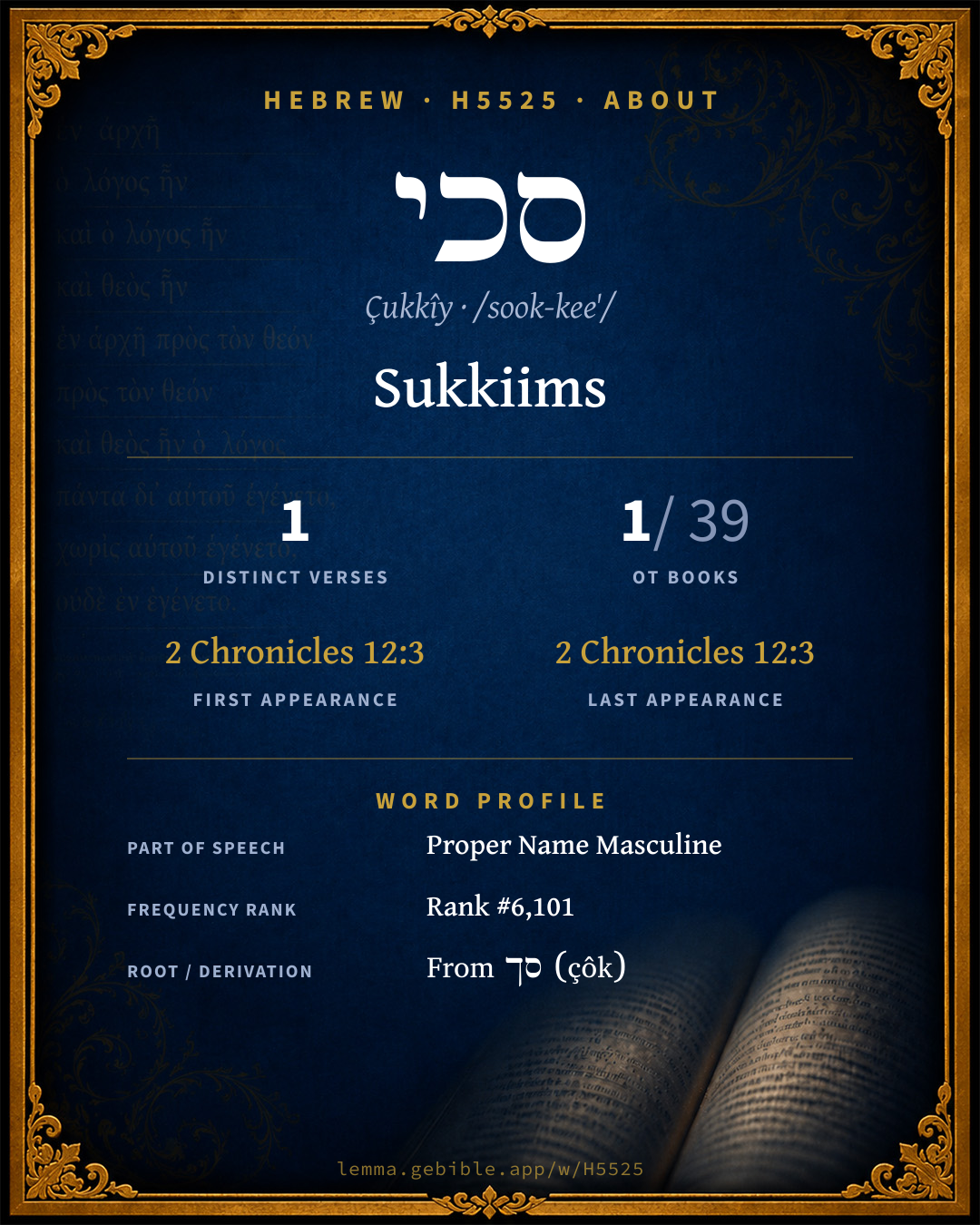
סֻכִּיִּים
Sukkiims
BDB lists 2 entries for ‘Sukkiims’ fuller range ↓
Full lexicon entry — Brown-Driver-Briggs (BDB)
From Brown-Driver-Briggs (BDB)
Where this word appears
Grammar key — what these labels mean
Part of speech
- Noun
- A naming word — a person, place, thing, or idea.
Noun type
- Gentilic
- A noun naming a member of a people, tribe, or region of origin (e.g. an Israelite, a Moabite).
State
- Absolute
- The independent form of a noun, not bound to a following word.
Gender
- Masculine
- Grammatically masculine.
Number
- Plural
- More than one (in Hebrew, generally three or more).
Every verse where H5525 appears — 1 distinct verse across 1 book. Click any verse to open its interlinear word-by-word view. Verse text shown in the World English Bible for context — . Each verse’s Hebrew form is shown with its reference; the English is not keyword-highlighted, since the data carries no word-level English alignment. Use “Compare translations” on any verse to read it across multiple English versions. This concordance covers the Hebrew Bible; Septuagint (Greek Old Testament) occurrences are not indexed here.
2 Chronicles 1 verse
About this entry
At a glance — auto-summarized from this page’s data, not written by a person. Every figure links to its source below. This summary describes the numbers; it doesn’t interpret them.
סכי — transliterated Çukkîy — is a Hebrew name carrying the sense “Sukkiims.” The Hebrew Bible uses it only 1 verse. Its uses cluster heavily in 2 Chronicles (100% of all occurrences). Its lone occurrence is 2 Chronicles 12:3. Each statement above links to its evidence; the full detail follows below.
Gloss history
Strong's 1890 vs modern scholarship
About this word
Strong's H5525 catalogs a Hebrew word from the Hebrew Old Testament.
These counts are not copied from any lexicon or concordance. They are computed here, from the morphology-tagged Hebrew Old Testament. What Lemma adds →
- 1
- distinct verses
- The word appears in 1 distinct verse.
- 1 / 39
- OT books
- The word appears in 1 of 39 Old Testament books.
- #6,101
- by frequency
- Rank #6,101 (rank 6,101 of 8,640 Hebrew words by occurrence).
View all 1 occurrence in the concordance →
Most concentrated in
- 2 Chronicles 1 verse 100%
By section of the Old Testament
By traditional corpus
Conventional, traditional groupings — biblical authorship is debated, so this is a traditional corpus grouping, not an authorship claim. Each share is this word’s portion of its verses in that division of the Hebrew canon. Each figure is a share of the word’s 1 distinct verse.
- Writings (Ketuvim) 1 verse · 100%
How translations render this word
Counts come from each version’s own published word-to-Strong’s tagging or interlinear alignment — an approximate guide to how each version renders this word, not a word-level alignment the data otherwise carries. Because each total is that version’s own tagged count, the per-version totals vary from one another and need not match the appearance or distinct-verse counts above. These counts may also differ from a printed concordance because Lemma counts each distinctly tagged rendering and does not collapse phrase taggings into a single head-word total. This is a fixed set of word-tagged versions (KJV, ASV, BSB, ULT) and does not change with the reading translation you choose elsewhere. Each version’s license is shown beside its name below (and on Sources).
- King James Version: Sukkiims 1×
- American Standard Version: Sukkiim 1×
- Berean Standard Bible: Sukkites 1×
- unfoldingWord Literal Text: Sukkites 1×
King James Version Public Domain
Renders H5525 across 1 tagged occurrence — most commonly:
American Standard Version Public Domain
Renders H5525 across 1 tagged occurrence — most commonly:
Berean Standard Bible Public Domain
Renders H5525 across 1 tagged occurrence — most commonly:
unfoldingWord Literal Text CC BY-SA 4.0
Renders H5525 across 1 tagged occurrence — most commonly:
Senses in BDB
The 2 senses BDB distinguishes for this word, in lexicon order (not ranked by frequency or importance). The full entry — with sub-senses — is in the Lexicon Entry tab.
- Sukkiims = "booth dwellers"
- a people who supplied warriors for the Egyptian army under Shishak
Word origin
n.pr.m.pl. a people in army of Shishak according to 2 Ch 12:3 (between לוּבִים and כּוּשִׁים); 𝔊 Τρωγλοδυται, so 𝔙; 𝔊L Σουχιειμ.
— Brown-Driver-Briggs (Oxford 1906, public domain), digitized via Sefaria, supplemented by the OpenScriptures HebrewLexicon (CC BY 4.0). See Sources.
Derived from סך (çôk) (H5520) — thicket.
Jastrow Dictionary
A second Hebrew/Aramaic lexicon for comparison, covering Aramaic and post-biblical (Talmudic, Targumic, Midrashic) usage that the biblical-Hebrew BDB does not. Matched by lemma rather than by Strong’s number, so a lemma may carry more than one Jastrow headword (shown separately below), and the entries cover usage well beyond the Bible.
סכי
- (cmp. זָכָה a. סְכוּכִית I) [to be clear; cmp. סָבַר,] to look, see, foresee. Meg. 14ᵃ (play on יסכה, Gen. XI, 29) שסָכְתָה ברוה"ק she looked into the future in holy inspiration. Ib. שהכל סוֹכִין ביפיה Ms. M. (ed. סכין, incorr.) all looked at her beauty. Lev. R. s. 1, beg. (ref. to סוכו = שׂוֹכוֹ, I Chr. IV, 18) the father of prophets שסוֹכִים ברוה"ק who see &c.—Part. pass. סָכוּי clear, transparent. Nidd. 24ᵇ עצמותיו סְכוּיִין his bones are transparent (v., however, סָבָא III). e.g. Genesis 11:29
סְכֵי
- , to look out; to hope. Targ. I Kings XVIII, 43. Targ. O. Gen. XXXI, 49 יִסְךְ ed. Berl. (oth. ed. יִסַךְ, יִסְכֵּי; Y. יִסְתְּכִי Ithpe; h. text יצף). Targ. Y. ib. XLV, 28. Targ. Prov. XX, 22; a. fr. (interch. with סבר).—Lev. R. s. 34 סְכִי בי אסתכל בי (the poor man says) look at me, observe me; סכי כי מה הוינא וכ׳ look at me (think) what I was, and observe what I am. Y. Taan. IV, 68ᵇ סְכוֹן מיעול וכ׳ look out (be on your guard) that you come in while it is yet day-time; Y. R. Hash. IV, 59ᶜ top סבין מטול ומיעול (corr. acc.).
- 1. same. Targ. Hab. II, 1 מְסַכֵּינָא (some ed. אֵיסָכֵינָא, incorr.). Targ. Is. XLVII, 13; a. fr.—Keth. 62ᵇ הוות מְסַכְּיָא וכ׳ his wife was looking out (for him, saying,) now he is coming &c. Midr. Till. to Ps. CV, 38 [read]: חמרא מַסְכֵּי … מיני ואיהו מסכי וכ׳ the ass was looking (hoping), when will he get down off me?, and he was looking, when shall I get down &c.; a. e. e.g. Habakkuk 2:1
- 2. (cmp. חָשַׁב) to calculate, count, sum up. B. Bath. 166ᵇ sq. אֲסוּכֵי מַסְכֵּי וכ׳ Rashi (ed. מסכן, read: מַסְכּוּ; v. Rabb. D. S. a. l. note) he (they) would count them (the P’rutahs) and state their amount in Zuzé.
- same, to look, face; to hope, wait. Targ. O. Gen. XV, 5 (Y. אסתכל; h. text הבט). Targ. O. Num. XXI, 20 מִסְתַּכְּיָא (ed. Berl. מִסְתַּכְיָא). Targ. Ps. XXXVII, 32; a. fr.—Snh. 97ᵇ עד הכא לא תִסְתְּכֵי ליה … אִסְתְּכִי ליה until that time do not hope for him (the Messiah), after that hope for him; a. e.
סָכֵי
- (preced.) סְכֵי שמש looking to the sun, euphem. for squinting, cross-eyed. Tosef. Bekh. V, 3, expl. שרואה את החדר וכ׳ who takes in the room and the ceiling in one glance; Bekh. VII, 3, changed by R. Jose. ib. 44ᵃ: סני שמש one who hates the sun, blinkard
A Dictionary of the Targumim, the Talmud Babli and Yerushalmi, and the Midrashic Literature (Marcus Jastrow; London, Luzac, 1903) — Public Domain. Digitized via Sefaria. Digitized via Sefaria. Full attribution on Sources.
Same root — word family
Other BDB entries built from the same root as H5525, grouped by Strong’s listed origin. These share a root / origin per the lexicon — not necessarily a shared meaning. Each links to that word’s own entry.
Derives from
Shares the same root
Compare all same-root words → They share a root, not necessarily a meaning.
Bible dictionary
Public-domain dictionary articles matched to this entry by name (Sukkiims). A biblical name can be shared by more than one person or place, so an article may treat several.
Easton's Bible Dictionary · M. G. Easton, 1897
Dwellers in tents, (Vulg. and LXX., "troglodites;" i.e., cave-dwellers in the hills along the Red Sea). Shiskak's army, with which he marched against Jerusalem, was composed partly of this tribe (2 Chr. 12:3).
Classic public-domain reference works; full attribution on Sources.
Septuagint verse parallels
This word appears in 1 verse that also exists in the Greek Old Testament (Septuagint), out of the 1 Hebrew verse it occurs in. You can read those verses in Greek by switching the Old Testament edition to the Septuagint.
Read these verses in the Septuagint
This is a verse-level parallel only — the same verses exist in both the Hebrew and Greek Old Testaments. No word-level Hebrew↔Greek correspondence is claimed: the data carries no such alignment, so no Greek word is shown as this Hebrew word’s translation. Coverage is not total — the Septuagint omits the deuterocanon and renumbers the Psalms, so some Hebrew verses have no direct Greek parallel.