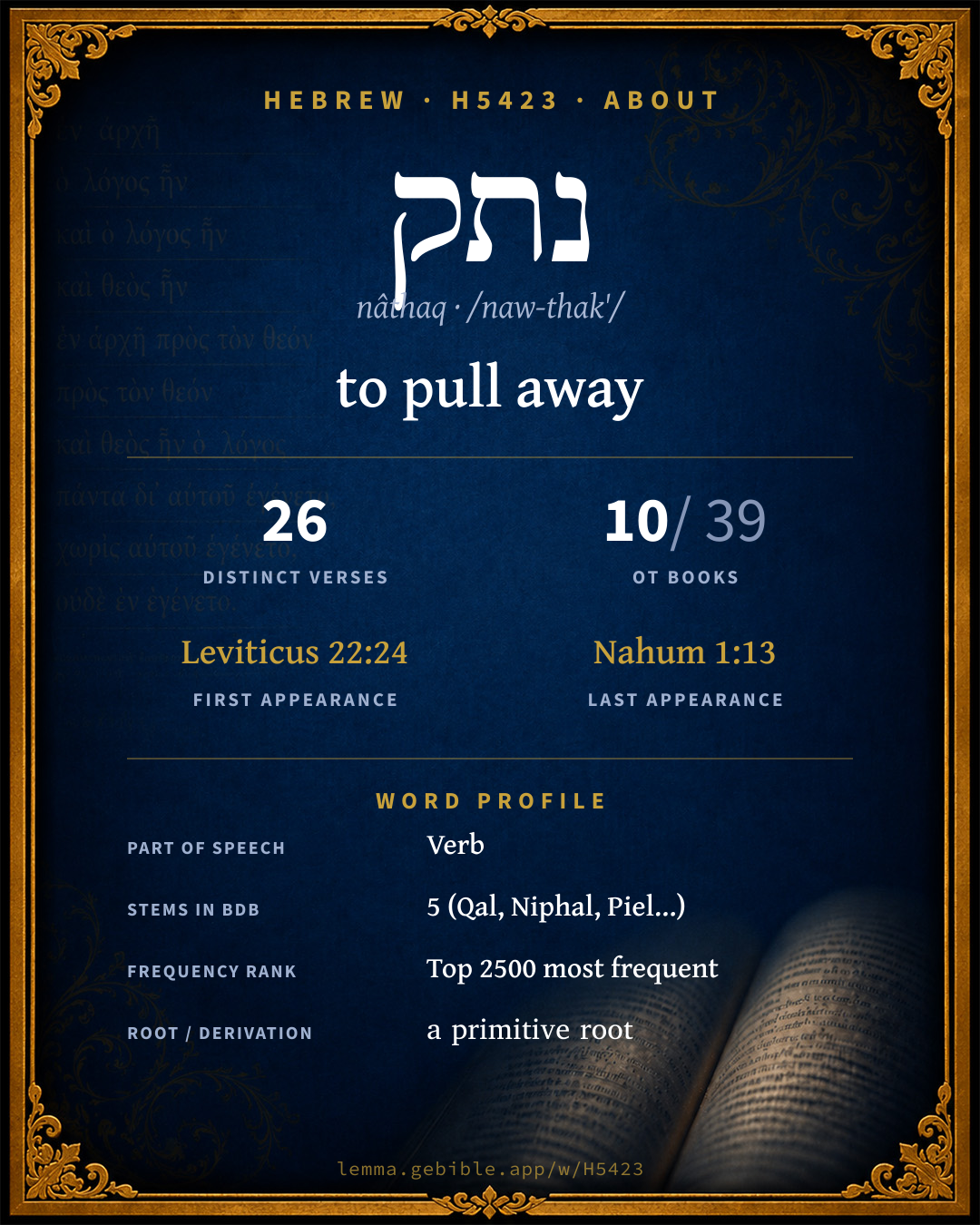
נָתַק
to pull away
‘to pull away’ is one of 2 main senses fuller range ↓
Full lexicon entry — Brown-Driver-Briggs (BDB)
From Brown-Driver-Briggs (BDB)
Where this word appears
See every Piel verb in the Hebrew Bible →
Grammar key — what these labels mean
Part of speech
- Verb
- An action or state-of-being word.
Stem
- Niphal
- Usually the simple passive or reflexive of the Qal (“he was written”). Here: ‘be drawn away from’
- Piel
- An intensive or resultative active stem. Here: ‘tear apart’
- Qal
- The basic, simple active stem — the plain form of the verb (“he wrote”). Here: ‘draw away warriors from’
- Hophal
- The passive counterpart of the Hiphil (“he was caused to…”).
- Hiphil
- The causative active stem (“he caused / brought about”).
Form
- Perfect
- A completed action or state — Hebrew marks aspect (completeness) more than strict tense (“he wrote”).
- Imperfect
- An incomplete, ongoing, or future action (“he will / would write”).
- Sequential Imperfect
- An imperfect with prefixed waw — the standard past-narrative form (waw-consecutive imperfect).
- Sequential Perfect
- A perfect with prefixed waw continuing a preceding imperfect or command (waw-consecutive perfect).
- Participle Passive
- A verbal adjective expressing action received (“written”).
- Infinitive Construct
- A bound verbal noun, frequently with prepositions (“to write / in writing”).
- Imperative
- A direct command (“write!”).
- Cohortative
- A first-person volitional form expressing wish or resolve (“let me / let us write”).
State
- Absolute
- The independent form of a noun, not bound to a following word.
Person
- 3rd Person
- The one spoken about (“he / she / it / they”).
- 1st Person
- The speaker (“I / we”).
- 2nd Person
- The one addressed (“you”).
Gender
- Common
- Either gender — not distinguished for this form.
- Masculine
- Grammatically masculine.
- Feminine
- Grammatically feminine.
Number
- Plural
- More than one (in Hebrew, generally three or more).
- Singular
- One.
Grammatical forms 19 distinct
- Verb, Niphal, Perfect, 3rd Person, Common, Plural 4 times (15%)
- Verb, Niphal, Imperfect, 3rd Person, Masculine, Singular 3 times (11%)
- Verb, Piel, Imperfect, 1st Person, Common, Singular 2 times (7%)
- Verb, Piel, Imperfect, 3rd Person, Masculine, Singular 2 times (7%)
- Verb, Piel, Sequential Imperfect, 3rd Person, Masculine, Singular 2 times (7%)
- Verb, Niphal, Sequential Imperfect, 3rd Person, Masculine, Plural 1 time (4%)
- Verb, Qal, Sequential Perfect, 1st Person, Common, Plural 1 time (4%)
- Verb, Qal, Participle Passive, Masculine, Singular, Absolute 1 time (4%)
+11 more forms (11 occurrences)
Parsed forms decoded from the imported morphology (morphhb / Westminster Leningrad Codex — WLC text public domain, morphhb tagging CC BY 4.0), counted across 27 parsed occurrences — not distinct verses.
Every verse where H5423 appears — 26 distinct verses across 10 books. Click any verse to open its interlinear word-by-word view. Verse text shown in the World English Bible for context — . Each verse’s Hebrew form is shown with its reference; the English is not keyword-highlighted, since the data carries no word-level English alignment. Use “Compare translations” on any verse to read it across multiple English versions. This concordance covers the Hebrew Bible; Septuagint (Greek Old Testament) occurrences are not indexed here.
Leviticus 1 verse
Joshua 3 verses
- Joshua 4:18 נִתְּק֗וּ Niphal pf 3cp It happened, when the priests who bore the ark of the covenant of Yahweh were come up out of the midst of the Jordan, and the soles of the priests' feet were lifted up to the dry ground, that the waters of the Jordan returned to their place, and went over all its banks, as before.
- Joshua 8:6 הַתִּיקֵ֤/נוּ Hiphil inf.cs + sfx pers 1cp and they will come out after us, until we have drawn them away from the city; for they will say, They flee before us, as at the first: so we will flee before them;
- Joshua 8:16 וַ/יִּנָּתְק֖וּ conj + Niphal wimpf 3mp All the people who were in the city were called together to pursue after them: and they pursued after Joshua, and were drawn away from the city.
Judges 4 verses
- Judges 16:9 וַ/יְנַתֵּק֙ יִנָּתֵ֤ק conj + Piel wimpf 3ms Niphal impf 3ms Now she had liers-in-wait abiding in the inner chamber. She said to him, The Philistines are on you, Samson. He broke the cords, as a string of tow is broken when it touches the fire. So his strength was not known.
- Judges 16:12 וַֽ/יְנַתְּקֵ֛/ם conj + Piel wimpf 3ms + sfx pers 3mp So Delilah took new ropes, and bound him therewith, and said to him, The Philistines are on you, Samson. The liers-in-wait were abiding in the inner chamber. He broke them off his arms like a thread.
- Judges 20:31 הָנְתְּק֖וּ Hophal pf 3cp The children of Benjamin went out against the people, and were drawn away from the city; and they began to strike and kill of the people, as at other times, in the highways, of which one goes up to Bethel, and the other to Gibeah, in the field, about thirty men of Israel.
- Judges 20:32 וּֽ/נְתַקְּנֻ֔/הוּ conj + Qal wpf 1cp + sfx pers 3ms The children of Benjamin said, They are struck down before us, as at the first. But the children of Israel said, Let us flee, and draw them away from the city to the highways.
Job 2 verses
Psalms 2 verses
Ecclesiastes 1 verse
Isaiah 3 verses
- Isaiah 5:27 נִתַּ֖ק Niphal pf 3ms None shall be weary nor stumble among them; None shall slumber nor sleep; Neither shall the belt of their loins be untied, Nor the latchet of their shoes be broken:
- Isaiah 33:20 יִנָּתֵֽקוּ Niphal impf 3mp Look on Zion, the city of our solemnities: your eyes shall see Jerusalem a quiet habitation, a tent that shall not be removed, the stakes of it shall never be plucked up, neither shall any of the cords of it be broken.
- Isaiah 58:6 תְּנַתֵּֽקוּ Piel impf 2mp Isn't this the fast that I have chosen: to loose the bonds of wickedness, to undo the bands of the yoke, and to let the oppressed go free, and that you break every yoke?
Jeremiah 7 verses
- Jeremiah 2:20 נִתַּ֨קְתִּי֙ Piel pf 1cs For of old time I have broken your yoke, and burst your bonds; and you said, I will not serve; for on every high hill and under every green tree you did bow yourself, playing the prostitute.
- Jeremiah 5:5 נִתְּק֖וּ Piel pf 3cp I will get me to the great men, and will speak to them; for they know the way of Yahweh, and the law of their God. But these with one accord have broken the yoke, and burst the bonds.
- Jeremiah 6:29 נִתָּֽקוּ Niphal pf 3cp The bellows blow fiercely; the lead is consumed of the fire: in vain do they go on refining; for the wicked are not plucked away.
- Jeremiah 10:20 נִתָּ֑קוּ Niphal pf 3cp My tent is destroyed, and all my cords are broken: my children are gone forth from me, and they are no more: there is none to spread my tent any more, and to set up my curtains.
- Jeremiah 12:3 הַתִּקֵ/ם֙ Hiphil impv 2ms + sfx pers 3mp But you, Yahweh, know me; you see me, and try my heart toward you: pull them out like sheep for the slaughter, and prepare them for the day of slaughter.
- Jeremiah 22:24 אֶתְּקֶֽ/נְךָּ Qal impf 1cs + sfx pers 2ms As I live, says Yahweh, though Coniah the son of Jehoiakim king of Judah were the signet on my right hand, yet would I pluck you there;
- Jeremiah 30:8 אֲנַתֵּ֑ק Piel impf 1cs It shall come to pass in that day, says Yahweh of Hosts, that I will break his yoke from off your neck, and will burst your bonds; and strangers shall no more make him their bondservant;
Ezekiel 2 verses
- Ezekiel 17:9 יְנַתֵּ֜ק Piel impf 3ms Say you, Thus says the Lord Yahweh: Shall it prosper? shall he not pull up the roots of it, and cut off the fruit of it, that it may wither; that all its fresh springing leaves may wither? and not by a strong arm or much people can it be raised from the roots of it.
- Ezekiel 23:34 תְּנַתֵּ֑קִי Piel impf 2fs You shall even drink it and drain it out, and you shall gnaw the broken pieces of it, and shall tear your breasts; for I have spoken it, says the Lord Yahweh.
Nahum 1 verse
About this entry
At a glance — auto-summarized from this page’s data, not written by a person. Every figure links to its source below. This summary describes the numbers; it doesn’t interpret them.
נתק (nâthaq) is a Hebrew verb most often rendered “to pull away.” Across 5 stems, its meaning turns on the binyan (Qal, Niphal). The Hebrew Bible uses it across 26 verses — moderately common. Jeremiah dominates its distribution — 7 of 26 verses. Debuting at Leviticus 22:24, it then recurs through the corpus. The sections below give every sense, occurrence, and version rendering.
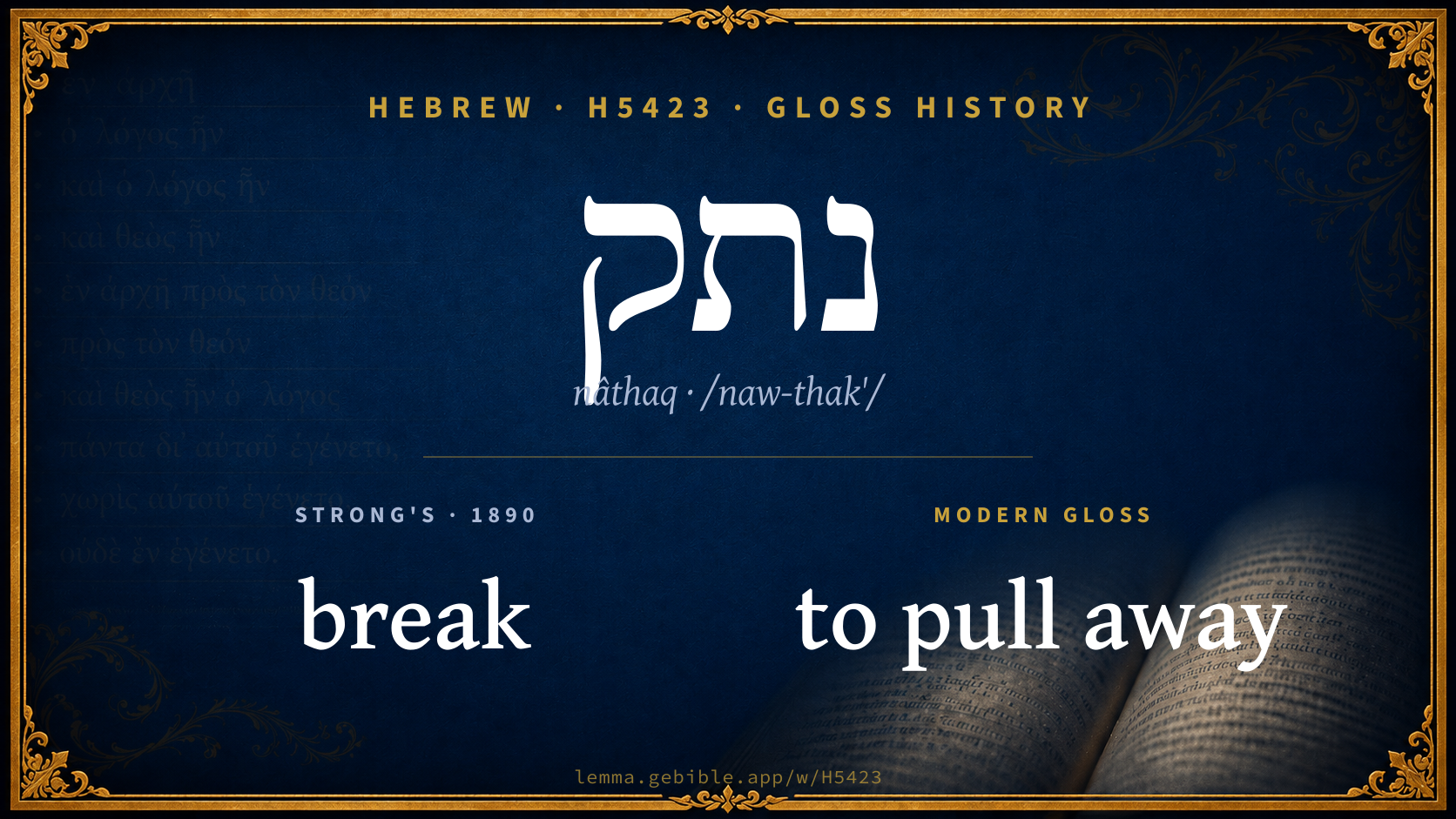
Gloss history
Strong's 1890 vs modern scholarship
About this word
Strong's H5423 catalogs a Hebrew word from the Hebrew Old Testament.
These counts are not copied from any lexicon or concordance. They are computed here, from the morphology-tagged Hebrew Old Testament. What Lemma adds →
- 26
- distinct verses
- The word appears in 26 distinct verses.
- 10 / 39
- OT books
- The word appears in 10 of 39 Old Testament books.
- #1,226
- by frequency
- Top 2500 most frequent Hebrew words (rank 1,226 of 8,640 Hebrew words by occurrence).
View all 26 occurrences in the concordance →
By section of the Old Testament
By traditional corpus
Conventional, traditional groupings — biblical authorship is debated, so this is a traditional corpus grouping, not an authorship claim. Each share is this word’s portion of its verses in that division of the Hebrew canon. Each figure is a share of the word’s 26 distinct verses.
- Prophets (Nevi'im) 20 verses · 77%
- Writings (Ketuvim) 5 verses · 19%
- Torah (Pentateuch) 1 verse · 4%
How translations render this word
Counts come from each version’s own published word-to-Strong’s tagging or interlinear alignment — an approximate guide to how each version renders this word, not a word-level alignment the data otherwise carries. Because each total is that version’s own tagged count, the per-version totals vary from one another and need not match the appearance or distinct-verse counts above. These counts may also differ from a printed concordance because Lemma counts each distinctly tagged rendering and does not collapse phrase taggings into a single head-word total. This is a fixed set of word-tagged versions (KJV, ASV, BSB, ULT) and does not change with the reading translation you choose elsewhere. Each version’s license is shown beside its name below (and on Sources).
- King James Version: Burst 2×, He brake 2×, Sunder 2×
- American Standard Version: Burst 2×, Sunder 2×, Were drawn away 2×
- Berean Standard Bible: He snapped 2×, Tear off 2×, Were drawn away 2×
- unfoldingWord Literal Text: Will 2×
King James Version Public Domain
Renders H5423 across 30 tagged occurrences — most commonly:
Plus 22 renderings that appear only once — usually multi-word phrases or single function words the recovered tagging swept in, not distinct renderings.
American Standard Version Public Domain
Renders H5423 across 30 tagged occurrences — most commonly:
Plus 24 renderings that appear only once — usually multi-word phrases or single function words the recovered tagging swept in, not distinct renderings.
Berean Standard Bible Public Domain
Renders H5423 across 26 tagged occurrences — most commonly:
Plus 20 renderings that appear only once — usually multi-word phrases or single function words the recovered tagging swept in, not distinct renderings. Not rendered by a distinct English word in 1 further occurrence.
unfoldingWord Literal Text CC BY-SA 4.0
Renders H5423 across 30 tagged occurrences — most commonly:
Plus 28 renderings that appear only once — usually multi-word phrases or single function words the recovered tagging swept in, not distinct renderings.
14 senses and sub-senses in the full BDB
Hebrew verbs can shift meaning by stem (binyan): Qal is the basic action, Niphal is often passive or reflexive, Piel often intensifies or makes it factitive, and Hiphil is typically causative. The senses below are grouped under the stem BDB assigns to each. This entry also uses Hophal (the passive of Hiphil).
What do BDB’s symbols mean?
BDB uses these scholarly abbreviations:
| Symbol | Meaning |
|---|---|
| 𝔊 | the Septuagint (the ancient Greek translation, LXX) |
| 𝔙 | the Vulgate (the Latin translation) |
| 𝔖 | the Syriac version (the Peshitta) |
| 𝔗 | the Targum (the Aramaic translation) |
| ψ | the Psalms |
| √ | root (the underlying root or stem) |
| ‖ | parallel passage (a synonymous or contrasted parallel) |
| † | the dagger: every passage where the word occurs is cited |
The 14 senses and sub-senses the full Brown-Driver-Briggs lexicon distinguishes for this word, in lexicon order (not ranked by frequency), with BDB’s own verbatim wording and sub-sense lettering. Shown in Hebrew script with BDB’s own scholarly abbreviations. The condensed entry is in the Lexicon Entry tab. See also the Forms in the corpus table below.
Qal
- Pf. 1 pl. sf. וּנְתַקְּנוּהוּ consec. Ju 20:32 (on d. f. dirim. v. Ges§ 20 h); Impf. 1 s. sf. אֶתְּקֶנְךָּ Je 22:24 (cf. Ges§ 58, i); Pt. pass. נָתוּק Lv 22:24;— e.g. Judges 20:32
- 1. draw away warriors from (כִון) city, unto (אֶל־) high road Ju 20:32. e.g. Judges 20:32
- 2. draw or pull off ring from (מִן) finger Je 22:24 (fig. of rejection of king of Judah by י׳). e.g. Jeremiah 22:24
- 3. pull, tear away Lv 22:24 (pass., of testicles, + מָעוּךְ, כָּתוּת, כָּרוּת). e.g. Leviticus 22:24
Niphal
- Pf. 3 ms. נִתַּק Is 5:27; 3 pl. נִתְּקוּ Jos 4:18; Jb 17:11, נִתָּ֑קוּ Je 6:29; 10:20; Impf. 3 ms. יִנָּתֵק Ju 16:9 + 2 times; 3 mpl. וַיִּנָּֽתְקוּ Jos 8:16, יִנָּתֵ֑קוּ Is 33:20;— e.g. Isaiah 5:27
- 1. be drawn away from (מִן) city Jos 8:16 (cf. Qal 1); of soles of feet, be drawn out (from water) unto (אֶל־) dry ground 4:18. e.g. Joshua 8:16
- 2. be torn apart, or in two, snapped: of sandal-thong Is 5:27, strand of tow Ju 16:9 (sim.), cord Ec 4:12; especially tent-cord (in fig.) Is 33:20 Je 10:20, so יִנָּתֵק מֵאָהֳלוֹ מִבְטַחוֹ Jb 18:14; metaph. of plans (זִמֹּת) 17:11. e.g. Isaiah 5:27
- 3. be separated, in smelting, fig., רָעִים לֹא נִתָּ֑קוּ Je 6:29. e.g. Jeremiah 6:29
Piel
- Pf. 1 s. נִתַּקְתִּי Je 2:20; 3 pl. נִתְּקוּ 5:5; Impf. 3 ms. יְנַתֵּק Ez 17:9 ψ 107:14, וַיְנַתֵּק Ju 16:9, sf. וַיְנַתְּקֵם v 12; 2 fs. תְּנַתֵּ֑קִי Ez 23:34; 1 s. אֲנַתֵּק Na 1:13; 1 pl. נְנַתְּקָה cohort. ψ 2:3; 2 mpl. תְּנַתֵּ֑קוּ Is 58:6;— e.g. Jeremiah 2:20
- 1. tear apart, snap, c. acc. הַיְתָרִים Ju 16:9 the cords, v 12 (+ מֵעַל זְרֹעֹתָיו); especially c. acc. מוֹסֵרוֹת, bonds (fig.) Na 1:13; Je 2:20; 5:5; 30:8 ψ 2:3; 107:14; obj. מוֹטָה Is 58:6 (‖ פַּתֵּחַ, and הַתֵּר אֲגֻדּוֹת מוֹטָה). e.g. Judges 16:9
- 2. tear out, up, obj. roots Ez 17:9 (in fig.); tear out, away, obj. breasts 23:34 (in violent fig. of Jerus. as drunken woman). e.g. Ezekiel 17:9
Hiphil
- 1. Inf. cstr. sf. הַתִּיקֵנוּ: draw away warriors from (מִוֹ city Jos 8:6 (= Qal 1). e.g. Joshua 8:6
- 2. Imv. ms. sf. הַתִּקֵם drag them away like sheep to slaughter Je 12:3 (of י׳’s dealing with wicked). e.g. Jeremiah 12:3
Hophal
- Pf. (si vera l.) הָנְתְּקוּ מִן־הָעִיר Ju 20:31 they were drawn away from the city (cf. Niph. 1), but prob. gloss, v. GFM. e.g. Judges 20:31
Senses from the full Brown-Driver-Briggs lexicon (Brown, Driver, Briggs; Oxford 1906 — public domain), digitized via Sefaria, supplemented by the OpenScriptures HebrewLexicon (CC BY 4.0). Full attribution on Sources.
Word origin
vb. pull, draw, tear away, apart, off (NH id.; 𝔗 נְתַק in der. species (rare), pull off, tear off; Chr Pal. Aramaic ܢܬܩ shake off, SchwallyIdiot. 58; Arabic نَتَقَ pull off, draw out, shake; Di 660 cp. Ethiopic ነተገ, ነትገ detrahere, etc.);—
— Brown-Driver-Briggs (Oxford 1906, public domain), digitized via Sefaria, supplemented by the OpenScriptures HebrewLexicon (CC BY 4.0). See Sources.
Origin: a primitive root
Jastrow Dictionary
A second Hebrew/Aramaic lexicon for comparison, covering Aramaic and post-biblical (Talmudic, Targumic, Midrashic) usage that the biblical-Hebrew BDB does not. Matched by lemma rather than by Strong’s number, so a lemma may carry more than one Jastrow headword (shown separately below), and the entries cover usage well beyond the Bible.
נָתַק
- cmp. preced. a.
- 1. to break loose; tear out. Y. Shebi. IV, 35ᵇ bot. מקום שנהגו לקוץ יִתּוֹק לִתּוֹק וכ׳ where it is customary to cut the reeds, let him pluck them; where it is customary to pluck them &c.; Tosef. ib. III, 19 Var. יִתּוֹךְ לִתּוֹךְ. Cant. R. to VIII, 6 (ref. to Jer. XXII, 24) שהוא נוֹתֵק מלכות וכ׳ that he will tear the Davidic kingdom out of his hand; ib. משם אני נותק וכ׳ from there I shall tear loose the kingdom &c.; Pesik. Shub., p. 163ᵃ. Bekh. 33ᵇ נותק he who tears loose (testicles and throws them away); נותק אחר כורת who removes them after one has cut them (tearing off the roots). Sifra Thazr., Neg., ch. VII, Par. 5 אם נְתָקוֹ אדם if a man made it bald (נֶתֶק); (R. S. to Neg. III, 5 אם נִיתְּקוּ בידי אדם, Nif.); a. e.—Part. pass. נָתוּק (b. h.) an animal whose testicles have been forcibly removed; [oth. opin.: whose membrum has been mutilated by a violent severance]. Sifra Emor, Par. 7, ch. VII; Tosef. Yeb. X, 5. e.g. Jeremiah 22:24
- 2. to cause oozing, to secrete. Tosef. Ter. III, 13 ענבים רכות ונוֹתְקוֹת … ואינן נוֹתְקִין וכ׳ grapes are soft and let their juice ooze out (when packed), but olives are hard and do not let their oil ooze out.; Y. ib. III, 42ᵇ top, v. דֵּיהֶא.
- 1. to tear loose. Cant. R. l. c. (ref. to Jer. l. c.) אֲנַתֶּקְךָ אין … אֲתַקֶּנְךָ it does not sayănatteḳkha (I shall tear thee loose), but (it may be read) athaḳḳenkha (I shall restore thee, v. תָּקַן); Yalk. Jer. 303 אַתֶּקְךָ (Hif.); Pesik. l. c.
- 2. [to tear, pull] to remonstrate, protest. Sifré Num. 115; Yalk. Num. 750 התחיל הבן ההוא מְנַתֵּק that son began to protest (against doing slave’s work); התחילו ישראל מְנַתְּקִים the Israelites remonstrated (against the laws imposed upon them); v. infra.
- 1. to be torn loose; to fall out. Ḥull. 123ᵇ שומר העשוי לִנָּתֵק מאליו a protection (cover) which it likely to come off of itself. Nidd. 65ᵃ כיון שנִתְּקוּ שניו וכ׳ when a man’s teeth are gone; a. e.
- 2. [to tear one’s self loose,] to remonstrate, be discontented. Sifra Aḥăré, Par. 9, ch. XIII גלוי … לִינָּתֵק בעריות it was known before the Lord that they would bear unwillingly the restrictive laws concerning sexual relations; נִיתְּקוּ בעריות they did remonstrate &c. (ref. to Num. XI, 10; v. Sabb. 130ᵃ; Yoma 75ᵃ); Yalk. Lev. 590. e.g. Numbers 11:10
- 3. to be shifted, transformed, modified. Zeb. 5ᵇ, a. fr. אשם שנ׳ לרעיה an animal dedicated as a guilt-offering which (on account of its owner’s death &c.) has been condemned to pasture until natural death (v. סָאַב).—Y. Naz. IV, end, 53ᶜ משנ׳ מלא תעשה לעשה since it (the cutting of the hair which is forbidden to the Nazarite) has gone over from a prohibition to a positive duty (Num. VI, 18).—לאו שנ׳ לעשה a prohibition transformed into a command, i.e. a prohibitive law the transgression of which must be repaired by a succeeding act, e.g. (Lev. XIX, 13) ‘thou shalt not rob’, and (ib. V, 23) ‘he shall make restitution.’ Ḥull. 141ᵃ (for which ib. XII, 4 מצות לא תעשה שיש בה קום עשה). Yoma 85ᵇ לא תעשה שנ׳ לעשה; a. fr. e.g. Numbers 6:18
- 4. (v. Kal 2) to enter a stage of moist decomposition. Y. Naz. VII, 56ᵇ, v. נֵצֶל.—5) (denom. of נֶתֶק) to become hairless and blanched, to be afflicted with נֶתֶק. Neg. X, 9 ונ׳ כל ראשו and his entire head became bald (v. קָרַחַת). Sifra Thazr. l. c. את שני׳ נתק בתוך נתק a person that became afflicted with a bald spot within a patch of hair surrounded by baldness (Neg. X, 7 שני נְתָקִין זה לפנים מזה; a. fr.).
נְתַק
- ; Af. אַתֵּיק to pull, drag. Targ. Jer. XII, 3 אַתִּיקִינוֹן or אַתְּקִינוֹן (ed. אַתְקְנִ׳, ed. Lag. אַתְקִינִי׳, v. תְּקַן; h. text התיקם).
- 1. to tear, sever. B. Kam. 9ᵇ שור דרכיה לנַתּוּקֵי an ox may be expected to tear (the rope). Bets. 10ᵇ מְנַתְּקֵּי Ms. M., v. נְתַח.
- 2. to snatch, take away. Yoma 46ᵇ כיון דנַתְּקָהּ נתקה having snatched it (the coal from the altar), he has snatched it (and it has its sacred character no longer).
- 3. to shift, transform. Macc. 15ᵃ ההוא לנַתּוּקֵי לאוי וכ׳ Ms. M. (Rashi לאויה, ed. לאו) this (positive command) has the function of modifying the prohibitory law (intimating the reparation in the event of its transgression); v. preced. Nif
- 1. to be severed, snatched. Targ. Koh. IV, 12.—Yoma l. c. אינְּתִיקָה למצותה the taking it from the altar was done for an ordained use of it; a. e.
- 2. to be set aside, be designated. Erub. 13ᵃ כיון דא׳ לשום רחל תו לא הדרא מִינַּתְּקָא וכ׳ having been originally designated (copied) for Rachel, it cannot again be converted and used for Leah; Sot. 20ᵇ. Zeb. 3ᵃ; a. e.
נֶתֶק
- preced.) [torn out,] bald (blanched) spot on the head or in the beard. Neg. X, 2; a. fr. Pl. נְתָקִים, נְתָקִין. Ib. 1; 7; a. fr.
A Dictionary of the Targumim, the Talmud Babli and Yerushalmi, and the Midrashic Literature (Marcus Jastrow; London, Luzac, 1903) — Public Domain. Digitized via Sefaria. Digitized via Sefaria. Full attribution on Sources.
Forms in the corpus
The 27 distinct written forms H5423 takes in the Hebrew Bible, most frequent first — each parse links to that stem’s occurrences in the concordance. Hebrew forms include their vowel points and cantillation, so a single lemma takes many written forms.
Same root — word family
Other BDB entries built from the same root as H5423, grouped by Strong’s listed origin. These share a root / origin per the lexicon — not necessarily a shared meaning. Each links to that word’s own entry.
Derived from this word
Compare all same-root words → They share a root, not necessarily a meaning.
Septuagint verse parallels
This word appears in 26 verses that also exist in the Greek Old Testament (Septuagint), out of the 26 Hebrew verses it occurs in. You can read those verses in Greek by switching the Old Testament edition to the Septuagint.
Read these verses in the Septuagint
- Leviticus 22:24
- Joshua 4:18
- Judges 16:9
- Job 17:11
- Psalms 2:3
- Ecclesiastes 4:12
- Isaiah 5:27
- Jeremiah 2:20
- Ezekiel 17:9
- Nahum 1:13
This is a verse-level parallel only — the same verses exist in both the Hebrew and Greek Old Testaments. No word-level Hebrew↔Greek correspondence is claimed: the data carries no such alignment, so no Greek word is shown as this Hebrew word’s translation. Coverage is not total — the Septuagint omits the deuterocanon and renumbers the Psalms, so some Hebrew verses have no direct Greek parallel.