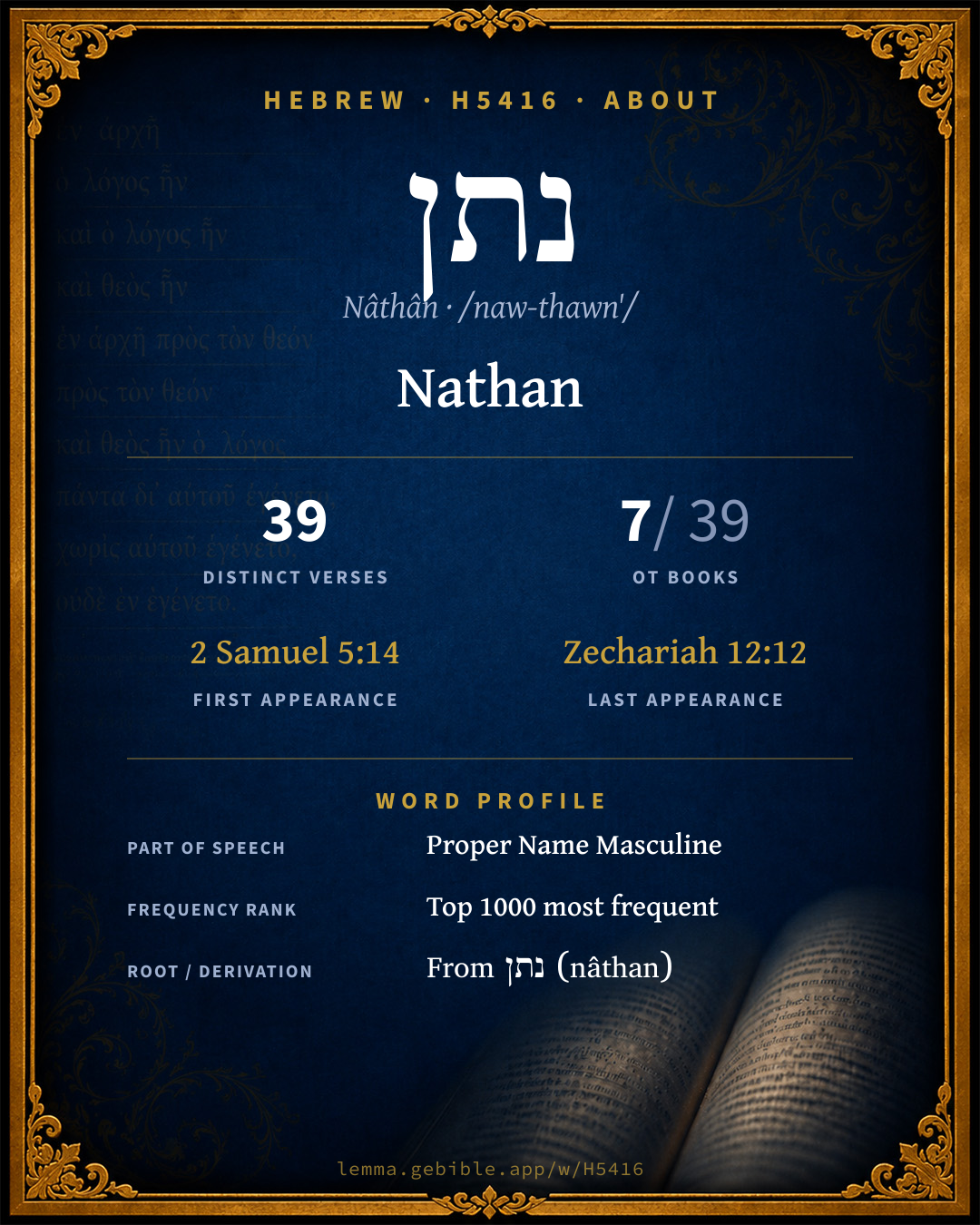
נָתָן
Nathan
BDB lists 10 entries for ‘Nathan’ fuller range ↓
Full lexicon entry — Brown-Driver-Briggs (BDB)
From Brown-Driver-Briggs (BDB)
Where this word appears
Grammar key — what these labels mean
Part of speech
- Noun
- A naming word — a person, place, thing, or idea.
Noun type
- Proper
- A name of a specific person, place, or people (e.g. Abraham, Zion, Israel).
Every verse where H5416 appears in the Book of Psalms — 1 distinct verse. Click any verse to open its interlinear word-by-word view. Verse text shown in the World English Bible for context — . Each verse’s Hebrew form is shown with its reference; the English is not keyword-highlighted, since the data carries no word-level English alignment. Use “Compare translations” on any verse to read it across multiple English versions. This concordance covers the Hebrew Bible; Septuagint (Greek Old Testament) occurrences are not indexed here.
Psalms
About this entry
At a glance — auto-summarized from this page’s data, not written by a person. Every figure links to its source below. This summary describes the numbers; it doesn’t interpret them.
“Nathan” is the headline sense of the Hebrew name נתן (Nâthân). First canonically at 2 Samuel 5:14, it enters the text early. With 39 verses in 7 books, it is a moderately common word in the Hebrew Bible. It concentrates in 2 Samuel, which alone accounts for 31% of its uses. The sections below give every occurrence and version rendering.
Gloss history
Strong's 1890 vs modern scholarship
About this word
Strong's H5416 catalogs a Hebrew word from the Hebrew Old Testament.
These counts are not copied from any lexicon or concordance. They are computed here, from the morphology-tagged Hebrew Old Testament. What Lemma adds →
- 39
- distinct verses
- The word appears in 39 distinct verses.
- 7 / 39
- OT books
- The word appears in 7 of 39 Old Testament books.
- #864
- by frequency
- Top 1000 most frequent Hebrew words (rank 864 of 8,640 Hebrew words by occurrence).
View all 39 occurrences in the concordance →
Most concentrated in
- 2 Samuel 12 verses 31%
- 1 Kings 12 verses 31%
- 1 Chronicles 9 verses 23%
By section of the Old Testament
By traditional corpus
Conventional, traditional groupings — biblical authorship is debated, so this is a traditional corpus grouping, not an authorship claim. Each share is this word’s portion of its verses in that division of the Hebrew canon. Each figure is a share of the word’s 39 distinct verses.
- Prophets (Nevi'im) 25 verses · 64%
- Writings (Ketuvim) 14 verses · 36%
How translations render this word
Counts come from each version’s own published word-to-Strong’s tagging or interlinear alignment — an approximate guide to how each version renders this word, not a word-level alignment the data otherwise carries. Because each total is that version’s own tagged count, the per-version totals vary from one another and need not match the appearance or distinct-verse counts above. These counts may also differ from a printed concordance because Lemma counts each distinctly tagged rendering and does not collapse phrase taggings into a single head-word total. This is a fixed set of word-tagged versions (KJV, ASV, BSB, ULT) and does not change with the reading translation you choose elsewhere. Each version’s license is shown beside its name below (and on Sources).
- King James Version: Nathan 36×, Did nathan 2×
- American Standard Version: Nathan 36×, Did nathan 2×
- Berean Standard Bible: Nathan 41×
- unfoldingWord Literal Text: Nathan 41×
King James Version Public Domain
Renders H5416 across 42 tagged occurrences — most commonly:
Plus 4 renderings that appear only once — usually multi-word phrases or single function words the recovered tagging swept in, not distinct renderings.
American Standard Version Public Domain
Renders H5416 across 41 tagged occurrences — most commonly:
Plus 3 renderings that appear only once — usually multi-word phrases or single function words the recovered tagging swept in, not distinct renderings.
Berean Standard Bible Public Domain
Renders H5416 across 42 tagged occurrences — most commonly:
Plus 1 rendering that appears only once — usually multi-word phrases or single function words the recovered tagging swept in, not distinct renderings.
unfoldingWord Literal Text CC BY-SA 4.0
Renders H5416 across 41 tagged occurrences — most commonly:
10 senses and sub-senses in the full BDB
What do BDB’s symbols mean?
BDB uses these scholarly abbreviations:
| Symbol | Meaning |
|---|---|
| 𝔊 | the Septuagint (the ancient Greek translation, LXX) |
| 𝔙 | the Vulgate (the Latin translation) |
| 𝔖 | the Syriac version (the Peshitta) |
| 𝔗 | the Targum (the Aramaic translation) |
| ψ | the Psalms |
| √ | root (the underlying root or stem) |
| ‖ | parallel passage (a synonymous or contrasted parallel) |
| † | the dagger: every passage where the word occurs is cited |
The 10 senses and sub-senses the full Brown-Driver-Briggs lexicon distinguishes for this word, in lexicon order (not ranked by frequency), with BDB’s own verbatim wording and sub-sense lettering. Shown in Hebrew script with BDB’s own scholarly abbreviations. The condensed entry is in the Lexicon Entry tab. See also the Forms in the corpus table below.
- 1. a son of David 2 S 5:14 = 1 Ch 3:15, 1 Ch 14:4. e.g. 2 Samuel 5:14
- 2. the prophet of David’s time 2 S 7:2, 3, 4, 17 = 1 Ch 17:1, 2, 3, 15; 2 S 12:1 + 6 times 2 S 12; 1 K 1:8 + 10 times 1 K 1, 2 Ch 29:25 ψ 51:2 (title); דִּבְרֵי נָתָן הַנָּבִיא as name of a book 1 Ch 29:29 2 Ch 9:29. e.g. 2 Samuel 7:2
- 3. father of one of David’s heroes 2 S 23:36. e.g. 2 Samuel 23:36
- 4. father of officers of Solomon, 1 K 4:5(×2) (= 2?). e.g. 1 Kings 4:5
- 5. name in Judah:
- a. 1 Ch 2:36(×2). e.g. 1 Chronicles 2:36
- b. 11:38. e.g. 1 Chronicles 11:38
- 6. companion of Ezra from Babylon Ezr 8:16. e.g. Ezra 8:16
- 7. one of those who took strange wives 10:39. e.g. Ezra 10:39
- 8. head of a family Zc 12:12. e.g. Zechariah 12:12
Senses from the full Brown-Driver-Briggs lexicon (Brown, Driver, Briggs; Oxford 1906 — public domain), digitized via Sefaria, supplemented by the OpenScriptures HebrewLexicon (CC BY 4.0). Full attribution on Sources.
Word origin
Derived from נתן (nâthan) (H5414) — to give.
Jastrow Dictionary
A second Hebrew/Aramaic lexicon for comparison, covering Aramaic and post-biblical (Talmudic, Targumic, Midrashic) usage that the biblical-Hebrew BDB does not. Matched by lemma rather than by Strong’s number, so a lemma may carry more than one Jastrow headword (shown separately below), and the entries cover usage well beyond the Bible.
נָתָן
- (b. h.) pr. n. m. Nathan,
- 1. the prophet. Koh. R. to IV, 12. Midr. Till. to Ps. LI; a. fr.—2) N. the Babylonian, a Tannai. Ber. IX, 5. Tosef. Yeb. VIII, 4. B. Bath. 73ᵃ; a. fr.—3) name of several Amoraim. Y. Erub. VI, 23ᶜ bot., v. דְּרוֹמָאָה; a. e.—Y. M. Kat. III, 82ᵃ נ׳ בר אבא.—Y. Ter. VII, 44ᶜ נ׳ בר הושעיה.—Y. Ber. IV, 7ᵇ נ׳ בר טובי; a. fr.—4) N. d’Tsutsitha, a penitent. Sabb. 56ᵇ.—אבות דר׳ נ׳, v. אָב II.
נָתַן
- (b. h.) to give; to place, put. Gitt. I, 6 תֵּן גט וכ׳ give this letter of divorce to my wife. Ib. תְּנוּ גט וכ׳ give ye &c. Ib. לא יִתְּנוּ לאחר מיתה they must not deliver it after the man’s death; a. v. fr.—נשא ונ׳, v. נָשָׂא.—נ׳ עיניו ל (to put an eye upon) to intend. B. Mets. 19ᵃ, a. e. כיון שנ׳ ע׳ לגרשה as soon as he has resolved to divorce her; a. fr.—נ׳ עיניו ב (to have an eye on) to desire, think of. Ned. XI, 12 שלא תהא אשה נוֹתֶנֶת עיניה באחר lest the woman have a liking for another man. Ib. 20ᵇ שלא אֶתֵּן עיני וכ׳ lest I think of another woman. Ib. אל ישתה … ויִתֵּן וכ׳ one must not drink of one cup (have connection with one woman) and think of another; a. fr.—Esp. נ׳ עיניו בו to cast an angry eye at, to hurt by an angry look. Ber. 58ᵃ נ׳ ע׳ בו ונעשה וכ׳ he cast an eye at him and he was changed into &c., v. גַּל; Sabb. 34ᵃ; a. e.—Y. Ber. III, beg. 5ᵈ, a. fr. נוֹתן תפלין puts on T’fillin.—נ׳ טעם, v. טַעַם.—הדין נותן the conclusion ad majus gives it, it is a legitimate conclusion. Bekh. 59ᵇ, a. fr. Ib. היא הנוֹתֶנֶת (on the contrary,) it is thus we should argue.—Gen. R. s. 33 והדין נותן and it stands to reason.—Esp. נ׳ (sub. דם) to put blood on the altar, sprinkle, smear. Zeb. VIII, 4; a. fr.—[Tosef. Neg. VI, 10 נותן, v. נָתַץ.]
- to be given, put &c.; to be intended. Ned. 38ᵃ לא נִיתְּנָה תורה אלא וכ׳ the Law was given only to Moses and his descendants. Ib. וכולן נִתְּנוּ וכ׳ and all those (gates of understanding) were granted to Moses; a. fr.—Keth. 81ᵃ לא ניתנה כתובה וכ׳ the K’thubah is not intended to be collected during life-time. R. Hash. 28ᵃ מצות … נִיתְּנוּ, v. הָנָה; a. fr.—[Tosef. Ab. Zar. V (VI), 8 עד שינתן, v. נָתַץ.]—Esp. to be put on the altar, sprinkled, smeared. Zeb. VIII, 9 הנִתָּנִין למטה … בנתנין למעלה blood which must be put below (the red line) which has been mixed with blood that must be put above. Ib. 10 יִנָּתְנוּ במתן וכ׳ shall be applied four times, v. מַתָּן a. מַתָּנָה; a. fr.
- to be put. Makhsh. I, 1 בכי יוּתַּן (הרי זה) it comes under the law (Lev. XI, 38), i.e. it is a liquid which, if put on eatables, makes them susceptible of uncleanness. Ib. 2 אינן בכי יותן do not qualify for uncleanness; a. fr. e.g. Leviticus 11:38
נְתַן
- Targ. Deut. XV, 10; a. fr.—[Targ. Is. LIII, 5 ובדנתינה some ed., read: ובדניתנהי, v. נְהֵי I.].
A Dictionary of the Targumim, the Talmud Babli and Yerushalmi, and the Midrashic Literature (Marcus Jastrow; London, Luzac, 1903) — Public Domain. Digitized via Sefaria. Digitized via Sefaria. Full attribution on Sources.
Forms in the corpus
The 18 distinct written forms H5416 takes in the Hebrew Bible, most frequent first — each parse links to that state’s occurrences in the concordance. Hebrew forms include their vowel points and cantillation, so a single lemma takes many written forms.
| Form | Parsing | Example | Uses |
|---|---|---|---|
| נָתָ֖ן | Noun, Proper | 1 Chronicles 14:4 | 8 |
| נָתָ֣ן | Noun, Proper | 1 Chronicles 17:1 | 8 |
| נָתָ֔ן | Noun, Proper | 1 Chronicles 2:36 | 4 |
| נָתָן֙ | Noun, Proper | 1 Chronicles 17:2 | 4 |
| וְ/נָתָ֖ן | Noun, Proper | Ezra 10:39 | 3 |
| וְ/נָתָ֤ן | Noun, Proper | 1 Chronicles 3:5 | 2 |
| נָתָ֛ן | Noun, Proper | 1 Kings 4:5 | 2 |
| וְ/נָתָ֣ן | Noun, Proper | 2 Chronicles 29:25 | 1 |
| וְ/נָתָ֥ן | Noun, Proper | 1 Kings 1:22 | 1 |
| וְ/נָתָ֧ן | Noun, Proper | 1 Kings 1:34 | 1 |
| וְ/נָתָ֨ן | Noun, Proper | 1 Kings 1:38 | 1 |
| וְ/נָתָן֩ | Noun, Proper | 1 Kings 1:45 | 1 |
| וּ/לְ/נָתָ֛ן | Noun, Proper | Ezra 8:16 | 1 |
| וּ/לְ/נָתָ֣ן | Noun, Proper | 1 Kings 1:32 | 1 |
| נָתָ֗ן | Noun, Proper | 1 Kings 1:11 | 1 |
| נָתָ֜ן | Noun, Proper | 2 Samuel 12:13 | 1 |
| נָתָן֒ | Noun, Proper | 1 Kings 1:24 | 1 |
| נָתָן֩ | Noun, Proper | 1 Kings 1:10 | 1 |
Same root — word family
Other BDB entries built from the same root as H5416, grouped by Strong’s listed origin. These share a root / origin per the lexicon — not necessarily a shared meaning. Each links to that word’s own entry.
Derives from
Shares the same root
Proper names from this root
People and places named from this root — a name, not an additional meaning of the word.
- נתנאל Nᵉthanʼêl H5417 Nethaneel
- נתניה Nᵉthanyâh H5418 Nethaniah
- נתןמלך Nᵉthan-Melek H5419 Nathan-melech
- Ναθαν Nathán G3481 Nathan
Compare all same-root words → Showing 4 of 9 — not the complete family. 4 of the same-root words are proper names (people or places). They share a root, not necessarily a meaning.
Bible dictionary
Public-domain dictionary articles matched to this entry by name (Nathan). A biblical name can be shared by more than one person or place, so an article may treat several.
Easton's Bible Dictionary · M. G. Easton, 1897
Given. (1.) A prophet in the reigns of David and Solomon (2 Chr. 9:29). He is first spoken of in connection with the arrangements David made for the building of the temple (2 Sam. 7:2, 3, 17), and next appears as the reprover of David on account of his sin with Bathsheba (12:1-14). He was charged with the education of Solomon (12:25), at whose inauguration to the throne he took a prominent part (1 Kings 1:8, 10, 11, 22-45). His two sons, Zabad (1 Chr. 2:36) and Azariah (1 Kings 4:5) occupied places of honour at the king's court. He last appears in assisting David in reorganizing the public worship (2 Chr. 29:25). He seems to have written a life of David, and also a life of Solomon (1 Chr. 29:29; 2 Chr. 9:29).
(2.) A son of David, by Bathsheba (2 Sam. 5:14), whose name appears in the genealogy of Mary, the mother of our Lord (Luke 3:31).
(3.) Ezra 8:16.
Smith's Bible Dictionary · William Smith, 1863
(a giver).
+ An eminent Hebrew prophet in the reigns of David and Solomon. (B.C. 1015.) He first appears in the consultation with David about the building of the temple. (2 Samuel 7:2,3,17) He next comes forward as the reprover of David for the sin with Bathsheba; and his famous apologue on the rich man and the ewe lamb, which is the only direct example of his prophetic power, shows it to have been of a very high order. (2 Samuel 12:1-12) + A son of David; one of the four who were borne to him by Bathsheba. (1 Chronicles 3:5) comp, 1Chr 14:4 and 2Sam 5:14 + Son or brother of one of the members of David's guard. (2 Samuel 23:36; 1 Chronicles 11:38) + One of the head men who returned from Babylon with Ezra on his second expedition. (Ezra 8:16) 1 Esdr. 8:44. It is not impossible that he may be the same with the "son of Bani." (Ezra 10:39)
Hitchcock's Bible Names Dictionary · Roswell D. Hitchcock, 1869
given; giving; rewarded
Classic public-domain reference works; full attribution on Sources.
Septuagint verse parallels
This word appears in 39 verses that also exist in the Greek Old Testament (Septuagint), out of the 39 Hebrew verses it occurs in. You can read those verses in Greek by switching the Old Testament edition to the Septuagint.
Read these verses in the Septuagint
This is a verse-level parallel only — the same verses exist in both the Hebrew and Greek Old Testaments. No word-level Hebrew↔Greek correspondence is claimed: the data carries no such alignment, so no Greek word is shown as this Hebrew word’s translation. Coverage is not total — the Septuagint omits the deuterocanon and renumbers the Psalms, so some Hebrew verses have no direct Greek parallel.