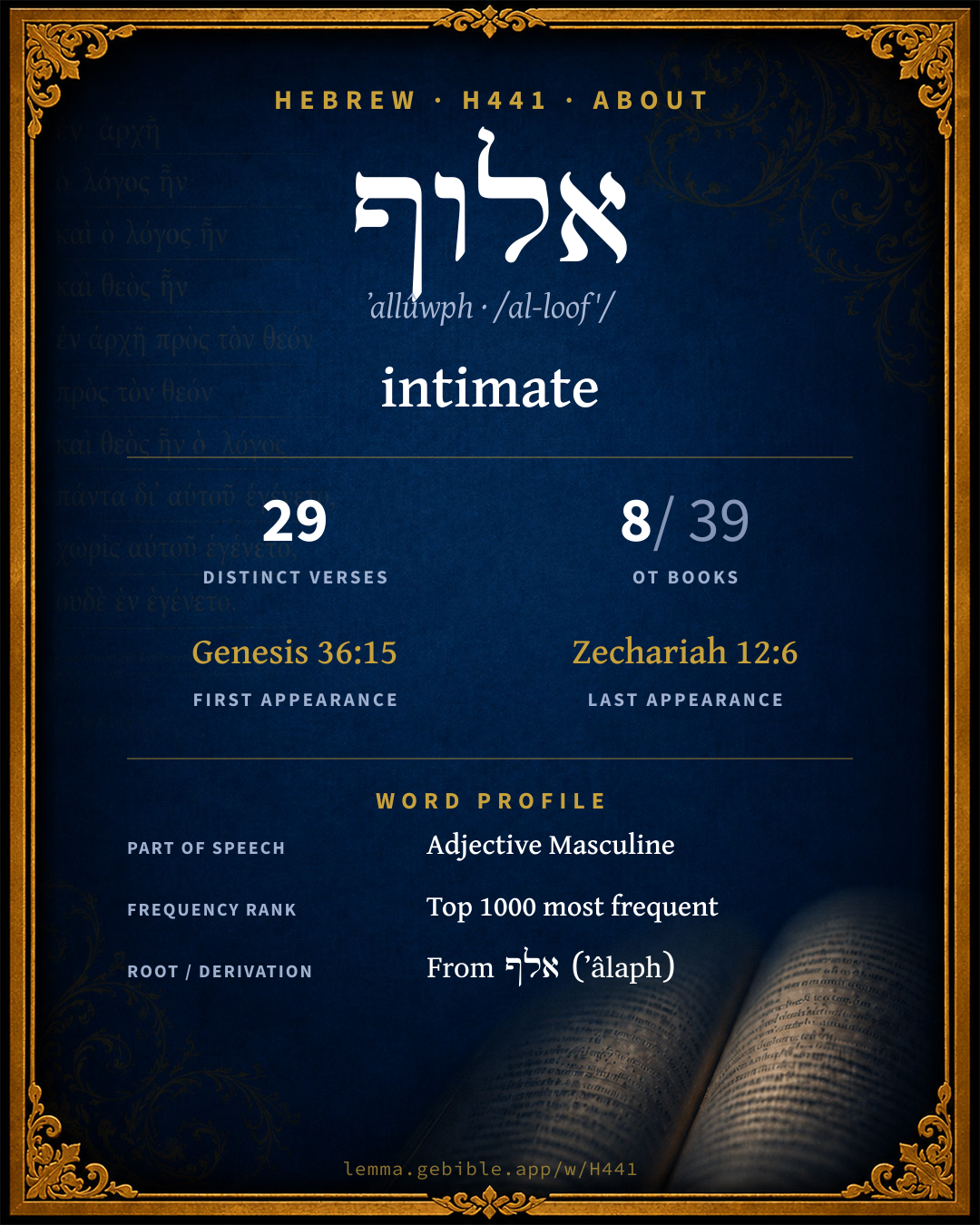
אַלּוּף
intimate
‘intimate’ is one of 3 main senses fuller range ↓
Full lexicon entry — Brown-Driver-Briggs (BDB)
From Brown-Driver-Briggs (BDB)
Where this word appears
See every Absolute-state word in the Hebrew Bible →
Grammar key — what these labels mean
Part of speech
- Noun
- A naming word — a person, place, thing, or idea.
- Adjective
- A word that describes or qualifies a noun.
Noun type
- Common
- A common noun — a general class of person, place, or thing (“king,” “city,” “water”), not a specific name.
State
- Absolute
- The independent form of a noun, not bound to a following word.
- Construct
- A noun bound to a following noun in a possessive / “of” relationship (the construct chain).
Gender
- Masculine
- Grammatically masculine.
Number
- Singular
- One.
- Plural
- More than one (in Hebrew, generally three or more).
Grammatical forms
- Noun, Common, Masculine, Singular, Absolute 44 times (64%)
- Noun, Common, Masculine, Plural, Construct 17 times (25%)
- Adjective, Adjective, Masculine, Singular, Absolute 4 times (6%)
- Noun, Common, Masculine, Singular, Construct 2 times (3%)
- Adjective, Adjective, Masculine, Singular, Construct 1 time (1%)
- Noun, Common, Masculine, Plural, Absolute 1 time (1%)
Parsed forms decoded from the imported morphology (morphhb / Westminster Leningrad Codex — WLC text public domain, morphhb tagging CC BY 4.0), counted across 69 parsed occurrences — not distinct verses.
Every verse where H441 appears — 29 distinct verses across 8 books. Click any verse to open its interlinear word-by-word view. Verse text shown in the World English Bible for context — . Each verse’s Hebrew form is shown with its reference; the English is not keyword-highlighted, since the data carries no word-level English alignment. Use “Compare translations” on any verse to read it across multiple English versions. This concordance covers the Hebrew Bible; Septuagint (Greek Old Testament) occurrences are not indexed here.
Genesis 12 verses
- Genesis 36:15 אַלּוּפֵ֣י אַלּ֤וּף אַלּ֣וּף אַלּ֥וּף אַלּ֥וּף n c mp cs n c ms n c ms n c ms n c ms These are the chiefs of the sons of Esau: the sons of Eliphaz the firstborn of Esau: chief Teman, chief Omar, chief Zepho, chief Kenaz,
- Genesis 36:16 אַלּֽוּף אַלּ֥וּף אַלּ֣וּף אַלּוּפֵ֤י n c ms n c ms n c ms n c mp cs chief Korah, chief Gatam, chief Amalek: these are the chiefs who came of Eliphaz in the land of Edom; these are the sons of Adah.
- Genesis 36:17 אַלּ֥וּף אַלּ֣וּף אַלּ֥וּף אַלּ֣וּף אַלּוּפֵ֤י n c ms n c ms n c ms n c ms n c mp cs These are the sons of Reuel, Esau's son: chief Nahath, chief Zerah, chief Shammah, chief Mizzah: these are the chiefs who came of Reuel in the land of Edom; these are the sons of Basemath, Esau's wife.
- Genesis 36:18 אַלּ֥וּף אַלּ֥וּף אַלּ֣וּף אַלּוּפֵ֞י n c ms n c ms n c ms n c mp cs These are the sons of Oholibamah, Esau's wife: chief Jeush, chief Jalam, chief Korah: these are the chiefs who came of Oholibamah the daughter of Anah, Esau's wife.
- Genesis 36:19 אַלּוּפֵי/הֶ֖ם n c mp cs + sfx pers 3mp These are the sons of Esau, and these are their chiefs. The same is Edom.
- Genesis 36:21 אַלּוּפֵ֧י n c mp cs Dishon, Ezer, and Dishan. These are the chiefs who came of the Horites, the children of Seir in the land of Edom.
- Genesis 36:29 אַלּוּפֵ֣י אַלּ֤וּף אַלּ֣וּף אַלּ֥וּף אַלּ֥וּף n c mp cs n c ms n c ms n c ms n c ms These are the chiefs who came of the Horites: chief Lotan, chief Shobal, chief Zibeon, chief Anah,
- Genesis 36:30 אַלּ֥וּף אַלּ֥וּף אַלּ֣וּף אַלּוּפֵ֧י לְ/אַלֻּפֵי/הֶ֖ם n c ms n c ms n c ms n c mp cs prep + n c mp cs + sfx pers 3mp chief Dishon, chief Ezer, and chief Dishan: these are the chiefs who came of the Horites, according to their chiefs in the land of Seir.
- Genesis 36:40 אַלּוּפֵ֤י אַלּ֥וּף אַלּ֥וּף אַלּ֥וּף n c mp cs n c ms n c ms n c ms These are the names of the chiefs who came from Esau, according to their families, after their places, and by their names: chief Timna, chief Alvah, chief Jetheth,
- Genesis 36:41 אַלּ֧וּף אַלּ֥וּף אַלּ֥וּף n c ms n c ms n c ms chief Oholibamah, chief Elah, chief Pinon,
- Genesis 36:42 אַלּ֥וּף אַלּ֥וּף אַלּ֥וּף n c ms n c ms n c ms chief Kenaz, chief Teman, chief Mibzar,
- Genesis 36:43 אַלּ֥וּף אַלּ֣וּף אַלּוּפֵ֣י n c ms n c ms n c mp cs chief Magdiel, and chief Iram. These are the chiefs of Edom, according to their habitations in the land of their possession. This is Esau, the father of the Edomites.
Exodus 1 verse
1 Chronicles 4 verses
- 1 Chronicles 1:51 אַלּוּפֵ֣י אַלּ֥וּף אַלּ֥וּף אַלּ֥וּף n c mp cs n c ms n c ms n c ms Hadad died. The chiefs of Edom were: chief Timna, chief Aliah, chief Jetheth,
- 1 Chronicles 1:52 אַלּ֧וּף אַלּ֥וּף אַלּ֥וּף n c ms n c ms n c ms chief Oholibamah, chief Elah, chief Pinon,
- 1 Chronicles 1:53 אַלּ֥וּף אַלּ֥וּף אַלּ֣וּף n c ms n c ms n c ms chief Kenaz, chief Teman, chief Mibzar,
- 1 Chronicles 1:54 אַלּ֥וּף אַלּ֣וּף אַלּוּפֵ֥י n c ms n c ms n c mp cs chief Magdiel, chief Iram. These are the chiefs of Edom.
Psalms 2 verses
Proverbs 3 verses
- Proverbs 2:17 אַלּ֣וּף adj Adjective ms cs Who forsakes the friend of her youth, And forgets the covenant of her God:
- Proverbs 16:28 אַלּֽוּף adj Adjective ms A perverse man stirs up strife. A whisperer separates close friends.
- Proverbs 17:9 אַלּֽוּף adj Adjective ms He who covers an offense promotes love; But he who repeats a matter separates best friends.
Jeremiah 3 verses
- Jeremiah 3:4 אַלּ֥וּף n c ms cs Will you not from this time cry to me, My Father, you are the guide of my youth?
- Jeremiah 11:19 אַלּ֖וּף adj Adjective ms But I was like a gentle lamb that is led to the slaughter; and I didn't know that they had devised devices against me, [saying], Let us destroy the tree with the fruit of it, and let us cut him off from the land of the living, that his name may be no more remembered.
- Jeremiah 13:21 אַלֻּפִ֖ים n c mp What will you say, when he shall set over you as head those whom you have yourself taught to be friends to you? shall not sorrows take hold of you, as of a woman in travail?
Micah 1 verse
Zechariah 3 verses
- Zechariah 9:7 כְּ/אַלֻּ֣ף prep + n c ms I will take away his blood out of his mouth, And his abominations from between his teeth; And he also will be a remnant for our God; And he will be as a chieftain in Judah, And Ekron as a Jebusite.
- Zechariah 12:5 אַלֻּפֵ֥י n c mp cs The chieftains of Judah will say in their heart, 'The inhabitants of Jerusalem are my strength in Yahweh of Hosts their God.'
- Zechariah 12:6 אַלֻּפֵ֨י n c mp cs In that day I will make the chieftains of Judah like a pan of fire among wood, and like a flaming torch among sheaves; and they will devour all the surrounding peoples, on the right hand and on the left; and Jerusalem will yet again dwell in their own place, even in Jerusalem.
About this entry
At a glance — auto-summarized from this page’s data, not written by a person. Every figure links to its source below. This summary describes the numbers; it doesn’t interpret them.
אלוף (ʼallûwph) is a Hebrew adjective most often rendered “intimate.” The King James Version usually renders it “duke,” while modern versions prefer “chiefs” (Berean Standard Bible) and “chief” (unfoldingWord Literal Text) — see the renderings breakdown. Spanning 29 verses in 8 books, it ranks among the moderately common words of the Hebrew Bible. Genesis dominates its distribution — 12 of 29 verses. Not a single-sense word: explore its full sense range. For the data behind this summary, explore the sense tree and the renderings breakdown below.
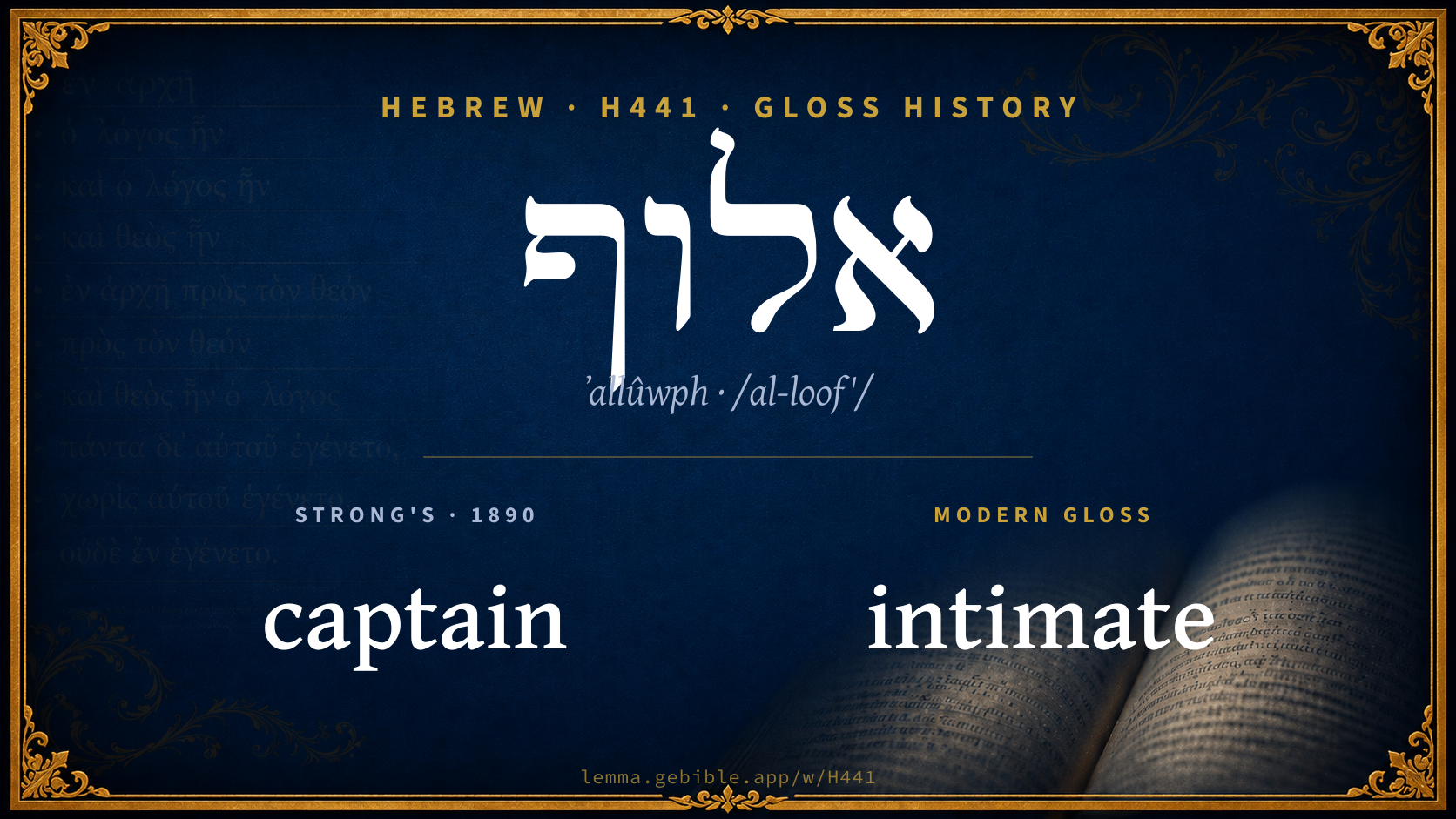
Gloss history
Strong's 1890 vs modern scholarship
About this word
Strong's H441 catalogs a Hebrew word from the Hebrew Old Testament.
These counts are not copied from any lexicon or concordance. They are computed here, from the morphology-tagged Hebrew Old Testament. What Lemma adds →
- 29
- distinct verses
- The word appears in 29 distinct verses.
- 8 / 39
- OT books
- The word appears in 8 of 39 Old Testament books.
- #575
- by frequency
- Top 1000 most frequent Hebrew words (rank 575 of 8,640 Hebrew words by occurrence).
View all 29 occurrences in the concordance →
Most concentrated in
- Genesis 12 verses 41%
- 1 Chronicles 4 verses 14%
- Proverbs 3 verses 10%
By section of the Old Testament
By traditional corpus
Conventional, traditional groupings — biblical authorship is debated, so this is a traditional corpus grouping, not an authorship claim. Each share is this word’s portion of its verses in that division of the Hebrew canon. Each figure is a share of the word’s 29 distinct verses.
- Torah (Pentateuch) 13 verses · 45%
- Writings (Ketuvim) 9 verses · 31%
- Prophets (Nevi'im) 7 verses · 24%
How translations render this word
Counts come from each version’s own published word-to-Strong’s tagging or interlinear alignment — an approximate guide to how each version renders this word, not a word-level alignment the data otherwise carries. Because each total is that version’s own tagged count, the per-version totals vary from one another and need not match the appearance or distinct-verse counts above. These counts may also differ from a printed concordance because Lemma counts each distinctly tagged rendering and does not collapse phrase taggings into a single head-word total. This is a fixed set of word-tagged versions (KJV, ASV, BSB, ULT) and does not change with the reading translation you choose elsewhere. Each version’s license is shown beside its name below (and on Sources).
BDB lists this Strong’s number as 2 distinct words (homographs). Each count above pools all of them and is not split by sense — see the Senses section below. A low-frequency rendering may belong to a different one of those words, not the primary meaning.
- King James Version†: Duke 42×, Are the dukes 6×, Dukes 3×
- American Standard Version†: Chief 42×, Are the chiefs 9×, Chief friends 2×
- Berean Standard Bible†: Chiefs 9×, Are the chiefs 7×, Companion 2×
- unfoldingWord Literal Text†: Chief 42×, Chiefs of 11×
King James Version Public Domain
Renders H441 across 69† tagged occurrences — most commonly:
Plus 13 renderings that appear only once — usually multi-word phrases or single function words the recovered tagging swept in, not distinct renderings.
American Standard Version Public Domain
Renders H441 across 69† tagged occurrences — most commonly:
Plus 10 renderings that appear only once — usually multi-word phrases or single function words the recovered tagging swept in, not distinct renderings.
Berean Standard Bible Public Domain
Renders H441 across 31† tagged occurrences — most commonly:
Plus 13 renderings that appear only once — usually multi-word phrases or single function words the recovered tagging swept in, not distinct renderings. Not rendered by a distinct English word in 38 further occurrences.
unfoldingWord Literal Text CC BY-SA 4.0
Renders H441 across 68† tagged occurrences — most commonly:
Plus 15 renderings that appear only once — usually multi-word phrases or single function words the recovered tagging swept in, not distinct renderings.
Senses in the full BDB
What do BDB’s symbols mean?
BDB uses these scholarly abbreviations:
| Symbol | Meaning |
|---|---|
| 𝔊 | the Septuagint (the ancient Greek translation, LXX) |
| 𝔙 | the Vulgate (the Latin translation) |
| 𝔖 | the Syriac version (the Peshitta) |
| 𝔗 | the Targum (the Aramaic translation) |
| ψ | the Psalms |
| √ | root (the underlying root or stem) |
| ‖ | parallel passage (a synonymous or contrasted parallel) |
| † | the dagger: every passage where the word occurs is cited |
The 3 senses and sub-senses the full Brown-Driver-Briggs lexicon distinguishes for this word, in lexicon order (not ranked by frequency), with BDB’s own verbatim wording and sub-sense lettering. Shown in Hebrew script with BDB’s own scholarly abbreviations. The condensed entry is in the Lexicon Entry tab. See also the Forms in the corpus table below.
- 1. tame, docile, כֶּבֶשׂ אַלּוּף a docile (gentle) lamb Je 11:19. e.g. Jeremiah 11:19
- 2. n.m. friend, intimate ψ 55:14 (‖ מְיֻדָּע) Mi 7:5 (‖ רֵעַ) Pr 16:28; 17:9 Je 13:21; of a woman’s husband א׳ נְעוּרֶיהָ Pr 2:17; fig. of י׳ as husband of Judah, id., Je 3:4. e.g. Psalms 55:14
- 3. i.q. 1. אֶלֶף; אַלּוּפֵינוּ מְסֻבָּלִים ψ 144:14 (i.e. cows). e.g. Psalms 144:14
Senses from the full Brown-Driver-Briggs lexicon (Brown, Driver, Briggs; Oxford 1906 — public domain), digitized via Sefaria, supplemented by the OpenScriptures HebrewLexicon (CC BY 4.0). Full attribution on Sources.
Word origin
I. adj. tame—א׳ abs. Mi 7:5 +; cstr. Pr 2:17 +; sf. אַלּוּפִי ψ 55:14; pl. אַלֻּפִים Je 13:21, sf. אַלּוּפֵינוּ ψ 144:14, etc.;—
II. n.m. 1 Ch 1:51 chief, chiliarch (denom. from ii. אֶלָף v. Di Gn 36:15)—א׳ abs. Gn 36:15 +; pl. cstr. אַלּוּפֵי (אַלֻּפֵי) Ex 15:15 +; sf. אַלּוּפֵיהֶם Gn 36:19, 30—chief (tribal) of Edom Gn 36:15 (5 times) + 38 times Gn 36 (P); Ex 15:15 (E) 1 Ch 1:51 (4 times) + 9 times; of Judah Zc 12:5, 6; so אַלֻּף 9:7 (in sim.)
— Brown-Driver-Briggs (Oxford 1906, public domain), digitized via Sefaria, supplemented by the OpenScriptures HebrewLexicon (CC BY 4.0). See Sources.
Derived from אלף (ʼâlaph) (H502) — to learn.
Jastrow Dictionary
A second Hebrew/Aramaic lexicon for comparison, covering Aramaic and post-biblical (Talmudic, Targumic, Midrashic) usage that the biblical-Hebrew BDB does not. Matched by lemma rather than by Strong’s number, so a lemma may carry more than one Jastrow headword (shown separately below), and the entries cover usage well beyond the Bible.
אַלּוּף
- prince, chief. Gen. R. s. 20 beg. אלופוֹ של עולם the world’s chief (Aleph, i.e. Adam).
A Dictionary of the Targumim, the Talmud Babli and Yerushalmi, and the Midrashic Literature (Marcus Jastrow; London, Luzac, 1903) — Public Domain. Digitized via Sefaria. Digitized via Sefaria. Full attribution on Sources.
Forms in the corpus
The 20 distinct written forms H441 takes in the Hebrew Bible, most frequent first — each parse links to that state’s occurrences in the concordance. Hebrew forms include their vowel points and cantillation, so a single lemma takes many written forms.
Same root — word family
Other BDB entries built from the same root as H441, grouped by Strong’s listed origin. These share a root / origin per the lexicon — not necessarily a shared meaning. Each links to that word’s own entry.
Derives from
Shares the same root
Compare all same-root words → They share a root, not necessarily a meaning.
Septuagint verse parallels
This word appears in 25 verses that also exist in the Greek Old Testament (Septuagint), out of the 29 Hebrew verses it occurs in. You can read those verses in Greek by switching the Old Testament edition to the Septuagint.
Read these verses in the Septuagint
This is a verse-level parallel only — the same verses exist in both the Hebrew and Greek Old Testaments. No word-level Hebrew↔Greek correspondence is claimed: the data carries no such alignment, so no Greek word is shown as this Hebrew word’s translation. Coverage is not total — the Septuagint omits the deuterocanon and renumbers the Psalms, so some Hebrew verses have no direct Greek parallel.