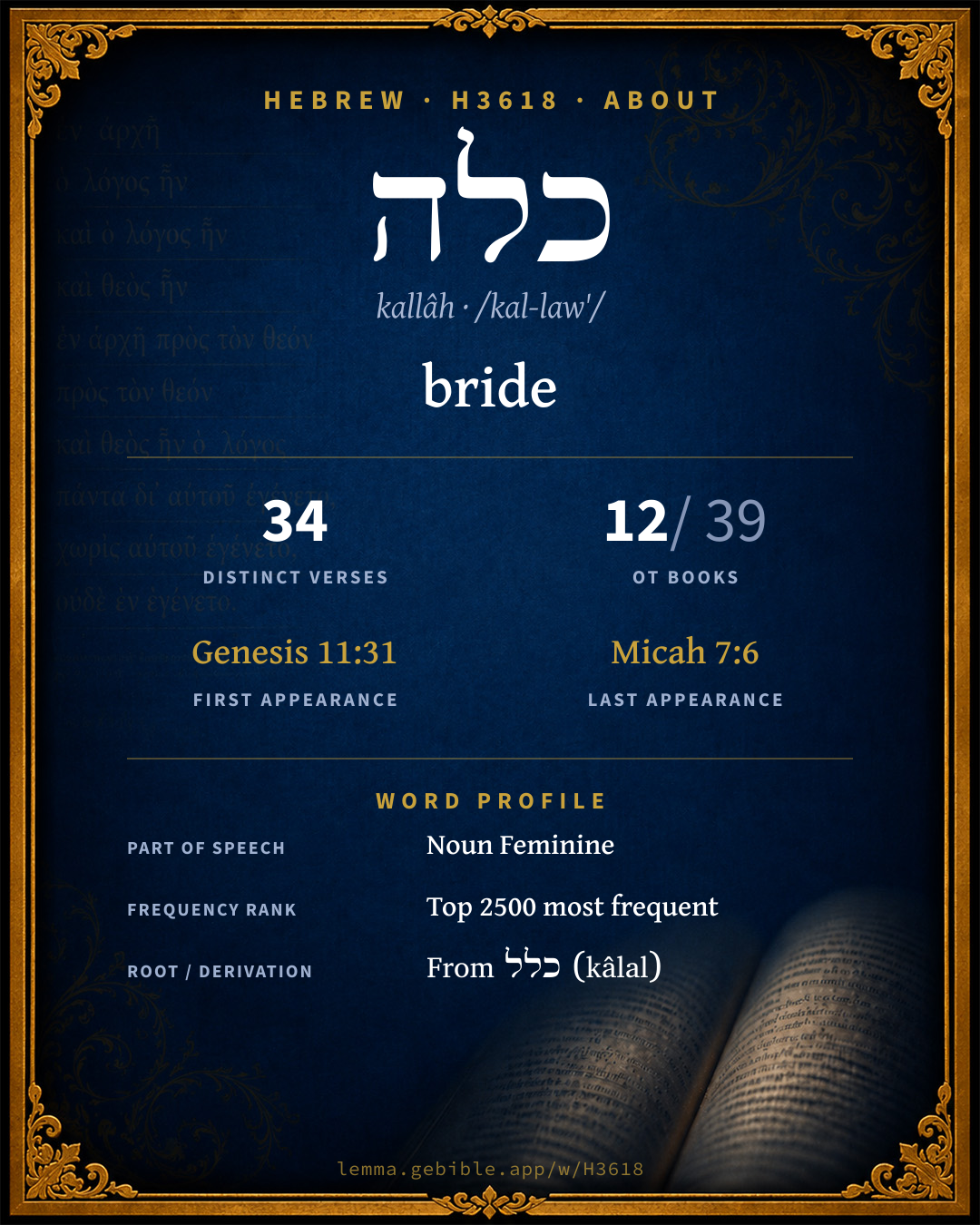
כַּלָּה
bride
‘bride’ is one of 3 main senses fuller range ↓
Full lexicon entry — Brown-Driver-Briggs (BDB)
From Brown-Driver-Briggs (BDB)
Where this word appears
Grammar key — what these labels mean
Part of speech
- Noun
- A naming word — a person, place, thing, or idea.
Noun type
- Common
- A common noun — a general class of person, place, or thing (“king,” “city,” “water”), not a specific name.
State
- Absolute
- The independent form of a noun, not bound to a following word.
- Construct
- A noun bound to a following noun in a possessive / “of” relationship (the construct chain).
Gender
- Feminine
- Grammatically feminine.
Number
- Singular
- One.
- Plural
- More than one (in Hebrew, generally three or more).
Every verse where H3618 appears in the Book of Ruth — 7 distinct verses. Click any verse to open its interlinear word-by-word view. Verse text shown in the World English Bible for context — . Each verse’s Hebrew form is shown with its reference; the English is not keyword-highlighted, since the data carries no word-level English alignment. Use “Compare translations” on any verse to read it across multiple English versions. This concordance covers the Hebrew Bible; Septuagint (Greek Old Testament) occurrences are not indexed here.
Ruth
- Ruth 1:6 וְ/כַלֹּתֶ֔י/הָ conj + n c fp cs + sfx pers 3fs Then she arose with her daughters-in-law, that she might return from the country of Moab: for she had heard in the country of Moab how that Yahweh had visited his people in giving them bread.
- Ruth 1:7 כַלֹּתֶ֖י/הָ n c fp cs + sfx pers 3fs She went forth out of the place where she was, and her two daughters-in-law with her; and they went on the way to return to the land of Judah.
- Ruth 1:8 כַלֹּתֶ֔י/הָ n c fp cs + sfx pers 3fs Naomi said to her two daughters-in-law, Go, return each of you to her mother's house: Yahweh deal kindly with you, as you have dealt with the dead, and with me.
- Ruth 1:22 כַלָּתָ/הּ֙ n c fs cs + sfx pers 3fs So Naomi returned, and Ruth the Moabitess, her daughter-in-law, with her, who returned out of the country of Moab: and they came to Bethlehem in the beginning of barley harvest.
- Ruth 2:20 לְ/כַלָּתָ֗/הּ prep + n c fs cs + sfx pers 3fs Naomi said to her daughter-in-law, Blessed be he of Yahweh, who has not left off his kindness to the living and to the dead. Naomi said to her, The man is a close relative to us, one of our near kinsmen.
- Ruth 2:22 כַּלָּתָ֑/הּ n c fs cs + sfx pers 3fs Naomi said to Ruth her daughter-in-law, It is good, my daughter, that you go out with his maidens, and that they not meet you in any other field.
- Ruth 4:15 כַלָּתֵ֤/ךְ n c fs cs + sfx pers 2fs He shall be to you a restorer of life, and sustain you in your old age, for your daughter-in-law, who loves you, who is better to you than seven sons, has borne him.
About this entry
At a glance — auto-summarized from this page’s data, not written by a person. Every figure links to its source below. This summary describes the numbers; it doesn’t interpret them.
“bride” is the headline sense of the Hebrew noun כלה (kallâh). Scripture first uses it in Genesis 11:31. It appears 34 verses across 12 books of the Hebrew Bible, among its moderately common vocabulary. Carrying more than one sense, it rewards its full sense range. It shares a root with כלל, כל and כליל. The sections below give every sense, occurrence, and version rendering.
Gloss history
Strong's 1890 vs modern scholarship
About this word
Strong's H3618 catalogs a Hebrew word from the Hebrew Old Testament.
These counts are not copied from any lexicon or concordance. They are computed here, from the morphology-tagged Hebrew Old Testament. What Lemma adds →
- 34
- distinct verses
- The word appears in 34 distinct verses.
- 12 / 39
- OT books
- The word appears in 12 of 39 Old Testament books.
- #1,041
- by frequency
- Top 2500 most frequent Hebrew words (rank 1,041 of 8,640 Hebrew words by occurrence).
View all 34 occurrences in the concordance →
Most concentrated in
- Ruth 7 verses 21%
- Song of Solomon 6 verses 18%
- Jeremiah 5 verses 15%
By section of the Old Testament
By traditional corpus
Conventional, traditional groupings — biblical authorship is debated, so this is a traditional corpus grouping, not an authorship claim. Each share is this word’s portion of its verses in that division of the Hebrew canon. Each figure is a share of the word’s 34 distinct verses.
- Prophets (Nevi'im) 14 verses · 41%
- Writings (Ketuvim) 14 verses · 41%
- Torah (Pentateuch) 6 verses · 18%
How translations render this word
Counts come from each version’s own published word-to-Strong’s tagging or interlinear alignment — an approximate guide to how each version renders this word, not a word-level alignment the data otherwise carries. Because each total is that version’s own tagged count, the per-version totals vary from one another and need not match the appearance or distinct-verse counts above. These counts may also differ from a printed concordance because Lemma counts each distinctly tagged rendering and does not collapse phrase taggings into a single head-word total. This is a fixed set of word-tagged versions (KJV, ASV, BSB, ULT) and does not change with the reading translation you choose elsewhere. Each version’s license is shown beside its name below (and on Sources).
BDB lists this Strong’s number as 2 distinct words (homographs). Each count above pools all of them and is not split by sense — see the Senses section below. A low-frequency rendering may belong to a different one of those words, not the primary meaning.
- King James Version†: Daughter in law 13×, Bride 6×, Spouse 6×
- American Standard Version†: Bride 12×, Daughter-in 10×, Brides 2×
- Berean Standard Bible†: Bride 13×, Daughter-in-law 11×, Daughters-in-law 5×
- unfoldingWord Literal Text†: Bride 13×, Daughter in law 11×, Daughters in law 5×
King James Version Public Domain
Renders H3618 across 34† tagged occurrences — most commonly:
Plus 4 renderings that appear only once — usually multi-word phrases or single function words the recovered tagging swept in, not distinct renderings.
American Standard Version Public Domain
Renders H3618 across 32† tagged occurrences — most commonly:
Plus 6 renderings that appear only once — usually multi-word phrases or single function words the recovered tagging swept in, not distinct renderings.
Berean Standard Bible Public Domain
Renders H3618 across 34† tagged occurrences — most commonly:
Plus 5 renderings that appear only once — usually multi-word phrases or single function words the recovered tagging swept in, not distinct renderings.
unfoldingWord Literal Text CC BY-SA 4.0
Renders H3618 across 34† tagged occurrences — most commonly:
Plus 3 renderings that appear only once — usually multi-word phrases or single function words the recovered tagging swept in, not distinct renderings.
Senses in the full BDB
What do BDB’s symbols mean?
BDB uses these scholarly abbreviations:
| Symbol | Meaning |
|---|---|
| 𝔊 | the Septuagint (the ancient Greek translation, LXX) |
| 𝔙 | the Vulgate (the Latin translation) |
| 𝔖 | the Syriac version (the Peshitta) |
| 𝔗 | the Targum (the Aramaic translation) |
| ψ | the Psalms |
| √ | root (the underlying root or stem) |
| ‖ | parallel passage (a synonymous or contrasted parallel) |
| † | the dagger: every passage where the word occurs is cited |
The 4 senses and sub-senses the full Brown-Driver-Briggs lexicon distinguishes for this word, in lexicon order (not ranked by frequency), with BDB’s own verbatim wording and sub-sense lettering. Shown in Hebrew script with BDB’s own scholarly abbreviations. The condensed entry is in the Lexicon Entry tab. See also the Forms in the corpus table below.
- 1. daughter-in-law, in ref. to husband’s father Gn 38:11, 16; 24 (J), cf. 1 Ch 2:4 1 S 4:19; Ez 22:11; Mi 7:6; Gn 11:31 (P), Lv 18:15; 20:12 (both H); husband’s mother Ru 1:6, 7, 8, 22; 2:20, 22; 4:15. e.g. Genesis 38:11
- 2. bride, usually
- a. just before marriage Is 49:18; 61:10; 62:5; Je 2:32 (all in sim., etc.), ‖ חָתָן 7:34; 16:9; 25:10; 33:11; Jo 2:16; Ct 4:8, 9, 10, 11, 12; 5:1. e.g. Isaiah 49:18
- b. also just after marriage = young wife Ho 4:13, 14; read הַכַּלָּה likewise 2 S 17:3 (for MT הַכֹּל), 𝔊 We Dr Klo Kit Bu. e.g. Hosea 4:13
Senses from the full Brown-Driver-Briggs lexicon (Brown, Driver, Briggs; Oxford 1906 — public domain), digitized via Sefaria, supplemented by the OpenScriptures HebrewLexicon (CC BY 4.0). Full attribution on Sources.
Word origin
I. v. sub II. כלל.
II. n.f. daughter-in-law, bride;—abs. כ׳ Je 2:32 + 14 times sf. כַּלָּתוֹ Gn 11:31 + 5 times; כַּלָּתָהּ Ru 1:22 + 2 times, etc.; pl. sf. כַּלֹּתֶיהָ Ru 1:6–8, כַּלּוֹתֶיהָ 1:7, כַלּוֹתֵיכֶם Ho 4:13, 14;—
— Brown-Driver-Briggs (Oxford 1906, public domain), digitized via Sefaria, supplemented by the OpenScriptures HebrewLexicon (CC BY 4.0). See Sources.
Derived from כלל (kâlal) (H3634) — to perfect.
Jastrow Dictionary
A second Hebrew/Aramaic lexicon for comparison, covering Aramaic and post-biblical (Talmudic, Targumic, Midrashic) usage that the biblical-Hebrew BDB does not. Matched by lemma rather than by Strong’s number, so a lemma may carry more than one Jastrow headword (shown separately below), and the entries cover usage well beyond the Bible.
*כְּלָה
- (v. אוּכְלָא, עוּכְלָא)K’lah, a measure for spices. Y. Bets. III, end, 62ᵇ תן לי כ׳ וכ׳ give me a k’lah of spices, for housekeepers are in the habit of putting a k. of spices &c. Y. Peah VIII, 20ᵈ bot. כולה תבלין a K. is the ordinary quantity for spices; (Erub. 29ᵃ; R. S. to Peah VIII, 5 עוכלא).
כַּלָּה
- 1. [crown, ornament, v. Is. XLIX, 18,] (sub. בעלת or בת, cmp. אִיתּוּ, חוֹרִים a. בֶּן חוֹרִים) bride; daughter-in-law. Yeb. I, 1 וכַלָּתוֹ and his (deceased) son’s wife. Sot. IX, 14 שתצא הב׳ וכ׳ that the bride on her wedding day may be taken around in procession, v. אַפִּרְיוֹן. Keth. 71ᵇ; Pes. 87ᵃ ככ׳ שנמצאת וכ׳ like a bride (daughter-in-law) found perfect in the house of her father-in-law. Ib. כ׳ בבית אביה a bride in her father’s house (not yet taken to her husband’s paternal house). Ex. R. s. 41 (play on ככלתו, Ex. XXXI, 18, cmp. כְּלַל Pa.) מה כ׳ זו מקושטת וכ׳ as the bride is adorned &c.; a. fr. [Tanḥ. Ki Thissa 18 כ׳ נופי, read with ed. Bub. ib. 9 קלי נינפי.]—Pl. כַּלּוֹת. Sot. l. c. עטרות כ׳ (Talm. ed. sing.) the bridal wreaths. Ib. 49ᵇ; a. fr e.g. Isaiah 49:18
- 2. general assembly, esp. Kallah, the assembly of Babylonian students in the months of Elul and Adar. Ber. 8ᵇ פרשייתא דכ׳ Ar. (Ms. Paris דכַלָּא, v. Rabb. D. S., Vol. I, p. 384; ed. דכולא שתא) the weekly Scripture lessons of the Kallah weeks (during which R. Bibi could not find time to peruse the section of each week). Ib. 6ᵃ, v. דּוּחֲקָא. Ib. 57ᵃ ראש לבני כ׳; B. Bath. 22ᵃ ריש כ׳ the president of the Kallah.—Pl. (of כַּלָּא) כַּלֵּי. Ḥull. 49ᵃ רישי כ׳.—מסכת כלה, מסכתא דכ׳ a (small) treatise of the Talmud named Kallah (from its first word). Sabb. 114ᵃ; Kidd. 49ᵇ; Taan. 10ᵇ; [oth. opin.: a subject which has been discussed in the general assembly].
כָּלָה
- , v. כלי
כלי
- v. כָּלַל)
- 1. to enclose; to restrain, keep back. Midr. Till. to Ps. CXIII לִכְלוֹת את המכה וכ׳ to ward this plague off from thee. Midd. IV, 6 כֹּלֵה עֹרֵב ‘keeping off the raven’, an arrangement of iron points on the roof of the Temple; Sabb. 90ᵃ כּוֹלֵי עורב (pl.) Ms. M. (ed. כַּלְיָיא ch.; v. Rabb. D. S. a. l. note); Men. 107ᵃ כולי Ms. M. (ed. כַּלְיָה); M. Kat. 9ᵃ כולי Ms. M. (ed. כליא); Arakh. 6ᵃ כליה.—Part. pass. כָּלוּי. Y. Naz. II, beg. 51ᵈ כ׳ אני ממנו I will be restrained from it (for ‘I will abstain’).
- 2. (cmp. שלם) to be full, to be finished, to cease. Ber. 39ᵃ צריך שתִּכְלֶה ברכה וכ׳ the benediction must be finished simultaneously with breaking the bread. Tanḥ. Ki Thissa 5 כבר כָּלוּ ישראל וכ׳ Israel would have ceased to exist; (Pesik. Shek., p. 13ᵇ חיו … מְכוּלִּין, v. infra). Snh. 97ᵇ כלו כל הקצין all the predicted terms of redemption are ended (have passed by); a. fr.—[Pesik. R. s. 12 מת וכלה בקבר, read: ובלה.]—Part. (fr. כּוּל, cmp. חוּל, part. חולות a. חלות) כָּל. Snh. 17ᵃ (ref. to כלאם, Num. XI, 28) הטל … והן כָּלִין מאליהם throw upon them the care for the public, and they will cease (to prophesy) of themselves; a. fr. e.g. Numbers 11:28
- 1. to finish, cease. Yoma 60ᵇ (ref to Lev. XVI, 20) אם כפר כ׳ when he has atoned (for the sanctuary &c.), he has finished (his task). Ib. אם כ׳ כפר when he has done all (the prescribed ritual), he has achieved atonement; Sifra Aḥăré ch. IV, Par. 4; a. e.—Tanḥ. Vayetse 2 מְכַלִּין את שדותיהן they reap their fields entirely (leaving no corners for the poor). Snh. 67ᵇ כַּלֵּה מִדַּבְּרוֹתֶיךָ ולך וכ׳ (some ed. כלך, v. Rab. D. S. a. l. note) cease from thy homiletical interpretations, and turn to &c.; Midr. Till. to Ps. CIV, 6; Ex. R. s. 10, v. כַּלֵּךְ. e.g. Leviticus 16:20
- 2. to finish, destroy. Y. Shek. VI, 50ᵇ top (ref. to מכלות, II Chr. IV, 21) הן כִּילּוּ וכ׳ they (these vessels) consumed all the gold (of the country); Men. 29ᵃ שכִּילַּתּוֹ וכ׳ it consumed &c. Pesik. R. s. 2 שכי׳ אותה וכ׳ whom the Lord destroyed. Num. R. s. 3 היה הארון מְכַלֶּה בבני וכ׳ the Ark made havoc among the sons of Kehath (who had charge of it; cmp. II Sam. VI, 7). Mekh. B’shall., Amalek, s. 2 לכַלָּן to destroy them. Y. Ḥag. II, 78ᵃ bot. (cited in Tosaf. to Ḥag. 17ᵇ a. v. אלא) ובלבד שיְכַלֶּה עיסתו (ed. שיבלים) provided he has used up all his dough for the day; a. fr.—Part. pass. מְכוּלֶּה, pl. מְכוּלִּין. Pesik. Shek., p. 13ᵇ כבר היו ישראל מ׳ וכ׳ Israel would then have been destroyed; a. e. e.g. 2 Chronicles 4:21
- to be destroyed, visited by death. Num. R. s. 5 היו מִתְכַּלִּין they were diminished. Ib. שלא יִתְכַּלּוּ מן וכ׳ that they may not be destroyed from the world. Num. R. s. 3 לא נ׳ וכ׳ not one of them was missing on being counted &c.; a. e.
A Dictionary of the Targumim, the Talmud Babli and Yerushalmi, and the Midrashic Literature (Marcus Jastrow; London, Luzac, 1903) — Public Domain. Digitized via Sefaria. Digitized via Sefaria. Full attribution on Sources.
Forms in the corpus
The 26 distinct written forms H3618 takes in the Hebrew Bible, most frequent first — each parse links to that state’s occurrences in the concordance. Hebrew forms include their vowel points and cantillation, so a single lemma takes many written forms.
Same root — word family
Other BDB entries built from the same root as H3618, grouped by Strong’s listed origin. These share a root / origin per the lexicon — not necessarily a shared meaning. Each links to that word’s own entry.
Derives from
Shares the same root
- כל kôl H3605 all
- כליל kâlîyl H3632 whole
- כלל kᵉlal H3635 to finish
- מכלול miklôwl H4358 perfection
- מכלל miklâl H4359 perfection
- מכלל miklul H4360 perfect thing
Derived from this word
Proper names from this root
People and places named from this root — a name, not an additional meaning of the word.
Compare all same-root words → Showing 4 of 10 — not the complete family. 1 of the same-root words is a proper name (a person or place). They share a root, not necessarily a meaning.
Septuagint verse parallels
This word appears in 34 verses that also exist in the Greek Old Testament (Septuagint), out of the 34 Hebrew verses it occurs in. You can read those verses in Greek by switching the Old Testament edition to the Septuagint.
Read these verses in the Septuagint
- Genesis 11:31
- Leviticus 18:15
- Ruth 1:6
- 1 Samuel 4:19
- 1 Chronicles 2:4
- Song of Solomon 4:8
- Isaiah 49:18
- Jeremiah 2:32
- Ezekiel 22:11
- Hosea 4:13
- Joel 2:16
- Micah 7:6
This is a verse-level parallel only — the same verses exist in both the Hebrew and Greek Old Testaments. No word-level Hebrew↔Greek correspondence is claimed: the data carries no such alignment, so no Greek word is shown as this Hebrew word’s translation. Coverage is not total — the Septuagint omits the deuterocanon and renumbers the Psalms, so some Hebrew verses have no direct Greek parallel.