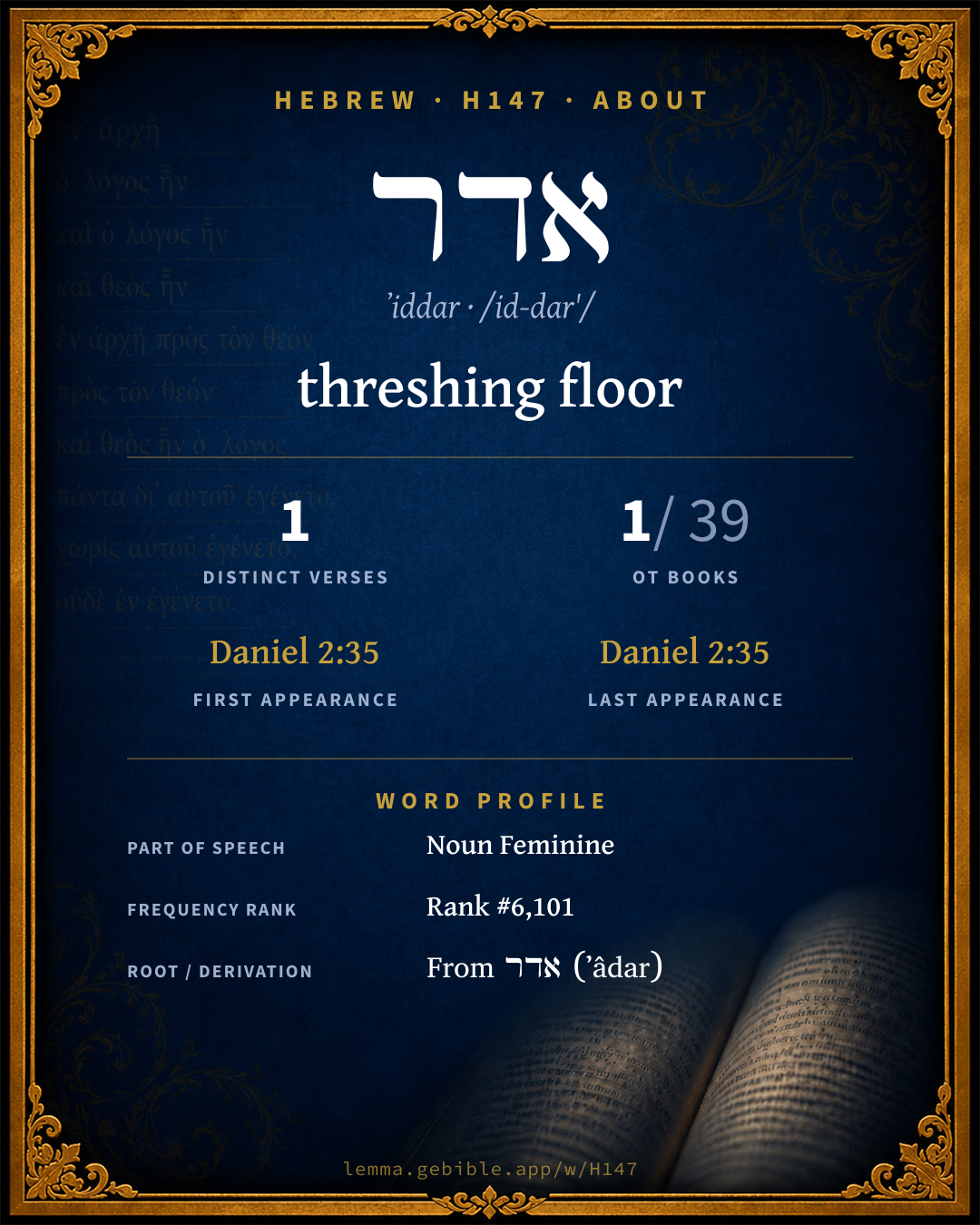
אִדַּר
threshing floor
Full lexicon entry — Brown-Driver-Briggs (BDB)
From Brown-Driver-Briggs (BDB)
Where this word appears
Grammar key — what these labels mean
Part of speech
- Noun
- A naming word — a person, place, thing, or idea.
Noun type
- Common
- A common noun — a general class of person, place, or thing (“king,” “city,” “water”), not a specific name.
State
- Construct
- A noun bound to a following noun in a possessive / “of” relationship (the construct chain).
Gender
- Masculine
- Grammatically masculine.
Number
- Plural
- More than one (in Hebrew, generally three or more).
Every verse where H147 appears — 1 distinct verse across 1 book. Click any verse to open its interlinear word-by-word view. Verse text shown in the World English Bible for context — . Each verse’s Hebrew form is shown with its reference; the English is not keyword-highlighted, since the data carries no word-level English alignment. Use “Compare translations” on any verse to read it across multiple English versions. This concordance covers the Hebrew Bible; Septuagint (Greek Old Testament) occurrences are not indexed here.
Daniel 1 verse
About this entry
At a glance — auto-summarized from this page’s data, not written by a person. Every figure links to its source below. This summary describes the numbers; it doesn’t interpret them.
אדר — transliterated ʼiddar — is a Hebrew noun carrying the sense “threshing floor.” The Hebrew Bible uses it only 1 verse. Its uses cluster heavily in Daniel (100% of all occurrences). Its lone occurrence is Daniel 2:35. Sharing its root, it stands alongside אדר, אדיר and אדר. See the sense tree, 1-verse concordance, and the renderings breakdown below.
Gloss history
Strong's 1890 vs modern scholarship
About this word
Strong's H147 catalogs a Hebrew word from the Hebrew Old Testament.
These counts are not copied from any lexicon or concordance. They are computed here, from the morphology-tagged Hebrew Old Testament. What Lemma adds →
- 1
- distinct verses
- The word appears in 1 distinct verse.
- 1 / 39
- OT books
- The word appears in 1 of 39 Old Testament books.
- #6,101
- by frequency
- Rank #6,101 (rank 6,101 of 8,640 Hebrew words by occurrence).
View all 1 occurrence in the concordance →
Most concentrated in
- Daniel 1 verse 100%
By section of the Old Testament
By traditional corpus
Conventional, traditional groupings — biblical authorship is debated, so this is a traditional corpus grouping, not an authorship claim. Each share is this word’s portion of its verses in that division of the Hebrew canon. Each figure is a share of the word’s 1 distinct verse.
- Writings (Ketuvim) 1 verse · 100%
How translations render this word
Counts come from each version’s own published word-to-Strong’s tagging or interlinear alignment — an approximate guide to how each version renders this word, not a word-level alignment the data otherwise carries. Because each total is that version’s own tagged count, the per-version totals vary from one another and need not match the appearance or distinct-verse counts above. These counts may also differ from a printed concordance because Lemma counts each distinctly tagged rendering and does not collapse phrase taggings into a single head-word total. This is a fixed set of word-tagged versions (KJV, ASV, BSB, ULT) and does not change with the reading translation you choose elsewhere. Each version’s license is shown beside its name below (and on Sources).
- King James Version: Threshingfloors 1×
- American Standard Version: Threshing-floors 1×
- Berean Standard Bible: Threshing floor 1×
- unfoldingWord Literal Text: The 1×, Threshing floors 1×
King James Version Public Domain
Renders H147 across 1 tagged occurrence — most commonly:
American Standard Version Public Domain
Renders H147 across 1 tagged occurrence — most commonly:
Berean Standard Bible Public Domain
Renders H147 across 1 tagged occurrence — most commonly:
unfoldingWord Literal Text CC BY-SA 4.0
Renders H147 across 2 tagged occurrences — most commonly:
Senses in BDB
The 1 sense BDB distinguishes for this word, in lexicon order (not ranked by frequency or importance). The full entry — with sub-senses — is in the Lexicon Entry tab.
- threshing floor
Word origin
[ אִדַּר ] n.m. threshing-floor;—pl. cstr. Dn 2:35.
— Brown-Driver-Briggs (Oxford 1906, public domain), digitized via Sefaria, supplemented by the OpenScriptures HebrewLexicon (CC BY 4.0). See Sources.
Derived from אדר (ʼâdar) (H142) — to be great.
Jastrow Dictionary
A second Hebrew/Aramaic lexicon for comparison, covering Aramaic and post-biblical (Talmudic, Targumic, Midrashic) usage that the biblical-Hebrew BDB does not. Matched by lemma rather than by Strong’s number, so a lemma may carry more than one Jastrow headword (shown separately below), and the entries cover usage well beyond the Bible.
אָדַר
- to cut off, surround, isolate; whence
- 1. (b. h.) to distinguish.—Den. אַדִּיר.
- 2. (Assyr. v. אֲדָר) to darken.
- 3. *to strip. cmp. עדר.—B. Kam. 11ᵃ (ref. to עד Ex. XXII, 12, v. עַד in H. Dict.) יביא אֲדוּרָה לב"ד Ar. (ed. עֲדוּדָה, v. עדד; Ms. ארורה, corr. acc.) let him bring the stripped (the remnants of the torn animal, skin &c.) before court for assessment of damages. e.g. Exodus 22:12
אֲדַר
- v. אִדְּרָא, אִדְרָא, אִדְּרוֹנָא.
- to distinguish. Snh. 63ᵇ (play on Adrammelekh II Kings XVI, 31) דא׳ ליה וכ׳ (the mule) that gives distinction to its owner when travelling. e.g. 2 Kings 16:31
אֲדָר
- Assyr. the cloudy; v. Fred. Delitzsch, The Hebr. Lang. p. 15) Adar, the twelfth month of the Jewish calendar, containing twenty nine days, and varying between the eleventh of February and the twenty eighth of March. In leap years: א׳ רִאשֹׁון First Adar, of thirty days duration between the thirty first of January and the tenth of March; א׳ שֵׁנִי Second Adar, of twenty nine days, between the second of March and the eighth of April. Targ. II Esth. IX, 29; a. fr.—Meg. I, 4; a. fr.—Pl. אֲדָרִים, אֲדָרִין. R. Hash. 19ᵇ
אִדַּר
- (אדר, נדר v. אָדַר) a place cut off, circle (cmp. זִירָה), whence threshing place, barn; also the grain piled up in the barn for threshing; cmp. גּוֹרֶן. Targ. Hos. II, 11 בעידן א׳ at the season of its being piled up; a. fr.—Gen. R. s. 63 the shovel דאפיך אי׳ which upturns the grain in the barn (= prayer averting evil decrees). Ib. (play on אדרת Gen. XXV, 25) כקש מא׳ like chaff from the barn. Ruth R. to III, 3 להיכן אקימתא א׳ where didst thou put up the barn?—Pl. אִידְּרַיָּא, אִדְּרֵי &c. Dan. II, 35. Targ. I Sam. XXIII, 1; a. e. Cant. R. to VII, 3 (homilet. rendition of הסהר אגן Cant. l. c.) א׳ דאזהרה a rounded place (cmp. גורן, זירה) of enlightenment, i.e. hall of the Sanhedrin. [With א or נ rejected: בי דרי. Taan. 3ᵇ. B. Mets. 73ᵃ.] e.g. Genesis 25:25
אֵדֶר I
- (v. אָדַר 3) skin, hide, leather-bag. Y. Maas. Sh. IV, 55ᶜ אדר תורתא hide of a cow. Ib. אדרא (ברא) דתבנא; Lam. R. to I, 1 (חד כותאי 2) אדר דתבן Ar. (ed. דור) a hide stuffed with straw. Y. Shebi. V, 36ᵃ top א׳ דאילין חכימא וכ׳ the leather of these bottles is distinguishable from the leather of those.—Pl. אוּדְרְיָיתָא. Shebu. 29ᵇ תליסר א׳ דתבנא Ar. (ed. אורוותא; Ms. F. אדידתא, v. Rashi a. l.) thirteen bagfuls of straw; Ned. 25ᵃ
אֵדֶר II
- ch. m. (v. אָדַר) [thick-leaved, dark]
- 1. a cedar species, prob. Spanish Juniper. R. Hash. 23ᵃ מאי קדרוס (ם) אדרא Ms. M. (ed. קתרוס) what is kedros (κέδρος)? Adara. Snh. 108ᵇ what is gofer? רב אמר אדרא דבי ר׳ שילא אמר וכ׳ Ar. a Ms. Fl. (v. Rabb. D. S. a. l.); cmp. Gen. R. s. 31; Yalk. Gen. 51.—Bets. 15ᵇ יטע אדר וכ׳ let him plant an edar (allud. to addir &c., Ps. XCIII, 4); א"נ אדרא וכ׳ or adara as its (popular or Chald.) name is; as people say, it is called adara because it lasts for generations (א־דרא). Git. 69ᵇ אטרף א׳ leaves of ad. Ib. מיא דא׳ decoct thereof. e.g. Psalms 93:4
- 2. אִדְרָא fig-tree. Targ. II, Esth. VII, 9 (to which perhaps belongs. Git. l. c.). e.g. Esther 7:9
נְדַר I
- Targ. Num. XXX, 3; a. fr.—Ned. 22ᵃ אילו הוה ידעת … מי נַדְרַת if thou hadst known …, wouldst thou have vowed? Ib. 22ᵇ נדרת אדעת דהכי wouldst thou have made the vow, if thou hadst known this. Ib. לא נַדְרִי I should not have vowed. Ib. 9ᵃ לא נְדרְנָא I will not vow; a. v. fr.
- as preced. Hif. Ib. 21ᵇ דאַדַּרְתָּהּ לברתה who forbade her daughter all benefits from her. Ib. 24ᵃ אַדְּרֵיה מזמנא וכ׳ the host urged the guest with a vow; אדריה זמינא וכ׳ the guest caused the host to invite him with a vow. Ib. 22ᵃ מי אדרתה wouldst thou have forbidden her? Gitt. 36ᵃ דאַדְּרֵיה ר׳ אחא whom R. A. forbade to teach. Keth. 70ᵇ אַדַּרְתָּן thou hast put me under restrictions; a fr.
A Dictionary of the Targumim, the Talmud Babli and Yerushalmi, and the Midrashic Literature (Marcus Jastrow; London, Luzac, 1903) — Public Domain. Digitized via Sefaria. Digitized via Sefaria. Full attribution on Sources.
Same root — word family
Other BDB entries built from the same root as H147, grouped by Strong’s listed origin. These share a root / origin per the lexicon — not necessarily a shared meaning. Each links to that word’s own entry.
Derives from
Shares the same root
Derived from this word
Proper names from this root
People and places named from this root — a name, not an additional meaning of the word.
Compare all same-root words → Showing 4 of 8 — not the complete family. 3 of the same-root words are proper names (people or places). They share a root, not necessarily a meaning.
Septuagint verse parallels
This word appears in 1 verse that also exists in the Greek Old Testament (Septuagint), out of the 1 Hebrew verse it occurs in. You can read those verses in Greek by switching the Old Testament edition to the Septuagint.
Read these verses in the Septuagint
This is a verse-level parallel only — the same verses exist in both the Hebrew and Greek Old Testaments. No word-level Hebrew↔Greek correspondence is claimed: the data carries no such alignment, so no Greek word is shown as this Hebrew word’s translation. Coverage is not total — the Septuagint omits the deuterocanon and renumbers the Psalms, so some Hebrew verses have no direct Greek parallel.