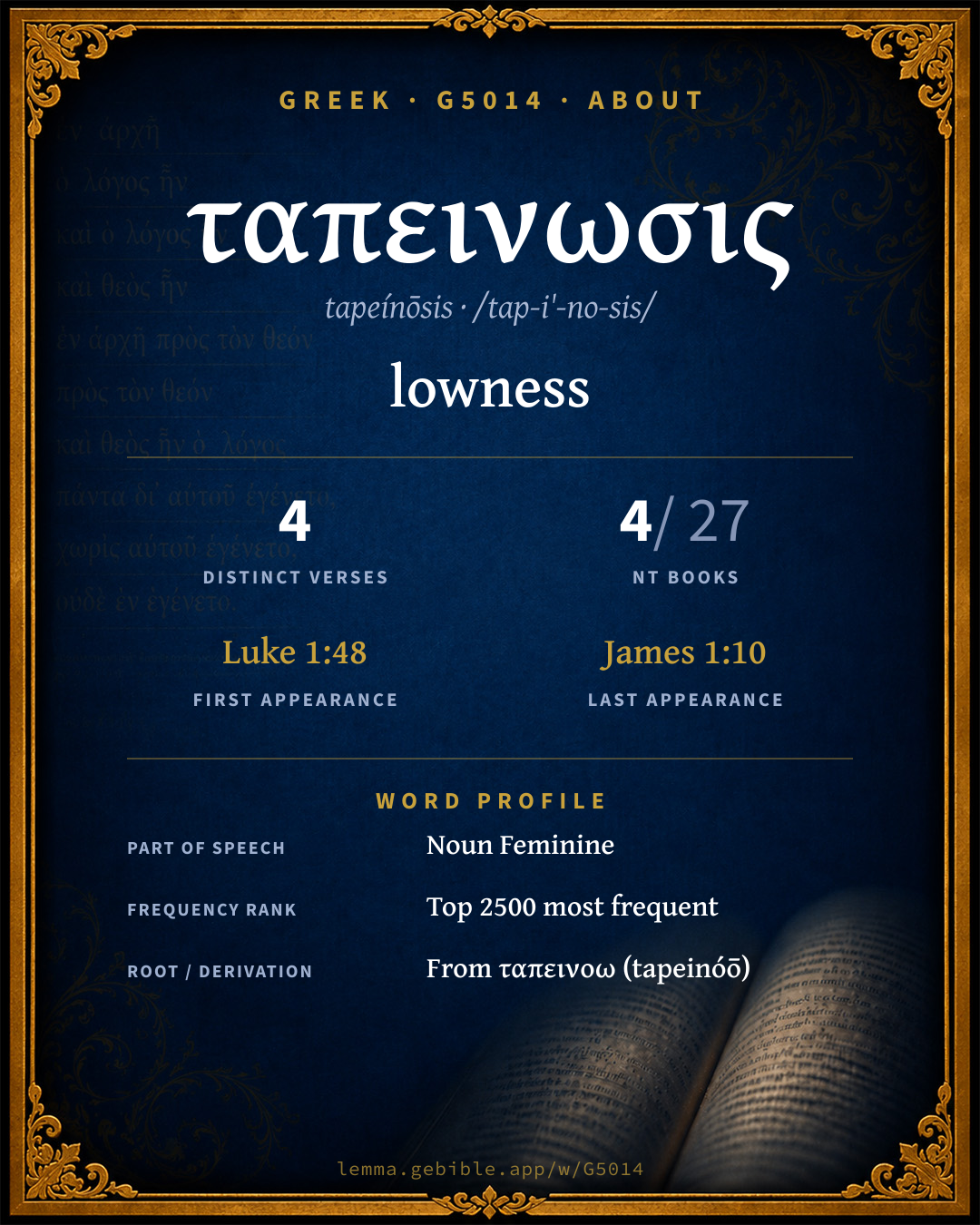
ταπείνωσις
lowness
‘lowness’ is one of 2 main senses fuller range ↓
Full lexicon entry — Thayer's Greek Lexicon
From Thayer's Greek Lexicon
Where this word appears
See every Dative-case word in the Greek New Testament →
Grammar key — what these labels mean
Part of speech
- Noun
- A naming word — a person, place, thing, or idea.
Case
- Dative
- The case of the indirect object, means, or location — “to / for / with / in.”
- Accusative
- The case of the direct object and of extent.
- Genitive
- The case of source, possession, or “of” — answers “whose / from what.”
Gender
- Feminine
- Grammatically feminine.
Number
- Singular
- One.
1 distinct verse where G5014 appears in the Accusative case, across 1 book. Filtered view — show all forms. Click any verse to open its interlinear word-by-word view. Verse text shown in the World English Bible for context — . Each verse’s Greek form is shown with its reference; the English is not keyword-highlighted, since the data carries no word-level English alignment. Use “Compare translations” on any verse to read it across multiple English versions. This concordance covers the Greek New Testament; Septuagint (Greek Old Testament) occurrences of this word are not indexed here.
Luke 1 verse
About this entry
At a glance — auto-summarized from this page’s data, not written by a person. Every figure links to its source below. This summary describes the numbers; it doesn’t interpret them.
At its core, ταπεινωσις (tapeínōsis) means “lowness.” It occurs a mere 4 verses across Scripture. Its uses concentrate in Luke (25% of all occurrences). Scripture first uses it in Luke 1:48. Ranging over 2 senses, it is not a single-sense word. Each statement above links to its evidence; the full detail follows below.
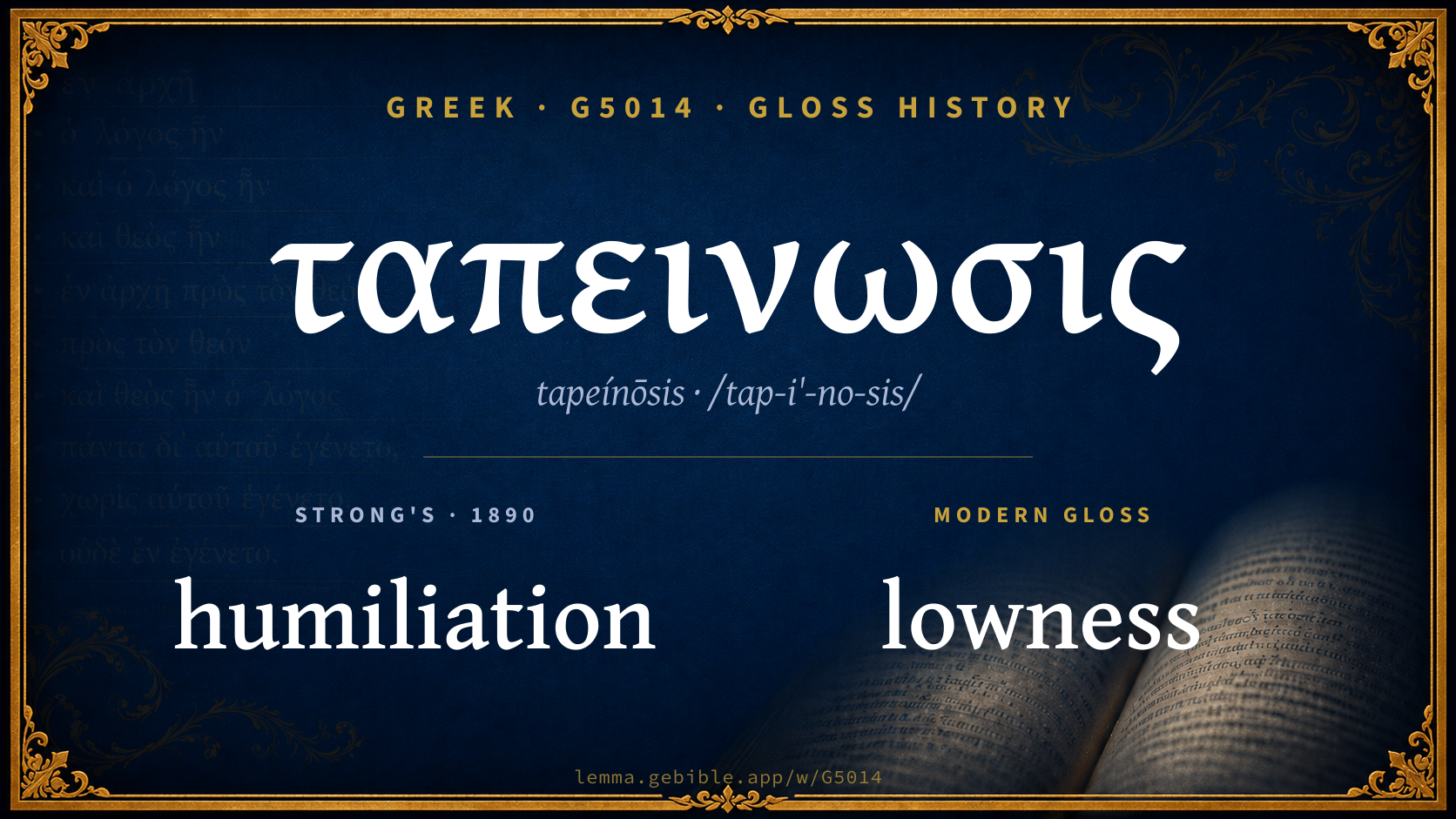
Gloss history
Strong's 1890 vs modern scholarship
About this word
Strong's G5014 catalogs a Greek word from the Greek New Testament.
These counts are not copied from any lexicon or concordance. They are computed here, from the morphology-tagged Greek New Testament. What Lemma adds →
- 4
- distinct verses
- The word appears in 4 distinct verses.
- 4 / 27
- NT books
- The word appears in 4 of 27 New Testament books.
- #1,877
- by frequency
- Top 2500 most frequent Greek words (rank 1,877 of 5,347 Greek words by occurrence).
View all 4 occurrences in the concordance →
Most concentrated in
- Luke 1 verse 25%
- Acts 1 verse 25%
- Philippians 1 verse 25%
By section of the New Testament
By traditional corpus
Conventional, traditional groupings — biblical authorship is debated, so this is a traditional corpus grouping, not an authorship claim. Some books belong to more than one corpus (Luke is in both the Gospels and the Lukan corpus, and so on), so these shares overlap and need not total 100%. Each figure is a share of the word’s 4 distinct verses.
- Lukan (Luke–Acts) 2 verses · 50%
- Gospels 1 verse · 25%
- Pauline corpus 1 verse · 25%
- General (Catholic) Epistles 1 verse · 25%
How translations render this word
Counts come from each version’s own published word-to-Strong’s tagging or interlinear alignment — an approximate guide to how each version renders this word, not a word-level alignment the data otherwise carries. Because each total is that version’s own tagged count, the per-version totals vary from one another and need not match the appearance or distinct-verse counts above. These counts may also differ from a printed concordance because Lemma counts each distinctly tagged rendering and does not collapse phrase taggings into a single head-word total. This is a fixed set of word-tagged versions (KJV, ASV, BSB, ULT) and does not change with the reading translation you choose elsewhere. Each version’s license is shown beside its name below (and on Sources).
- King James Version: Humiliation 1×, Is made low 1×, Low estate 1×
- American Standard Version: Humiliation 2×
- Berean Standard Bible: Humble state 1×, Humiliation 1×, Low position 1×
- unfoldingWord Literal Text: Humiliation 1×, Low condition 1×, Lowliness 1×
King James Version Public Domain
Renders G5014 across 4 tagged occurrences — most commonly:
American Standard Version Public Domain
Renders G5014 across 4 tagged occurrences — most commonly:
Plus 2 renderings that appear only once — usually multi-word phrases or single function words the recovered tagging swept in, not distinct renderings.
Berean Standard Bible Public Domain
Renders G5014 across 4 tagged occurrences — most commonly:
unfoldingWord Literal Text CC BY-SA 4.0
Renders G5014 across 4 tagged occurrences — most commonly:
Senses in Thayer's
The 2 senses Thayer's distinguishes for this word, in lexicon order (not ranked by frequency or importance). The full entry — with sub-senses — is in the Lexicon Entry tab.
- lowness, low estate
- metaph.
Word origin
Derived from ταπεινοω (tapeinóō) (G5013) — to humble.
From G5013 ; depression (in rank or feeling): - humiliation be made low low estate vile.
— Strong’s Exhaustive Concordance (1890), public domain.
Forms in the corpus
The 3 distinct written forms G5014 takes in the Greek New Testament, most frequent first — each parse links to that case’s occurrences in the concordance.
| Form | Parsing | Example | Uses |
|---|---|---|---|
| ταπεινώσει tapeinṓsei | Noun, Dative, Singular, Feminine | Acts 8:33 | 2 |
| ταπείνωσιν tapeínōsin | Noun, Accusative, Singular, Feminine | Luke 1:48 | 1 |
| ταπεινώσεως tapeinṓseōs | Noun, Genitive, Singular, Feminine | Philippians 3:21 | 1 |
Septuagint usage
The same Greek word ταπεινωσις appears 30 times in the Greek Old Testament (Septuagint), across 30 verses in 12 books.
- 30
- LXX occurrences
- Tagged occurrences of this Greek word in the Septuagint.
- 30
- verses
- Distinct Septuagint verses containing this word.
- 12 / 39
- OT books
- The word appears in 12 of the 39 Old Testament books.
Sample Septuagint occurrences
- Genesis 16:11 ταπείνωσις
- Deuteronomy 26:7 ταπείνωσις
- 1 Samuel 1:11 ταπείνωσις
- 2 Samuel 16:12 ταπείνωσις
- 2 Kings 14:26 ταπείνωσις
- Ezra 9:5 ταπείνωσις
- Esther 4:8 ταπείνωσις
- Psalms 9:14 ταπείνωσις
- Proverbs 16:15 ταπείνωσις
- Isaiah 40:2 ταπείνωσις
- Jeremiah 2:24 ταπείνωσις
- Lamentations 1:3 ταπείνωσις
Septuagint occurrences (same lexeme)
Every verse where the same Strong’s number (G5014) appears in the Greek Septuagint. Verse text shown in the World English Bible for context; the Greek form is the matched word — the English is not keyword-highlighted.
- Genesis 16:11 ταπείνωσις The angel of Yahweh said to her, "Behold, you are with child, and will bear a son. You shall call his name Ishmael, because Yahweh has heard your affliction.
- Genesis 29:32 ταπείνωσις Leah conceived, and bore a son, and she named him Reuben. For she said, "Because Yahweh has looked at my affliction. For now my husband will love me."
- Genesis 31:42 ταπείνωσις Unless the God of my father, the God of Abraham, and the fear of Isaac, had been with me, surely now you would have sent me away empty. God has seen my affliction and the labor of my hands, and rebuked you last night."
- Genesis 41:52 ταπείνωσις The name of the second, he called Ephraim: "For God has made me fruitful in the land of my affliction."
- Deuteronomy 26:7 ταπείνωσις and we cried to Yahweh, the God of our fathers, and Yahweh heard our voice, and saw our affliction, and our toil, and our oppression;
- 1 Samuel 1:11 ταπείνωσις She vowed a vow, and said, Yahweh of hosts, if you will indeed look on the affliction of your handmaid, and remember me, and not forget your handmaid, but will give to your handmaid a man-child, then I will give him to Yahweh all the days of his life, and there shall no razor come on his head.
- 1 Samuel 9:16 ταπείνωσις Tomorrow about this time I will send you a man out of the land of Benjamin, and you shall anoint him to be prince over my people Israel; and he shall save my people out of the hand of the Philistines: for I have looked on my people, because their cry is come to me.
- 2 Samuel 16:12 ταπείνωσις It may be that Yahweh will look on the wrong done to me, and that Yahweh will requite me good for [his] cursing of me this day.
- 2 Kings 14:26 ταπείνωσις For Yahweh saw the affliction of Israel, that it was very bitter; for there was none shut up nor left at large, neither was there any helper for Israel.
- Ezra 9:5 ταπείνωσις At the evening offering I arose up from my humiliation, even with my garment and my robe torn; and I fell on my knees, and spread out my hands to Yahweh my God;
- Ezra 19:9 ταπείνωσις
- Esther 4:8 ταπείνωσις Also he gave him the copy of the writing of the decree that was given out in Shushan to destroy them, to show it to Esther, and to declare it to her, and to charge her that she should go in to the king, to make supplication to him, and to make request before him, for her people.
- Psalms 9:14 ταπείνωσις That I may show forth all your praise. In the gates of the daughter of Zion, I will rejoice in your salvation.
- Psalms 9:31 ταπείνωσις
- Psalms 21:22 ταπείνωσις
- Psalms 24:18 ταπείνωσις
- Psalms 30:8 ταπείνωσις I cried to you, Yahweh. To Yahweh I made supplication:
- Psalms 71:4 ταπείνωσις Rescue me, my God, from the hand of the wicked, From the hand of the unrighteous and cruel man.
- Psalms 89:3 ταπείνωσις "I have made a covenant with my chosen one, I have sworn to David, my servant,
- Psalms 118:50 ταπείνωσις
- Psalms 118:92 ταπείνωσις
- Psalms 118:153 ταπείνωσις
- Psalms 135:23 ταπείνωσις
- Proverbs 16:15 ταπείνωσις In the light of the king's face is life. His favor is like a cloud of the spring rain.
- Isaiah 40:2 ταπείνωσις Speak comfortably to Jerusalem; and cry to her, that her warfare is accomplished, that her iniquity is pardoned, that she has received of Yahweh's hand double for all her sins.
- Isaiah 53:8 ταπείνωσις By oppression and judgment he was taken away; and as for his generation, who [among them] considered that he was cut off out of the land of the living for the disobedience of my people to whom the stroke [was due]?
- Jeremiah 2:24 ταπείνωσις a wild donkey used to the wilderness, that snuffs up the wind in her desire; in her occasion who can turn her away? all those who seek her will not weary themselves; in her month they shall find her.
- Lamentations 1:3 ταπείνωσις Judah is gone into captivity because of affliction, and because of great servitude; She dwells among the nations, she finds no rest: All her persecutors overtook her within the straits.
- Lamentations 1:7 ταπείνωσις Jerusalem remembers in the days of her affliction and of her miseries all her pleasant things that were from the days of old: When her people fell into the hand of the adversary, and none did help her, The adversaries saw her, they did mock at her desolations.
- Lamentations 1:9 ταπείνωσις Her filthiness was in her skirts; she didn't remember her latter end; Therefore is she come down wonderfully; she has no comforter: See, Yahweh, my affliction; for the enemy has magnified himself.
These are occurrences of the same Greek lexeme (G5014) in the Septuagint — not a translation of any one Hebrew word. The store carries no word-level Hebrew↔Greek alignment, so no Hebrew original is asserted here. Counts come from the recovered LXX Strong's tagging — high-frequency vocabulary is well covered, while rare or late forms may be untagged — so they reflect tagged occurrences and may slightly undercount.