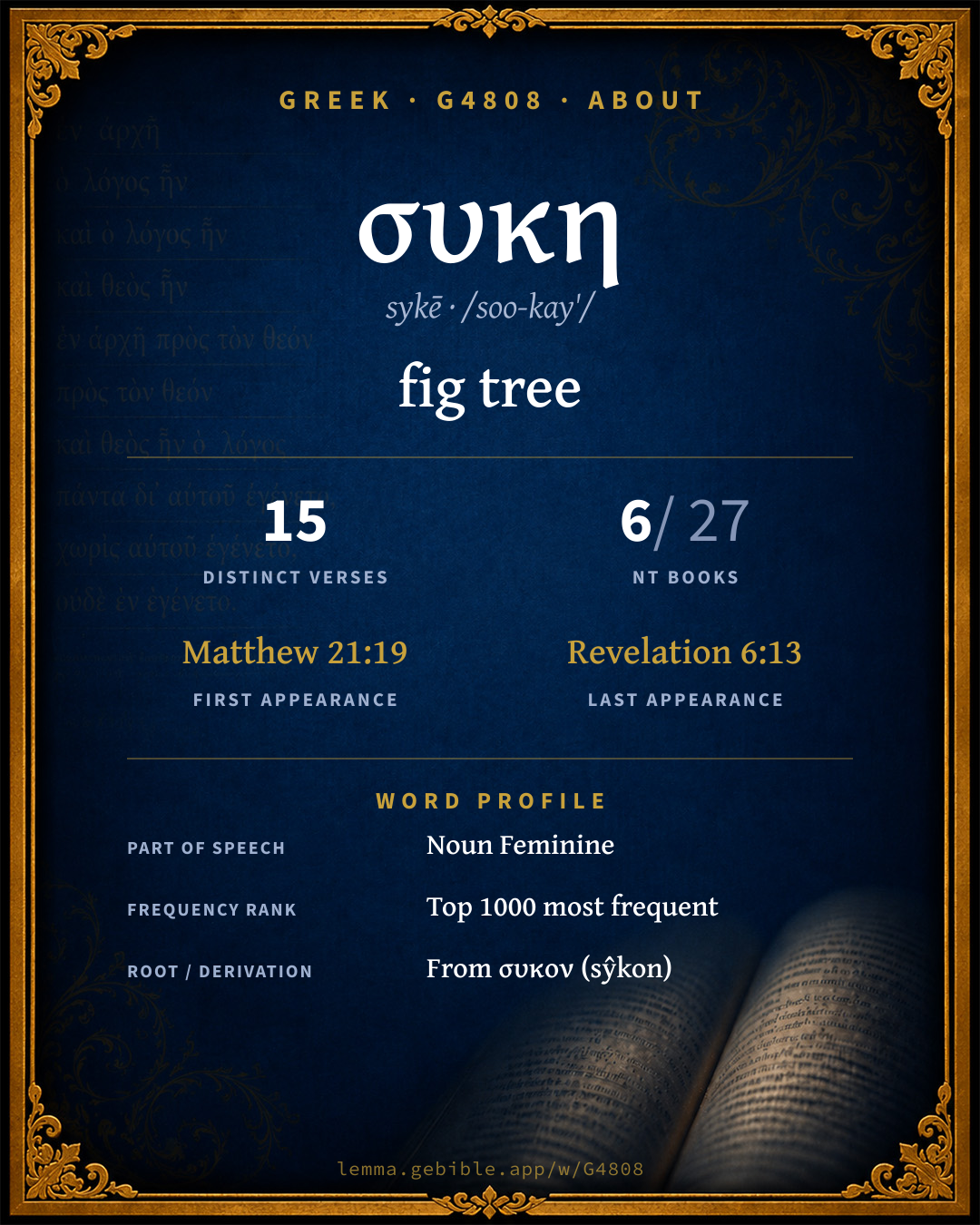
συκῆ
fig tree
Full lexicon entry — Thayer's Greek Lexicon
From Thayer's Greek Lexicon
Where this word appears
Grammar key — what these labels mean
Part of speech
- Noun
- A naming word — a person, place, thing, or idea.
Case
- Accusative
- The case of the direct object and of extent.
- Nominative
- The case of the subject (and the predicate nominative).
- Genitive
- The case of source, possession, or “of” — answers “whose / from what.”
- Dative
- The case of the indirect object, means, or location — “to / for / with / in.”
Gender
- Feminine
- Grammatically feminine.
Number
- Singular
- One.
Every verse where G4808 appears in the Book of Revelation — 1 distinct verse. Click any verse to open its interlinear word-by-word view. Verse text shown in the World English Bible for context — . Each verse’s Greek form is shown with its reference; the English is not keyword-highlighted, since the data carries no word-level English alignment. Use “Compare translations” on any verse to read it across multiple English versions. This concordance covers the Greek New Testament; Septuagint (Greek Old Testament) occurrences of this word are not indexed here.
Revelation
About this entry
At a glance — auto-summarized from this page’s data, not written by a person. Every figure links to its source below. This summary describes the numbers; it doesn’t interpret them.
συκη — transliterated sykē — is a Greek noun carrying the sense “fig tree.” It first appears in Matthew 21:19. The Greek New Testament uses it across 15 verses — uncommon. More than a quarter of its appearances fall in Matthew. Related forms include συκον, συκομωραια and συκοφαντεω. See the sense tree, 15-verse concordance, and the renderings breakdown below.
Gloss history
Strong's 1890 vs modern scholarship
About this word
Strong's G4808 catalogs a Greek word from the Greek New Testament.
These counts are not copied from any lexicon or concordance. They are computed here, from the morphology-tagged Greek New Testament. What Lemma adds →
- 15
- distinct verses
- The word appears in 15 distinct verses.
- 6 / 27
- NT books
- The word appears in 6 of 27 New Testament books.
- #726
- by frequency
- Top 1000 most frequent Greek words (rank 726 of 5,347 Greek words by occurrence).
View all 15 occurrences in the concordance →
By section of the New Testament
By traditional corpus
Conventional, traditional groupings — biblical authorship is debated, so this is a traditional corpus grouping, not an authorship claim. Some books belong to more than one corpus (Luke is in both the Gospels and the Lukan corpus, and so on), so these shares overlap and need not total 100%. Each figure is a share of the word’s 15 distinct verses.
- Gospels 13 verses · 87%
- Lukan (Luke–Acts) 3 verses · 20%
- Johannine 3 verses · 20%
- General (Catholic) Epistles 1 verse · 7%
- Revelation 1 verse · 7%
How translations render this word
Counts come from each version’s own published word-to-Strong’s tagging or interlinear alignment — an approximate guide to how each version renders this word, not a word-level alignment the data otherwise carries. Because each total is that version’s own tagged count, the per-version totals vary from one another and need not match the appearance or distinct-verse counts above. These counts may also differ from a printed concordance because Lemma counts each distinctly tagged rendering and does not collapse phrase taggings into a single head-word total. This is a fixed set of word-tagged versions (KJV, ASV, BSB, ULT) and does not change with the reading translation you choose elsewhere. Each version’s license is shown beside its name below (and on Sources).
- King James Version: Fig tree 14×
- American Standard Version: Fig tree 15×
- Berean Standard Bible: Fig tree 14×, Tree 2×
- unfoldingWord Literal Text: Fig tree 16×
King James Version Public Domain
Renders G4808 across 16 tagged occurrences — most commonly:
Plus 2 renderings that appear only once — usually multi-word phrases or single function words the recovered tagging swept in, not distinct renderings.
American Standard Version Public Domain
Renders G4808 across 16 tagged occurrences — most commonly:
Plus 1 rendering that appears only once — usually multi-word phrases or single function words the recovered tagging swept in, not distinct renderings.
Berean Standard Bible Public Domain
Renders G4808 across 16 tagged occurrences — most commonly:
unfoldingWord Literal Text CC BY-SA 4.0
Renders G4808 across 17 tagged occurrences — most commonly:
Plus 1 rendering that appears only once — usually multi-word phrases or single function words the recovered tagging swept in, not distinct renderings.
Senses in Thayer's
The 1 sense Thayer's distinguishes for this word, in lexicon order (not ranked by frequency or importance). The full entry — with sub-senses — is in the Lexicon Entry tab.
- a fig tree
Word origin
Derived from συκον (sŷkon) (G4810) — fig.
From G4810 ; a fig tree : - fig tree.
— Strong’s Exhaustive Concordance (1890), public domain.
Forms in the corpus
The 5 distinct written forms G4808 takes in the Greek New Testament, most frequent first — each parse links to that case’s occurrences in the concordance.
| Form | Parsing | Example | Uses |
|---|---|---|---|
| συκῆ sykē̂ | Noun, Nominative, Singular, Feminine | Matthew 21:19 | 5 |
| συκῆν sykē̂n | Noun, Accusative, Singular, Feminine | Matthew 21:19 | 5 |
| συκῆς sykē̂s | Noun, Genitive, Singular, Feminine | Matthew 21:21 | 4 |
| Συκῆν Sykē̂n | Noun, Accusative, Singular, Feminine | Luke 13:6 | 1 |
| συκῇ sykē̂ | Noun, Dative, Singular, Feminine | Luke 13:7 | 1 |
Same root — word family
Other Thayer's entries built from the same root as G4808, grouped by Strong’s listed origin. These share a root / origin per the lexicon — not necessarily a shared meaning. Each links to that word’s own entry.
Derives from
Shares the same root
Compare all same-root words → They share a root, not necessarily a meaning.
Septuagint usage
The same Greek word συκη appears 30 times in the Greek Old Testament (Septuagint), across 29 verses in 19 books.
- 30
- LXX occurrences
- Tagged occurrences of this Greek word in the Septuagint.
- 29
- verses
- Distinct Septuagint verses containing this word.
- 19 / 39
- OT books
- The word appears in 19 of the 39 Old Testament books.
Sample Septuagint occurrences
- Genesis 3:7 συκῆ
- Numbers 13:23 συκῆ
- Deuteronomy 8:8 συκῆ
- Judges 9:10 συκῆ
- 1 Kings 2:46 συκῆ
- 2 Kings 18:31 συκῆ
- Ezra 12:13 συκῆ
- Psalms 104:33 συκῆ
- Proverbs 27:18 συκῆ
- Song of Solomon 2:13 συκῆ
- Isaiah 34:4 συκῆ
- Jeremiah 8:13 συκῆ
Septuagint occurrences (same lexeme)
Every verse where the same Strong’s number (G4808) appears in the Greek Septuagint. Verse text shown in the World English Bible for context; the Greek form is the matched word — the English is not keyword-highlighted.
- Genesis 3:7 συκῆ Both of their eyes were opened, and they knew that they were naked. They sewed fig leaves together, and made themselves aprons.
- Numbers 13:23 συκῆ They came to the valley of Eshcol, and cut down from there a branch with one cluster of grapes, and they bore it on a staff between two; [they brought] also of the pomegranates, and of the figs.
- Numbers 20:5 συκῆ Why have you made us to come up out of Egypt, to bring us in to this evil place? it is no place of seed, or of figs, or of vines, or of pomegranates; neither is there any water to drink.
- Deuteronomy 8:8 συκῆ a land of wheat and barley, and vines and fig trees and pomegranates; a land of olive trees and honey;
- Judges 9:10 συκῆ The trees said to the fig tree, Come you, and reign over us.
- Judges 9:11 συκῆ But the fig tree said to them, Should I leave my sweetness, and my good fruit, and go to wave back and forth over the trees?
- 1 Kings 2:46 συκῆ So the king commanded Benaiah the son of Jehoiada; and he went out, and fell on him, so that he died. The kingdom was established in the hand of Solomon.
- 2 Kings 18:31 συκῆ Don't listen to Hezekiah: for thus says the king of Assyria, Make your peace with me, and come out to me; and eat you everyone of his vine, and everyone of his fig tree, and everyone drink the waters of his own cistern;
- 2 Kings 20:7 συκῆ Isaiah said, Take a cake of figs. They took and laid it on the boil, and he recovered.
- Ezra 12:13 συκῆ
- Psalms 104:33 συκῆ I will sing to Yahweh as long as I live. I will sing praise to my God while I have any being.
- Proverbs 27:18 συκῆ Whoever tends the fig tree shall eat its fruit. He who looks after his master shall be honored.
- Song of Solomon 2:13 συκῆ The fig tree ripens her green figs. The vines are in blossom; They give forth their fragrance. Arise, my love, my beautiful one, And come away. Lover
- Isaiah 34:4 συκῆ All the host of the sky shall be dissolved, and the heavens shall be rolled together as a scroll; and all their host shall fade away, as the leaf fades from off the vine, and as a fading [leaf] from the fig tree.
- Isaiah 36:16 συκῆ Don't listen to Hezekiah: for thus says the king of Assyria, Make your peace with me, and come out to me; and eat you everyone of his vine, and everyone of his fig tree, and drink you everyone the waters of his own cistern;
- Isaiah 38:21 συκῆ Now Isaiah had said, Let them take a cake of figs, and lay it for a plaster on the boil, and he shall recover.
- Jeremiah 8:13 συκῆ I will utterly consume them, says Yahweh: there shall be no grapes on the vine, nor figs on the fig tree, and the leaf shall fade; and [the things that] I have given them shall pass away from them.
- Jeremiah 24:1 συκῆ Yahweh shown me, and, behold, two baskets of figs set before the temple of Yahweh, after that Nebuchadrezzar king of Babylon had carried away captive Jeconiah the son of Jehoiakim, king of Judah, and the princes of Judah, with the craftsmen and smiths, from Jerusalem, and had brought them to Babylon.
- Jeremiah 24:2 συκῆ One basket had very good figs, like the figs that are first-ripe; and the other basket had very bad figs, which could not be eaten, they were so bad.
- Hosea 2:14 συκῆ "Therefore, behold, I will allure her, And bring her into the wilderness, And speak tenderly to her.
- Hosea 9:10 συκῆ I found Israel like grapes in the wilderness. I saw your fathers as the first ripe in the fig tree at its first season; But they came to Baal Peor, and consecrated themselves to the shameful thing, And became abominable like that which they loved.
- Joel 1:7 συκῆ He has laid my vine waste, And stripped my fig tree. He has stripped its bark, and thrown it away. Its branches are made white.
- Joel 1:12 συκῆ The vine has dried up, and the fig tree withered; the pomegranate tree, the palm tree also, and the apple tree, Even all of the trees of the field are withered; For joy has withered away from the sons of men.
- Joel 2:22 συκῆ Don't be afraid, you animals of the field; For the pastures of the wilderness spring up, For the tree bears its fruit. The fig tree and the vine yield their strength.
- Micah 4:4 συκῆ But they will sit every man under his vine and under his fig tree; And no one will make them afraid: For the mouth of Yahweh of Hosts has spoken.
- Nahum 3:12 συκῆ All your fortresses will be like fig trees with the first-ripe figs: if they are shaken, they fall into the mouth of the eater.
- Habakkuk 3:17 συκῆ For though the fig tree doesn't flourish, Nor fruit be in the vines; The labor of the olive fails, The fields yield no food; The flocks are cut off from the fold, And there is no herd in the stalls:
- Haggai 2:19 συκῆ Is the seed yet in the barn? Yes, the vine, the fig tree, the pomegranate, and the olive tree haven't brought forth. From this day will I bless you.'"
- Zechariah 3:10 συκῆ In that day,' says Yahweh of hosts, 'you will invite every man his neighbor under the vine and under the fig tree.'"
These are occurrences of the same Greek lexeme (G4808) in the Septuagint — not a translation of any one Hebrew word. The store carries no word-level Hebrew↔Greek alignment, so no Hebrew original is asserted here. Counts come from the recovered LXX Strong's tagging — high-frequency vocabulary is well covered, while rare or late forms may be untagged — so they reflect tagged occurrences and may slightly undercount.