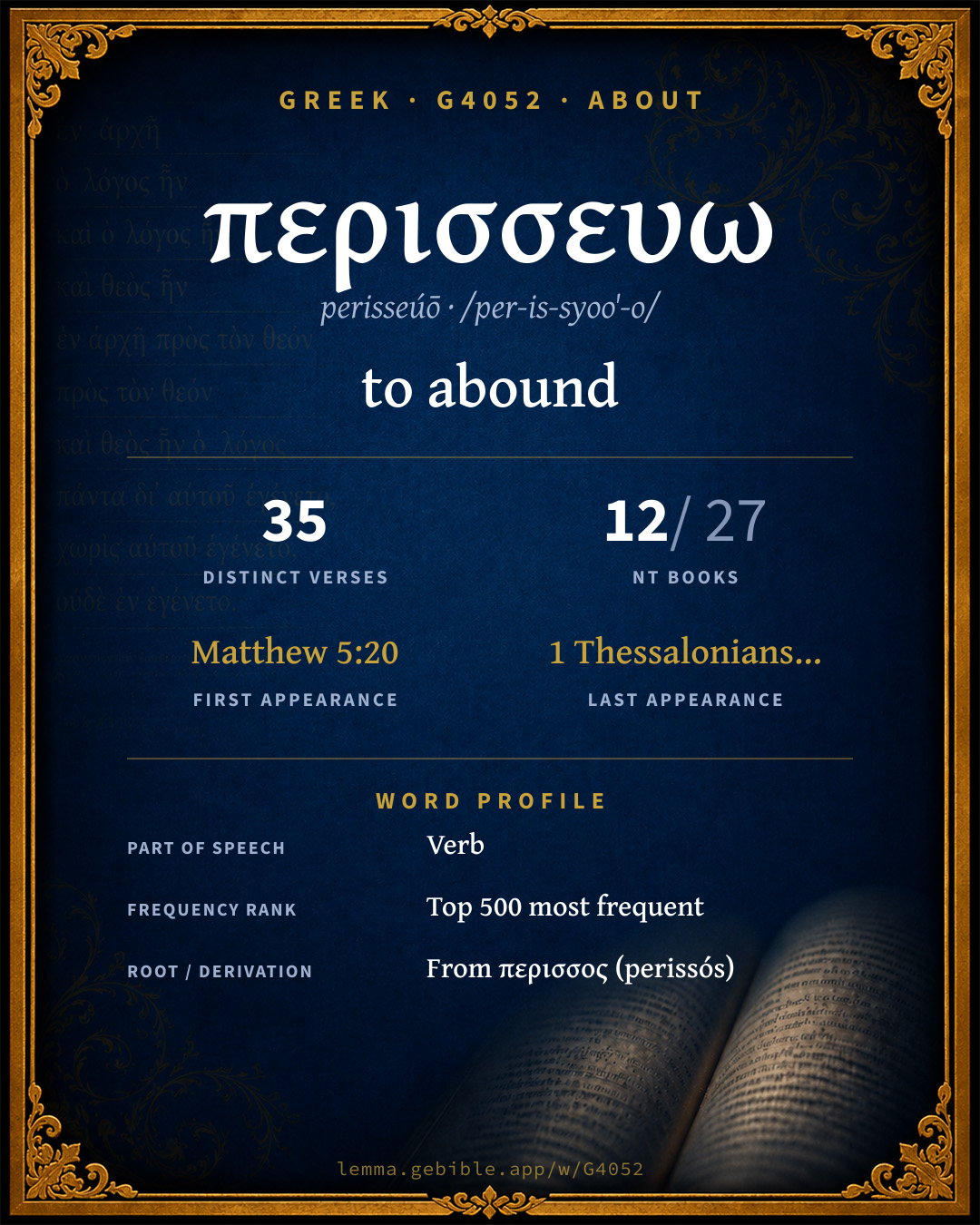
περισσεύω
to abound
‘to abound’ is one of 3 main senses fuller range ↓
Full lexicon entry — Thayer's Greek Lexicon
From Thayer's Greek Lexicon
Where this word appears
See every Present-tense verb in the Greek New Testament →
Grammar key — what these labels mean
Part of speech
- Verb
- An action or state-of-being word.
Tense
- Present
- Ongoing or general action in present time (imperfective aspect).
- Aorist
- Action viewed as a simple whole, without regard to duration — often past (perfective aspect).
- Future
- Action expected in future time.
- Imperfect
- Continuous or repeated action in past time (“was writing”).
Voice
- Active
- The subject performs the action.
- Passive
- The subject receives the action.
Mood
- Infinitive
- A verbal noun (“to write”), unmarked for person or number.
- Indicative
- States a fact or asks a factual question (the mood of reality).
- Subjunctive
- Expresses probability, purpose, or possibility (the mood of contingency).
- Participle
- A verbal adjective (“writing,” “having written”).
- Optative
- Expresses a wish or a remote possibility.
Case
- Accusative
- The case of the direct object and of extent.
- Genitive
- The case of source, possession, or “of” — answers “whose / from what.”
- Nominative
- The case of the subject (and the predicate nominative).
Person
- 3rd person
- The one spoken about (“he / she / it / they”).
- 2nd person
- The one addressed (“you”).
- 1st person
- The speaker (“I / we”).
Gender
- Neuter
- Grammatically neuter.
- Masculine
- Grammatically masculine.
- Feminine
- Grammatically feminine.
Number
- Singular
- One.
- Plural
- More than one.
Grammatical forms 21 distinct
- Verb, Present, Active, Infinitive 5 times (13%)
- Verb, Aorist, Active, Indicative, 3rd person, Singular 4 times (10%)
- Verb, Present, Active, Subjunctive, 2nd person, Plural 4 times (10%)
- Verb, Present, Active, Indicative, 3rd person, Singular 3 times (8%)
- Verb, Aorist, Active, Subjunctive, 3rd person, Singular 2 times (5%)
- Verb, Future, Passive, Indicative, 3rd person, Singular 2 times (5%)
- Verb, Present, Active, Participle, Accusative, Singular, Neuter 2 times (5%)
- Verb, Present, Active, Participle, Genitive, Singular, Neuter 2 times (5%)
+13 more forms (15 occurrences)
Parsed forms decoded from the imported morphology (Robinson–Tischendorf, public domain), counted across 39 parsed occurrences — not distinct verses.
Every verse where G4052 appears — 35 distinct verses across 12 books. Click any verse to open its interlinear word-by-word view. Verse text shown in the World English Bible for context — . Each verse’s Greek form is shown with its reference; the English is not keyword-highlighted, since the data carries no word-level English alignment. Use “Compare translations” on any verse to read it across multiple English versions. This concordance covers the Greek New Testament; Septuagint (Greek Old Testament) occurrences of this word are not indexed here.
Matthew 5 verses
- Matthew 5:20 περισσεύσῃ aor act subj 3sg For I tell you that unless your righteousness exceeds that of the scribes and Pharisees, there is no way you will enter into the Kingdom of Heaven.
- Matthew 13:12 περισσευθήσεται fut pass ind 3sg For whoever has, to him will be given, and he will have abundance, but whoever doesn't have, from him will be taken away even that which he has.
- Matthew 14:20 περισσεῦον pres act ptcp acc sg neut They all ate, and were filled. They took up twelve baskets full of that which remained left over from the broken pieces.
- Matthew 15:37 περισσεῦον pres act ptcp acc sg neut They all ate, and were filled. They took up seven baskets full of the broken pieces that were left over.
- Matthew 25:29 περισσευθήσεται fut pass ind 3sg For to everyone who has will be given, and he will have abundance, but from him who has not, even that which he has will be taken away.
Mark 1 verse
Luke 4 verses
- Luke 9:17 περισσεῦσαν aor act ptcp nom sg neut They ate, and were all filled. They gathered up twelve baskets of broken pieces that were left over.
- Luke 12:15 περισσεύειν pres act inf He said to them, "Beware! Keep yourselves from covetousness, for a man's life doesn't consist of the abundance of the things which he possesses."
- Luke 15:17 περισσεύουσιν pres act ind 3pl But when he came to himself he said, 'How many hired servants of my father's have bread enough to spare, and I'm dying with hunger!
- Luke 21:4 περισσεύοντος pres act ptcp gen sg neut for all these put in gifts for God from their abundance, but she, out of her poverty, put in all that she had to live on."
John 2 verses
- John 6:12 περισσεύσαντα aor act ptcp acc pl neut When they were filled, he said to his disciples, "Gather up the broken pieces which are left over, that nothing be lost."
- John 6:13 ἐπερίσσευσαν aor act ind 3pl So they gathered them up, and filled twelve baskets with broken pieces from the five barley loaves, which were left over by those who had eaten.
Acts 1 verse
Romans 3 verses
- Romans 3:7 ἐπερίσσευσεν aor act ind 3sg For if the truth of God through my lie abounded to his glory, why am I also still judged as a sinner?
- Romans 5:15 ἐπερίσσευσεν aor act ind 3sg But the free gift isn't like the trespass. For if by the trespass of the one the many died, much more did the grace of God, and the gift by the grace of the one man, Jesus Christ, abound to the many.
- Romans 15:13 περισσεύειν pres act inf Now may the God of hope fill you with all joy and peace in believing, that you may abound in hope, in the power of the Holy Spirit.
1 Corinthians 3 verses
- 1 Corinthians 8:8 περισσεύομεν pres act ind 1pl But food will not commend us to God. For neither, if we don't eat, are we the worse; nor, if we eat, are we the better.
- 1 Corinthians 14:12 περισσεύητε pres act subj 2pl So also you, since you are zealous for spiritual gifts, seek that you may abound to the building up of the assembly.
- 1 Corinthians 15:58 περισσεύοντες pres act ptcp nom pl masc Therefore, my beloved brothers, be steadfast, immovable, always abounding in the Lord's work, because you know that your labor is not in vain in the Lord.
2 Corinthians 7 verses
- 2 Corinthians 1:5 περισσεύει περισσεύει pres act ind 3sg pres act ind 3sg For as the sufferings of Christ abound to us, even so our comfort also abounds through Christ.
- 2 Corinthians 3:9 περισσεύει pres act ind 3sg For if the service of condemnation has glory, the service of righteousness exceeds much more in glory.
- 2 Corinthians 4:15 περισσεύσῃ aor act subj 3sg For all things are for your sakes, that the grace, being multiplied through the many, may cause the thanksgiving to abound to the glory of God.
- 2 Corinthians 8:2 ἐπερίσσευσεν aor act ind 3sg how that in much proof of affliction the abundance of their joy and their deep poverty abounded to the riches of their liberality.
- 2 Corinthians 8:7 περισσεύετε περισσεύητε pres act ind 2pl pres act subj 2pl But as you abound in everything, in faith, utterance, knowledge, all earnestness, and in your love to us, see that you also abound in this grace.
- 2 Corinthians 9:8 περισσεῦσαι περισσεύητε aor act inf pres act subj 2pl And God is able to make all grace abound to you, that you, always having all sufficiency in everything, may abound to every good work.
- 2 Corinthians 9:12 περισσεύουσα pres act ptcp nom sg fem For this service of giving that you perform not only makes up for lack among the saints, but abounds also through many givings of thanks to God;
Ephesians 1 verse
Philippians 4 verses
- Philippians 1:9 περισσεύῃ pres act subj 3sg This I pray, that your love may abound yet more and more in knowledge and all discernment;
- Philippians 1:26 περισσεύῃ pres act subj 3sg that your rejoicing may abound in Christ Jesus in me through my presence with you again.
- Philippians 4:12 περισσεύειν περισσεύειν pres act inf pres act inf I know how to be humbled, and I know also how to abound. In everything and in all things I have learned the secret both to be filled and to be hungry, both to abound and to be in need.
- Philippians 4:18 περισσεύω pres act ind 1sg But I have all things, and abound. I am filled, having received from Epaphroditus the things that came from you, a sweet-smelling fragrance, an acceptable and well-pleasing sacrifice to God.
Colossians 1 verse
1 Thessalonians 3 verses
- 1 Thessalonians 3:12 περισσεύσαι aor act opt 3sg and the Lord make you to increase and abound in love one toward another, and toward all men, even as we also do toward you,
- 1 Thessalonians 4:1 περισσεύητε pres act subj 2pl Finally then, brothers, we beg and exhort you in the Lord Jesus, that as you received from us how you ought to walk and to please God, that you abound more and more.
- 1 Thessalonians 4:10 περισσεύειν pres act inf for indeed you do it toward all the brothers who are in all Macedonia. But we exhort you, brothers, that you abound more and more;
About this entry
At a glance — auto-summarized from this page’s data, not written by a person. Every figure links to its source below. This summary describes the numbers; it doesn’t interpret them.
“to abound” is the headline sense of the Greek verb περισσευω (perisseúō). Scripture first uses it in Matthew 5:20. With 35 verses in 12 books, it is a moderately common word in the Greek New Testament. Catalogued under 3 senses, its meaning is not single-sense. From the same root come περισσος, περισσοτερος and περισσως. The sections below give every sense, occurrence, and version rendering.
Gloss history
Strong's 1890 vs modern scholarship
About this word
Strong's G4052 catalogs a Greek word from the Greek New Testament.
These counts are not copied from any lexicon or concordance. They are computed here, from the morphology-tagged Greek New Testament. What Lemma adds →
- 35
- distinct verses
- The word appears in 35 distinct verses.
- 12 / 27
- NT books
- The word appears in 12 of 27 New Testament books.
- #385
- by frequency
- Top 500 most frequent Greek words (rank 385 of 5,347 Greek words by occurrence).
View all 35 occurrences in the concordance →
Most concentrated in
- 2 Corinthians 7 verses 20%
- Matthew 5 verses 14%
- Luke 4 verses 11%
By section of the New Testament
By traditional corpus
Conventional, traditional groupings — biblical authorship is debated, so this is a traditional corpus grouping, not an authorship claim. Some books belong to more than one corpus (Luke is in both the Gospels and the Lukan corpus, and so on), so these shares overlap and need not total 100%. Each figure is a share of the word’s 35 distinct verses.
- Pauline corpus 22 verses · 63%
- Gospels 12 verses · 34%
- Lukan (Luke–Acts) 5 verses · 14%
- Johannine 2 verses · 6%
How translations render this word
Counts come from each version’s own published word-to-Strong’s tagging or interlinear alignment — an approximate guide to how each version renders this word, not a word-level alignment the data otherwise carries. Because each total is that version’s own tagged count, the per-version totals vary from one another and need not match the appearance or distinct-verse counts above. These counts may also differ from a printed concordance because Lemma counts each distinctly tagged rendering and does not collapse phrase taggings into a single head-word total. This is a fixed set of word-tagged versions (KJV, ASV, BSB, ULT) and does not change with the reading translation you choose elsewhere. Each version’s license is shown beside its name below (and on Sources).
- King James Version: Abound 5×, Abundance 3×, Abounding 2×
- American Standard Version: Abound 7×, May abound 4×, Remained 3×
- Berean Standard Bible: Abound 3×, Excel 3×, Were left over 3×
- unfoldingWord Literal Text: Abound 8×, Abounding 6×, Abounds 4×
King James Version Public Domain
Renders G4052 across 41 tagged occurrences — most commonly:
Plus 25 renderings that appear only once — usually multi-word phrases or single function words the recovered tagging swept in, not distinct renderings.
American Standard Version Public Domain
Renders G4052 across 39 tagged occurrences — most commonly:
Plus 16 renderings that appear only once — usually multi-word phrases or single function words the recovered tagging swept in, not distinct renderings.
Berean Standard Bible Public Domain
Renders G4052 across 37 tagged occurrences — most commonly:
Plus 24 renderings that appear only once — usually multi-word phrases or single function words the recovered tagging swept in, not distinct renderings. Not rendered by a distinct English word in 2 further occurrences.
unfoldingWord Literal Text CC BY-SA 4.0
Renders G4052 across 44 tagged occurrences — most commonly:
Plus 21 renderings that appear only once — usually multi-word phrases or single function words the recovered tagging swept in, not distinct renderings.
Senses in Thayer's
The 3 senses Thayer's distinguishes for this word, in lexicon order (not ranked by frequency or importance). The full entry — with sub-senses — is in the Lexicon Entry tab.
- to exceed a fixed number of measure, to be left over and above a certain number or measure
- to furnish one richly so that he has abundance
- to make abundant or excellent
Word origin
Derived from περισσος (perissós) (G4053) — exceeding.
From G4053 ; to superabound (in quantity or quality) be in excess be superfluous ; also (transitively) to cause to superabound or excel : - (make more) abound (have have more) abundance (be more) abundant be the better enough and to spare exceed excel increase be left redound remain (over and above).
— Strong’s Exhaustive Concordance (1890), public domain.
Forms in the corpus
The 21 distinct written forms G4052 takes in the Greek New Testament, most frequent first — each parse links to that tense’s occurrences in the concordance.
Same root — word family
Other Thayer's entries built from the same root as G4052, grouped by Strong’s listed origin. These share a root / origin per the lexicon — not necessarily a shared meaning. Each links to that word’s own entry.
Derives from
Shares the same root
Derived from this word
Compare all same-root words → Showing 4 of 6 — not the complete family. They share a root, not necessarily a meaning.
Septuagint usage
The same Greek word περισσευω appears 3 times in the Greek Old Testament (Septuagint), across 3 verses in 2 books.
- 3
- LXX occurrences
- Tagged occurrences of this Greek word in the Septuagint.
- 3
- verses
- Distinct Septuagint verses containing this word.
- 2 / 39
- OT books
- The word appears in 2 of the 39 Old Testament books.
Sample Septuagint occurrences
- 1 Samuel 2:33 περισσεύω
- Ecclesiastes 3:19 περισσεύω
Septuagint occurrences (same lexeme)
Every verse where the same Strong’s number (G4052) appears in the Greek Septuagint. Verse text shown in the World English Bible for context; the Greek form is the matched word — the English is not keyword-highlighted.
- 1 Samuel 2:33 περισσεύω The man of yours, [whom] I shall not cut off from my altar, [shall be] to consume your eyes, and to grieve your heart; and all the increase of your house shall die in the flower of their age.
- 1 Samuel 2:36 περισσεύω It shall happen, that everyone who is left in your house shall come and bow down to him for a piece of silver and a loaf of bread, and shall say, Please put me into one of the priests' offices, that I may eat a morsel of bread.
- Ecclesiastes 3:19 περισσεύω For that which happens to the sons of men happens to animals. Even one thing happens to them. As the one dies, so the other dies. Yes, they have all one breath; and man has no advantage over the animals: for all is vanity.
These are occurrences of the same Greek lexeme (G4052) in the Septuagint — not a translation of any one Hebrew word. The store carries no word-level Hebrew↔Greek alignment, so no Hebrew original is asserted here. Counts come from the recovered LXX Strong's tagging — high-frequency vocabulary is well covered, while rare or late forms may be untagged — so they reflect tagged occurrences and may slightly undercount.