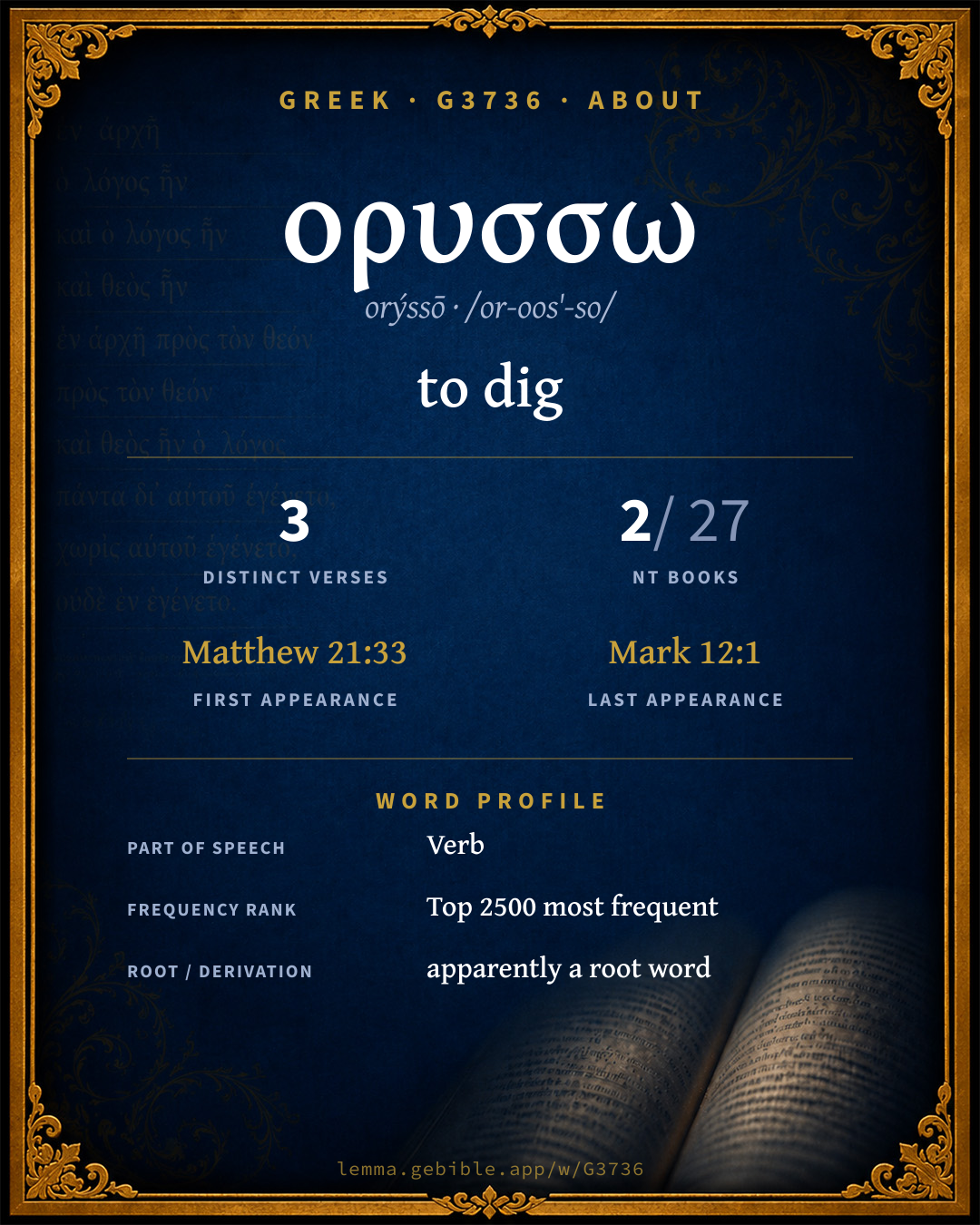
ὀρύσσω
to dig
Full lexicon entry — Thayer's Greek Lexicon
From Thayer's Greek Lexicon
Where this word appears
Grammar key — what these labels mean
Part of speech
- Verb
- An action or state-of-being word.
Tense
- Aorist
- Action viewed as a simple whole, without regard to duration — often past (perfective aspect).
Voice
- Active
- The subject performs the action.
Mood
- Indicative
- States a fact or asks a factual question (the mood of reality).
Person
- 3rd person
- The one spoken about (“he / she / it / they”).
Number
- Singular
- One.
Every verse where G3736 appears — 3 distinct verses across 2 books. Click any verse to open its interlinear word-by-word view. Verse text shown in the World English Bible for context — . Each verse’s Greek form is shown with its reference; the English is not keyword-highlighted, since the data carries no word-level English alignment. Use “Compare translations” on any verse to read it across multiple English versions. This concordance covers the Greek New Testament; Septuagint (Greek Old Testament) occurrences of this word are not indexed here.
Matthew 2 verses
- Matthew 21:33 ὤρυξεν aor act ind 3sg "Hear another parable. There was a man who was a master of a household, who planted a vineyard, set a hedge about it, dug a winepress in it, built a tower, leased it out to farmers, and went into another country.
- Matthew 25:18 ὤρυξεν aor act ind 3sg But he who received the one went away and dug in the earth, and hid his lord's money.
Mark 1 verse
About this entry
At a glance — auto-summarized from this page’s data, not written by a person. Every figure links to its source below. This summary describes the numbers; it doesn’t interpret them.
ορυσσω — transliterated orýssō — is a Greek verb carrying the sense “to dig.” It occurs a mere 3 verses across Scripture. More than two-thirds of its appearances fall in Matthew. Its earliest occurrence is Matthew 21:33. See the sense tree, 3-verse concordance, and the renderings breakdown below.
Gloss history
Strong's 1890 vs modern scholarship
About this word
Strong's G3736 catalogs a Greek word from the Greek New Testament.
These counts are not copied from any lexicon or concordance. They are computed here, from the morphology-tagged Greek New Testament. What Lemma adds →
- 3
- distinct verses
- The word appears in 3 distinct verses.
- 2 / 27
- NT books
- The word appears in 2 of 27 New Testament books.
- #2,203
- by frequency
- Top 2500 most frequent Greek words (rank 2,203 of 5,347 Greek words by occurrence).
View all 3 occurrences in the concordance →
By traditional corpus
Conventional, traditional groupings — biblical authorship is debated, so this is a traditional corpus grouping, not an authorship claim. Some books belong to more than one corpus (Luke is in both the Gospels and the Lukan corpus, and so on), so these shares overlap and need not total 100%. Each figure is a share of the word’s 3 distinct verses.
- Gospels 3 verses · 100%
How translations render this word
Counts come from each version’s own published word-to-Strong’s tagging or interlinear alignment — an approximate guide to how each version renders this word, not a word-level alignment the data otherwise carries. Because each total is that version’s own tagged count, the per-version totals vary from one another and need not match the appearance or distinct-verse counts above. These counts may also differ from a printed concordance because Lemma counts each distinctly tagged rendering and does not collapse phrase taggings into a single head-word total. This is a fixed set of word-tagged versions (KJV, ASV, BSB, ULT) and does not change with the reading translation you choose elsewhere. Each version’s license is shown beside its name below (and on Sources).
- King James Version: Digged 3×
- American Standard Version: Digged 3×
- Berean Standard Bible: Dug 2×
- unfoldingWord Literal Text: Dug 3×
King James Version Public Domain
Renders G3736 across 3 tagged occurrences — most commonly:
American Standard Version Public Domain
Renders G3736 across 3 tagged occurrences — most commonly:
Berean Standard Bible Public Domain
Renders G3736 across 3 tagged occurrences — most commonly:
Plus 1 rendering that appears only once — usually multi-word phrases or single function words the recovered tagging swept in, not distinct renderings.
unfoldingWord Literal Text CC BY-SA 4.0
Renders G3736 across 3 tagged occurrences — most commonly:
Senses in Thayer's
The 1 sense Thayer's distinguishes for this word, in lexicon order (not ranked by frequency or importance). The full entry — with sub-senses — is in the Lexicon Entry tab.
- to dig
Word origin
Origin: apparently a root word
Apparently a primary verb; to burrow in the ground that is dig : - dig.
— Strong’s Exhaustive Concordance (1890), public domain.
Septuagint usage
The same Greek word ορυσσω appears 28 times in the Greek Old Testament (Septuagint), across 26 verses in 11 books.
- 28
- LXX occurrences
- Tagged occurrences of this Greek word in the Septuagint.
- 26
- verses
- Distinct Septuagint verses containing this word.
- 11 / 39
- OT books
- The word appears in 11 of the 39 Old Testament books.
Sample Septuagint occurrences
- Genesis 21:30 ὀρύσσω
- Numbers 21:18 ὀρύσσω
- Deuteronomy 23:14 ὀρύσσω
- 2 Chronicles 16:14 ὀρύσσω
- Psalms 7:16 ὀρύσσω
- Proverbs 16:23 ὀρύσσω
- Ecclesiastes 10:8 ὀρύσσω
- Isaiah 5:2 ὀρύσσω
- Jeremiah 2:13 ὀρύσσω
- Ezekiel 8:8 ὀρύσσω
- Zechariah 3:9 ὀρύσσω
Septuagint occurrences (same lexeme)
Every verse where the same Strong’s number (G3736) appears in the Greek Septuagint. Verse text shown in the World English Bible for context; the Greek form is the matched word — the English is not keyword-highlighted.
- Genesis 21:30 ὀρύσσω He said, "You shall take these seven ewe lambs from my hand, that it may be a witness to me, that I have dug this well."
- Genesis 26:15 ὀρύσσω Now all the wells which his father's servants had dug in the days of Abraham his father, the Philistines had stopped, and filled with earth.
- Genesis 26:18 ὀρύσσω Isaac dug again the wells of water, which they had dug in the days of Abraham his father. For the Philistines had stopped them after the death of Abraham. He called their names after the names by which his father had called them.
- Genesis 26:19 ὀρύσσω Isaac's servants dug in the valley, and found there a well of springing water.
- Genesis 26:21 ὀρύσσω They dug another well, and they argued over that, also. He called the name of it Sitnah.
- Genesis 26:22 ὀρύσσω He left that place, and dug another well. They didn't argue over that one. He called it Rehoboth. He said, "For now Yahweh has made room for us, and we will be fruitful in the land."
- Genesis 26:25 ὀρύσσω He built an altar there, and called on the name of Yahweh, and pitched his tent there. There Isaac's servants dug a well.
- Genesis 26:32 ὀρύσσω It happened the same day, that Isaac's servants came, and told him concerning the well which they had dug, and said to him, "We have found water."
- Genesis 50:5 ὀρύσσω 'My father made me swear, saying, "Behold, I am dying. Bury me in my grave which I have dug for myself in the land of Canaan." Now therefore, please let me go up and bury my father, and I will come again.'"
- Numbers 21:18 ὀρύσσω The well, which the princes dug, Which the nobles of the people dug, With the scepter, [and] with their poles. From the wilderness [they traveled] to Mattanah;
- Deuteronomy 23:14 ὀρύσσω for Yahweh your God walks in the midst of your camp, to deliver you, and to give up your enemies before you; therefore shall your camp be holy, that he may not see an unclean thing in you, and turn away from you.
- 2 Chronicles 16:14 ὀρύσσω They buried him in his own tombs, which he had hewn out for himself in the city of David, and laid him in the bed which was filled with sweet odors and various kinds [of spices] prepared by the perfumers' are: and they made a very great burning for him.
- Psalms 7:16 ὀρύσσω The trouble he causes shall return to his own head. His violence shall come down on the crown of his own head.
- Psalms 21:17 ὀρύσσω
- Psalms 56:7 ὀρύσσω Shall they escape by iniquity? In anger cast down the peoples, God.
- Psalms 93:13 ὀρύσσω
- Proverbs 16:23 ὀρύσσω The heart of the wise instructs his mouth, And adds learning to his lips.
- Proverbs 26:27 ὀρύσσω Whoever digs a pit shall fall into it. Whoever rolls a stone, it will come back on him.
- Proverbs 29:22 ὀρύσσω An angry man stirs up strife, And a wrathful man abounds in sin.
- Ecclesiastes 10:8 ὀρύσσω He who digs a pit may fall into it; and whoever breaks through a wall may be bitten by a snake.
- Isaiah 5:2 ὀρύσσω He dug it up, Gathered out its stones, Planted it with the choicest vine, Built a tower in its midst, And also cut out a winepress therein. He looked for it to yield grapes, But it yielded wild grapes.
- Isaiah 51:1 ὀρύσσω Listen to me, you who follow after righteousness, you who seek Yahweh: look to the rock whence you were hewn, and to the hold of the pit whence you were dug.
- Jeremiah 2:13 ὀρύσσω For my people have committed two evils: they have forsaken me, the spring of living waters, and hewed them out cisterns, broken cisterns, that can hold no water.
- Jeremiah 13:7 ὀρύσσω Then I went to the Euphrates, and dug, and took the belt from the place where I had hid it; and, behold, the belt was marred, it was profitable for nothing.
- Ezekiel 8:8 ὀρύσσω Then said he to me, Son of man, dig now in the wall: and when I had dug in the wall, behold, a door.
- Zechariah 3:9 ὀρύσσω For, behold, the stone that I have set before Joshua; on one stone are seven eyes: behold, I will engrave the engraving of it,' says Yahweh of Hosts, 'and I will remove the iniquity of that land in one day.
These are occurrences of the same Greek lexeme (G3736) in the Septuagint — not a translation of any one Hebrew word. The store carries no word-level Hebrew↔Greek alignment, so no Hebrew original is asserted here. Counts come from the recovered LXX Strong's tagging — high-frequency vocabulary is well covered, while rare or late forms may be untagged — so they reflect tagged occurrences and may slightly undercount.