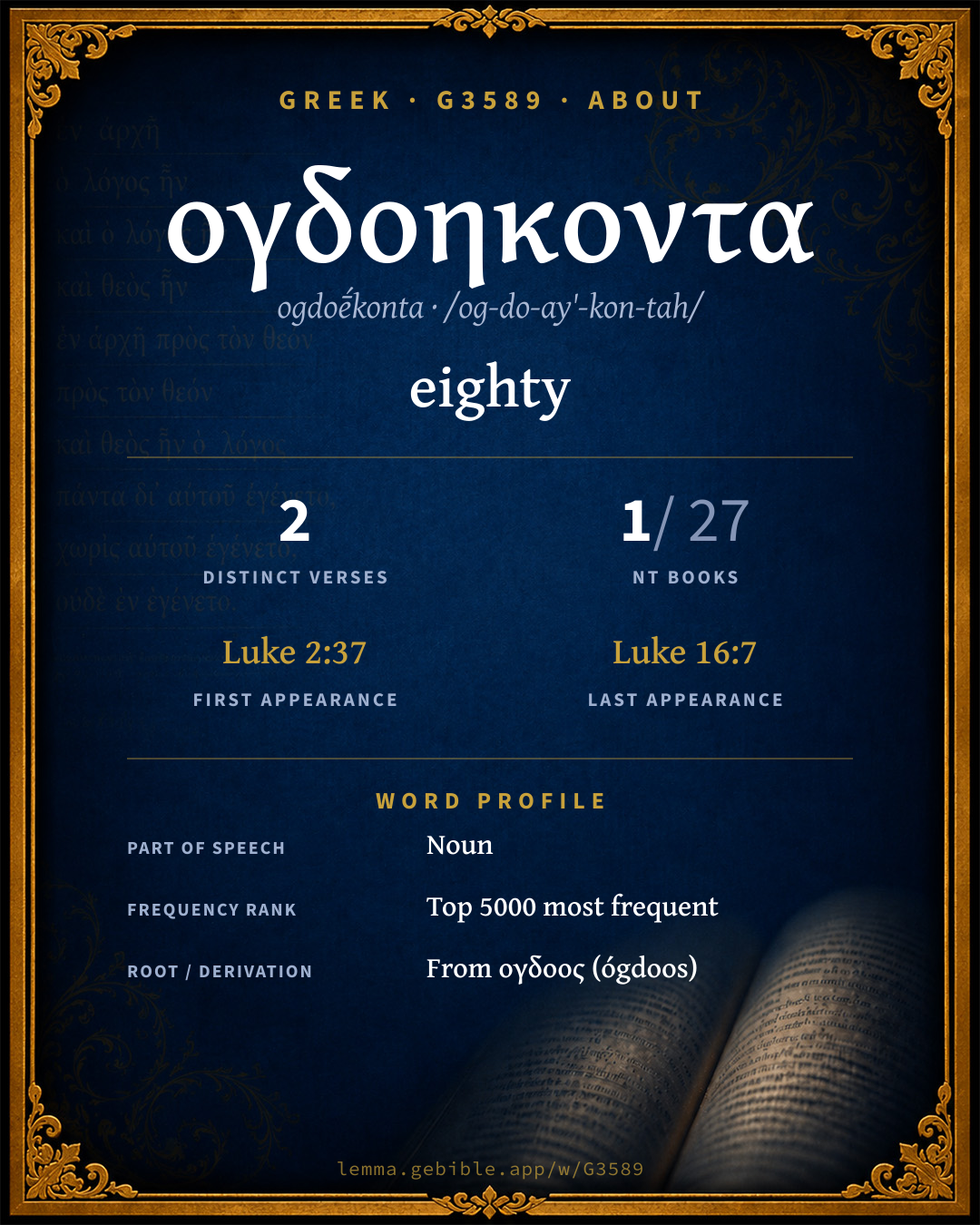
ὀγδοήκοντα
eighty
Full lexicon entry — Thayer's Greek Lexicon
From Thayer's Greek Lexicon
Where this word appears
Every verse where G3589 appears — 2 distinct verses across 1 book. Click any verse to open its interlinear word-by-word view. Verse text shown in the World English Bible for context — . Each verse’s Greek form is shown with its reference; the English is not keyword-highlighted, since the data carries no word-level English alignment. Use “Compare translations” on any verse to read it across multiple English versions. This concordance covers the Greek New Testament; Septuagint (Greek Old Testament) occurrences of this word are not indexed here.
Luke 2 verses
- Luke 2:37 ὀγδοήκοντα adj num indecl and she had been a widow for about eighty-four years), who didn't depart from the temple, worshipping with fastings and petitions night and day.
- Luke 16:7 ὀγδοήκοντα adj num indecl Then said he to another, 'How much do you owe?' He said, 'A hundred cors of wheat.' He said to him, 'Take your bill, and write eighty.'
About this entry
At a glance — auto-summarized from this page’s data, not written by a person. Every figure links to its source below. This summary describes the numbers; it doesn’t interpret them.
ογδοηκοντα — transliterated ogdoḗkonta — is a Greek noun carrying the sense “eighty.” With only 2 verses it sits in the long tail of Greek New Testament vocabulary. More than three-quarters of its appearances fall in Luke. Debuting at Luke 2:37, it then recurs through the corpus. Each statement above links to its evidence; the full detail follows below.
Gloss history
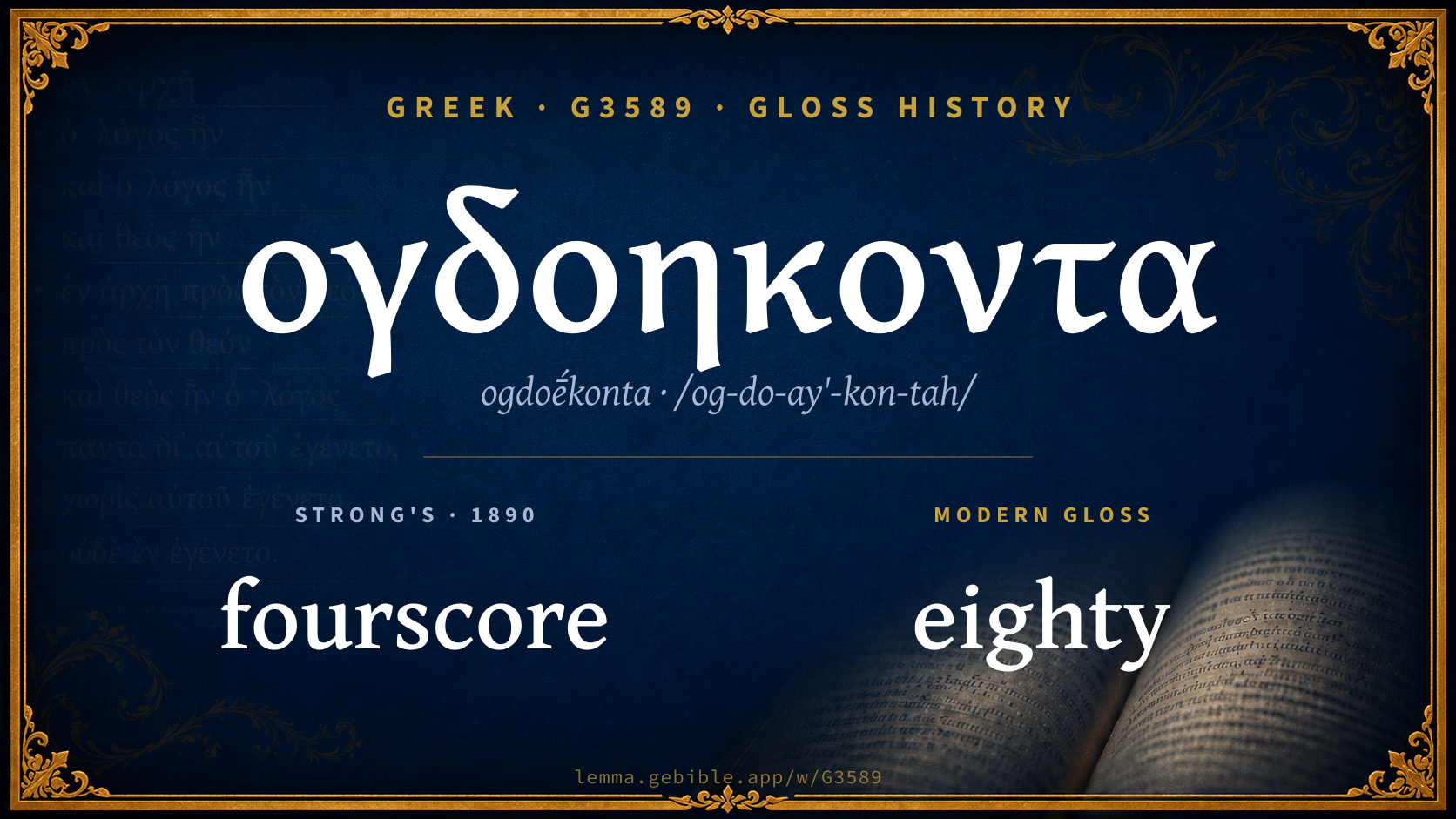
Strong's 1890 vs modern scholarship
About this word
Strong's G3589 catalogs a Greek word from the Greek New Testament.
These counts are not copied from any lexicon or concordance. They are computed here, from the morphology-tagged Greek New Testament. What Lemma adds →
- 2
- distinct verses
- The word appears in 2 distinct verses.
- 1 / 27
- NT books
- The word appears in 1 of 27 New Testament books.
- #2,678
- by frequency
- Top 5000 most frequent Greek words (rank 2,678 of 5,347 Greek words by occurrence).
View all 2 occurrences in the concordance →
Most concentrated in
- Luke 2 verses 100%
By section of the New Testament
By traditional corpus
Conventional, traditional groupings — biblical authorship is debated, so this is a traditional corpus grouping, not an authorship claim. Some books belong to more than one corpus (Luke is in both the Gospels and the Lukan corpus, and so on), so these shares overlap and need not total 100%. Each figure is a share of the word’s 2 distinct verses.
- Gospels 2 verses · 100%
- Lukan (Luke–Acts) 2 verses · 100%
How translations render this word
Counts come from each version’s own published word-to-Strong’s tagging or interlinear alignment — an approximate guide to how each version renders this word, not a word-level alignment the data otherwise carries. Because each total is that version’s own tagged count, the per-version totals vary from one another and need not match the appearance or distinct-verse counts above. These counts may also differ from a printed concordance because Lemma counts each distinctly tagged rendering and does not collapse phrase taggings into a single head-word total. This is a fixed set of word-tagged versions (KJV, ASV, BSB, ULT) and does not change with the reading translation you choose elsewhere. Each version’s license is shown beside its name below (and on Sources).
- King James Version: Fourscore 2×
- American Standard Version: Fourscore 1×, Fourscore and four 1×
- Berean Standard Bible: Eighty 1×, Eighty-four 1×
- unfoldingWord Literal Text: not separately translated
King James Version Public Domain
Renders G3589 across 2 tagged occurrences — most commonly:
American Standard Version Public Domain
Renders G3589 across 2 tagged occurrences — most commonly:
Berean Standard Bible Public Domain
Renders G3589 across 2 tagged occurrences — most commonly:
unfoldingWord Literal Text CC BY-SA 4.0
Does not render G3589 with a distinct English word (not separately translated in its 2 tagged occurrences).
Senses in Thayer's
The 1 sense Thayer's distinguishes for this word, in lexicon order (not ranked by frequency or importance). The full entry — with sub-senses — is in the Lexicon Entry tab.
- eighty
Word origin
Derived from ογδοος (ógdoos) (G3590) — eighth.
From G3590 ; ten times eight : - fourscore.
— Strong’s Exhaustive Concordance (1890), public domain.
Septuagint usage
The same Greek word ογδοηκοντα appears 32 times in the Greek Old Testament (Septuagint), across 31 verses in 16 books.
- 32
- LXX occurrences
- Tagged occurrences of this Greek word in the Septuagint.
- 31
- verses
- Distinct Septuagint verses containing this word.
- 16 / 39
- OT books
- The word appears in 16 of the 39 Old Testament books.
Sample Septuagint occurrences
- Genesis 5:28 ὀγδοήκοντα
- Exodus 7:7 ὀγδοήκοντα
- Numbers 2:9 ὀγδοήκοντα
- Joshua 14:10 ὀγδοήκοντα
- Judges 3:30 ὀγδοήκοντα
- 2 Samuel 19:33 ὀγδοήκοντα
- 1 Kings 2:35 ὀγδοήκοντα
- 2 Kings 10:24 ὀγδοήκοντα
- 1 Chronicles 7:5 ὀγδοήκοντα
- 2 Chronicles 2:1 ὀγδοήκοντα
- Ezra 8:8 ὀγδοήκοντα
- Esther 1:4 ὀγδοήκοντα
Septuagint occurrences (same lexeme)
Every verse where the same Strong’s number (G3589) appears in the Greek Septuagint. Verse text shown in the World English Bible for context; the Greek form is the matched word — the English is not keyword-highlighted.
- Genesis 5:28 ὀγδοήκοντα Lamech lived one hundred eighty-two years, and became the father of a son,
- Genesis 16:16 ὀγδοήκοντα Abram was eighty-six years old, when Hagar bore Ishmael to Abram.
- Genesis 35:28 ὀγδοήκοντα The days of Isaac were one hundred eighty years.
- Exodus 7:7 ὀγδοήκοντα Moses was eighty years old, and Aaron eighty-three years old, when they spoke to Pharaoh.
- Numbers 2:9 ὀγδοήκοντα All who were numbered of the camp of Judah were one hundred eighty-six thousand four hundred, according to their divisions. They shall set out first.
- Numbers 4:48 ὀγδοήκοντα even those who were numbered of them, were eight thousand five hundred eighty.
- Joshua 14:10 ὀγδοήκοντα Now, behold, Yahweh has kept me alive, as he spoke, these forty-five years, from the time that Yahweh spoke this word to Moses, while Israel walked in the wilderness: and now, behold, I am this day eighty-five years old.
- Judges 3:30 ὀγδοήκοντα So Moab was subdued that day under the hand of Israel. The land had rest eighty years.
- 2 Samuel 19:33 ὀγδοήκοντα The king said to Barzillai, Come you over with me, and I will sustain you with me in Jerusalem.
- 2 Samuel 19:36 ὀγδοήκοντα Your servant would but just go over the Jordan with the king: and why should the king recompense it me with such a reward?
- 1 Kings 2:35 ὀγδοήκοντα The king put Benaiah the son of Jehoiada in his room over the host; and Zadok the priest did the king put in the room of Abiathar.
- 1 Kings 5:29 ὀγδοήκοντα
- 2 Kings 10:24 ὀγδοήκοντα They went in to offer sacrifices and burnt offerings. Now Jehu had appointed him eighty men outside, and said, If any of the men whom I bring into your hands escape, [he who lets him go], his life shall be for the life of him.
- 2 Kings 19:35 ὀγδοήκοντα It happened that night, that the angel of Yahweh went forth, and struck in the camp of the Assyrians one hundred eighty-five thousand: and when men arose early in the morning, behold, these were all dead bodies.
- 1 Chronicles 7:5 ὀγδοήκοντα Their brothers among all the families of Issachar, mighty men of valor, reckoned in all by genealogy, were eighty-seven thousand.
- 1 Chronicles 15:9 ὀγδοήκοντα of the sons of Hebron, Eliel the chief, and his brothers eighty;
- 1 Chronicles 21:5 ὀγδοήκοντα Joab gave up the sum of the numbering of the people to David. All those of Israel were one million one hundred thousand men who drew sword: and in Judah were four hundred seventy thousand men who drew sword.
- 1 Chronicles 25:7 ὀγδοήκοντα The number of them, with their brothers who were instructed in singing to Yahweh, even all who were skillful, was two hundred eighty-eight.
- 2 Chronicles 2:1 ὀγδοήκοντα Now Solomon purposed to build a house for the name of Yahweh, and a house for his kingdom.
- 2 Chronicles 2:17 ὀγδοήκοντα Solomon numbered all the foreigners who were in the land of Israel, after the numbering with which David his father had numbered them; and they were found one hundred fifty-three thousand six hundred.
- 2 Chronicles 11:1 ὀγδοήκοντα When Rehoboam was come to Jerusalem, he assembled the house of Judah and Benjamin, one hundred eighty thousand chosen men, who were warriors, to fight against Israel, to bring the kingdom again to Rehoboam.
- 2 Chronicles 17:15 ὀγδοήκοντα and next to him Jehohanan the captain, and with him two hundred eighty thousand;
- 2 Chronicles 17:18 ὀγδοήκοντα and next to him Jehozabad and with him one hundred eighty thousand ready prepared for war.
- 2 Chronicles 26:17 ὀγδοήκοντα Azariah the priest went in after him, and with him eighty priests of Yahweh, who were valiant men:
- Ezra 8:8 ὀγδοήκοντα Of the sons of Shephatiah, Zebadiah the son of Michael; and with him eighty males.
- Ezra 21:18 ὀγδοήκοντα
- Esther 1:4 ὀγδοήκοντα when he shown the riches of his glorious kingdom and the honor of his excellent majesty many days, even one hundred eighty days.
- Psalms 89:10 ὀγδοήκοντα You have broken Rahab in pieces, like one of the slain. You have scattered your enemies with your mighty arm.
- Song of Solomon 6:8 ὀγδοήκοντα There are sixty queens, eighty concubines, And virgins without number.
- Isaiah 37:36 ὀγδοηκοντα The angel of Yahweh went forth, and struck in the camp of the Assyrians one hundred and eighty-five thousand; and when men arose early in the morning, behold, these were all dead bodies.
- Jeremiah 48:5 ὀγδοηκοντα For by the ascent of Luhith with continual weeping shall they go up; for at the descent of Horonaim they have heard the distress of the cry of destruction.
These are occurrences of the same Greek lexeme (G3589) in the Septuagint — not a translation of any one Hebrew word. The store carries no word-level Hebrew↔Greek alignment, so no Hebrew original is asserted here. Counts come from the recovered LXX Strong's tagging — high-frequency vocabulary is well covered, while rare or late forms may be untagged — so they reflect tagged occurrences and may slightly undercount.