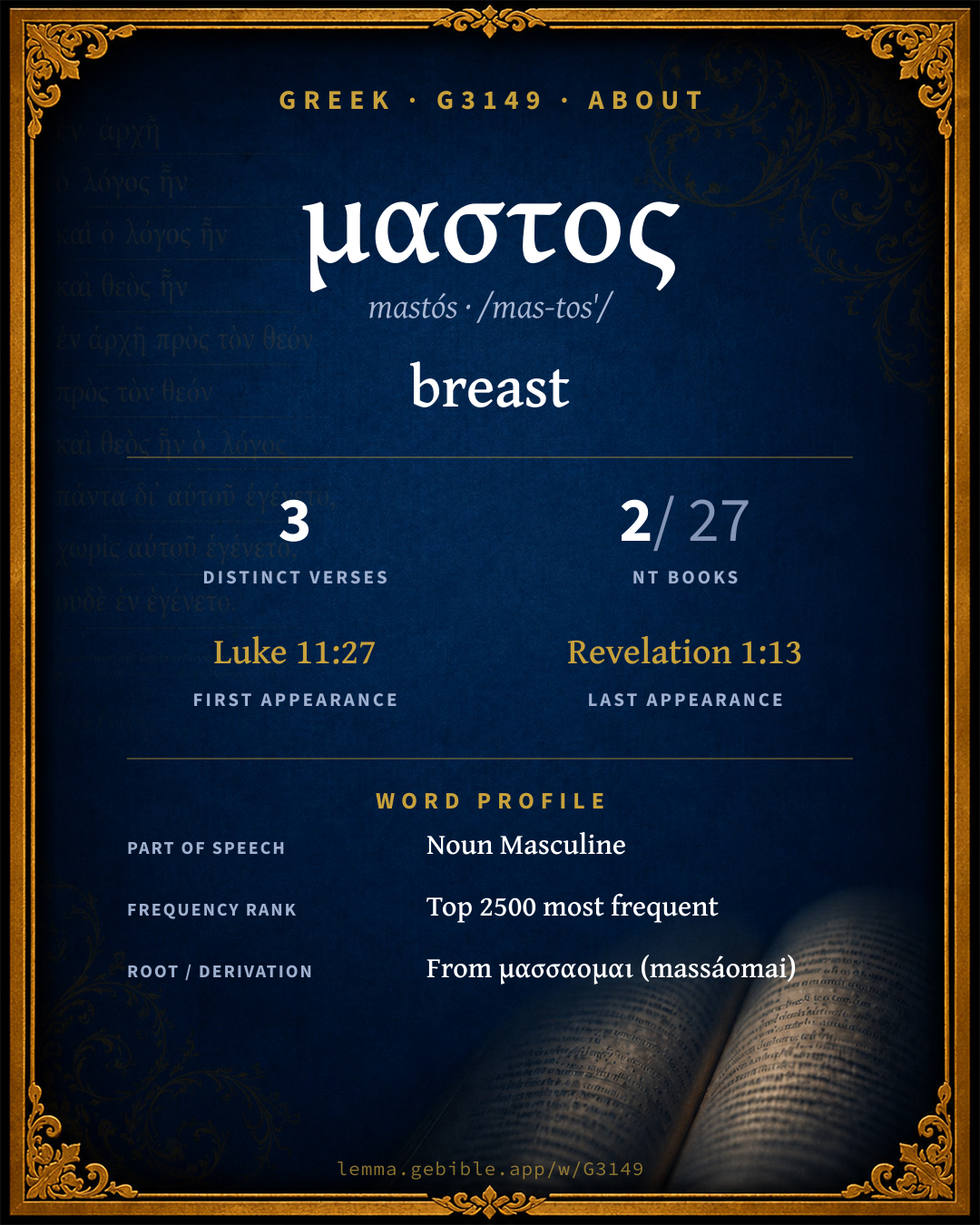
μαστός
breast
‘breast’ is one of 3 main senses fuller range ↓
Full lexicon entry — Thayer's Greek Lexicon
From Thayer's Greek Lexicon
Where this word appears
See every Nominative-case word in the Greek New Testament →
Grammar key — what these labels mean
Part of speech
- Noun
- A naming word — a person, place, thing, or idea.
Case
- Nominative
- The case of the subject (and the predicate nominative).
- Dative
- The case of the indirect object, means, or location — “to / for / with / in.”
Gender
- Masculine
- Grammatically masculine.
Number
- Plural
- More than one.
2 distinct verses where G3149 appears in the Nominative case, across 1 book. Filtered view — show all forms. Click any verse to open its interlinear word-by-word view. Verse text shown in the World English Bible for context — . Each verse’s Greek form is shown with its reference; the English is not keyword-highlighted, since the data carries no word-level English alignment. Use “Compare translations” on any verse to read it across multiple English versions. This concordance covers the Greek New Testament; Septuagint (Greek Old Testament) occurrences of this word are not indexed here.
Luke 2 verses
- Luke 11:27 μαστοὶ n nom pl masc It came to pass, as he said these things, a certain woman out of the multitude lifted up her voice, and said to him, "Blessed is the womb that bore you, and the breasts which nursed you!"
- Luke 23:29 μαστοὶ n nom pl masc For behold, the days are coming in which they will say, 'Blessed are the barren, the wombs that never bore, and the breasts that never nursed.'
About this entry
At a glance — auto-summarized from this page’s data, not written by a person. Every figure links to its source below. This summary describes the numbers; it doesn’t interpret them.
“breast” is the headline sense of the Greek noun μαστος (mastós). It is rare — just 3 verses in the entire Greek New Testament. It clusters heavily in Luke, which alone accounts for 67% of its uses. First canonically at Luke 11:27, it enters the text early. Lexicons map it across 3 senses. The sections below give every sense, occurrence, and version rendering.
Gloss history
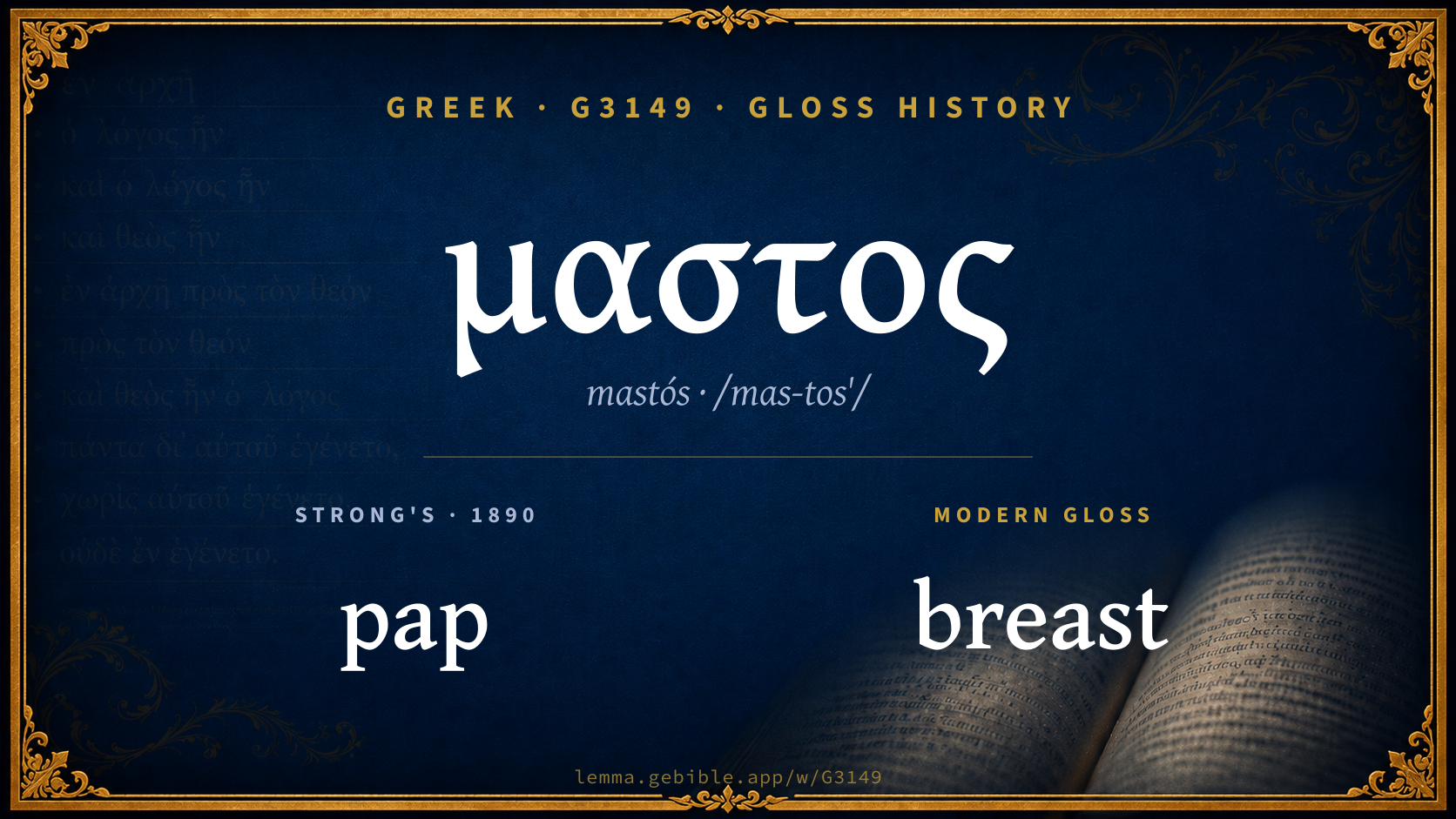
Strong's 1890 vs modern scholarship
About this word
Strong's G3149 catalogs a Greek word from the Greek New Testament.
These counts are not copied from any lexicon or concordance. They are computed here, from the morphology-tagged Greek New Testament. What Lemma adds →
- 3
- distinct verses
- The word appears in 3 distinct verses.
- 2 / 27
- NT books
- The word appears in 2 of 27 New Testament books.
- #2,203
- by frequency
- Top 2500 most frequent Greek words (rank 2,203 of 5,347 Greek words by occurrence).
View all 3 occurrences in the concordance →
Most concentrated in
- Luke 2 verses 67%
- Revelation 1 verse 33%
By section of the New Testament
By traditional corpus
Conventional, traditional groupings — biblical authorship is debated, so this is a traditional corpus grouping, not an authorship claim. Some books belong to more than one corpus (Luke is in both the Gospels and the Lukan corpus, and so on), so these shares overlap and need not total 100%. Each figure is a share of the word’s 3 distinct verses.
- Gospels 2 verses · 67%
- Lukan (Luke–Acts) 2 verses · 67%
- Johannine 1 verse · 33%
- Revelation 1 verse · 33%
How translations render this word
Counts come from each version’s own published word-to-Strong’s tagging or interlinear alignment — an approximate guide to how each version renders this word, not a word-level alignment the data otherwise carries. Because each total is that version’s own tagged count, the per-version totals vary from one another and need not match the appearance or distinct-verse counts above. These counts may also differ from a printed concordance because Lemma counts each distinctly tagged rendering and does not collapse phrase taggings into a single head-word total. This is a fixed set of word-tagged versions (KJV, ASV, BSB, ULT) and does not change with the reading translation you choose elsewhere. Each version’s license is shown beside its name below (and on Sources).
- King James Version: Paps 3×
- American Standard Version: Breasts 3×
- Berean Standard Bible: Breasts 2×
- unfoldingWord Literal Text: Breasts 2×
King James Version Public Domain
Renders G3149 across 3 tagged occurrences — most commonly:
American Standard Version Public Domain
Renders G3149 across 3 tagged occurrences — most commonly:
Berean Standard Bible Public Domain
Renders G3149 across 3 tagged occurrences — most commonly:
Plus 1 rendering that appears only once — usually multi-word phrases or single function words the recovered tagging swept in, not distinct renderings.
unfoldingWord Literal Text CC BY-SA 4.0
Renders G3149 across 3 tagged occurrences — most commonly:
Plus 1 rendering that appears only once — usually multi-word phrases or single function words the recovered tagging swept in, not distinct renderings.
Senses in Thayer's
The 3 senses Thayer's distinguishes for this word, in lexicon order (not ranked by frequency or importance). The full entry — with sub-senses — is in the Lexicon Entry tab.
- the breasts
- the breasts (nipples) of a man
- breasts of a women
Word origin
Derived from μασσαομαι (massáomai) (G3145) — to chew.
From the base of G3145 ; a (properly female) breast (as if kneaded up): - pap.
— Strong’s Exhaustive Concordance (1890), public domain.
Forms in the corpus
The 2 distinct written forms G3149 takes in the Greek New Testament, most frequent first — each parse links to that case’s occurrences in the concordance.
| Form | Parsing | Example | Uses |
|---|---|---|---|
| μαστοὶ mastoì | Noun, Nominative, Plural, Masculine | Luke 11:27 | 2 |
| μασθοῖς masthoîs | Noun, Dative, Plural, Masculine | Revelation 1:13 | 1 |
Same root — word family
Other Thayer's entries built from the same root as G3149, grouped by Strong’s listed origin. These share a root / origin per the lexicon — not necessarily a shared meaning. Each links to that word’s own entry.
Derives from
Shares the same root
Derived from this word
Compare all same-root words → Showing 4 of 6 — not the complete family. They share a root, not necessarily a meaning.
Septuagint usage
The same Greek word μαστος appears 31 times in the Greek Old Testament (Septuagint), across 30 verses in 10 books.
- 31
- LXX occurrences
- Tagged occurrences of this Greek word in the Septuagint.
- 30
- verses
- Distinct Septuagint verses containing this word.
- 10 / 39
- OT books
- The word appears in 10 of the 39 Old Testament books.
Sample Septuagint occurrences
- Genesis 49:25 μαστός
- Job 3:12 μαστός
- Psalms 21:10 μαστός
- Song of Solomon 1:2 μαστός
- Isaiah 28:9 μαστός
- Jeremiah 18:14 μαστός
- Lamentations 2:20 μαστός
- Ezekiel 16:4 μαστός
- Hosea 2:4 μαστός
- Joel 2:16 μαστός
Septuagint occurrences (same lexeme)
Every verse where the same Strong’s number (G3149) appears in the Greek Septuagint. Verse text shown in the World English Bible for context; the Greek form is the matched word — the English is not keyword-highlighted.
- Genesis 49:25 μαστός Even by the God of your father, who will help you, By the Almighty, who will bless you, With blessings of heaven above, Blessings of the deep that lies below, Blessings of the breasts, and of the womb.
- Job 3:12 μαστός Why did the knees receive me? Or why the breast, that I should suck?
- Job 24:9 μαστός There are those who pluck the fatherless from the breast, And take a pledge of the poor,
- Psalms 21:10 μαστός You will destroy their descendants from the earth, Their posterity from among the children of men.
- Song of Solomon 1:2 μαστός Let him kiss me with the kisses of his mouth; For your love is better than wine.
- Song of Solomon 1:4 μαστός Take me away with you. Let us hurry. The king has brought me into his chambers. Friends We will be glad and rejoice in you. We will praise your love more than wine! Beloved They are right to love you.
- Song of Solomon 1:13 μαστός My beloved is to me a sachet of myrrh, That lies between my breasts.
- Song of Solomon 4:5 μαστός Your two breasts are like two fawns That are twins of a roe, Which feed among the lilies.
- Song of Solomon 4:10 μαστός How beautiful is your love, my sister, my bride! How much better is your love than wine! The fragrance of your perfumes than all manner of spices!
- Song of Solomon 6:11 μαστός I went down into the nut tree grove, To see the green plants of the valley, To see whether the vine budded, And the pomegranates were in flower.
- Song of Solomon 7:4 μαστός Your neck is like an ivory tower. Your eyes are like the pools in Heshbon by the gate of Bath-rabbim; Your nose is like the tower of Lebanon which looks toward Damascus.
- Song of Solomon 7:8 μαστός I said, "I will climb up into the palm tree. I will take hold of its fruit." Let your breasts be like clusters of the vine, The smell of your breath like apples, Beloved
- Song of Solomon 7:9 μαστός Your mouth like the best wine, That goes down smoothly for my beloved, Gliding through the lips of those who are asleep.
- Song of Solomon 7:13 μαστός The mandrakes give forth fragrance. At our doors are all kinds of precious fruits, new and old, Which I have stored up for you, my beloved.
- Song of Solomon 8:1 μαστός Oh that you were like my brother, Who sucked the breasts of my mother! If I found you outside, I would kiss you; Yes, and no one would despise me.
- Song of Solomon 8:8 μαστός We have a little sister. She has no breasts. What shall we do for our sister In the day when she is to be spoken for?
- Song of Solomon 8:10 μαστός I am a wall, and my breasts like towers, Then I was in his eyes like one who found peace.
- Isaiah 28:9 μαστός Whom will he teach knowledge? and whom will he make to understand the message? those who are weaned from the milk, and drawn from the breasts?
- Isaiah 32:12 μαστός They shall strike on the breasts for the pleasant fields, for the fruitful vine.
- Isaiah 66:11 μαστός that you may suck and be satisfied with the breasts of her consolations; that you may milk out, and be delighted with the abundance of her glory.
- Jeremiah 18:14 μαστός Shall the snow of Lebanon fail from the rock of the field? [or] shall the cold waters that flow down from afar be dried up?
- Lamentations 2:20 μαστός Look, Yahweh, and see to whom you have done thus! Shall the women eat their fruit, the children that are dandled in the hands? Shall the priest and the prophet be killed in the sanctuary of the Lord?
- Lamentations 4:3 μαστός Even the jackals draw out the breast, they give suck to their young ones: The daughter of my people is become cruel, like the ostriches in the wilderness.
- Ezekiel 16:4 μαστός As for your birth, in the day you were born your navel was not cut, neither were you washed in water to cleanse you; you weren't salted at all, nor swaddled at all.
- Ezekiel 16:7 μαστός I caused you to multiply as that which grows in the field, and you increased and grew great, and you attained to excellent ornament; your breasts were fashioned, and your hair was grown; yet you were naked and bare.
- Ezekiel 23:3 μαστός and they played the prostitute in Egypt; they played the prostitute in their youth; there were their breasts pressed, and there was handled the bosom of their virginity.
- Ezekiel 23:21 μαστός Thus you called to memory the lewdness of your youth, in the handling of your bosom by the Egyptians for the breasts of your youth.
- Hosea 2:4 μαστός Indeed, on her children I will have no mercy; For they are children of unfaithfulness;
- Hosea 9:14 μαστός Give them--Yahweh what will you give? Give them a miscarrying womb and dry breasts.
- Joel 2:16 μαστός Gather the people. Sanctify the assembly. Assemble the elders. Gather the children, and those who suck the breasts. Let the bridegroom go forth from his room, And the bride out of her chamber.
These are occurrences of the same Greek lexeme (G3149) in the Septuagint — not a translation of any one Hebrew word. The store carries no word-level Hebrew↔Greek alignment, so no Hebrew original is asserted here. Counts come from the recovered LXX Strong's tagging — high-frequency vocabulary is well covered, while rare or late forms may be untagged — so they reflect tagged occurrences and may slightly undercount.