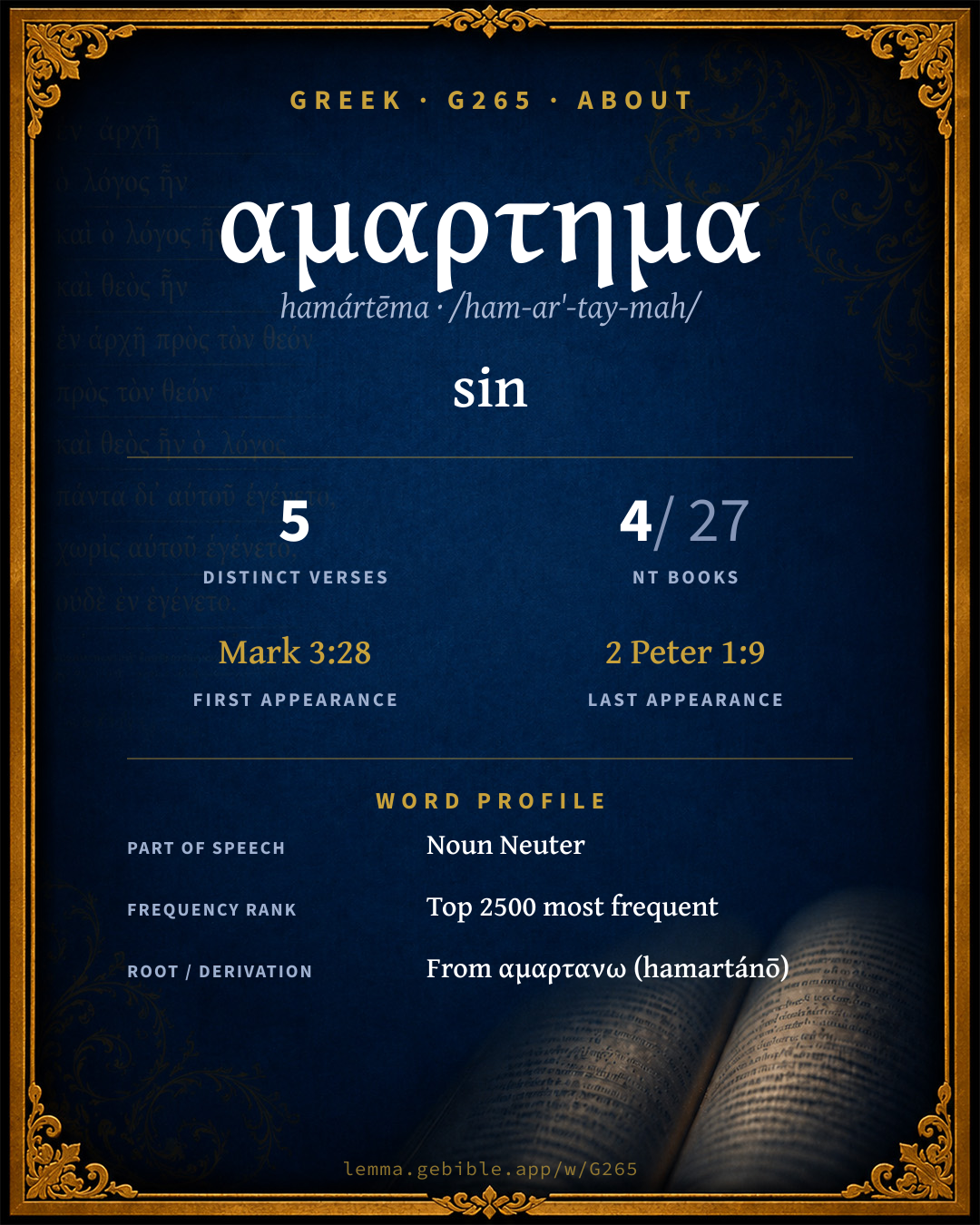
ἁμάρτημα
sin
Full lexicon entry — Thayer's Greek Lexicon
From Thayer's Greek Lexicon
Where this word appears
Grammar key — what these labels mean
Part of speech
- Noun
- A naming word — a person, place, thing, or idea.
Case
- Genitive
- The case of source, possession, or “of” — answers “whose / from what.”
- Nominative
- The case of the subject (and the predicate nominative).
Gender
- Neuter
- Grammatically neuter.
Number
- Plural
- More than one.
- Singular
- One.
Every verse where G265 appears in the Book of Romans — 1 distinct verse. Click any verse to open its interlinear word-by-word view. Verse text shown in the World English Bible for context — . Each verse’s Greek form is shown with its reference; the English is not keyword-highlighted, since the data carries no word-level English alignment. Use “Compare translations” on any verse to read it across multiple English versions. This concordance covers the Greek New Testament; Septuagint (Greek Old Testament) occurrences of this word are not indexed here.
Romans
About this entry
At a glance — auto-summarized from this page’s data, not written by a person. Every figure links to its source below. This summary describes the numbers; it doesn’t interpret them.
The Greek noun αμαρτημα centers on the idea of “sin.” A scarce word — 5 verses in all of the Greek New Testament. The word gravitates to Mark (40%), then Romans and 1 Corinthians. Its earliest occurrence is Mark 3:28. It shares a root with αμαρτανω, αμαρτια and αμαρτωλος. For the data behind this summary, explore the sense tree and the renderings breakdown below.
Gloss history
Strong's 1890 vs modern scholarship
About this word
Strong's G265 catalogs a Greek word from the Greek New Testament.
These counts are not copied from any lexicon or concordance. They are computed here, from the morphology-tagged Greek New Testament. What Lemma adds →
- 5
- distinct verses
- The word appears in 5 distinct verses.
- 4 / 27
- NT books
- The word appears in 4 of 27 New Testament books.
- #1,648
- by frequency
- Top 2500 most frequent Greek words (rank 1,648 of 5,347 Greek words by occurrence).
View all 5 occurrences in the concordance →
Most concentrated in
- Mark 2 verses 40%
- Romans 1 verse 20%
- 1 Corinthians 1 verse 20%
By section of the New Testament
By traditional corpus
Conventional, traditional groupings — biblical authorship is debated, so this is a traditional corpus grouping, not an authorship claim. Some books belong to more than one corpus (Luke is in both the Gospels and the Lukan corpus, and so on), so these shares overlap and need not total 100%. Each figure is a share of the word’s 5 distinct verses.
- Gospels 2 verses · 40%
- Pauline corpus 2 verses · 40%
- General (Catholic) Epistles 1 verse · 20%
How translations render this word
Counts come from each version’s own published word-to-Strong’s tagging or interlinear alignment — an approximate guide to how each version renders this word, not a word-level alignment the data otherwise carries. Because each total is that version’s own tagged count, the per-version totals vary from one another and need not match the appearance or distinct-verse counts above. These counts may also differ from a printed concordance because Lemma counts each distinctly tagged rendering and does not collapse phrase taggings into a single head-word total. This is a fixed set of word-tagged versions (KJV, ASV, BSB, ULT) and does not change with the reading translation you choose elsewhere. Each version’s license is shown beside its name below (and on Sources).
- King James Version: Sins 3×
- American Standard Version: Sins 2×
- Berean Standard Bible: Sin 2×, Sins 2×
- unfoldingWord Literal Text: Sin 2×, Sins 2×
King James Version Public Domain
Renders G265 across 4 tagged occurrences — most commonly:
Plus 1 rendering that appears only once — usually multi-word phrases or single function words the recovered tagging swept in, not distinct renderings.
American Standard Version Public Domain
Renders G265 across 4 tagged occurrences — most commonly:
Plus 2 renderings that appear only once — usually multi-word phrases or single function words the recovered tagging swept in, not distinct renderings.
Berean Standard Bible Public Domain
Renders G265 across 4 tagged occurrences — most commonly:
unfoldingWord Literal Text CC BY-SA 4.0
Renders G265 across 6 tagged occurrences — most commonly:
Plus 2 renderings that appear only once — usually multi-word phrases or single function words the recovered tagging swept in, not distinct renderings.
Senses in Thayer's
The 1 sense Thayer's distinguishes for this word, in lexicon order (not ranked by frequency or importance). The full entry — with sub-senses — is in the Lexicon Entry tab.
- sin, evil deed
Word origin
Derived from αμαρτανω (hamartánō) (G264) — to sin.
From G264 ; a sin (properly concrete): - sin.
— Strong’s Exhaustive Concordance (1890), public domain.
Forms in the corpus
The 4 distinct written forms G265 takes in the Greek New Testament, most frequent first — each parse links to that case’s occurrences in the concordance.
| Form | Parsing | Example | Uses |
|---|---|---|---|
| ἁμαρτημάτων hamartēmátōn | Noun, Genitive, Plural, Neuter | Romans 3:25 | 2 |
| ἁμάρτημα hamártēma | Noun, Nominative, Singular, Neuter | 1 Corinthians 6:18 | 1 |
| ἁμαρτήματα hamartḗmata | Noun, Nominative, Plural, Neuter | Mark 3:28 | 1 |
| ἁμαρτήματος hamartḗmatos | Noun, Genitive, Singular, Neuter | Mark 3:29 | 1 |
Same root — word family
Other Thayer's entries built from the same root as G265, grouped by Strong’s listed origin. These share a root / origin per the lexicon — not necessarily a shared meaning. Each links to that word’s own entry.
Derives from
Shares the same root
Compare all same-root words → They share a root, not necessarily a meaning.
Septuagint usage
The same Greek word αμαρτημα appears 19 times in the Greek Old Testament (Septuagint), across 19 verses in 13 books.
- 19
- LXX occurrences
- Tagged occurrences of this Greek word in the Septuagint.
- 19
- verses
- Distinct Septuagint verses containing this word.
- 13 / 39
- OT books
- The word appears in 13 of the 39 Old Testament books.
Sample Septuagint occurrences
- Genesis 31:36 ἁμάρτημα
- Exodus 28:38 ἁμάρτημα
- Leviticus 4:29 ἁμάρτημα
- Numbers 1:53 ἁμάρτημα
- Deuteronomy 9:27 ἁμάρτημα
- Joshua 22:17 ἁμάρτημα
- 1 Samuel 15:25 ἁμάρτημα
- 2 Samuel 12:13 ἁμάρτημα
- Isaiah 40:2 ἁμάρτημα
- Jeremiah 14:20 ἁμάρτημα
- Lamentations 1:22 ἁμάρτημα
- Ezekiel 18:10 ἁμάρτημα
Septuagint occurrences (same lexeme)
Every verse where the same Strong’s number (G265) appears in the Greek Septuagint. Verse text shown in the World English Bible for context; the Greek form is the matched word — the English is not keyword-highlighted.
- Genesis 31:36 ἁμάρτημα Jacob was angry, and argued with Laban. Jacob answered Laban, "What is my trespass? What is my sin, that you have hotly pursued after me?
- Exodus 28:38 ἁμάρτημα It shall be on Aaron's forehead, and Aaron shall bear the iniquity of the holy things, which the children of Israel shall make holy in all their holy gifts; and it shall be always on his forehead, that they may be accepted before Yahweh.
- Leviticus 4:29 ἁμάρτημα He shall lay his hand on the head of the sin offering, and kill the sin offering in the place of burnt offering.
- Numbers 1:53 ἁμάρτημα But the Levites shall encamp around the Tabernacle of the Testimony, that there may be no wrath on the congregation of the children of Israel: and the Levites shall be responsible for the Tabernacle of the Testimony."
- Numbers 18:23 ἁμάρτημα But the Levites shall do the service of the tent of meeting, and they shall bear their iniquity: it shall be a statute forever throughout your generations; and among the children of Israel they shall have no inheritance.
- Deuteronomy 9:27 ἁμάρτημα Remember your servants, Abraham, Isaac, and Jacob; don't look to the stubbornness of this people, nor to their wickedness, nor to their sin,
- Deuteronomy 19:15 ἁμάρτημα One witness shall not rise up against a man for any iniquity, or for any sin, in any sin that he sins: at the mouth of two witnesses, or at the mouth of three witnesses, shall a matter be established.
- Deuteronomy 22:26 ἁμάρτημα but to the lady you shall do nothing; there is in the lady no sin worthy of death: for as when a man rises against his neighbor, and kills him, even so is this matter;
- Joshua 22:17 ἁμάρτημα Is the iniquity of Peor too little for us, from which we have not cleansed ourselves to this day, although there came a plague on the congregation of Yahweh,
- Joshua 24:19 ἁμάρτημα Joshua said to the people, You can't serve Yahweh; for he is a holy God; he is a jealous God; he will not forgive your disobedience nor your sins.
- 1 Samuel 15:25 ἁμάρτημα Now therefore, please pardon my sin, and turn again with me, that I may worship Yahweh.
- 2 Samuel 12:13 ἁμάρτημα David said to Nathan, "I have sinned against Yahweh." Nathan said to David, "Yahweh also has put away your sin. You will not die.
- Isaiah 40:2 ἁμάρτημα Speak comfortably to Jerusalem; and cry to her, that her warfare is accomplished, that her iniquity is pardoned, that she has received of Yahweh's hand double for all her sins.
- Isaiah 58:1 ἁμάρτημα Cry aloud, don't spare, lift up your voice like a trumpet, and declare to my people their disobedience, and to the house of Jacob their sins.
- Isaiah 59:2 ἁμάρτημα but your iniquities have separated between you and your God, and your sins have hidden his face from you, so that he will not hear.
- Jeremiah 14:20 ἁμάρτημα We acknowledge, Yahweh, our wickedness, and the iniquity of our fathers; for we have sinned against you.
- Lamentations 1:22 ἁμάρτημα Let all their wickedness come before you; Do to them, as you have done to me for all my transgressions: For my sighs are many, and my heart is faint.
- Ezekiel 18:10 ἁμάρτημα If he fathers a son who is a robber, a shedder of blood, and who does any one of these things,
- Hosea 10:8 ἁμάρτημα The high places also of Aven, the sin of Israel, will be destroyed. The thorn and the thistle will come up on their altars. They will tell the mountains, "Cover us!" and the hills, "Fall on us!"
These are occurrences of the same Greek lexeme (G265) in the Septuagint — not a translation of any one Hebrew word. The store carries no word-level Hebrew↔Greek alignment, so no Hebrew original is asserted here. Counts come from the recovered LXX Strong's tagging — high-frequency vocabulary is well covered, while rare or late forms may be untagged — so they reflect tagged occurrences and may slightly undercount.