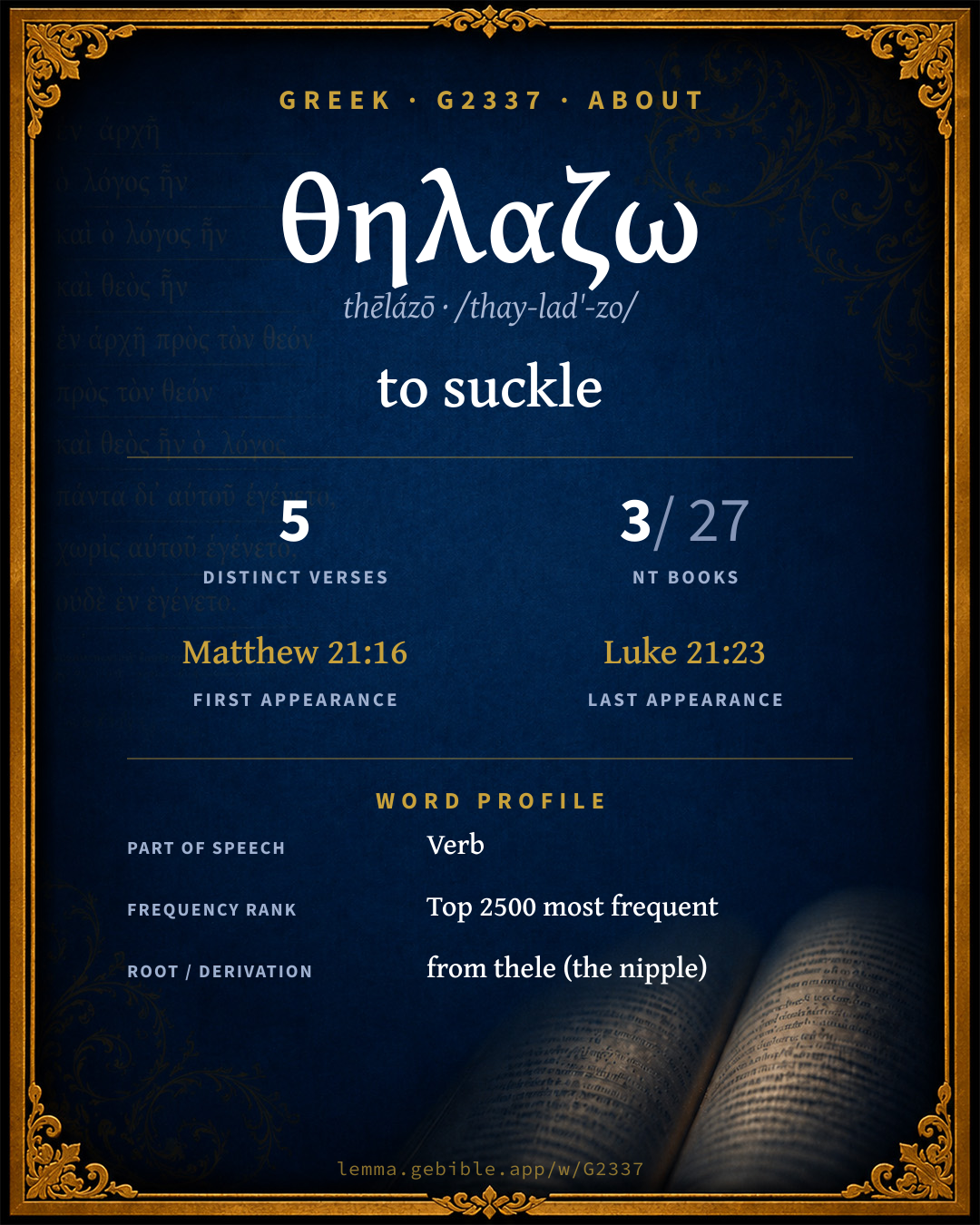
θηλάζω
to suckle
‘to suckle’ is one of 2 main senses fuller range ↓
Full lexicon entry — Thayer's Greek Lexicon
From Thayer's Greek Lexicon
Where this word appears
See every Present-tense verb in the Greek New Testament →
Grammar key — what these labels mean
Part of speech
- Verb
- An action or state-of-being word.
Tense
- Present
- Ongoing or general action in present time (imperfective aspect).
- Aorist
- Action viewed as a simple whole, without regard to duration — often past (perfective aspect).
Voice
- Active
- The subject performs the action.
Mood
- Participle
- A verbal adjective (“writing,” “having written”).
- Indicative
- States a fact or asks a factual question (the mood of reality).
Case
- Dative
- The case of the indirect object, means, or location — “to / for / with / in.”
- Genitive
- The case of source, possession, or “of” — answers “whose / from what.”
Person
- 2nd person
- The one addressed (“you”).
Gender
- Feminine
- Grammatically feminine.
- Masculine
- Grammatically masculine.
Number
- Plural
- More than one.
- Singular
- One.
1 distinct verse where G2337 appears in the Aorist tense, across 1 book. Filtered view — show all forms. Click any verse to open its interlinear word-by-word view. Verse text shown in the World English Bible for context — . Each verse’s Greek form is shown with its reference; the English is not keyword-highlighted, since the data carries no word-level English alignment. Use “Compare translations” on any verse to read it across multiple English versions. This concordance covers the Greek New Testament; Septuagint (Greek Old Testament) occurrences of this word are not indexed here.
Luke 1 verse
About this entry
At a glance — auto-summarized from this page’s data, not written by a person. Every figure links to its source below. This summary describes the numbers; it doesn’t interpret them.
The Greek verb θηλαζω centers on the idea of “to suckle.” It is rare — just 5 verses in the entire Greek New Testament. Matthew dominates its distribution — 2 of 5 verses. First canonically at Matthew 21:16, it enters the text early. Lexicons map it across 2 senses. For the data behind this summary, explore the sense tree and the renderings breakdown below.
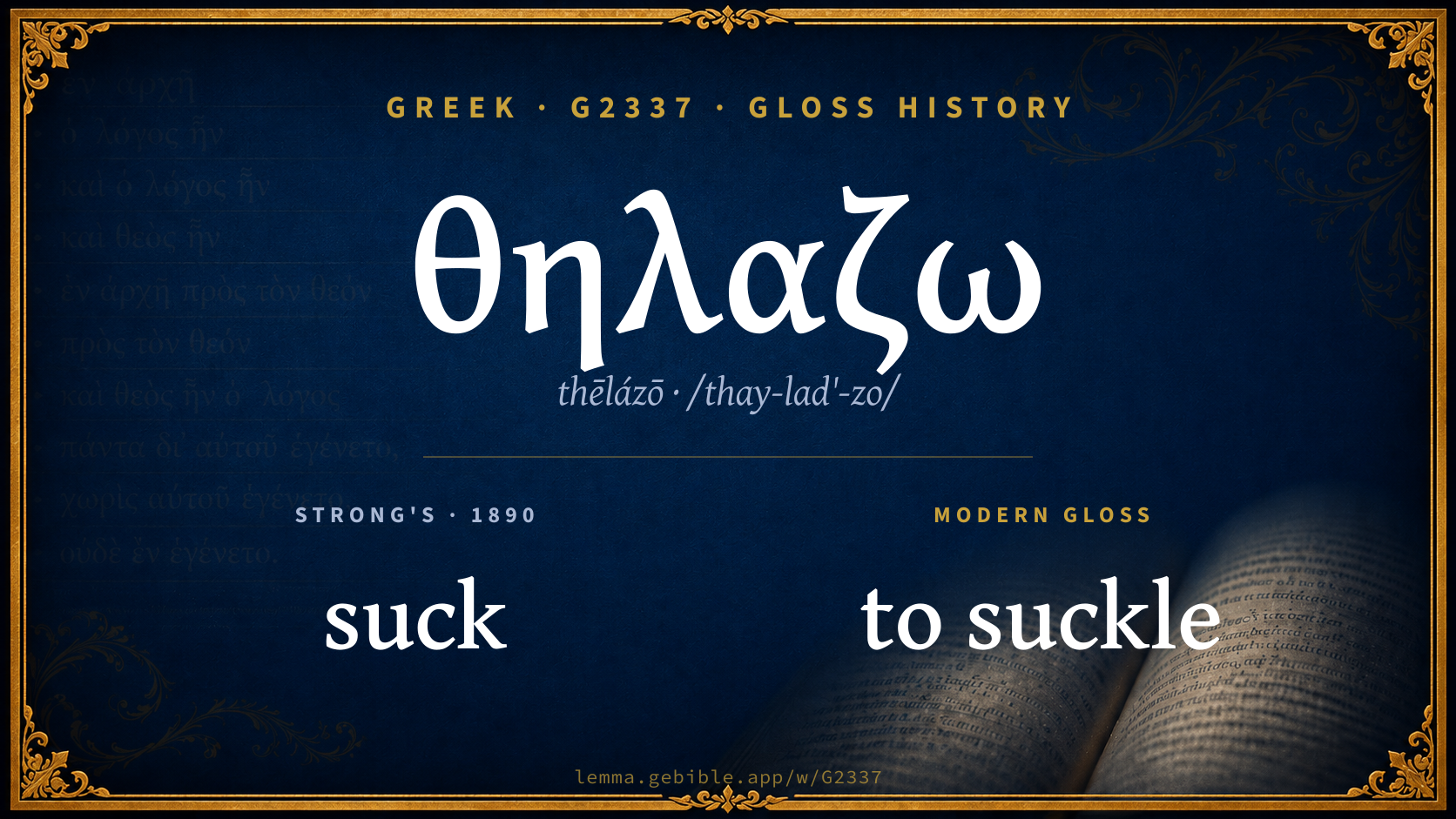
Gloss history
Strong's 1890 vs modern scholarship
About this word
Strong's G2337 catalogs a Greek word from the Greek New Testament.
These counts are not copied from any lexicon or concordance. They are computed here, from the morphology-tagged Greek New Testament. What Lemma adds →
- 5
- distinct verses
- The word appears in 5 distinct verses.
- 3 / 27
- NT books
- The word appears in 3 of 27 New Testament books.
- #1,648
- by frequency
- Top 2500 most frequent Greek words (rank 1,648 of 5,347 Greek words by occurrence).
View all 5 occurrences in the concordance →
By section of the New Testament
By traditional corpus
Conventional, traditional groupings — biblical authorship is debated, so this is a traditional corpus grouping, not an authorship claim. Some books belong to more than one corpus (Luke is in both the Gospels and the Lukan corpus, and so on), so these shares overlap and need not total 100%. Each figure is a share of the word’s 5 distinct verses.
- Gospels 5 verses · 100%
- Lukan (Luke–Acts) 2 verses · 40%
How translations render this word
Counts come from each version’s own published word-to-Strong’s tagging or interlinear alignment — an approximate guide to how each version renders this word, not a word-level alignment the data otherwise carries. Because each total is that version’s own tagged count, the per-version totals vary from one another and need not match the appearance or distinct-verse counts above. These counts may also differ from a printed concordance because Lemma counts each distinctly tagged rendering and does not collapse phrase taggings into a single head-word total. This is a fixed set of word-tagged versions (KJV, ASV, BSB, ULT) and does not change with the reading translation you choose elsewhere. Each version’s license is shown beside its name below (and on Sources).
- King James Version: Give suck 3×
- American Standard Version: Give suck 3×
- Berean Standard Bible: Nursing 3×
- unfoldingWord Literal Text: Nursing 3×
King James Version Public Domain
Renders G2337 across 6 tagged occurrences — most commonly:
Plus 3 renderings that appear only once — usually multi-word phrases or single function words the recovered tagging swept in, not distinct renderings.
American Standard Version Public Domain
Renders G2337 across 6 tagged occurrences — most commonly:
Plus 3 renderings that appear only once — usually multi-word phrases or single function words the recovered tagging swept in, not distinct renderings.
Berean Standard Bible Public Domain
Renders G2337 across 5 tagged occurrences — most commonly:
Plus 2 renderings that appear only once — usually multi-word phrases or single function words the recovered tagging swept in, not distinct renderings.
unfoldingWord Literal Text CC BY-SA 4.0
Renders G2337 across 5 tagged occurrences — most commonly:
Plus 2 renderings that appear only once — usually multi-word phrases or single function words the recovered tagging swept in, not distinct renderings.
Senses in Thayer's
The 2 senses Thayer's distinguishes for this word, in lexicon order (not ranked by frequency or importance). The full entry — with sub-senses — is in the Lexicon Entry tab.
- to give the breast, give suck, to suckle
- to suck
Word origin
Origin: from thele (the nipple)
From θηλή thē lē (the nipple ); to suckle ; by implication to suck : - (give) suck (-ling).
— Strong’s Exhaustive Concordance (1890), public domain.
Forms in the corpus
The 3 distinct written forms G2337 takes in the Greek New Testament, most frequent first — each parse links to that tense’s occurrences in the concordance.
| Form | Parsing | Example | Uses |
|---|---|---|---|
| θηλαζούσαις thēlazoúsais | Verb, Present, Active, Participle, Dative, Plural, Feminine | Matthew 24:19 | 3 |
| θηλαζόντων thēlazóntōn | Verb, Present, Active, Participle, Genitive, Plural, Masculine | Matthew 21:16 | 1 |
| ἐθήλασας ethḗlasas | Verb, Aorist, Active, Indicative, 2nd person, Singular | Luke 11:27 | 1 |
Same root — word family
Other Thayer's entries built from the same root as G2337, grouped by Strong’s listed origin. These share a root / origin per the lexicon — not necessarily a shared meaning. Each links to that word’s own entry.
Derived from this word
Compare all same-root words → They share a root, not necessarily a meaning.
Septuagint usage
The same Greek word θηλαζω appears 25 times in the Greek Old Testament (Septuagint), across 24 verses in 13 books.
- 25
- LXX occurrences
- Tagged occurrences of this Greek word in the Septuagint.
- 24
- verses
- Distinct Septuagint verses containing this word.
- 13 / 39
- OT books
- The word appears in 13 of the 39 Old Testament books.
Sample Septuagint occurrences
- Genesis 21:7 θηλάζω
- Exodus 2:9 θηλάζω
- Numbers 11:12 θηλάζω
- Deuteronomy 32:13 θηλάζω
- 1 Samuel 1:23 θηλάζω
- 1 Kings 3:21 θηλάζω
- Job 3:12 θηλάζω
- Psalms 8:3 θηλάζω
- Song of Solomon 8:1 θηλάζω
- Isaiah 60:16 θηλάζω
- Jeremiah 51:7 θηλάζω
- Lamentations 2:11 θηλάζω
Septuagint occurrences (same lexeme)
Every verse where the same Strong’s number (G2337) appears in the Greek Septuagint. Verse text shown in the World English Bible for context; the Greek form is the matched word — the English is not keyword-highlighted.
- Genesis 21:7 θηλάζω She said, "Who would have said to Abraham, that Sarah would nurse children? For I have borne him a son in his old age."
- Genesis 32:16 θηλάζω He delivered them into the hands of his servants, every herd by itself, and said to his servants, "Pass over before me, and put a space between herd and herd."
- Exodus 2:9 θηλάζω Pharaoh's daughter said to her, "Take this child away, and nurse him for me, and I will give you your wages." The woman took the child, and nursed it.
- Numbers 11:12 θηλάζω Have I conceived all this people? have I brought them forth, that you should tell me, Carry them in your bosom, as a nursing-father carries the sucking child, to the land which you swore to their fathers?
- Deuteronomy 32:13 θηλάζω He made him ride on the high places of the earth, He ate the increase of the field; He made him to suck honey out of the rock, Oil out of the flinty rock;
- Deuteronomy 32:25 θηλάζω Outside shall the sword bereave, In the chambers terror; [It shall destroy] both young man and virgin, The suckling with the man of gray hairs.
- Deuteronomy 33:19 θηλάζω They shall call the peoples to the mountain; There shall they offer sacrifices of righteousness: For they shall suck the abundance of the seas, The hidden treasures of the sand.
- 1 Samuel 1:23 θηλάζω Elkanah her husband said to her, Do what seems you good; wait until you have weaned him; only Yahweh establish his word. So the woman waited and nursed her son, until she weaned him.
- 1 Samuel 15:3 θηλάζω Now go and strike Amalek, and utterly destroy all that they have, and don't spare them; but kill both man and woman, infant and suckling, ox and sheep, camel and donkey.
- 1 Samuel 22:19 θηλάζω Nob, the city of the priests, struck he with the edge of the sword, both men and women, children and nursing babies, and oxen and donkeys and sheep, with the edge of the sword.
- 1 Kings 3:21 θηλάζω When I rose in the morning to give my child suck, behold, it was dead; but when I had looked at it in the morning, behold, it was not my son, whom I bore.
- 1 Kings 3:25 θηλάζω The king said, Divide the living child in two, and give half to the one, and half to the other.
- Job 3:12 θηλάζω Why did the knees receive me? Or why the breast, that I should suck?
- Job 20:16 θηλάζω He shall suck cobra venom. The viper's tongue shall kill him.
- Psalms 8:3 θηλάζω When I consider your heavens, the work of your fingers, The moon and the stars, which you have ordained;
- Song of Solomon 8:1 θηλάζω Oh that you were like my brother, Who sucked the breasts of my mother! If I found you outside, I would kiss you; Yes, and no one would despise me.
- Isaiah 60:16 θηλάζω You shall also suck the milk of the nations, and shall suck the breast of kings; and you shall know that I, Yahweh, am your Savior, and your Redeemer, the Mighty One of Jacob.
- Isaiah 66:11 θηλάζω that you may suck and be satisfied with the breasts of her consolations; that you may milk out, and be delighted with the abundance of her glory.
- Jeremiah 51:7 θηλάζω Babylon has been a golden cup in Yahweh's hand, who made all the earth drunken: the nations have drunk of her wine; therefore the nations are mad.
- Lamentations 2:11 θηλάζω My eyes do fail with tears, my heart is troubled; My liver is poured on the earth, because of the destruction of the daughter of my people, Because the young children and the infants swoon in the streets of the city.
- Lamentations 2:20 θηλάζω Look, Yahweh, and see to whom you have done thus! Shall the women eat their fruit, the children that are dandled in the hands? Shall the priest and the prophet be killed in the sanctuary of the Lord?
- Lamentations 4:3 θηλάζω Even the jackals draw out the breast, they give suck to their young ones: The daughter of my people is become cruel, like the ostriches in the wilderness.
- Lamentations 4:4 θηλάζω The tongue of the sucking child cleaves to the roof of his mouth for thirst: The young children ask bread, and no man breaks it to them.
- Joel 2:16 θηλάζω Gather the people. Sanctify the assembly. Assemble the elders. Gather the children, and those who suck the breasts. Let the bridegroom go forth from his room, And the bride out of her chamber.
These are occurrences of the same Greek lexeme (G2337) in the Septuagint — not a translation of any one Hebrew word. The store carries no word-level Hebrew↔Greek alignment, so no Hebrew original is asserted here. Counts come from the recovered LXX Strong's tagging — high-frequency vocabulary is well covered, while rare or late forms may be untagged — so they reflect tagged occurrences and may slightly undercount.