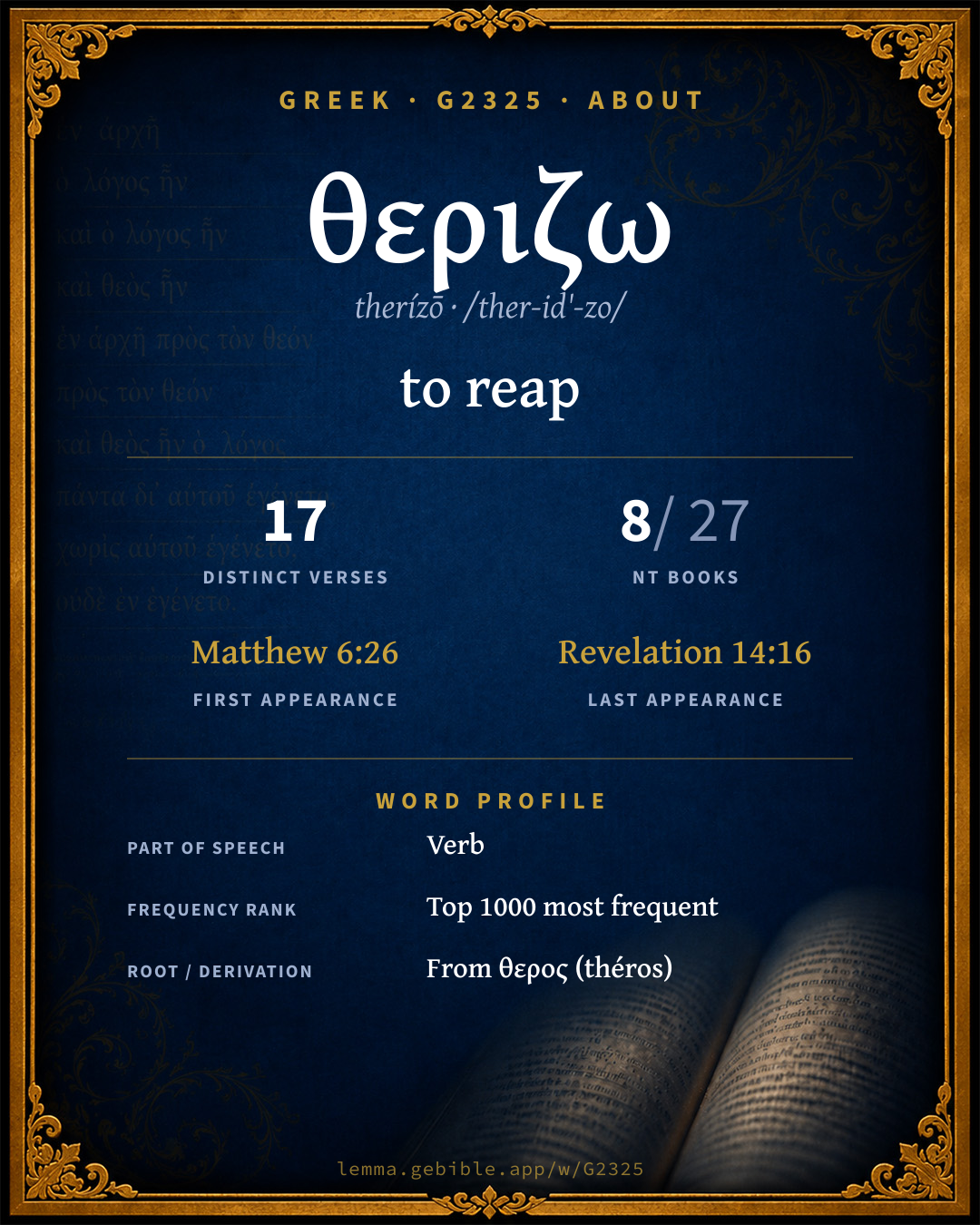
θεριζω
to reap
‘to reap’ is one of 3 main senses fuller range ↓
Full lexicon entry — Thayer's Greek Lexicon
From Thayer's Greek Lexicon
Where this word appears
See every Present-tense verb in the Greek New Testament →
Grammar key — what these labels mean
Part of speech
- Verb
- An action or state-of-being word.
Tense
- Future
- Action expected in future time.
- Present
- Ongoing or general action in present time (imperfective aspect).
- Aorist
- Action viewed as a simple whole, without regard to duration — often past (perfective aspect).
Voice
- Active
- The subject performs the action.
- Passive
- The subject receives the action.
Mood
- Indicative
- States a fact or asks a factual question (the mood of reality).
- Participle
- A verbal adjective (“writing,” “having written”).
- Imperative
- Expresses a command or request.
- Infinitive
- A verbal noun (“to write”), unmarked for person or number.
Case
- Nominative
- The case of the subject (and the predicate nominative).
- Genitive
- The case of source, possession, or “of” — answers “whose / from what.”
Person
- 3rd person
- The one spoken about (“he / she / it / they”).
- 1st person
- The speaker (“I / we”).
- 2nd person
- The one addressed (“you”).
Gender
- Masculine
- Grammatically masculine.
Number
- Singular
- One.
- Plural
- More than one.
9 distinct verses where G2325 appears in the Present tense, across 3 books. Filtered view — show all forms. Click any verse to open its interlinear word-by-word view. Verse text shown in the World English Bible for context — . Each verse’s Greek form is shown with its reference; the English is not keyword-highlighted, since the data carries no word-level English alignment. Use “Compare translations” on any verse to read it across multiple English versions. This concordance covers the Greek New Testament; Septuagint (Greek Old Testament) occurrences of this word are not indexed here.
Matthew 3 verses
- Matthew 6:26 θερίζουσιν pres act ind 3pl See the birds of the sky, that they don't sow, neither do they reap, nor gather into barns. Your heavenly Father feeds them. Aren't you of much more value than they?
- Matthew 25:24 θερίζων pres act ptcp nom sg masc "He also who had received the one talent came and said, 'Lord, I knew you that you are a hard man, reaping where you did not sow, and gathering where you did not scatter.
- Matthew 25:26 θερίζω pres act ind 1sg "But his lord answered him, 'You wicked and slothful servant. You knew that I reap where I didn't sow, and gather where I didn't scatter.
Luke 3 verses
- Luke 12:24 θερίζουσιν pres act ind 3pl Consider the ravens: they don't sow, they don't reap, they have no warehouse or barn, and God feeds them. How much more valuable are you than birds!
- Luke 19:21 θερίζεις pres act ind 2sg for I feared you, because you are an exacting man. You take up that which you didn't lay down, and reap that which you didn't sow.'
- Luke 19:22 θερίζων pres act ptcp nom sg masc "He said to him, 'Out of your own mouth will I judge you, you wicked servant! You knew that I am an exacting man, taking up that which I didn't lay down, and reaping that which I didn't sow.
John 3 verses
- John 4:36 θερίζων θερίζων pres act ptcp nom sg masc pres act ptcp nom sg masc He who reaps receives wages, and gathers fruit to eternal life; that both he who sows and he who reaps may rejoice together.
- John 4:37 θερίζων pres act ptcp nom sg masc For in this the saying is true, 'One sows, and another reaps.'
- John 4:38 θερίζειν pres act inf I sent you to reap that for which you haven't labored. Others have labored, and you have entered into their labor."
About this entry
At a glance — auto-summarized from this page’s data, not written by a person. Every figure links to its source below. This summary describes the numbers; it doesn’t interpret them.
θεριζω (therízō) is a Greek verb most often rendered “to reap.” It first appears in Matthew 6:26. It turns up in 17 verses across 8 books, an uncommon footprint. Its lexical range runs to 3 senses. From the same root come θερος, θεραπων and θερμη. The sections below give every sense, occurrence, and version rendering.
Gloss history
Strong's 1890 vs modern scholarship

About this word
Strong's G2325 catalogs a Greek word from the Greek New Testament.
These counts are not copied from any lexicon or concordance. They are computed here, from the morphology-tagged Greek New Testament. What Lemma adds →
- 17
- distinct verses
- The word appears in 17 distinct verses.
- 8 / 27
- NT books
- The word appears in 8 of 27 New Testament books.
- #607
- by frequency
- Top 1000 most frequent Greek words (rank 607 of 5,347 Greek words by occurrence).
View all 17 occurrences in the concordance →
By section of the New Testament
By traditional corpus
Conventional, traditional groupings — biblical authorship is debated, so this is a traditional corpus grouping, not an authorship claim. Some books belong to more than one corpus (Luke is in both the Gospels and the Lukan corpus, and so on), so these shares overlap and need not total 100%. Each figure is a share of the word’s 17 distinct verses.
- Gospels 9 verses · 53%
- Johannine 5 verses · 29%
- Pauline corpus 5 verses · 29%
- Lukan (Luke–Acts) 3 verses · 18%
- Revelation 2 verses · 12%
- General (Catholic) Epistles 1 verse · 6%
How translations render this word
Counts come from each version’s own published word-to-Strong’s tagging or interlinear alignment — an approximate guide to how each version renders this word, not a word-level alignment the data otherwise carries. Because each total is that version’s own tagged count, the per-version totals vary from one another and need not match the appearance or distinct-verse counts above. These counts may also differ from a printed concordance because Lemma counts each distinctly tagged rendering and does not collapse phrase taggings into a single head-word total. This is a fixed set of word-tagged versions (KJV, ASV, BSB, ULT) and does not change with the reading translation you choose elsewhere. Each version’s license is shown beside its name below (and on Sources).
- King James Version: Reap 7×, Shall reap 3×, He that reapeth 2×
- American Standard Version: Reap 7×, Shall reap 3×, Reapeth 2×
- Berean Standard Bible: Reap 8×, Reaper 2×, Reaping 2×
- unfoldingWord Literal Text: Reap 7×, Harvesting 4×, Will reap 3×
King James Version Public Domain
Renders G2325 across 24 tagged occurrences — most commonly:
Plus 8 renderings that appear only once — usually multi-word phrases or single function words the recovered tagging swept in, not distinct renderings.
American Standard Version Public Domain
Renders G2325 across 24 tagged occurrences — most commonly:
Plus 8 renderings that appear only once — usually multi-word phrases or single function words the recovered tagging swept in, not distinct renderings.
Berean Standard Bible Public Domain
Renders G2325 across 21 tagged occurrences — most commonly:
Plus 7 renderings that appear only once — usually multi-word phrases or single function words the recovered tagging swept in, not distinct renderings.
unfoldingWord Literal Text CC BY-SA 4.0
Renders G2325 across 24 tagged occurrences — most commonly:
Plus 6 renderings that appear only once — usually multi-word phrases or single function words the recovered tagging swept in, not distinct renderings.
Senses in Thayer's
The 3 senses Thayer's distinguishes for this word, in lexicon order (not ranked by frequency or importance). The full entry — with sub-senses — is in the Lexicon Entry tab.
- to reap, harvest
- proverbial expression for sowing and reaping
- cut off, destroy
Word origin
Derived from θερος (théros) (G2330) — summer.
From G2330 (in the sense of the crop ); to harvest : - reap.
— Strong’s Exhaustive Concordance (1890), public domain.
Forms in the corpus
The 11 distinct written forms G2325 takes in the Greek New Testament, most frequent first — each parse links to that tense’s occurrences in the concordance.
| Form | Parsing | Example | Uses |
|---|---|---|---|
| θερίζων therízōn | Verb, Present, Active, Participle, Nominative, Singular, Masculine | Matthew 25:24 | 5 |
| θερίσει therísei | Verb, Future, Active, Indicative, 3rd person, Singular | 2 Corinthians 9:6 | 5 |
| θερίζουσιν therízousin | Verb, Present, Active, Indicative, 3rd person, Plural | Matthew 6:26 | 2 |
| θερίσομεν therísomen | Verb, Future, Active, Indicative, 1st person, Plural | 1 Corinthians 9:11 | 2 |
| θέρισον thérison | Verb, Aorist, Active, Imperative, 2nd person, Singular | Revelation 14:15 | 1 |
| θερίζειν therízein | Verb, Present, Active, Infinitive | John 4:38 | 1 |
| θερίζεις therízeis | Verb, Present, Active, Indicative, 2nd person, Singular | Luke 19:21 | 1 |
| θερίζω therízō | Verb, Present, Active, Indicative, 1st person, Singular | Matthew 25:26 | 1 |
| θερίσαι therísai | Verb, Aorist, Active, Infinitive | Revelation 14:15 | 1 |
| θερισάντων therisántōn | Verb, Aorist, Active, Participle, Genitive, Plural, Masculine | James 5:4 | 1 |
| ἐθερίσθη etherísthē | Verb, Aorist, Passive, Indicative, 3rd person, Singular | Revelation 14:16 | 1 |
Same root — word family
Other Thayer's entries built from the same root as G2325, grouped by Strong’s listed origin. These share a root / origin per the lexicon — not necessarily a shared meaning. Each links to that word’s own entry.
Derives from
Shares the same root
Derived from this word
Compare all same-root words → Showing 4 of 6 — not the complete family. They share a root, not necessarily a meaning.
Septuagint usage
The same Greek word θεριζω appears 24 times in the Greek Old Testament (Septuagint), across 23 verses in 9 books.
- 24
- LXX occurrences
- Tagged occurrences of this Greek word in the Septuagint.
- 23
- verses
- Distinct Septuagint verses containing this word.
- 9 / 39
- OT books
- The word appears in 9 of the 39 Old Testament books.
Sample Septuagint occurrences
- Leviticus 23:10 θερίζω
- Ruth 2:3 θερίζω
- 1 Samuel 6:13 θερίζω
- 2 Kings 4:18 θερίζω
- Job 4:8 θερίζω
- Psalms 125:5 θερίζω
- Proverbs 22:8 θερίζω
- Ecclesiastes 11:4 θερίζω
- Jeremiah 9:21 θερίζω
Septuagint occurrences (same lexeme)
Every verse where the same Strong’s number (G2325) appears in the Greek Septuagint. Verse text shown in the World English Bible for context; the Greek form is the matched word — the English is not keyword-highlighted.
- Leviticus 23:10 θερίζω "Speak to the children of Israel, and tell them, 'When you have come into the land which I give to you, and shall reap its the harvest, then you shall bring the sheaf of the first fruits of your harvest to the priest:
- Leviticus 23:22 θερίζω "'When you reap the harvest of your land, you shall not wholly reap into the corners of your field, neither shall you gather the gleanings of your harvest: you shall leave them for the poor, and for the foreigner. I am Yahweh your God.'"
- Ruth 2:3 θερίζω She went, and came and gleaned in the field after the reapers: and she happened to come to the portion of the field belonging to Boaz, who was of the family of Elimelech.
- Ruth 2:4 θερίζω Behold, Boaz came from Bethlehem, and said to the reapers, Yahweh be with you. They answered him, Yahweh bless you.
- Ruth 2:5 θερίζω Then said Boaz to his servant who was set over the reapers, Whose young lady is this?
- Ruth 2:6 θερίζω The servant who was set over the reapers answered, It is the Moabite lady who came back with Naomi out of the country of Moab:
- Ruth 2:7 θερίζω She said, Please let me glean and gather after the reapers among the sheaves. So she came, and has continued even from the morning until now, except that she stayed a little in the house.
- Ruth 2:9 θερίζω Let your eyes be on the field that they reap, and go after them: haven't I charged the young men that they shall not touch you? and when you are thirsty, go to the vessels, and drink of that which the young men have drawn.
- Ruth 2:14 θερίζω At meal-time Boaz said to her, Come here, and eat of the bread, and dip your morsel in the vinegar. She sat beside the reapers, and they reached her parched grain, and she ate, and was sufficed, and left of it.
- 1 Samuel 6:13 θερίζω They of Beth-shemesh were reaping their wheat harvest in the valley; and they lifted up their eyes, and saw the ark, and rejoiced to see it.
- 1 Samuel 8:12 θερίζω and he will appoint them to him for captains of thousands, and captains of fifties; and [he will set some] to plow his ground, and to reap his harvest, and to make his instruments of war, and the instruments of his chariots.
- 1 Samuel 13:21 θερίζω yet they had a file for the mattocks, and for the plowshares, and for the forks, and for the axes, and to set the goads.
- 2 Kings 4:18 θερίζω When the child was grown, it fell on a day, that he went out to his father to the reapers.
- Job 4:8 θερίζω According to what I have seen, those who plow iniquity, And sow trouble, Reap the same.
- Job 5:26 θερίζω You shall come to your grave in a full age, Like a shock of grain comes in its season.
- Job 8:12 θερίζω While it is yet in its greenness, not cut down, It withers before any other reed.
- Job 24:6 θερίζω They cut their provender in the field. They glean the vineyard of the wicked.
- Psalms 125:5 θερίζω But as for those who turn aside to their crooked ways, Yahweh will lead them away with the workers of iniquity. Peace be on Israel.
- Psalms 128:7 θερίζω
- Proverbs 22:8 θερίζω He who sows wickedness reaps trouble, And the rod of his fury will be destroyed.
- Ecclesiastes 11:4 θερίζω He who observes the wind won't sow; And he who regards the clouds won't reap.
- Jeremiah 9:21 θερίζω For death is come up into our windows, it is entered into our palaces; to cut off the children from outside, [and] the young men from the streets.
- Jeremiah 12:13 θερίζω They have sown wheat, and have reaped thorns; they have put themselves to pain, and profit nothing: and you shall be ashamed of your fruits, because of the fierce anger of Yahweh.
These are occurrences of the same Greek lexeme (G2325) in the Septuagint — not a translation of any one Hebrew word. The store carries no word-level Hebrew↔Greek alignment, so no Hebrew original is asserted here. Counts come from the recovered LXX Strong's tagging — high-frequency vocabulary is well covered, while rare or late forms may be untagged — so they reflect tagged occurrences and may slightly undercount.