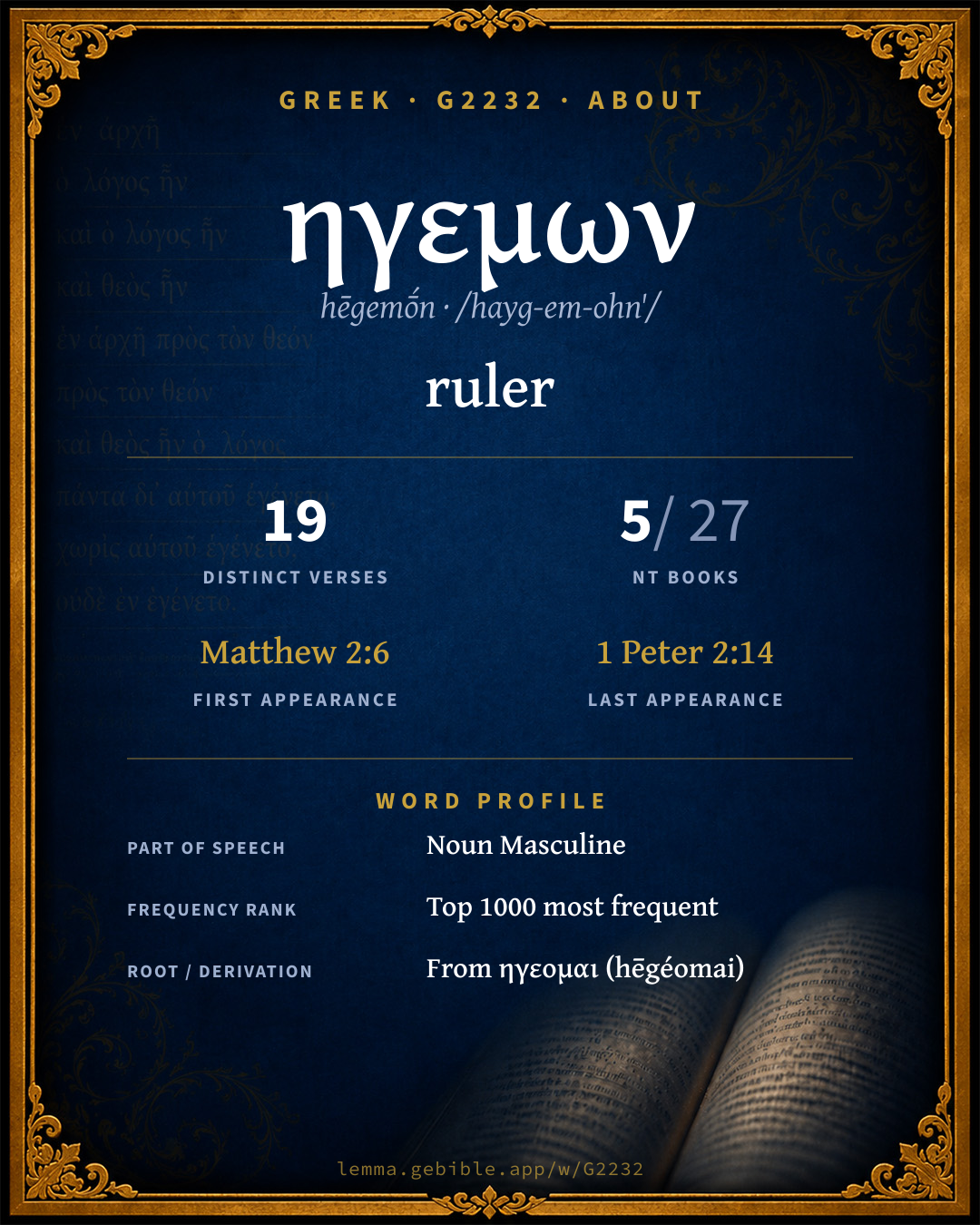
ἡγεμών
ruler
Full lexicon entry — Thayer's Greek Lexicon
From Thayer's Greek Lexicon
Where this word appears
See every Accusative-case word in the Greek New Testament →
Grammar key — what these labels mean
Part of speech
- Noun
- A naming word — a person, place, thing, or idea.
Case
- Genitive
- The case of source, possession, or “of” — answers “whose / from what.”
- Dative
- The case of the indirect object, means, or location — “to / for / with / in.”
- Nominative
- The case of the subject (and the predicate nominative).
- Accusative
- The case of the direct object and of extent.
Gender
- Masculine
- Grammatically masculine.
Number
- Singular
- One.
- Plural
- More than one.
Every verse where G2232 appears in the Book of Luke — 2 distinct verses. Click any verse to open its interlinear word-by-word view. Verse text shown in the World English Bible for context — . Each verse’s Greek form is shown with its reference; the English is not keyword-highlighted, since the data carries no word-level English alignment. Use “Compare translations” on any verse to read it across multiple English versions. This concordance covers the Greek New Testament; Septuagint (Greek Old Testament) occurrences of this word are not indexed here.
Luke
- Luke 20:20 ἡγεμόνος n gen sg masc They watched him, and sent out spies, who pretended to be righteous, that they might trap him in something he said, so as to deliver him up to the power and authority of the governor.
- Luke 21:12 ἡγεμόνας n acc pl masc But before all these things, they will lay their hands on you and will persecute you, delivering you up to synagogues and prisons, bringing you before kings and governors for my name's sake.
About this entry
At a glance — auto-summarized from this page’s data, not written by a person. Every figure links to its source below. This summary describes the numbers; it doesn’t interpret them.
At its core, ηγεμων (hēgemṓn) means “ruler.” Scripture first uses it in Matthew 2:6. It turns up in 19 verses across 5 books, an uncommon footprint. The word gravitates to Matthew (47%), then Acts and Luke. It shares a root with ηγεομαι, ηγεμονευω and ηγεμονια. Dig into 19-verse concordance and the renderings breakdown below.
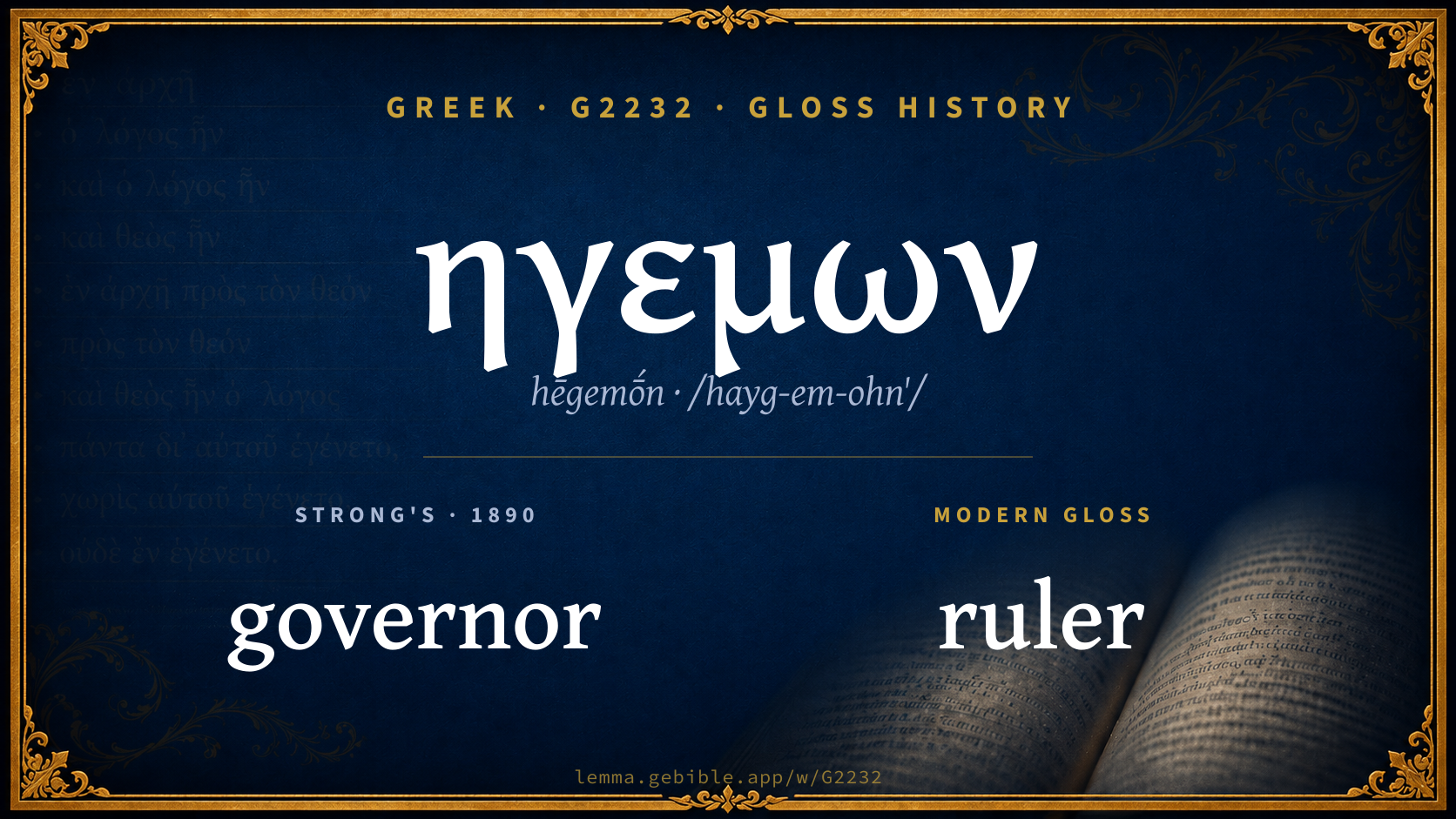
Gloss history
Strong's 1890 vs modern scholarship
About this word
Strong's G2232 catalogs a Greek word from the Greek New Testament.
These counts are not copied from any lexicon or concordance. They are computed here, from the morphology-tagged Greek New Testament. What Lemma adds →
- 19
- distinct verses
- The word appears in 19 distinct verses.
- 5 / 27
- NT books
- The word appears in 5 of 27 New Testament books.
- #622
- by frequency
- Top 1000 most frequent Greek words (rank 622 of 5,347 Greek words by occurrence).
View all 19 occurrences in the concordance →
By section of the New Testament
By traditional corpus
Conventional, traditional groupings — biblical authorship is debated, so this is a traditional corpus grouping, not an authorship claim. Some books belong to more than one corpus (Luke is in both the Gospels and the Lukan corpus, and so on), so these shares overlap and need not total 100%. Each figure is a share of the word’s 19 distinct verses.
- Gospels 12 verses · 63%
- Lukan (Luke–Acts) 8 verses · 42%
- General (Catholic) Epistles 1 verse · 5%
How translations render this word
Counts come from each version’s own published word-to-Strong’s tagging or interlinear alignment — an approximate guide to how each version renders this word, not a word-level alignment the data otherwise carries. Because each total is that version’s own tagged count, the per-version totals vary from one another and need not match the appearance or distinct-verse counts above. These counts may also differ from a printed concordance because Lemma counts each distinctly tagged rendering and does not collapse phrase taggings into a single head-word total. This is a fixed set of word-tagged versions (KJV, ASV, BSB, ULT) and does not change with the reading translation you choose elsewhere. Each version’s license is shown beside its name below (and on Sources).
- King James Version: Governor 15×, Governors 2×, Rulers 2×
- American Standard Version: Governor 15×, Governors 4×
- Berean Standard Bible: Governor 11×, Governors 4×, Governor’s 3×
- unfoldingWord Literal Text: Governor 15×, Governors 4×
King James Version Public Domain
Renders G2232 across 22 tagged occurrences — most commonly:
Plus 3 renderings that appear only once — usually multi-word phrases or single function words the recovered tagging swept in, not distinct renderings.
American Standard Version Public Domain
Renders G2232 across 21 tagged occurrences — most commonly:
Plus 2 renderings that appear only once — usually multi-word phrases or single function words the recovered tagging swept in, not distinct renderings.
Berean Standard Bible Public Domain
Renders G2232 across 19 tagged occurrences — most commonly:
Plus 1 rendering that appears only once — usually multi-word phrases or single function words the recovered tagging swept in, not distinct renderings. Not rendered by a distinct English word in 1 further occurrence.
unfoldingWord Literal Text CC BY-SA 4.0
Renders G2232 across 21 tagged occurrences — most commonly:
Plus 2 renderings that appear only once — usually multi-word phrases or single function words the recovered tagging swept in, not distinct renderings.
Senses in Thayer's
The 1 sense Thayer's distinguishes for this word, in lexicon order (not ranked by frequency or importance). The full entry — with sub-senses — is in the Lexicon Entry tab.
- a leader of any kind, a guide, ruler, prefect, president, chief, general, commander, sovereign
Word origin
Derived from ηγεομαι (hēgéomai) (G2233) — to govern.
From G2233 ; a leader that is chief person (or figuratively place) of a province : - governor prince ruler.
— Strong’s Exhaustive Concordance (1890), public domain.
Forms in the corpus
The 7 distinct written forms G2232 takes in the Greek New Testament, most frequent first — each parse links to that case’s occurrences in the concordance.
| Form | Parsing | Example | Uses |
|---|---|---|---|
| ἡγεμόνος hēgemónos | Noun, Genitive, Singular, Masculine | Matthew 27:11 | 5 |
| ἡγεμόνι hēgemóni | Noun, Dative, Singular, Masculine | Matthew 27:2 | 4 |
| ἡγεμὼν hēgemṑn | Noun, Nominative, Singular, Masculine | Matthew 27:11 | 4 |
| ἡγεμόνα hēgemóna | Noun, Accusative, Singular, Masculine | Matthew 27:14 | 2 |
| ἡγεμόνας hēgemónas | Noun, Accusative, Plural, Masculine | Matthew 10:18 | 2 |
| ἡγεμόσιν hēgemósin | Noun, Dative, Plural, Masculine | Matthew 2:6 | 2 |
| ἡγεμόνων hēgemónōn | Noun, Genitive, Plural, Masculine | Mark 13:9 | 1 |
Same root — word family
Other Thayer's entries built from the same root as G2232, grouped by Strong’s listed origin. These share a root / origin per the lexicon — not necessarily a shared meaning. Each links to that word’s own entry.
Derives from
Derived from this word
Compare all same-root words → They share a root, not necessarily a meaning.
Septuagint usage
The same Greek word ηγεμων appears 74 times in the Greek Old Testament (Septuagint), across 34 verses in 7 books.
- 74
- LXX occurrences
- Tagged occurrences of this Greek word in the Septuagint.
- 34
- verses
- Distinct Septuagint verses containing this word.
- 7 / 39
- OT books
- The word appears in 7 of the 39 Old Testament books.
Sample Septuagint occurrences
- Genesis 36:15 ἡγεμών
- Exodus 15:15 ἡγεμών
- 1 Chronicles 1:39 ἡγεμών
- Job 42:17 ἡγεμών
- Psalms 54:14 ἡγεμών
- Jeremiah 28:23 ἡγεμών
- Ezekiel 23:23 ἡγεμών
Septuagint occurrences (same lexeme)
Every verse where the same Strong’s number (G2232) appears in the Greek Septuagint. Verse text shown in the World English Bible for context; the Greek form is the matched word — the English is not keyword-highlighted.
- Genesis 36:15 ἡγεμών These are the chiefs of the sons of Esau: the sons of Eliphaz the firstborn of Esau: chief Teman, chief Omar, chief Zepho, chief Kenaz,
- Genesis 36:16 ἡγεμών chief Korah, chief Gatam, chief Amalek: these are the chiefs who came of Eliphaz in the land of Edom; these are the sons of Adah.
- Genesis 36:17 ἡγεμών These are the sons of Reuel, Esau's son: chief Nahath, chief Zerah, chief Shammah, chief Mizzah: these are the chiefs who came of Reuel in the land of Edom; these are the sons of Basemath, Esau's wife.
- Genesis 36:18 ἡγεμών These are the sons of Oholibamah, Esau's wife: chief Jeush, chief Jalam, chief Korah: these are the chiefs who came of Oholibamah the daughter of Anah, Esau's wife.
- Genesis 36:19 ἡγεμών These are the sons of Esau, and these are their chiefs. The same is Edom.
- Genesis 36:21 ἡγεμών Dishon, Ezer, and Dishan. These are the chiefs who came of the Horites, the children of Seir in the land of Edom.
- Genesis 36:29 ἡγεμών These are the chiefs who came of the Horites: chief Lotan, chief Shobal, chief Zibeon, chief Anah,
- Genesis 36:30 ἡγεμών chief Dishon, chief Ezer, and chief Dishan: these are the chiefs who came of the Horites, according to their chiefs in the land of Seir.
- Genesis 36:40 ἡγεμών These are the names of the chiefs who came from Esau, according to their families, after their places, and by their names: chief Timna, chief Alvah, chief Jetheth,
- Genesis 36:41 ἡγεμών chief Oholibamah, chief Elah, chief Pinon,
- Genesis 36:42 ἡγεμών chief Kenaz, chief Teman, chief Mibzar,
- Genesis 36:43 ἡγεμών chief Magdiel, and chief Iram. These are the chiefs of Edom, according to their habitations in the land of their possession. This is Esau, the father of the Edomites.
- Exodus 15:15 ἡγεμών Then the chiefs of Edom were dismayed. Trembling takes hold of the mighty men of Moab. All the inhabitants of Canaan are melted away.
- 1 Chronicles 1:39 ἡγεμών The sons of Lotan: Hori, and Homam; and Timna was Lotan's sister.
- 1 Chronicles 1:40 ἡγεμών The sons of Shobal: Alian, and Manahath, and Ebal, Shephi, and Onam. The sons of Zibeon: Aiah, and Anah.
- 1 Chronicles 1:41 ἡγεμών The sons of Anah: Dishon. The sons of Dishon: Hamran, and Eshban, and Ithran, and Cheran.
- 1 Chronicles 1:42 ἡγεμών The sons of Ezer: Bilhan, and Zaavan, Jaakan. The sons of Dishan: Uz, and Aran.
- Job 42:17 ἡγεμών So Job died, being old and full of days.
- Psalms 54:14 ἡγεμών
- Psalms 67:28 ἡγεμών
- Jeremiah 28:23 ἡγεμών
- Jeremiah 28:57 ἡγεμών
- Jeremiah 45:17 ἡγεμών
- Jeremiah 46:3 ἡγεμών Prepare you the buckler and shield, and draw near to battle.
- Jeremiah 47:7 ἡγεμών How can you be quiet, seeing Yahweh has given you a charge? Against Ashkelon, and against the sea-shore, there has he appointed it.
- Jeremiah 47:13 ἡγεμών
- Jeremiah 48:11 ἡγεμών Moab has been at ease from his youth, and he has settled on his lees, and has not been emptied from vessel to vessel, neither has he gone into captivity: therefore his taste remains in him, and his scent is not changed.
- Jeremiah 48:13 ἡγεμών Moab shall be ashamed of Chemosh, as the house of Israel was ashamed of Bethel their confidence.
- Jeremiah 48:16 ἡγεμών The calamity of Moab is near to come, and his affliction hurries fast.
- Jeremiah 49:1 ἡγεμών Of the children of Ammon. Thus says Yahweh: Has Israel no sons? has he no heir? why then does Malcam possess Gad, and his people well in the cities of it?
- Jeremiah 49:8 ἡγεμών Flee you, turn back, dwell in the depths, inhabitants of Dedan; for I will bring the calamity of Esau on him, the time that I shall visit him.
- Jeremiah 50:4 ἡγεμών In those days, and in that time, says Yahweh, the children of Israel shall come, they and the children of Judah together; they shall go on their way weeping, and shall seek Yahweh their God.
- Jeremiah 50:5 ἡγεμών They shall inquire concerning Zion with their faces turned toward it, [saying], Come you, and join yourselves to Yahweh in an everlasting covenant that shall not be forgotten.
- Ezekiel 23:23 ἡγεμών the Babylonians and all the Chaldeans, Pekod and Shoa and Koa, [and] all the Assyrians with them; desirable young men, governors and rulers all of them, princes and men of renown, all of them riding on horses.
These are occurrences of the same Greek lexeme (G2232) in the Septuagint — not a translation of any one Hebrew word. The store carries no word-level Hebrew↔Greek alignment, so no Hebrew original is asserted here. Counts come from the recovered LXX Strong's tagging — high-frequency vocabulary is well covered, while rare or late forms may be untagged — so they reflect tagged occurrences and may slightly undercount.