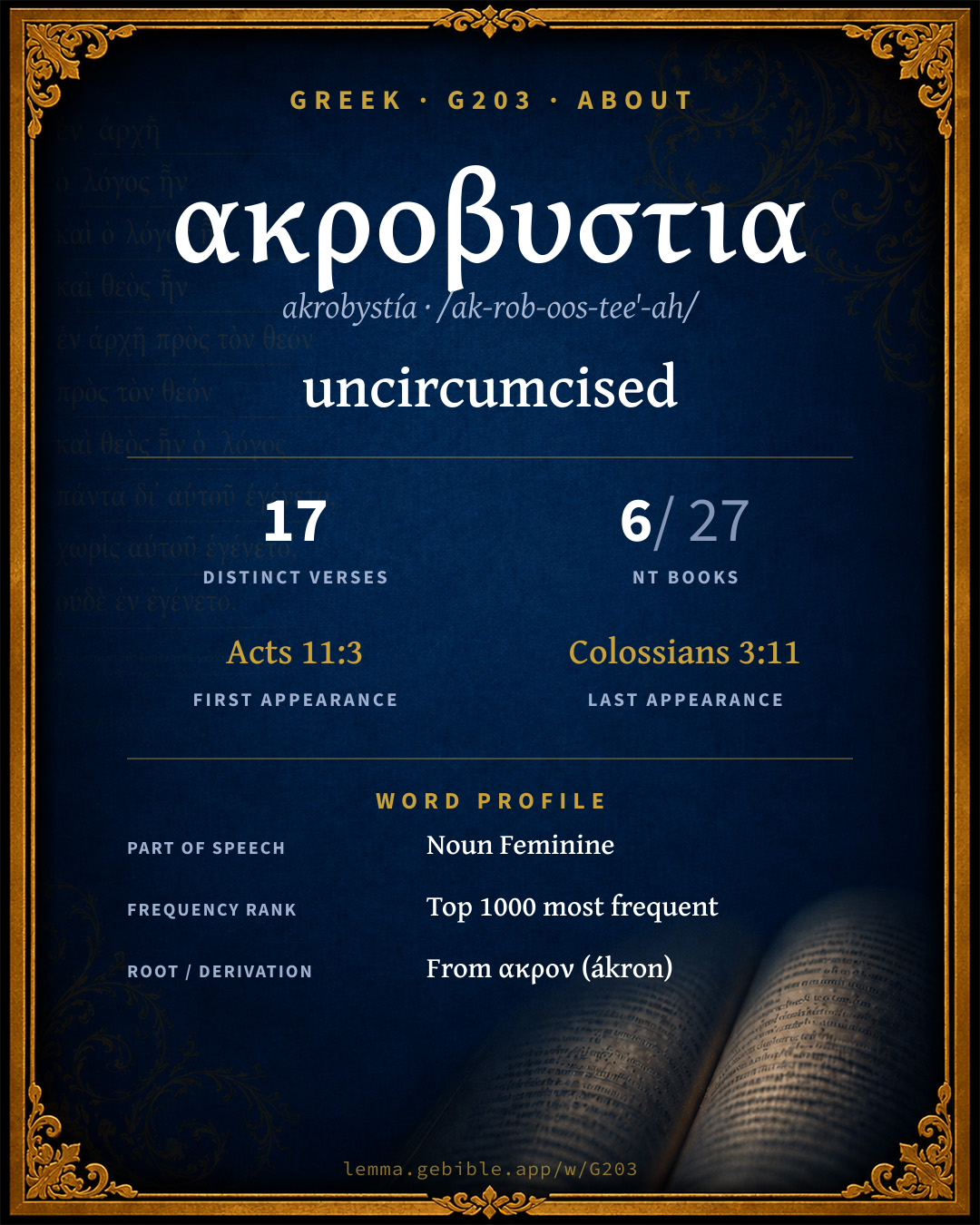
ἀκροβυστία
uncircumcised
‘uncircumcised’ is one of 3 main senses fuller range ↓
Full lexicon entry — Thayer's Greek Lexicon
From Thayer's Greek Lexicon
Where this word appears
See every Dative-case word in the Greek New Testament →
Grammar key — what these labels mean
Part of speech
- Noun
- A naming word — a person, place, thing, or idea.
Case
- Nominative
- The case of the subject (and the predicate nominative).
- Dative
- The case of the indirect object, means, or location — “to / for / with / in.”
- Accusative
- The case of the direct object and of extent.
- Genitive
- The case of source, possession, or “of” — answers “whose / from what.”
Gender
- Feminine
- Grammatically feminine.
Number
- Singular
- One.
Every verse where G203 appears in the Book of Romans — 8 distinct verses. Click any verse to open its interlinear word-by-word view. Verse text shown in the World English Bible for context — . Each verse’s Greek form is shown with its reference; the English is not keyword-highlighted, since the data carries no word-level English alignment. Use “Compare translations” on any verse to read it across multiple English versions. This concordance covers the Greek New Testament; Septuagint (Greek Old Testament) occurrences of this word are not indexed here.
Romans
- Romans 2:25 ἀκροβυστία n nom sg fem For circumcision indeed profits, if you are a doer of the law, but if you are a transgressor of the law, your circumcision has become uncircumcision.
- Romans 2:26 ἀκροβυστία ἀκροβυστία n nom sg fem n nom sg fem If therefore the uncircumcised keep the ordinances of the law, won't his uncircumcision be accounted as circumcision?
- Romans 2:27 ἀκροβυστία n nom sg fem Won't the uncircumcision which is by nature, if it fulfills the law, judge you, who with the letter and circumcision are a transgressor of the law?
- Romans 3:30 ἀκροβυστίαν n acc sg fem since indeed there is one God who will justify the circumcised by faith, and the uncircumcised through faith.
- Romans 4:9 ἀκροβυστίαν n acc sg fem Is this blessing then pronounced on the circumcised, or on the uncircumcised also? For we say that faith was accounted to Abraham for righteousness.
- Romans 4:10 ἀκροβυστίᾳ ἀκροβυστίᾳ n dat sg fem n dat sg fem How then was it counted? When he was in circumcision, or in uncircumcision? Not in circumcision, but in uncircumcision.
- Romans 4:11 ἀκροβυστίᾳ ἀκροβυστίας n dat sg fem n gen sg fem He received the sign of circumcision, a seal of the righteousness of the faith which he had while he was in uncircumcision, that he might be the father of all those who believe, though they be in uncircumcision, that righteousness might also be accounted to them.
- Romans 4:12 ἀκροβυστίᾳ n dat sg fem The father of circumcision to those who not only are of the circumcision, but who also walk in the steps of that faith of our father Abraham, which he had in uncircumcision.
About this entry
At a glance — auto-summarized from this page’s data, not written by a person. Every figure links to its source below. This summary describes the numbers; it doesn’t interpret them.
“uncircumcised” is the headline sense of the Greek noun ακροβυστια (akrobystía). Scripture first uses it in Acts 11:3. With 17 verses in 6 books, it is an uncommon word in the Greek New Testament. It concentrates in Romans, which alone accounts for 47% of its uses. Catalogued under 3 senses, its meaning is not single-sense. The sections below give every sense, occurrence, and version rendering.
Gloss history
Strong's 1890 vs modern scholarship

About this word
Strong's G203 catalogs a Greek word from the Greek New Testament.
These counts are not copied from any lexicon or concordance. They are computed here, from the morphology-tagged Greek New Testament. What Lemma adds →
- 17
- distinct verses
- The word appears in 17 distinct verses.
- 6 / 27
- NT books
- The word appears in 6 of 27 New Testament books.
- #622
- by frequency
- Top 1000 most frequent Greek words (rank 622 of 5,347 Greek words by occurrence).
View all 17 occurrences in the concordance →
Most concentrated in
- Romans 8 verses 47%
- Galatians 3 verses 18%
- 1 Corinthians 2 verses 12%
By section of the New Testament
By traditional corpus
Conventional, traditional groupings — biblical authorship is debated, so this is a traditional corpus grouping, not an authorship claim. Some books belong to more than one corpus (Luke is in both the Gospels and the Lukan corpus, and so on), so these shares overlap and need not total 100%. Each figure is a share of the word’s 17 distinct verses.
- Pauline corpus 16 verses · 94%
- Lukan (Luke–Acts) 1 verse · 6%
How translations render this word
Counts come from each version’s own published word-to-Strong’s tagging or interlinear alignment — an approximate guide to how each version renders this word, not a word-level alignment the data otherwise carries. Because each total is that version’s own tagged count, the per-version totals vary from one another and need not match the appearance or distinct-verse counts above. These counts may also differ from a printed concordance because Lemma counts each distinctly tagged rendering and does not collapse phrase taggings into a single head-word total. This is a fixed set of word-tagged versions (KJV, ASV, BSB, ULT) and does not change with the reading translation you choose elsewhere. Each version’s license is shown beside its name below (and on Sources).
- King James Version: Uncircumcision 16×, Uncircumcised 3×
- American Standard Version: Uncircumcision 18×
- Berean Standard Bible: Uncircumcised 8×, Uncircumcision 6×
- unfoldingWord Literal Text: Uncircumcision 18×
King James Version Public Domain
Renders G203 across 20 tagged occurrences — most commonly:
Plus 1 rendering that appears only once — usually multi-word phrases or single function words the recovered tagging swept in, not distinct renderings.
American Standard Version Public Domain
Renders G203 across 20 tagged occurrences — most commonly:
Plus 2 renderings that appear only once — usually multi-word phrases or single function words the recovered tagging swept in, not distinct renderings.
Berean Standard Bible Public Domain
Renders G203 across 18 tagged occurrences — most commonly:
Plus 4 renderings that appear only once — usually multi-word phrases or single function words the recovered tagging swept in, not distinct renderings. Not rendered by a distinct English word in 2 further occurrences.
unfoldingWord Literal Text CC BY-SA 4.0
Renders G203 across 20 tagged occurrences — most commonly:
Plus 2 renderings that appear only once — usually multi-word phrases or single function words the recovered tagging swept in, not distinct renderings.
Senses in Thayer's
The 3 senses Thayer's distinguishes for this word, in lexicon order (not ranked by frequency or importance). The full entry — with sub-senses — is in the Lexicon Entry tab.
- having the foreskin, uncircumcised
- a Gentile
- a condition in which the corrupt desires rooted in the flesh were not yet extinct
Word origin
Derived from ακρον (ákron) (G206) — end.
From G206 and probably a modified form of πόσθη posthē (the penis or male sexual organ); the prepuce ; by implication an uncircumcised (that is gentile figuratively unregenerate ) state or person : - not circumcised uncircumcised [with G2192] uncircumcision.
— Strong’s Exhaustive Concordance (1890), public domain.
Forms in the corpus
The 4 distinct written forms G203 takes in the Greek New Testament, most frequent first — each parse links to that case’s occurrences in the concordance.
| Form | Parsing | Example | Uses |
|---|---|---|---|
| ἀκροβυστία akrobystía | Noun, Nominative, Singular, Feminine | Romans 2:25 | 9 |
| ἀκροβυστίᾳ akrobystía | Noun, Dative, Singular, Feminine | Romans 4:10 | 6 |
| ἀκροβυστίαν akrobystían | Noun, Accusative, Singular, Feminine | Acts 11:3 | 3 |
| ἀκροβυστίας akrobystías | Noun, Genitive, Singular, Feminine | Romans 4:11 | 2 |
Same root — word family
Other Thayer's entries built from the same root as G203, grouped by Strong’s listed origin. These share a root / origin per the lexicon — not necessarily a shared meaning. Each links to that word’s own entry.
Derives from
Shares the same root
- ακριβεστατος akribéstatos G196 exact
- ακρις akrís G200 locust
- ακρογωνιαιος akrogōniaîos G204 cornerstone
- ακροθινιον akrothínion G205 first fruits
- αχρι áchri G891 until
Compare all same-root words → Showing 4 of 7 — not the complete family. They share a root, not necessarily a meaning.
Septuagint usage
The same Greek word ακροβυστια appears 14 times in the Greek Old Testament (Septuagint), across 14 verses in 7 books.
- 14
- LXX occurrences
- Tagged occurrences of this Greek word in the Septuagint.
- 14
- verses
- Distinct Septuagint verses containing this word.
- 7 / 39
- OT books
- The word appears in 7 of the 39 Old Testament books.
Sample Septuagint occurrences
- Genesis 17:11 ἀκροβυστία
- Exodus 4:25 ἀκροβυστία
- Leviticus 12:3 ἀκροβυστία
- Joshua 5:3 ἀκροβυστία
- 1 Samuel 18:15 ἀκροβυστία
- 2 Samuel 3:14 ἀκροβυστία
- Jeremiah 9:24 ἀκροβυστία
Septuagint occurrences (same lexeme)
Every verse where the same Strong’s number (G203) appears in the Greek Septuagint. Verse text shown in the World English Bible for context; the Greek form is the matched word — the English is not keyword-highlighted.
- Genesis 17:11 ἀκροβυστία You shall be circumcised in the flesh of your foreskin. It will be a token of a covenant between me and you.
- Genesis 17:14 ἀκροβυστία The uncircumcised male who is not circumcised in the flesh of his foreskin, that soul shall be cut off from his people. He has broken my covenant."
- Genesis 17:23 ἀκροβυστία Abraham took Ishmael his son, all who were born in his house, and all who were bought with his money; every male among the men of Abraham's house, and circumcised the flesh of their foreskin in the same day, as God had said to him.
- Genesis 17:24 ἀκροβυστία Abraham was ninety-nine years old, when he was circumcised in the flesh of his foreskin.
- Genesis 17:25 ἀκροβυστία Ishmael, his son, was thirteen years old when he was circumcised in the flesh of his foreskin.
- Genesis 34:14 ἀκροβυστία and said to them, "We can't do this thing, to give our sister to one who is uncircumcised; for that is a reproach to us.
- Genesis 34:24 ἀκροβυστία All who went out of the gate of his city listened to Hamor, and to Shechem his son; and every male was circumcised, all who went out of the gate of his city.
- Exodus 4:25 ἀκροβυστία Then Zipporah took a flint, and cut off the foreskin of her son, and cast it at his feet; and she said, "Surely you are a bridegroom of blood to me."
- Leviticus 12:3 ἀκροβυστία In the eighth day the flesh of his foreskin shall be circumcised.
- Joshua 5:3 ἀκροβυστία Joshua made himself flint knives, and circumcised the children of Israel at the hill of the foreskins.
- 1 Samuel 18:15 ἀκροβυστία When Saul saw that he behaved himself very wisely, he stood in awe of him.
- 1 Samuel 18:17 ἀκροβυστία Saul said to David, Behold, my elder daughter Merab, her will I give you as wife: only be valiant for me, and fight Yahweh's battles. For Saul said, Don't let my hand be on him, but let the hand of the Philistines be on him.
- 2 Samuel 3:14 ἀκροβυστία David sent messengers to Ish-bosheth, Saul's son, saying, Deliver me my wife Michal, whom I pledged to be married to me for one hundred foreskins of the Philistines.
- Jeremiah 9:24 ἀκροβυστία but let him who glories glory in this, that he has understanding, and knows me, that I am Yahweh who exercises loving kindness, justice, and righteousness, in the earth: for in these things I delight, says Yahweh.
These are occurrences of the same Greek lexeme (G203) in the Septuagint — not a translation of any one Hebrew word. The store carries no word-level Hebrew↔Greek alignment, so no Hebrew original is asserted here. Counts come from the recovered LXX Strong's tagging — high-frequency vocabulary is well covered, while rare or late forms may be untagged — so they reflect tagged occurrences and may slightly undercount.