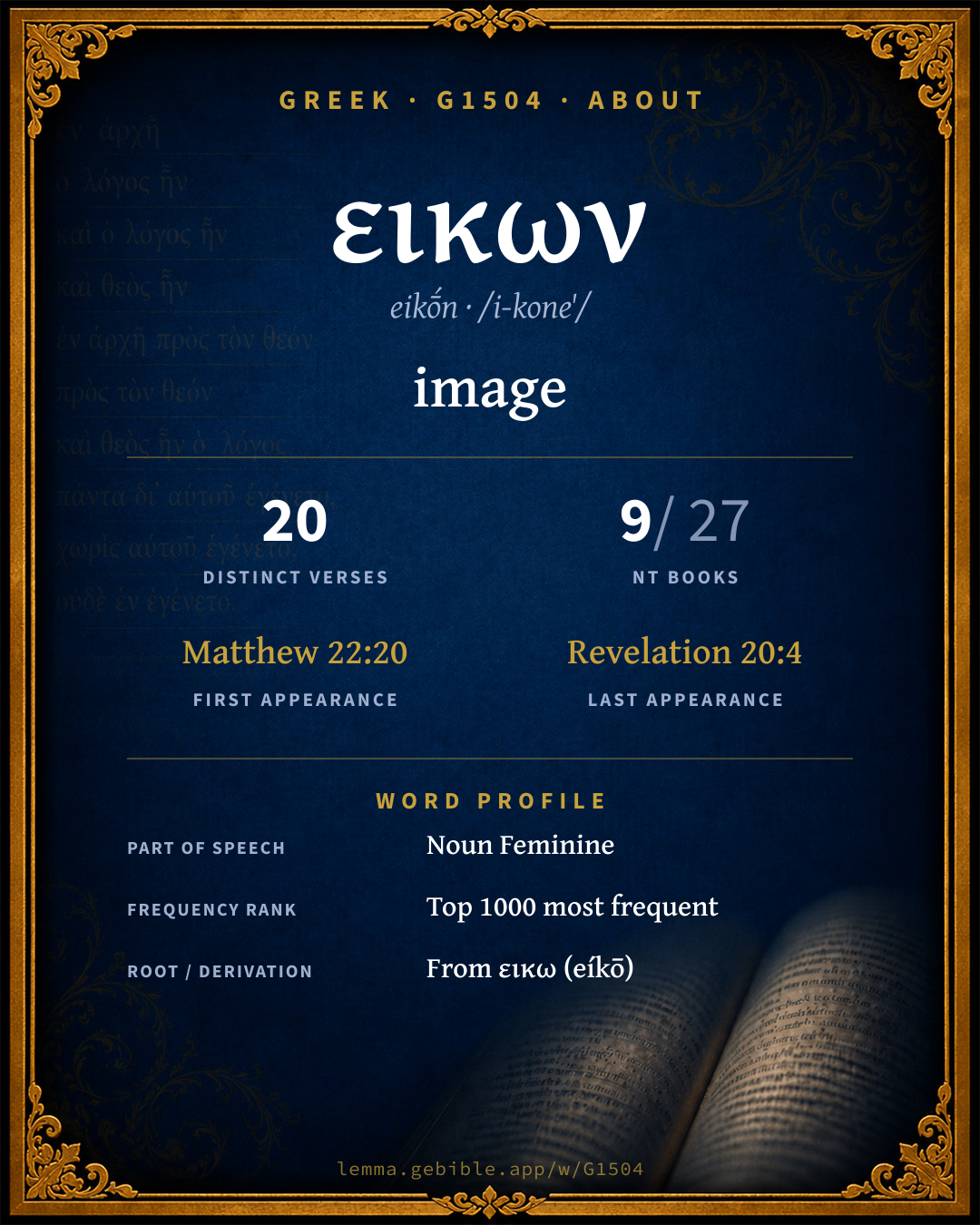
εἰκών
image
Full lexicon entry — Thayer's Greek Lexicon
From Thayer's Greek Lexicon
Where this word appears
See every Accusative-case word in the Greek New Testament →
Grammar key — what these labels mean
Part of speech
- Noun
- A naming word — a person, place, thing, or idea.
Case
- Accusative
- The case of the direct object and of extent.
- Nominative
- The case of the subject (and the predicate nominative).
- Dative
- The case of the indirect object, means, or location — “to / for / with / in.”
- Genitive
- The case of source, possession, or “of” — answers “whose / from what.”
Gender
- Feminine
- Grammatically feminine.
Number
- Singular
- One.
1 verse where G1504 appears in the Nominative case in the Book of Colossians. Filtered view — show all forms. Click any verse to open its interlinear word-by-word view. Verse text shown in the World English Bible for context — . Each verse’s Greek form is shown with its reference; the English is not keyword-highlighted, since the data carries no word-level English alignment. Use “Compare translations” on any verse to read it across multiple English versions. This concordance covers the Greek New Testament; Septuagint (Greek Old Testament) occurrences of this word are not indexed here.
Colossians
About this entry
At a glance — auto-summarized from this page’s data, not written by a person. Every figure links to its source below. This summary describes the numbers; it doesn’t interpret them.
εικων (eikṓn) is a Greek noun most often rendered “image.” Scripture first uses it in Matthew 22:20. It turns up in 20 verses across 9 books, an uncommon footprint. It concentrates in Revelation, which alone accounts for 40% of its uses. It clusters with εικω and Ικονιον under a shared root. The sections below give every sense, occurrence, and version rendering.
Gloss history
Strong's 1890 vs modern scholarship
About this word
Strong's G1504 catalogs a Greek word from the Greek New Testament.
These counts are not copied from any lexicon or concordance. They are computed here, from the morphology-tagged Greek New Testament. What Lemma adds →
- 20
- distinct verses
- The word appears in 20 distinct verses.
- 9 / 27
- NT books
- The word appears in 9 of 27 New Testament books.
- #563
- by frequency
- Top 1000 most frequent Greek words (rank 563 of 5,347 Greek words by occurrence).
View all 20 occurrences in the concordance →
Most concentrated in
- Revelation 8 verses 40%
- Romans 2 verses 10%
- 1 Corinthians 2 verses 10%
By section of the New Testament
By traditional corpus
Conventional, traditional groupings — biblical authorship is debated, so this is a traditional corpus grouping, not an authorship claim. Some books belong to more than one corpus (Luke is in both the Gospels and the Lukan corpus, and so on), so these shares overlap and need not total 100%. Each figure is a share of the word’s 20 distinct verses.
- Johannine 8 verses · 40%
- Pauline corpus 8 verses · 40%
- Revelation 8 verses · 40%
- Gospels 3 verses · 15%
- Lukan (Luke–Acts) 1 verse · 5%
- Hebrews 1 verse · 5%
How translations render this word
Counts come from each version’s own published word-to-Strong’s tagging or interlinear alignment — an approximate guide to how each version renders this word, not a word-level alignment the data otherwise carries. Because each total is that version’s own tagged count, the per-version totals vary from one another and need not match the appearance or distinct-verse counts above. These counts may also differ from a printed concordance because Lemma counts each distinctly tagged rendering and does not collapse phrase taggings into a single head-word total. This is a fixed set of word-tagged versions (KJV, ASV, BSB, ULT) and does not change with the reading translation you choose elsewhere. Each version’s license is shown beside its name below (and on Sources).
- King James Version: Image 22×
- American Standard Version: Image 21×
- Berean Standard Bible: Image 18×, Likeness 2×
- unfoldingWord Literal Text: Image 23×
King James Version Public Domain
Renders G1504 across 23 tagged occurrences — most commonly:
Plus 1 rendering that appears only once — usually multi-word phrases or single function words the recovered tagging swept in, not distinct renderings.
American Standard Version Public Domain
Renders G1504 across 23 tagged occurrences — most commonly:
Plus 2 renderings that appear only once — usually multi-word phrases or single function words the recovered tagging swept in, not distinct renderings.
Berean Standard Bible Public Domain
Renders G1504 across 22 tagged occurrences — most commonly:
Plus 2 renderings that appear only once — usually multi-word phrases or single function words the recovered tagging swept in, not distinct renderings.
unfoldingWord Literal Text CC BY-SA 4.0
Renders G1504 across 23 tagged occurrences — most commonly:
Senses in Thayer's
The 1 sense Thayer's distinguishes for this word, in lexicon order (not ranked by frequency or importance). The full entry — with sub-senses — is in the Lexicon Entry tab.
- an image, figure, likeness
Word origin
Derived from εικω (eíkō) (G1503) — to be like.
From G1503 ; a likeness that is (literally) statue profile or (figuratively) representation resemblance : - image.
— Strong’s Exhaustive Concordance (1890), public domain.
Forms in the corpus
The 4 distinct written forms G1504 takes in the Greek New Testament, most frequent first — each parse links to that case’s occurrences in the concordance.
| Form | Parsing | Example | Uses |
|---|---|---|---|
| εἰκόνα eikóna | Noun, Accusative, Singular, Feminine | Luke 20:24 | 10 |
| εἰκὼν eikṑn | Noun, Nominative, Singular, Feminine | Matthew 22:20 | 6 |
| εἰκόνι eikóni | Noun, Dative, Singular, Feminine | Revelation 13:15 | 4 |
| εἰκόνος eikónos | Noun, Genitive, Singular, Feminine | Romans 1:23 | 3 |
Same root — word family
Other Thayer's entries built from the same root as G1504, grouped by Strong’s listed origin. These share a root / origin per the lexicon — not necessarily a shared meaning. Each links to that word’s own entry.
Derives from
Proper names from this root
People and places named from this root — a name, not an additional meaning of the word.
Compare all same-root words → 1 of the same-root words is a proper name (a person or place). They share a root, not necessarily a meaning.
Septuagint usage
The same Greek word εικων appears 31 times in the Greek Old Testament (Septuagint), across 29 verses in 9 books.
- 31
- LXX occurrences
- Tagged occurrences of this Greek word in the Septuagint.
- 29
- verses
- Distinct Septuagint verses containing this word.
- 9 / 39
- OT books
- The word appears in 9 of the 39 Old Testament books.
Sample Septuagint occurrences
- Genesis 1:26 εἰκών
- Deuteronomy 4:16 εἰκών
- 2 Kings 11:18 εἰκών
- 2 Chronicles 33:7 εἰκών
- Psalms 38:7 εἰκών
- Isaiah 40:19 εἰκών
- Ezekiel 7:20 εἰκών
- Daniel 2:31 εἰκών
- Hosea 13:2 εἰκων
Septuagint occurrences (same lexeme)
Every verse where the same Strong’s number (G1504) appears in the Greek Septuagint. Verse text shown in the World English Bible for context; the Greek form is the matched word — the English is not keyword-highlighted.
- Genesis 1:26 εἰκών God said, "Let us make man in our image, after our likeness: and let them have dominion over the fish of the sea, and over the birds of the sky, and over the cattle, and over all the earth, and over every creeping thing that creeps on the earth."
- Genesis 1:27 εἰκών God created man in his own image. In God's image he created him; male and female he created them.
- Genesis 5:1 εἰκών This is the book of the generations of Adam. In the day that God created man, he made him in God's likeness.
- Genesis 5:3 εἰκών Adam lived one hundred thirty years, and became the father of a son in his own likeness, after his image, and named him Seth.
- Genesis 9:6 εἰκών Whoever sheds man's blood, by man will his blood be shed, for in the image of God made he man.
- Deuteronomy 4:16 εἰκών Lest you corrupt yourselves, and make yourself an engraved image in the form of any figure, the likeness of male or female,
- 2 Kings 11:18 εἰκών All the people of the land went to the house of Baal, and broke it down; his altars and his images broke they in pieces thoroughly, and killed Mattan the priest of Baal before the altars. The priest appointed officers over the house of Yahweh.
- 2 Chronicles 33:7 εἰκών He set the engraved image of the idol, which he had made, in the house of God, of which God said to David and to Solomon his son, In this house, and in Jerusalem, which I have chosen out of all the tribes of Israel, will I put my name forever:
- Psalms 38:7 εἰκών For my loins are filled with burning. There is no soundness in my flesh.
- Psalms 72:20 εἰκών This ends the prayers by David, the son of Jesse.
- Isaiah 40:19 εἰκών The image, a workman has cast [it], and the goldsmith overlays it with gold, and casts [for it] silver chains.
- Isaiah 40:20 εἰκών He who is too impoverished for [such] an offering chooses a tree that will not rot; he seeks to him a skillful workman to set up an engraved image, that shall not be moved.
- Ezekiel 7:20 εἰκών As for the beauty of his ornament, he set it in majesty; but they made the images of their abominations [and] their detestable things therein: therefore have I made it to them as an unclean thing.
- Ezekiel 16:17 εἰκών You also took your beautiful jewels of my gold and of my silver, which I had given you, and made for yourself images of men, and played the prostitute with them;
- Ezekiel 23:14 εἰκών She increased her prostitution; for she saw men portrayed on the wall, the images of the Chaldeans portrayed with vermilion,
- Daniel 2:31 εἰκών You, O king, saw, and, behold, a great image. This image, which was mighty, and whose brightness was excellent, stood before you; and the aspect of it was awesome.
- Daniel 2:34 εἰκών You saw until a stone was cut out without hands, which struck the image on its feet that were of iron and clay, and broke them in pieces.
- Daniel 2:35 εἰκών Then was the iron, the clay, the brass, the silver, and the gold, broken in pieces together, and became like the chaff of the summer threshing floors; and the wind carried them away, so that no place was found for them: and the stone that struck the image became a great mountain, and filled the whole earth.
- Daniel 3:1 εἰκών Nebuchadnezzar the king made an image of gold, whose height was sixty cubits, and the breadth of it six cubits: he set it up in the plain of Dura, in the province of Babylon.
- Daniel 3:2 εἰκών Then Nebuchadnezzar the king sent to gather together the satraps, the deputies, and the governors, the judges, the treasurers, the counselors, the sheriffs, and all the rulers of the provinces, to come to the dedication of the image which Nebuchadnezzar the king had set up.
- Daniel 3:3 εἰκών Then the satraps, the deputies, and the governors, the judges, the treasurers, the counselors, the sheriffs, and all the rulers of the provinces, were gathered together to the dedication of the image that Nebuchadnezzar the king had set up; and they stood before the image that Nebuchadnezzar had set up.
- Daniel 3:5 εἰκών that whenever you hear the sound of the horn, flute, zither, lyre, harp, pipe, and all kinds of music, you fall down and worship the golden image that Nebuchadnezzar the king has set up;
- Daniel 3:7 εἰκών Therefore at that time, when all the peoples heard the sound of the horn, flute, zither, lyre, harp, pipe, and all kinds of music, all the peoples, the nations, and the languages, fell down and worshiped the golden image that Nebuchadnezzar the king had set up.
- Daniel 3:10 εἰκών You, O king, have made a decree, that every man that shall hear the sound of the horn, flute, zither, lyre, harp, pipe, and all kinds of music, shall fall down and worship the golden image;
- Daniel 3:12 εἰκών There are certain Jews whom you have appointed over the affairs of the province of Babylon: Shadrach, Meshach, and Abednego; these men, O king, have not regarded you: they don't serve your gods, nor worship the golden image which you have set up.
- Daniel 3:14 εἰκών Nebuchadnezzar answered them, Is it on purpose, Shadrach, Meshach, and Abednego, that you don't serve my god, nor worship the golden image which I have set up?
- Daniel 3:15 εἰκών Now if you are ready whenever you hear the sound of the horn, flute, zither, lyre, harp, pipe, and all kinds of music to you fall down and worship the image which I have made, [well]: but if you don't worship, you shall be cast the same hour into the midst of a burning fiery furnace; and who is that god that shall deliver you out of my hands?
- Daniel 3:18 εἰκών But if not, be it known to you, O king, that we will not serve your gods, nor worship the golden image which you have set up.
- Hosea 13:2 εἰκων Now they sin more and more, And have made themselves molten images of their silver, Even idols according to their own understanding, All of them the work of the craftsmen. They say of them, "They offer human sacrifice and kiss the calves."
These are occurrences of the same Greek lexeme (G1504) in the Septuagint — not a translation of any one Hebrew word. The store carries no word-level Hebrew↔Greek alignment, so no Hebrew original is asserted here. Counts come from the recovered LXX Strong's tagging — high-frequency vocabulary is well covered, while rare or late forms may be untagged — so they reflect tagged occurrences and may slightly undercount.