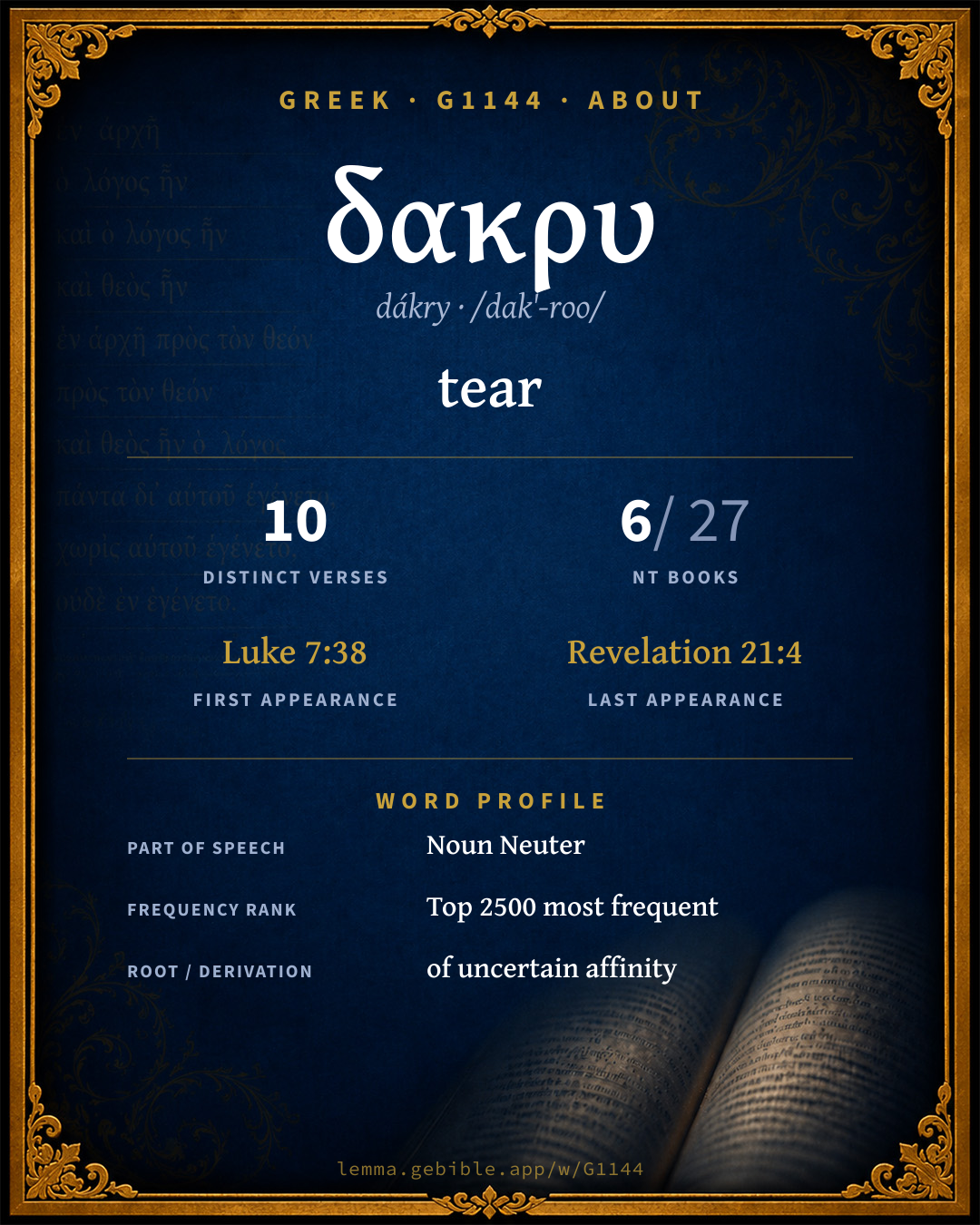
δακρυ
tear
Full lexicon entry — Thayer's Greek Lexicon
From Thayer's Greek Lexicon
Where this word appears
Grammar key — what these labels mean
Part of speech
- Noun
- A naming word — a person, place, thing, or idea.
Case
- Genitive
- The case of source, possession, or “of” — answers “whose / from what.”
- Accusative
- The case of the direct object and of extent.
- Dative
- The case of the indirect object, means, or location — “to / for / with / in.”
Gender
- Neuter
- Grammatically neuter.
Number
- Plural
- More than one.
- Singular
- One.
Every verse where G1144 appears in the Book of Revelation — 2 distinct verses. Click any verse to open its interlinear word-by-word view. Verse text shown in the World English Bible for context — . Each verse’s Greek form is shown with its reference; the English is not keyword-highlighted, since the data carries no word-level English alignment. Use “Compare translations” on any verse to read it across multiple English versions. This concordance covers the Greek New Testament; Septuagint (Greek Old Testament) occurrences of this word are not indexed here.
Revelation
- Revelation 7:17 δάκρυον n acc sg neut for the Lamb who is in the midst of the throne shepherds them, and leads them to springs of waters of life. And God will wipe away every tear from their eyes."
- Revelation 21:4 δάκρυον n acc sg neut He will wipe away from them every tear from their eyes. Death will be no more; neither will there be mourning, nor crying, nor pain, any more. The first things have passed away."
About this entry
At a glance — auto-summarized from this page’s data, not written by a person. Every figure links to its source below. This summary describes the numbers; it doesn’t interpret them.
The Greek noun δακρυ centers on the idea of “tear.” Debuting at Luke 7:38, it then recurs through the corpus. Spanning 10 verses in 6 books, it ranks among the uncommon words of the Greek New Testament. Sharing its root, it stands alongside δακρυω. Dig into 10-verse concordance and the renderings breakdown below.
Gloss history
Strong's 1890 vs modern scholarship
About this word
Strong's G1144 catalogs a Greek word from the Greek New Testament.
These counts are not copied from any lexicon or concordance. They are computed here, from the morphology-tagged Greek New Testament. What Lemma adds →
- 10
- distinct verses
- The word appears in 10 distinct verses.
- 6 / 27
- NT books
- The word appears in 6 of 27 New Testament books.
- #1,056
- by frequency
- Top 2500 most frequent Greek words (rank 1,056 of 5,347 Greek words by occurrence).
View all 10 occurrences in the concordance →
By section of the New Testament
By traditional corpus
Conventional, traditional groupings — biblical authorship is debated, so this is a traditional corpus grouping, not an authorship claim. Some books belong to more than one corpus (Luke is in both the Gospels and the Lukan corpus, and so on), so these shares overlap and need not total 100%. Each figure is a share of the word’s 10 distinct verses.
- Lukan (Luke–Acts) 4 verses · 40%
- Gospels 2 verses · 20%
- Johannine 2 verses · 20%
- Pauline corpus 2 verses · 20%
- Hebrews 2 verses · 20%
- Revelation 2 verses · 20%
How translations render this word
Counts come from each version’s own published word-to-Strong’s tagging or interlinear alignment — an approximate guide to how each version renders this word, not a word-level alignment the data otherwise carries. Because each total is that version’s own tagged count, the per-version totals vary from one another and need not match the appearance or distinct-verse counts above. These counts may also differ from a printed concordance because Lemma counts each distinctly tagged rendering and does not collapse phrase taggings into a single head-word total. This is a fixed set of word-tagged versions (KJV, ASV, BSB, ULT) and does not change with the reading translation you choose elsewhere. Each version’s license is shown beside its name below (and on Sources).
- King James Version: Tears 11×
- American Standard Version: Tears 8×, Tear 2×
- Berean Standard Bible: Tears 8×, Tear 2×
- unfoldingWord Literal Text: Tears 8×, Tear 2×
King James Version Public Domain
Renders G1144 across 11 tagged occurrences — most commonly:
American Standard Version Public Domain
Renders G1144 across 10 tagged occurrences — most commonly:
Berean Standard Bible Public Domain
Renders G1144 across 10 tagged occurrences — most commonly:
unfoldingWord Literal Text CC BY-SA 4.0
Renders G1144 across 10 tagged occurrences — most commonly:
Senses in Thayer's
The 1 sense Thayer's distinguishes for this word, in lexicon order (not ranked by frequency or importance). The full entry — with sub-senses — is in the Lexicon Entry tab.
- a tear
Word origin
Origin: of uncertain affinity
Of uncertain affinity; a tear : - tear.
— Strong’s Exhaustive Concordance (1890), public domain.
Forms in the corpus
The 3 distinct written forms G1144 takes in the Greek New Testament, most frequent first — each parse links to that case’s occurrences in the concordance.
| Form | Parsing | Example | Uses |
|---|---|---|---|
| δακρύων dakrýōn | Noun, Genitive, Plural, Neuter | Acts 20:19 | 6 |
| δάκρυον dákryon | Noun, Accusative, Singular, Neuter | Revelation 7:17 | 2 |
| δάκρυσιν dákrysin | Noun, Dative, Plural, Neuter | Luke 7:38 | 2 |
Same root — word family
Other Thayer's entries built from the same root as G1144, grouped by Strong’s listed origin. These share a root / origin per the lexicon — not necessarily a shared meaning. Each links to that word’s own entry.
Derived from this word
Compare all same-root words → They share a root, not necessarily a meaning.
Septuagint usage
The same Greek word δακρυ appears 22 times in the Greek Old Testament (Septuagint), across 21 verses in 8 books.
- 22
- LXX occurrences
- Tagged occurrences of this Greek word in the Septuagint.
- 21
- verses
- Distinct Septuagint verses containing this word.
- 8 / 39
- OT books
- The word appears in 8 of the 39 Old Testament books.
Sample Septuagint occurrences
- 2 Kings 20:5 δάκρυ
- Psalms 6:7 δάκρυ
- Ecclesiastes 4:1 δάκρυ
- Isaiah 25:8 δάκρυ
- Jeremiah 8:23 δάκρυ
- Lamentations 1:2 δάκρυ
- Micah 2:6 δάκρυ
- Malachi 2:13 δάκρυ
Septuagint occurrences (same lexeme)
Every verse where the same Strong’s number (G1144) appears in the Greek Septuagint. Verse text shown in the World English Bible for context; the Greek form is the matched word — the English is not keyword-highlighted.
- 2 Kings 20:5 δάκρυ Turn back, and tell Hezekiah the prince of my people, Thus says Yahweh, the God of David your father, I have heard your prayer, I have seen your tears: behold, I will heal you; on the third day you shall go up to the house of Yahweh.
- Psalms 6:7 δάκρυ My eye wastes away because of grief; It grows old because of all my adversaries.
- Psalms 38:13 δάκρυ But I, as a deaf man, don't hear. I am as a mute man who doesn't open his mouth.
- Psalms 41:4 δάκρυ I said, "Yahweh, have mercy on me! Heal me, for I have sinned against you."
- Psalms 55:9 δάκρυ Confuse them, Lord, and confound their language, For I have seen violence and strife in the city.
- Psalms 79:6 δάκρυ Pour out your wrath on the nations that don't know you; On the kingdoms that don't call on your name;
- Psalms 114:8 δάκρυ Who turned the rock into a pool of water, The flint into a spring of waters.
- Psalms 125:5 δάκρυ But as for those who turn aside to their crooked ways, Yahweh will lead them away with the workers of iniquity. Peace be on Israel.
- Ecclesiastes 4:1 δάκρυ Then I returned and saw all the oppressions that are done under the sun: and, behold, the tears of those who were oppressed, and they had no comforter; and on the side of their oppressors there was power; but they had no comforter.
- Isaiah 25:8 δάκρυ He has swallowed up death forever; and the Lord Yahweh will wipe away tears from off all faces; and the reproach of his people will he take away from off all the earth: for Yahweh has spoken it.
- Isaiah 38:5 δάκρυ Go, and tell Hezekiah, Thus says Yahweh, the God of David your father, I have heard your prayer, I have seen your tears: behold, I will add to your days fifteen years.
- Jeremiah 8:23 δάκρυ
- Jeremiah 9:17 δάκρυ Thus says Yahweh of Hosts, Consider you, and call for the mourning women, that they may come; and send for the skillful women, that they may come:
- Jeremiah 13:17 δάκρυ But if you will not hear it, my soul shall weep in secret for [your] pride; and my eye shall weep sore, and run down with tears, because Yahweh's flock is taken captive.
- Jeremiah 14:17 δάκρυ You shall say this word to them, Let my eyes run down with tears night and day, and let them not cease; for the virgin daughter of my people is broken with a great breach, with a very grievous wound.
- Jeremiah 38:16 δάκρυ So Zedekiah the king swore secretly to Jeremiah, saying, As Yahweh lives, who made us this soul, I will not put you to death, neither will I give you into the hand of these men who seek your life.
- Lamentations 1:2 δάκρυ She weeps sore in the night, and her tears are on her cheeks; Among all her lovers she has none to comfort her: All her friends have dealt treacherously with her; they are become her enemies.
- Lamentations 2:11 δάκρυ My eyes do fail with tears, my heart is troubled; My liver is poured on the earth, because of the destruction of the daughter of my people, Because the young children and the infants swoon in the streets of the city.
- Lamentations 2:18 δάκρυ Their heart cried to the Lord: wall of the daughter of Zion, let tears run down like a river day and night; Give yourself no respite; don't let the apple of your eye cease.
- Micah 2:6 δάκρυ "Don't you prophesy!" They prophesy. "Don't prophesy about these things. Disgrace won't overtake us."
- Malachi 2:13 δάκρυ This again you do: you cover the altar of Yahweh with tears, with weeping, and with sighing, because he doesn't regard the offering any more, neither receives it with good will at your hand.
These are occurrences of the same Greek lexeme (G1144) in the Septuagint — not a translation of any one Hebrew word. The store carries no word-level Hebrew↔Greek alignment, so no Hebrew original is asserted here. Counts come from the recovered LXX Strong's tagging — high-frequency vocabulary is well covered, while rare or late forms may be untagged — so they reflect tagged occurrences and may slightly undercount.