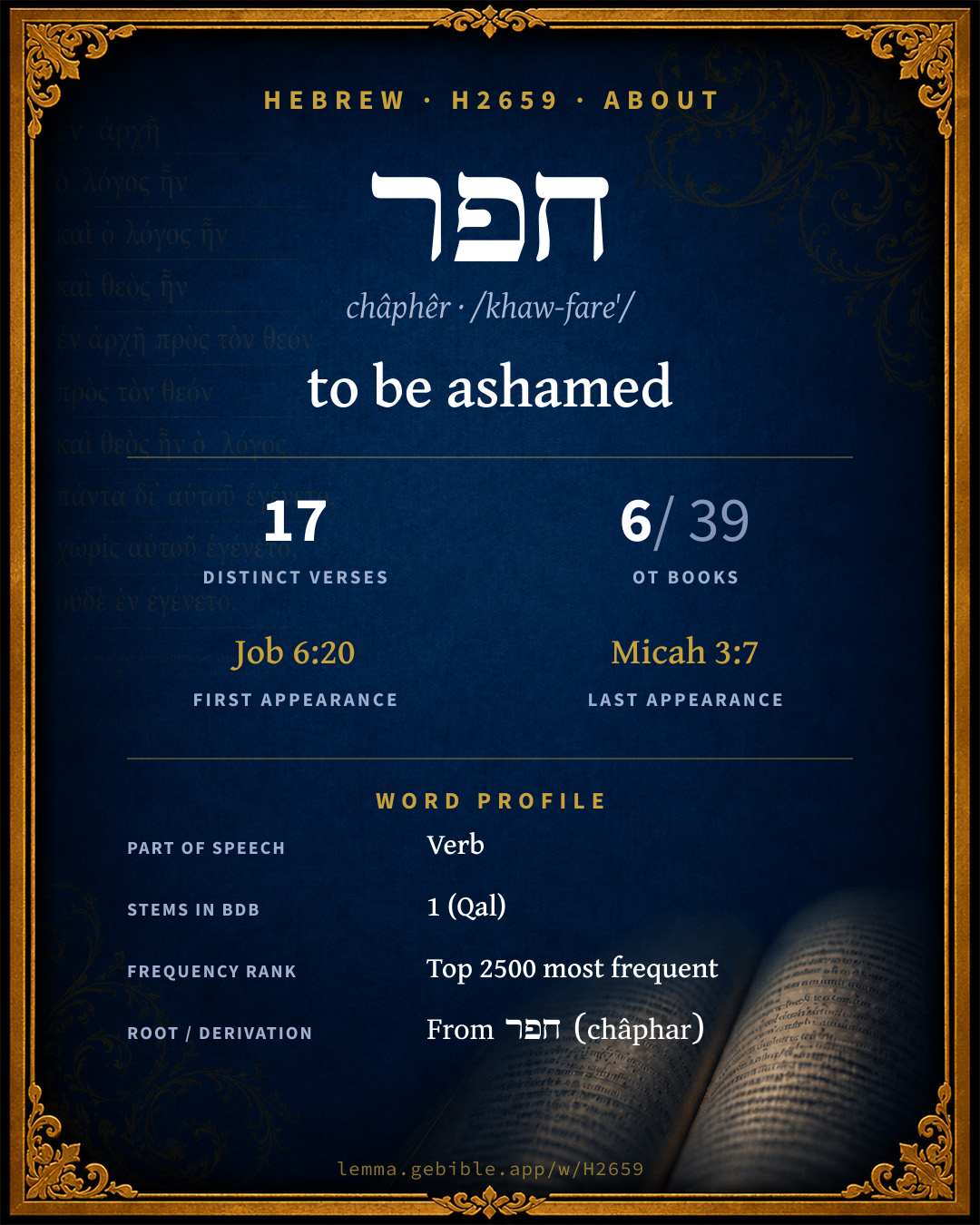
חָפֵר
to be ashamed
also: be confounded, be abashed, feel abashed fuller range ↓
Full lexicon entry — Brown-Driver-Briggs (BDB)
From Brown-Driver-Briggs (BDB)
Where this word appears
See every Qal verb in the Hebrew Bible →
Grammar key — what these labels mean
Part of speech
- Verb
- An action or state-of-being word.
Stem
- Qal
- The basic, simple active stem — the plain form of the verb (“he wrote”). Here: ‘dig’
- Hiphil
- The causative active stem (“he caused / brought about”).
Form
- Imperfect
- An incomplete, ongoing, or future action (“he will / would write”).
- Participle Active
- A verbal adjective expressing ongoing or characteristic action (“writing / one who writes”).
- Perfect
- A completed action or state — Hebrew marks aspect (completeness) more than strict tense (“he wrote”).
- Sequential Perfect
- A perfect with prefixed waw continuing a preceding imperfect or command (waw-consecutive perfect).
- Sequential Imperfect
- An imperfect with prefixed waw — the standard past-narrative form (waw-consecutive imperfect).
- Jussive
- A third- or second-person volitional form expressing wish or command (“let him write”).
State
- Absolute
- The independent form of a noun, not bound to a following word.
Person
- 3rd Person
- The one spoken about (“he / she / it / they”).
- 2nd Person
- The one addressed (“you”).
Gender
- Masculine
- Grammatically masculine.
- Feminine
- Grammatically feminine.
- Common
- Either gender — not distinguished for this form.
Number
- Plural
- More than one (in Hebrew, generally three or more).
- Singular
- One.
Grammatical forms 12 distinct
- Verb, Qal, Imperfect, 3rd Person, Masculine, Plural 5 times (29%)
- Verb, Qal, Perfect, 3rd Person, Feminine, Singular 2 times (12%)
- Verb, Hiphil, Imperfect, 3rd Person, Masculine, Singular 1 time (6%)
- Verb, Hiphil, Participle Active, Masculine, Singular, Absolute 1 time (6%)
- Verb, Qal, Imperfect, 2nd Person, Masculine, Plural 1 time (6%)
- Verb, Qal, Sequential Perfect, 3rd Person, Common, Plural 1 time (6%)
- Verb, Qal, Sequential Perfect, 3rd Person, Feminine, Singular 1 time (6%)
- Verb, Qal, Sequential Imperfect, 3rd Person, Masculine, Plural 1 time (6%)
+4 more forms (4 occurrences)
Parsed forms decoded from the imported morphology (morphhb / Westminster Leningrad Codex — WLC text public domain, morphhb tagging CC BY 4.0), counted across 17 parsed occurrences — not distinct verses.
Every verse where H2659 appears — 17 distinct verses across 6 books. Click any verse to open its interlinear word-by-word view. Verse text shown in the World English Bible for context — . Each verse’s Hebrew form is shown with its reference; the English is not keyword-highlighted, since the data carries no word-level English alignment. Use “Compare translations” on any verse to read it across multiple English versions. This concordance covers the Hebrew Bible; Septuagint (Greek Old Testament) occurrences are not indexed here.
Job 1 verse
Psalms 7 verses
- Psalms 34:5 יֶחְפָּֽרוּ Qal juss 3mp They looked to him, and were radiant. Their faces shall never be covered with shame.
- Psalms 35:4 וְ/יַחְפְּר֑וּ conj + Qal impf 3mp Let those who seek after my soul be disappointed and brought to dishonor. Let those who plot my ruin be turned back and confounded.
- Psalms 35:26 וְ/יַחְפְּר֨וּ conj + Qal impf 3mp Let them be disappointed and confounded together who rejoice at my calamity. Let them be clothed with shame and dishonor who magnify themselves against me.
- Psalms 40:14 וְ/יַחְפְּר֨וּ conj + Qal impf 3mp Let them be disappointed and confounded together who seek after my soul to destroy it. Let them be turned backward and brought to dishonor who delight in my hurt.
- Psalms 70:2 וְ/יַחְפְּרוּ֮ conj + Qal impf 3mp Let them be disappointed and confounded who seek my soul. Let those who desire my ruin be turned back in disgrace.
- Psalms 71:24 חָ֝פְר֗וּ Qal pf 3cp My tongue will also talk about your righteousness all day long, For they are disappointed, and they are confounded, who want to harm me.
- Psalms 83:17 וְֽ/יַחְפְּר֥וּ conj + Qal impf 3mp Let them be disappointed and dismayed forever. Yes, let them be confounded and perish;
Proverbs 2 verses
Isaiah 4 verses
- Isaiah 1:29 וְ/תַ֨חְפְּר֔וּ conj + Qal impf 2mp For they shall be ashamed of the oaks which you have desired, And you shall be confounded for the gardens that you have chosen.
- Isaiah 24:23 וְ/חָֽפְרָה֙ conj + Qal wpf 3fs Then the moon shall be confounded, and the sun ashamed; for Yahweh of Hosts will reign on Mount Zion, and in Jerusalem; and before his elders shall be glory.
- Isaiah 33:9 הֶחְפִּ֥יר Hiphil pf 3ms The land mourns and languishes; Lebanon is confounded and withers away; Sharon is like a desert; and Bashan and Carmel shake off [their leaves].
- Isaiah 54:4 תַחְפִּ֑ירִי Hiphil impf 2fs Don't be afraid; for you shall not be ashamed: neither be confounded; for you shall not be disappointed: for you shall forget the shame of your youth; and the reproach of your widowhood shall you remember no more.
Jeremiah 2 verses
- Jeremiah 15:9 וְ/חָפֵ֑רָה conj + Qal pf 3fs She who has borne seven languishes; she has given up the spirit; her sun is gone down while it was yet day; she has been disappointed and confounded: and the residue of them will I deliver to the sword before their enemies, says Yahweh.
- Jeremiah 50:12 חָפְרָ֖ה Qal pf 3fs your mother shall be utterly disappointed; she who bore you shall be confounded: behold, she shall be the least of the nations, a wilderness, a dry land, and a desert.
Micah 1 verse
About this entry
At a glance — auto-summarized from this page’s data, not written by a person. Every figure links to its source below. This summary describes the numbers; it doesn’t interpret them.
חפר — transliterated châphêr — is a Hebrew verb carrying the sense “to be ashamed.” Debuting at Job 6:20, it then recurs through the corpus. It appears 17 verses across 6 books of the Hebrew Bible, among its uncommon vocabulary. More than a third of its appearances fall in Psalms. It also covers “be confounded”, “be abashed”, and “feel abashed”, alongside “to be ashamed” — see its full sense range. See the sense tree, 17-verse concordance, and the renderings breakdown below.
Gloss history
Strong's 1890 vs modern scholarship
About this word
Strong's H2659 catalogs a Hebrew word from the Hebrew Old Testament.
These counts are not copied from any lexicon or concordance. They are computed here, from the morphology-tagged Hebrew Old Testament. What Lemma adds →
- 17
- distinct verses
- The word appears in 17 distinct verses.
- 6 / 39
- OT books
- The word appears in 6 of 39 Old Testament books.
- #1,671
- by frequency
- Top 2500 most frequent Hebrew words (rank 1,671 of 8,640 Hebrew words by occurrence).
View all 17 occurrences in the concordance →
By section of the Old Testament
By traditional corpus
Conventional, traditional groupings — biblical authorship is debated, so this is a traditional corpus grouping, not an authorship claim. Each share is this word’s portion of its verses in that division of the Hebrew canon. Each figure is a share of the word’s 17 distinct verses.
- Writings (Ketuvim) 10 verses · 59%
- Prophets (Nevi'im) 7 verses · 41%
How translations render this word
Counts come from each version’s own published word-to-Strong’s tagging or interlinear alignment — an approximate guide to how each version renders this word, not a word-level alignment the data otherwise carries. Because each total is that version’s own tagged count, the per-version totals vary from one another and need not match the appearance or distinct-verse counts above. These counts may also differ from a printed concordance because Lemma counts each distinctly tagged rendering and does not collapse phrase taggings into a single head-word total. This is a fixed set of word-tagged versions (KJV, ASV, BSB, ULT) and does not change with the reading translation you choose elsewhere. Each version’s license is shown beside its name below (and on Sources).
- King James Version: Confounded 4×, Brought to confusion 2×
- American Standard Version: Bringeth reproach 1×, Cometh to shame 1×, Confounded 1×
- Berean Standard Bible: Confounded 5×, Disgrace 3×, Will be disgraced 2×
- unfoldingWord Literal Text: Causes embarrassment 2×, Confounded 2×
King James Version Public Domain
Renders H2659 across 17 tagged occurrences — most commonly:
Plus 11 renderings that appear only once — usually multi-word phrases or single function words the recovered tagging swept in, not distinct renderings.
American Standard Version Public Domain
Renders H2659 across 13 tagged occurrences — most commonly:
Plus other, less common renderings.
Berean Standard Bible Public Domain
Renders H2659 across 17 tagged occurrences — most commonly:
Plus 7 renderings that appear only once — usually multi-word phrases or single function words the recovered tagging swept in, not distinct renderings.
unfoldingWord Literal Text CC BY-SA 4.0
Renders H2659 across 19 tagged occurrences — most commonly:
Plus 15 renderings that appear only once — usually multi-word phrases or single function words the recovered tagging swept in, not distinct renderings.
Senses in the full BDB
What do BDB’s symbols mean?
BDB uses these scholarly abbreviations:
| Symbol | Meaning |
|---|---|
| 𝔊 | the Septuagint (the ancient Greek translation, LXX) |
| 𝔙 | the Vulgate (the Latin translation) |
| 𝔖 | the Syriac version (the Peshitta) |
| 𝔗 | the Targum (the Aramaic translation) |
| ψ | the Psalms |
| √ | root (the underlying root or stem) |
| ‖ | parallel passage (a synonymous or contrasted parallel) |
| † | the dagger: every passage where the word occurs is cited |
The 5 senses and sub-senses the full Brown-Driver-Briggs lexicon distinguishes for this word, in lexicon order (not ranked by frequency), with BDB’s own verbatim wording and sub-sense lettering. Shown in Hebrew script with BDB’s own scholarly abbreviations. The condensed entry is in the Lexicon Entry tab. See also the Forms in the corpus table below.
Qal
- Pf. ח׳ Jb 39:29; וְחָפַרְתָּ֫ Jb 11:18; וְחָפַרְתָּ֫ה Dt 23:14; חָפַרְתִּי Gn 21:30; חָֽפְרוּ Gn 26:18 + 2 times; חָפָ֑רוּ Gn 26:32; חֲפָרוּהָ Nu 21:18; Impf. וַיַּחְפֹּר Gn 26:18, 22; וַיַּחְפִּרֵהוּ ψ 7:16; וָאֶחְפֹּר Je 13:7; יַחְפְּדוּ Jb 39:21 (but read יַחְפֹּר so 𝔊 𝔙 𝔖 Di) Dt 1:22; וַיַּחְפְּרוּ Gn 26:19 + 2 times; וַיַּחְפְּרֻהוּ Jb 3:21; Inf. cstr. לַחְפֹּר Jos 2:2, 3 + Is 2:20 (cf. infr.); Pt. חֹפֵר Ec 10:8;— e.g. Job 39:29
- 1. dig:
- a. a well, c. acc. בְּאֵר Gn 21:30 (E), 26:15, 18(×2), 19, 21, 22, 32 (J), Nu 21:18 (E); cf. Ex 7:24 (E); dig (a hole, implied as obj.) Dt 23:14; a pit, with hostile purpose, as snare or trap, fig. of malicious plan, c. acc. בּוֹר ψ 7:16 (‖ כָּרָה); so c. acc. גומץ Ec 10:8, cf. ח׳ לְנַפְשִׁי [שַׁחַת] ψ 35:7; of horse, dig, i.e. paw the ground, יַחְפֹּר בָּעֵמֶק Jb 39:21 (so read, v. supr.) he paweth in the valley (cf. Arabic حَافِرٌ hoof). e.g. Genesis 21:30
- b. dig for something hidden, c. acc. Jb 3:21 (fig. of longing for death), Je 13:7 (no obj. expr.) e.g. Job 3:21
- 2. search, search out, explore, c. acc. הָאָרֶץ Jos 2:2, 3 (JE), Dt 1:22; of eagle, search for food, c. acc. ח׳ אֹכֶל Jb 39:29, with especially reference to keen vision (‖ מֵרָחוֹק עֵינָיו יַבִּיטוּ); so = search or look carefully about before going to rest Jb 11:18 (no obj.).—לַחְפֹּר Is 2:20 v. חֲפַרְפָּרָה infr. e.g. Joshua 2:2
Senses from the full Brown-Driver-Briggs lexicon (Brown, Driver, Briggs; Oxford 1906 — public domain), digitized via Sefaria, supplemented by the OpenScriptures HebrewLexicon (CC BY 4.0). Full attribution on Sources.
Word origin
vb. dig, search for (Arabic حَفَرَ id.; Aramaic חֲפַר, ܚܦܰܪ, id.; NH חֵפֶר act of digging)—
— Brown-Driver-Briggs (Oxford 1906, public domain), digitized via Sefaria, supplemented by the OpenScriptures HebrewLexicon (CC BY 4.0). See Sources.
Derived from חפר (châphar) (H2658) — to dig.
Jastrow Dictionary
A second Hebrew/Aramaic lexicon for comparison, covering Aramaic and post-biblical (Talmudic, Targumic, Midrashic) usage that the biblical-Hebrew BDB does not. Matched by lemma rather than by Strong’s number, so a lemma may carry more than one Jastrow headword (shown separately below), and the entries cover usage well beyond the Bible.
חפַר
- to dig, hollow out. B. Kam. V, 5 החוֹפֵר בור וכ׳ if one hollows out a pit on private ground, but opens it on public ground; Tosef. ib. VI, 4. B. Mets. 50ᵃ, v. אוּשׁ II. Midr. Sam. ch. XXXII, end לַחְפֹּור to dig graves, v. חֵפֶר; a. fr.
חֲפַר I
- 1. to dig. Targ. Ps. VII, 16 (Ms. כרא). Targ. Gen. XXVI, 15; a. fr.—Part. pass. חֲפִיר q. v.
- 2. (trnsf.) to plan, espy. Targ. Prov. XVI, 27. Targ. Job XXXIX, 29.
חֲפַר II
- to be white, be ashamed. Targ. Prov. XIII, 5.
חֵפֶר
- (חָפַר) grave-digging. Y. Taan. IV, end, 69ᶜ בטל הח׳ the grave-digging (for the generation of the wilderness) ceased; Lam. R. introd. (R. Z’era). Y. l. c. צאו לח׳ go out for grave-digging; (Lam. R. l. c.; Midr. Sam. ch. XXXII, end לַחְפּוֹר).
A Dictionary of the Targumim, the Talmud Babli and Yerushalmi, and the Midrashic Literature (Marcus Jastrow; London, Luzac, 1903) — Public Domain. Digitized via Sefaria. Digitized via Sefaria. Full attribution on Sources.
Forms in the corpus
The 16 distinct written forms H2659 takes in the Hebrew Bible, most frequent first — each parse links to that stem’s occurrences in the concordance. Hebrew forms include their vowel points and cantillation, so a single lemma takes many written forms.
Same root — word family
Other BDB entries built from the same root as H2659, grouped by Strong’s listed origin. These share a root / origin per the lexicon — not necessarily a shared meaning. Each links to that word’s own entry.
Derives from
Shares the same root
Proper names from this root
People and places named from this root — a name, not an additional meaning of the word.
Compare all same-root words → 1 of the same-root words is a proper name (a person or place). They share a root, not necessarily a meaning.
Septuagint verse parallels
This word appears in 14 verses that also exist in the Greek Old Testament (Septuagint), out of the 17 Hebrew verses it occurs in. You can read those verses in Greek by switching the Old Testament edition to the Septuagint.
Read these verses in the Septuagint
This is a verse-level parallel only — the same verses exist in both the Hebrew and Greek Old Testaments. No word-level Hebrew↔Greek correspondence is claimed: the data carries no such alignment, so no Greek word is shown as this Hebrew word’s translation. Coverage is not total — the Septuagint omits the deuterocanon and renumbers the Psalms, so some Hebrew verses have no direct Greek parallel.