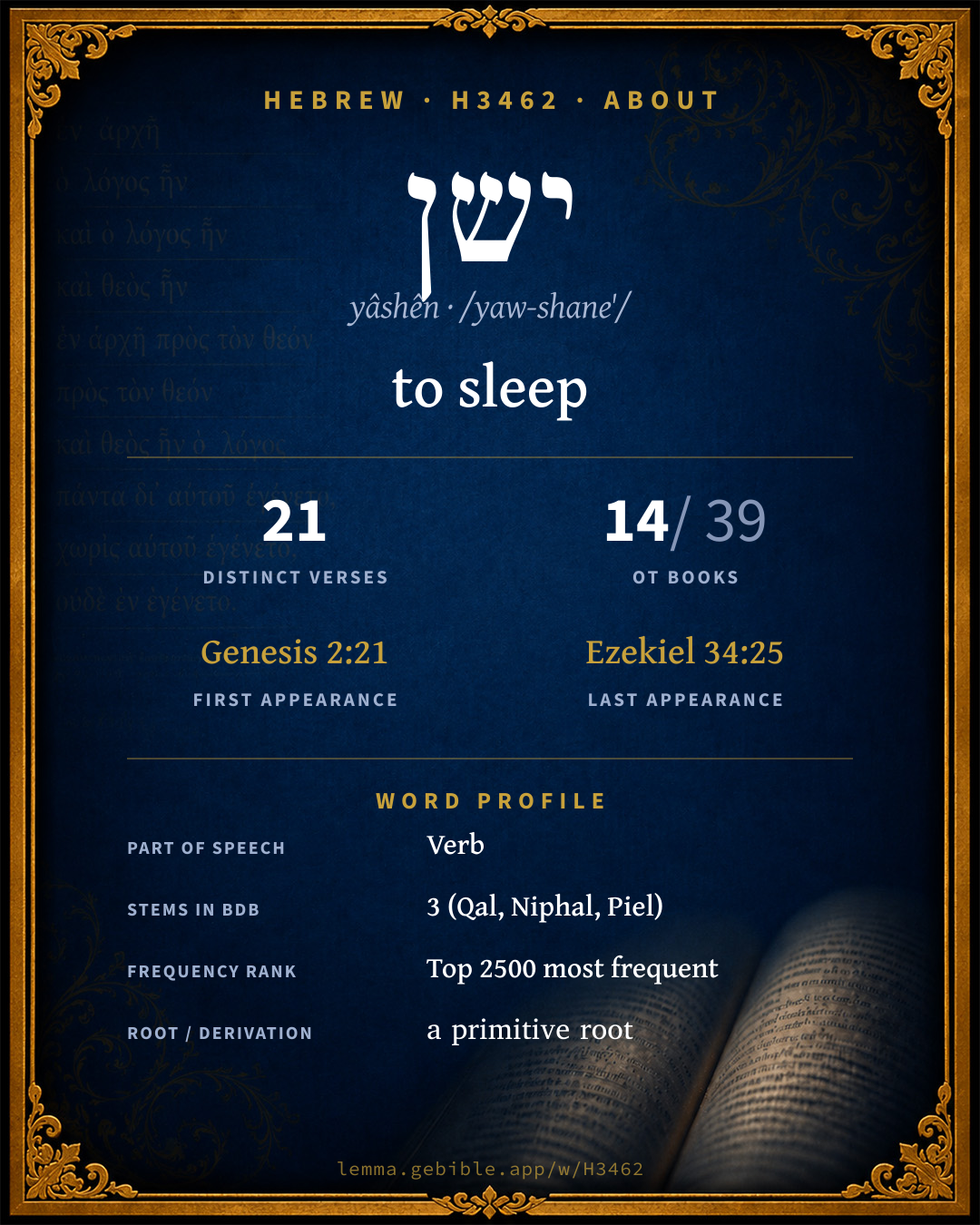
יָשֵׁן
to sleep
‘to sleep’ is one of 3 main senses fuller range ↓
Full lexicon entry — Brown-Driver-Briggs (BDB)
From Brown-Driver-Briggs (BDB)
Where this word appears
See every Qal verb in the Hebrew Bible →
Grammar key — what these labels mean
Part of speech
- Adjective
- A word that describes or qualifies a noun.
- Verb
- An action or state-of-being word.
Stem
- Qal
- The basic, simple active stem — the plain form of the verb (“he wrote”).
- Niphal
- Usually the simple passive or reflexive of the Qal (“he was written”).
- Piel
- An intensive or resultative active stem.
Form
- Sequential Perfect
- A perfect with prefixed waw continuing a preceding imperfect or command (waw-consecutive perfect).
- Sequential Imperfect
- An imperfect with prefixed waw — the standard past-narrative form (waw-consecutive imperfect).
- Imperfect
- An incomplete, ongoing, or future action (“he will / would write”).
- Infinitive Construct
- A bound verbal noun, frequently with prepositions (“to write / in writing”).
- Participle Active
- A verbal adjective expressing ongoing or characteristic action (“writing / one who writes”).
- Participle Passive
- A verbal adjective expressing action received (“written”).
- Perfect
- A completed action or state — Hebrew marks aspect (completeness) more than strict tense (“he wrote”).
State
- Absolute
- The independent form of a noun, not bound to a following word.
Person
- 3rd Person
- The one spoken about (“he / she / it / they”).
- 2nd Person
- The one addressed (“you”).
- 1st Person
- The speaker (“I / we”).
Gender
- Common
- Either gender — not distinguished for this form.
- Masculine
- Grammatically masculine.
- Feminine
- Grammatically feminine.
Number
- Plural
- More than one (in Hebrew, generally three or more).
- Singular
- One.
Grammatical forms 14 distinct
- Verb, Qal, Sequential Perfect, 3rd Person, Common, Plural 3 times (14%)
- Verb, Qal, Sequential Imperfect, 3rd Person, Masculine, Singular 3 times (14%)
- Adjective, Adjective, Masculine, Plural, Absolute 2 times (10%)
- Verb, Qal, Imperfect, 3rd Person, Masculine, Singular 2 times (10%)
- Verb, Qal, Imperfect, 1st Person, Common, Singular 2 times (10%)
- Verb, Niphal, Sequential Perfect, 2nd Person, Masculine, Plural 1 time (5%)
- Verb, Piel, Sequential Imperfect, 3rd Person, Feminine, Singular 1 time (5%)
- Verb, Qal, Sequential Imperfect, 1st Person, Common, Singular 1 time (5%)
+6 more forms (6 occurrences)
Parsed forms decoded from the imported morphology (morphhb / Westminster Leningrad Codex — WLC text public domain, morphhb tagging CC BY 4.0), counted across 21 parsed occurrences — not distinct verses.
Every verse where H3462 appears — 21 distinct verses across 14 books. Click any verse to open its interlinear word-by-word view. Verse text shown in the World English Bible for context — . Each verse’s Hebrew form is shown with its reference; the English is not keyword-highlighted, since the data carries no word-level English alignment. Use “Compare translations” on any verse to read it across multiple English versions. This concordance covers the Hebrew Bible; Septuagint (Greek Old Testament) occurrences are not indexed here.
Genesis 2 verses
- Genesis 2:21 וַ/יִּישָׁ֑ן conj + Qal wimpf 3ms Yahweh God caused a deep sleep to fall on the man, and he slept; and he took one of his ribs, and closed up the flesh in its place.
- Genesis 41:5 וַ/יִּישָׁ֕ן conj + Qal wimpf 3ms He slept and dreamed a second time: and, behold, seven heads of grain came up on one stalk, healthy and good.
Leviticus 2 verses
- Leviticus 13:11 נוֹשֶׁ֤נֶת Niphal ptcp.act fs it is a chronic leprosy in the skin of his body, and the priest shall pronounce him unclean. He shall not isolate him, for he is unclean.
- Leviticus 26:10 נוֹשָׁ֑ן Niphal ptcp.pass ms You shall eat old store long kept, and you shall move out the old because of the new.
Deuteronomy 1 verse
Judges 1 verse
1 Samuel 1 verse
1 Kings 1 verse
Job 1 verse
Psalms 5 verses
- Psalms 3:5 וָֽ/אִ֫ישָׁ֥נָ/ה conj + Qal wimpf 1cs + sfx h I laid myself down and slept. I awakened; for Yahweh sustains me.
- Psalms 4:8 וְ/אִ֫ישָׁ֥ן conj + Qal impf 1cs In peace I will both lay myself down and sleep, For you, Yahweh alone, make me live in safety.
- Psalms 13:3 אִישַׁ֥ן Qal impf 1cs Behold, and answer me, Yahweh, my God. Give light to my eyes, lest I sleep in death;
- Psalms 44:23 תִישַׁ֥ן Qal impf 2ms Wake up! Why do you sleep, Lord? Arise! Don't reject us forever.
- Psalms 121:4 יִישָׁ֑ן Qal impf 3ms Behold, he who keeps Israel Will neither slumber nor sleep.
Proverbs 1 verse
Ecclesiastes 1 verse
Song of Solomon 1 verse
Isaiah 1 verse
Jeremiah 2 verses
- Jeremiah 51:39 וְ/יָשְׁנ֥וּ conj + Qal wpf 3cp When they are heated, I will make their feast, and I will make them drunken, that they may rejoice, and sleep a perpetual sleep, and not wake, says Yahweh.
- Jeremiah 51:57 וְ/יָשְׁנ֥וּ conj + Qal wpf 3cp I will make drunk her princes and her wise men, her governors and her deputies, and her mighty men; and they shall sleep a perpetual sleep, and not wake up, says the King, whose name is Yahweh of Hosts.
Ezekiel 1 verse
About this entry
At a glance — auto-summarized from this page’s data, not written by a person. Every figure links to its source below. This summary describes the numbers; it doesn’t interpret them.
At its core, ישן (yâshên) means “to sleep.” Scripture first uses it in Genesis 2:21. It appears 21 verses across 14 books of the Hebrew Bible, among its uncommon vocabulary. As a verb its force shifts by stem, across 3 stems (Qal, Niphal, and more). Sharing its root, it stands alongside ישן, ישן and שנה. Dig into 21-verse concordance and the renderings breakdown below.
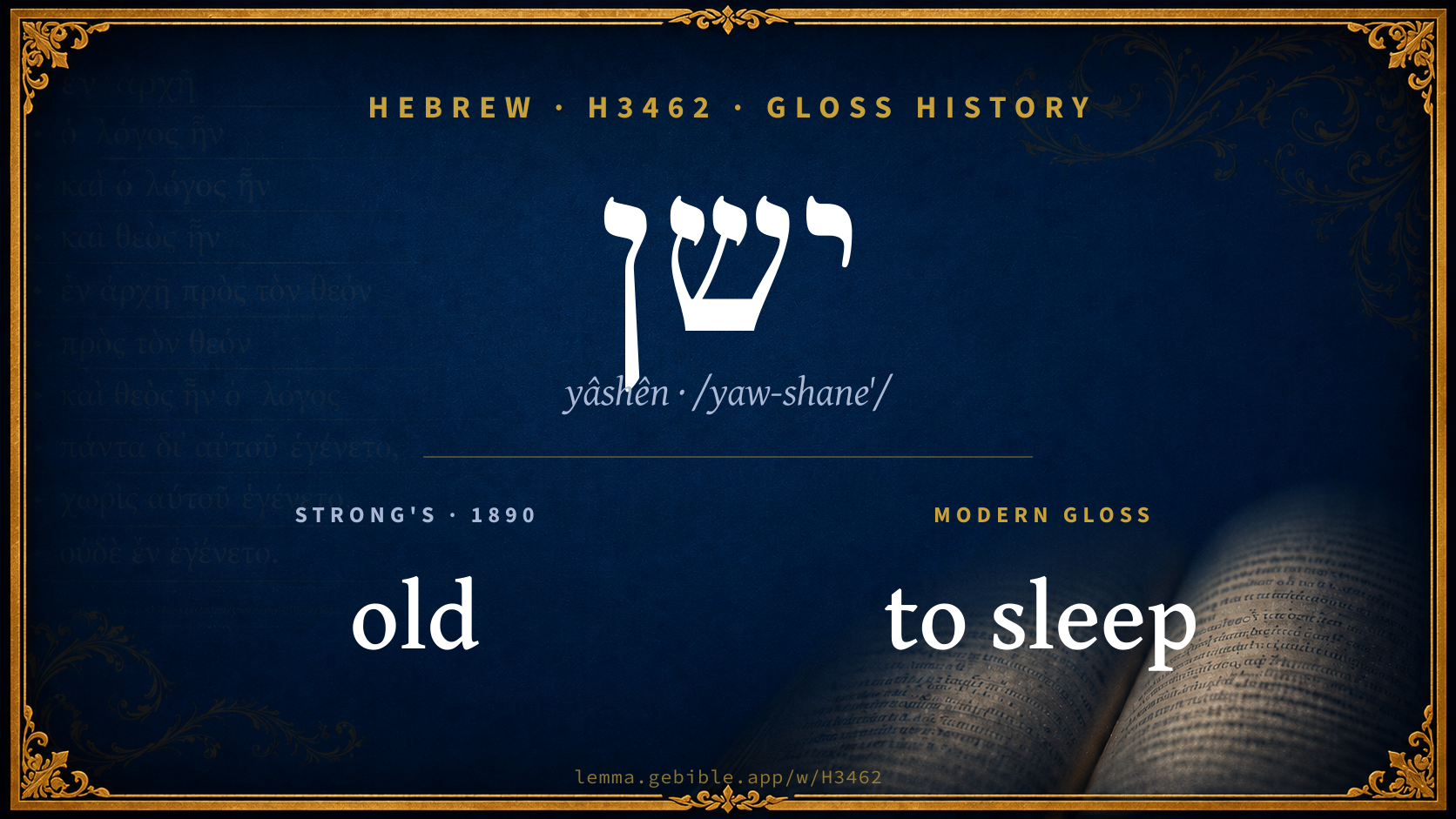
Gloss history
Strong's 1890 vs modern scholarship
About this word
Strong's H3462 catalogs a Hebrew word from the Hebrew Old Testament.
These counts are not copied from any lexicon or concordance. They are computed here, from the morphology-tagged Hebrew Old Testament. What Lemma adds →
- 21
- distinct verses
- The word appears in 21 distinct verses.
- 14 / 39
- OT books
- The word appears in 14 of 39 Old Testament books.
- #1,462
- by frequency
- Top 2500 most frequent Hebrew words (rank 1,462 of 8,640 Hebrew words by occurrence).
View all 21 occurrences in the concordance →
By section of the Old Testament
By traditional corpus
Conventional, traditional groupings — biblical authorship is debated, so this is a traditional corpus grouping, not an authorship claim. Each share is this word’s portion of its verses in that division of the Hebrew canon. Each figure is a share of the word’s 21 distinct verses.
- Writings (Ketuvim) 9 verses · 43%
- Prophets (Nevi'im) 7 verses · 33%
- Torah (Pentateuch) 5 verses · 24%
How translations render this word
Counts come from each version’s own published word-to-Strong’s tagging or interlinear alignment — an approximate guide to how each version renders this word, not a word-level alignment the data otherwise carries. Because each total is that version’s own tagged count, the per-version totals vary from one another and need not match the appearance or distinct-verse counts above. These counts may also differ from a printed concordance because Lemma counts each distinctly tagged rendering and does not collapse phrase taggings into a single head-word total. This is a fixed set of word-tagged versions (KJV, ASV, BSB, ULT) and does not change with the reading translation you choose elsewhere. Each version’s license is shown beside its name below (and on Sources).
BDB lists this Strong’s number as 3 distinct words (homographs). Each count above pools all of them and is not split by sense — see the Senses section below. A low-frequency rendering may belong to a different one of those words, not the primary meaning.
- King James Version†: Sleep 6×, He slept 2×, Slept 2×
- American Standard Version†: Sleep 5×, He slept 2×
- Berean Standard Bible†: Sleep 6×, They will fall asleep 2×
- unfoldingWord Literal Text†: Sleep 4×, Slept 2×
King James Version Public Domain
Renders H3462 across 19† tagged occurrences — most commonly:
Plus 9 renderings that appear only once — usually multi-word phrases or single function words the recovered tagging swept in, not distinct renderings.
American Standard Version Public Domain
Renders H3462 across 19† tagged occurrences — most commonly:
Plus 12 renderings that appear only once — usually multi-word phrases or single function words the recovered tagging swept in, not distinct renderings.
Berean Standard Bible Public Domain
Renders H3462 across 19† tagged occurrences — most commonly:
Plus 11 renderings that appear only once — usually multi-word phrases or single function words the recovered tagging swept in, not distinct renderings.
unfoldingWord Literal Text CC BY-SA 4.0
Renders H3462 across 21† tagged occurrences — most commonly:
Plus 15 renderings that appear only once — usually multi-word phrases or single function words the recovered tagging swept in, not distinct renderings.
Senses in the full BDB
Hebrew verbs can shift meaning by stem (binyan): Qal is the basic action, Niphal is often passive or reflexive, Piel often intensifies or makes it factitive, and Hiphil is typically causative. The senses below are grouped under the stem BDB assigns to each.
What do BDB’s symbols mean?
BDB uses these scholarly abbreviations:
| Symbol | Meaning |
|---|---|
| 𝔊 | the Septuagint (the ancient Greek translation, LXX) |
| 𝔙 | the Vulgate (the Latin translation) |
| 𝔖 | the Syriac version (the Peshitta) |
| 𝔗 | the Targum (the Aramaic translation) |
| ψ | the Psalms |
| √ | root (the underlying root or stem) |
| ‖ | parallel passage (a synonymous or contrasted parallel) |
| † | the dagger: every passage where the word occurs is cited |
The 3 senses and sub-senses the full Brown-Driver-Briggs lexicon distinguishes for this word, in lexicon order (not ranked by frequency), with BDB’s own verbatim wording and sub-sense lettering. Shown in Hebrew script with BDB’s own scholarly abbreviations. The condensed entry is in the Lexicon Entry tab. See also the Forms in the corpus table below.
ישן I sleep (NH id.
Qal
- Pf. יָשַׁנְתִּי Jb 3:13; וְיָֽשְׁנוּ consec. Je 51:39 + 2 times; Impf. יִישָׁ֑ן Is 5:27 ψ 121:4; וַיִּישַׁן 1 K 19:5, etc.; Inf. cstr. לִישׁוֹן Ec 5:11;—sleep, go to sleep, and be asleep, Gn 2:21 (J), 41:5 (E), Ez 34:25; Jb 3:13 ψ 3:6; 4:9; Pr 4:16; Ec 5:11, also 2 S 4:6 𝔊 We Dr Kit Bu, vid. חֹמֶשׁ; c. לֹא, of Assyrian army Is 5:27 (‖ נוּם); of Baal 1 K 19:5; of י׳, עוּרָה לָמָּה תִישַׁן אֲדֹנָי ψ 44:24; לֹא יִישָׁ֑ן 121:4 (‖ נוּם); c. acc. cogn. ישׁ׳ שְׁנַת עוֹלָם Je 51:39, 57 (v. שֵׁנָה), of death, cf. אִישַׁן הַמָּוֶת ψ 13:4. e.g. Job 3:13
Niphal
- . only in deriv. sense of become inactive or stationary; Pf. וְנוֹשַׁנְתֶּם consec. Dt 4:25 and ye be grown old בָּאָרֶץ, i.e. (v. Di Dr) have lost freshness of first impressions; of inanimate things, be old, stale, only Pt. יָשָׁן נוֹשָׁן Lv 26:10 (H), f. צרעת נוֹשֶׁנֶת Lv 13:11 = old leprosy (P); these poss. denom. from יָשָׁן. e.g. Deuteronomy 4:25
Piel
- . causat. Impf. וַתְּיַשְּׁנֵהוּ Ju 16:19 and she made him sleep. e.g. Judges 16:19
ישן II sleeping
ישן III m. one of David’s heroes, 2 S 23
Senses from the full Brown-Driver-Briggs lexicon (Brown, Driver, Briggs; Oxford 1906 — public domain), digitized via Sefaria, supplemented by the OpenScriptures HebrewLexicon (CC BY 4.0). Full attribution on Sources.
Word origin
I. vb. sleep (NH id.; Aramaic n. ܫܶܢܬܳܐ sleep; Arabic وَسِنَ be sleepy, وَسَنٌ, سِنَةٌ sleep; Assyrian šittu, sleep, DlHWB 246, šunatu, šuttu, dream, Id ib, Flood iv. 22 AsrbAnnals, v R. 2, 97)—
II. adj. sleeping;—ms. יָשֵׁן 1 S 26:7 + 3 times, fs. יְשֵׁנָה 1 K 3:20; Ct 5:2; pl. יְשֵׁנִים 1 S 26:12 Ct 7:10; cstr. יְשֵׁנֵי Dn 12:2;—asleep, sleeping 1 S 26:7, 12 1 K 3:20 Ct 5:2; 7:10; so, fig., Ho 7:6, expl. as = יֶעְשַׁן smoketh, cf. Dt 29:19, by RSJPhil. xvi. 1888, 72; Proph. iv, n. 19 Che with אַפְּהֶם (Ges§ 91. 1. R. 1 a) for אֹפֵהֶם; but their anger sleepeth; of Baal 1 K 18:27; in sim. of י׳ ψ 78:65; of dead, as sleeping in dust, Dn 12:2.
III. n.pr.m. one of David’s heroes, 2 S 23:32 = הָשֵׁם 1 Ch 11:34 (in both del. בְּנֵי as dittogr., We Dr Bu); v. הָשֵׁם, and גוּנִי.
— Brown-Driver-Briggs (Oxford 1906, public domain), digitized via Sefaria, supplemented by the OpenScriptures HebrewLexicon (CC BY 4.0). See Sources.
Origin: a primitive root
Jastrow Dictionary
A second Hebrew/Aramaic lexicon for comparison, covering Aramaic and post-biblical (Talmudic, Targumic, Midrashic) usage that the biblical-Hebrew BDB does not. Matched by lemma rather than by Strong’s number, so a lemma may carry more than one Jastrow headword (shown separately below), and the entries cover usage well beyond the Bible.
יָשֵׁן I
- [to recover strength, cmp. חָלַם,] to sleep, trnsf. to be idle, lazy. Shebu. III, 5 (I swear) שאִישַׁן that I will sleep, שיָשַׁנְתִּי that I have slept. Num. R. s. 20 בא לִישָׁן going to sleep.—Cant. R. to III, 1 ישנתי לי מן התירה וכ׳ I (Israel) have been lazy in the study of the Law and the performance of good deeds; a. fr.
יָשֵׁן II
- preced.) asleep, inactive. Midr. Till. to Ps. LIX הקב"ה עושה עצמו כביכול י׳ the Lord sometimes pretends, if it were permitted to say so, to be asleep; a. fr.—Pl. יְשֵׁנִים, יְשֵׁנִין, יְשֵי׳. Num. R. s. 20 הרי הן י׳ מן וכ׳ they are sluggish in study &c., v. preced. Cant. R. to VII, 10 י׳ במערת וכ׳ sleeping in the cave of Makhpelah. Ex. R. s. 1; a. fr.—Fem. יְשֵׁנָה, יְשֵׁי׳. Midr. Till. to Ps. CX, beg. (ref. to Is. XLI, 2) הצדקה היתה י׳ וכ׳ Righteousness was asleep and Abraham waked her up. Cant. R. to V, 2 אני י׳ מן וכ׳ I (Israel) was lazy &c., v. supra; a. fr. e.g. Isaiah 41:2
יָשַׁן
- cmp. preced. wds. a. to be strong, hard, old (cmp. קשיש).—V. יוֹשֶׁן a. next w.
- to let grow old (strong), keep, reserve. B. Bath. 91ᵇ דברים שדרכן ליַישְּׁנָן things which it is customary to keep (to store, as wine &c.). Deut. R. s. 9, beg. מן היין הזה אני מְיַישֵּׁן וכ׳ of this wine I will store away a portion for my son’s wedding. Tosef. Ab. Zar. VIII (IX), 3 צריך ליַשֵּׁן he must store them away (leave them unused); Tosef. Toh. XI, 16. Ib. כמה הוא מְיַשְּׁנָן, v. יִשּׁוּן; Y. Ab. Zar. V, end 45ᵇ מְיַישְּׁנָן כל י"ב וכ׳ he must leave them unused for the whole twelve-month; Bab. Ab. Zar. 75ᵃ.—Part. pass. מְיוּשָּׁן stored up, v. infra. Y. B. Bath. VII, end, 15ᶜ. Y. Gitt. III, end, 45ᵇ ‘old’ means last year’s crop, מי׳ של וכ׳ ‘stored’ means three years old.
- to be stored up, to improve with age. Sifra B’huck. ch. III; Yalk. Lev. 672 (ref. to ישן נושן, Lev. XXVI, 10) כל המִתְיַשֵּׁן יפה מחבירו the sort which is stored up is the better of its kind; B. Bath. l. c. [read with Ms. R.:] כל המְיוּשָּׁן יפה מחבירו. Y. Gitt. l. c. הדא אמרה דאי מתישן וכ׳ this intimates that if wine is sold as mithyashshen (fit for storage) the seller is responsible for three years. Sifra l. c. לרבות כל המִתְיַישְּׁנִים including all produces fit for storage (besides wine); Yalk. l. c. לרבות כל הדבר המיושן. e.g. Leviticus 26:10
- same. B. Bath. l. c.; a e., v. next w.
יָשָׁן
- preced.) hard, dry; old, of last year, opp. חָדָשׁ. Dem. IV, 7. B. Bath. 91ᵇ, a. e. expl. י׳ נוֹשָׁן (Lev. XXVI, 10), v. preced. Ab. IV, 20 קנקן חדש מלא י׳ a new vessel full of old wine (a young man but learned). Ab. Zar. III, 9 ואם י׳ וכ׳ and if the oven is old (dried) &c.; a. fr.—Pl. יְשָׁנִים. Ib. 33ᵃ י׳ ומזופפין old or pitched wine vessels. Yoma II, 4, v. חָדָשׁ. Lev. R. s. 2, v. חָדָשׁ; a. fr.—Fem. יְשָׁנָה. Kidd. IV, 5, Num. R. s. 9, v. אַרְכִי I.—Pl. יְשָׁנוֹת. Tosef. Ab. Zar. IV (V), 10 י׳ זפופות, v. supra; a. fr. e.g. Leviticus 26:10
A Dictionary of the Targumim, the Talmud Babli and Yerushalmi, and the Midrashic Literature (Marcus Jastrow; London, Luzac, 1903) — Public Domain. Digitized via Sefaria. Digitized via Sefaria. Full attribution on Sources.
Forms in the corpus
The 19 distinct written forms H3462 takes in the Hebrew Bible, most frequent first — each parse links to that stem’s occurrences in the concordance. Hebrew forms include their vowel points and cantillation, so a single lemma takes many written forms.
Same root — word family
Other BDB entries built from the same root as H3462, grouped by Strong’s listed origin. These share a root / origin per the lexicon — not necessarily a shared meaning. Each links to that word’s own entry.
Derived from this word
Compare all same-root words → Showing 4 of 5 — not the complete family. They share a root, not necessarily a meaning.
Septuagint verse parallels
This word appears in 18 verses that also exist in the Greek Old Testament (Septuagint), out of the 21 Hebrew verses it occurs in. You can read those verses in Greek by switching the Old Testament edition to the Septuagint.
Read these verses in the Septuagint
- Genesis 2:21
- Leviticus 13:11
- Deuteronomy 4:25
- Judges 16:19
- 1 Samuel 26:12
- 1 Kings 19:5
- Job 3:13
- Psalms 3:5
- Proverbs 4:16
- Ecclesiastes 5:12
- Song of Solomon 7:9
- Isaiah 5:27
This is a verse-level parallel only — the same verses exist in both the Hebrew and Greek Old Testaments. No word-level Hebrew↔Greek correspondence is claimed: the data carries no such alignment, so no Greek word is shown as this Hebrew word’s translation. Coverage is not total — the Septuagint omits the deuterocanon and renumbers the Psalms, so some Hebrew verses have no direct Greek parallel.