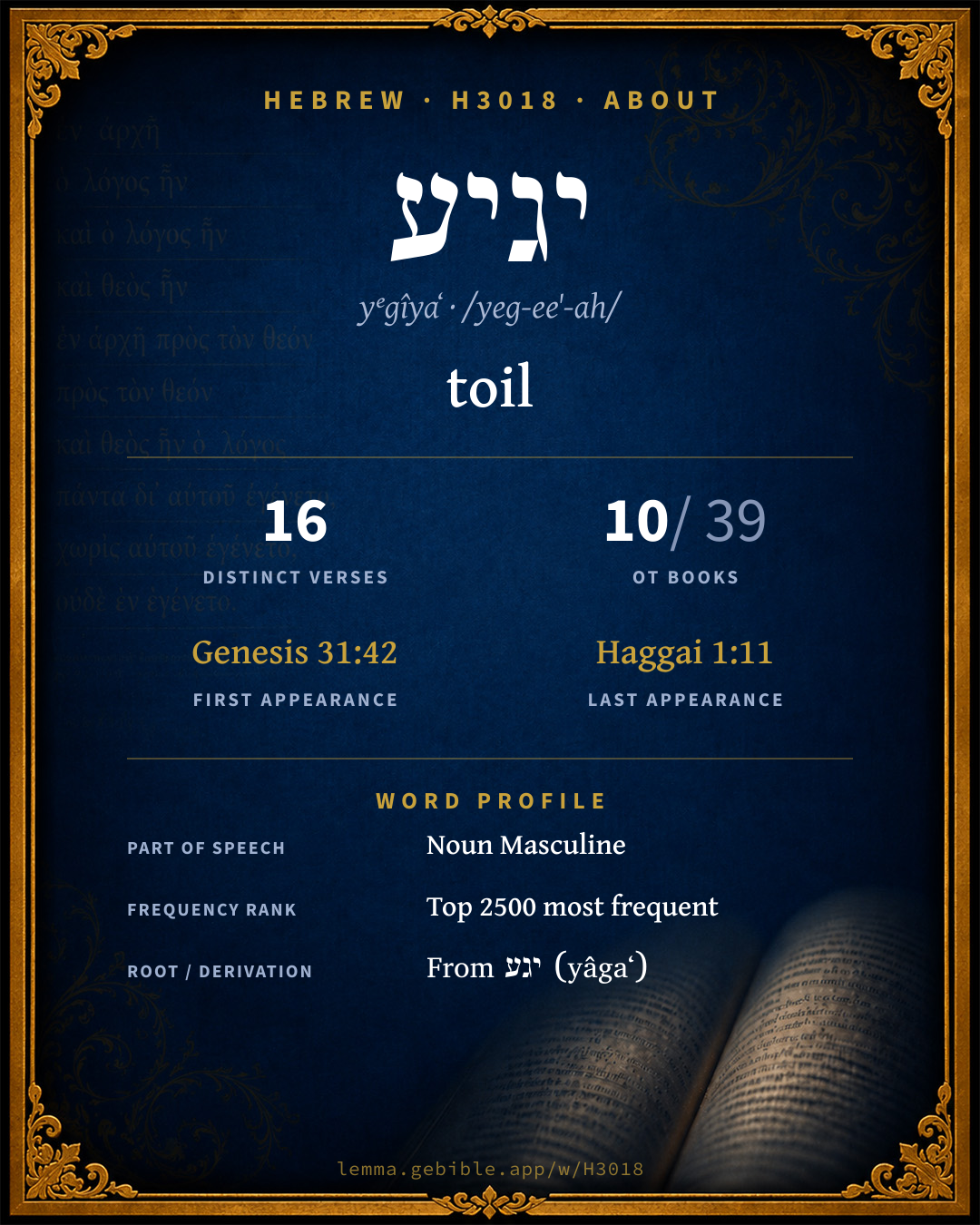
יְגִיעַ
toil
‘toil’ is one of 2 main senses fuller range ↓
Full lexicon entry — Brown-Driver-Briggs (BDB)
From Brown-Driver-Briggs (BDB)
Where this word appears
Grammar key — what these labels mean
Part of speech
- Noun
- A naming word — a person, place, thing, or idea.
Noun type
- Common
- A common noun — a general class of person, place, or thing (“king,” “city,” “water”), not a specific name.
State
- Construct
- A noun bound to a following noun in a possessive / “of” relationship (the construct chain).
Gender
- Masculine
- Grammatically masculine.
Number
- Singular
- One.
- Plural
- More than one (in Hebrew, generally three or more).
Grammatical forms
- Noun, Common, Masculine, Singular, Construct 15 times (94%)
- Noun, Common, Masculine, Plural, Construct 1 time (6%)
Parsed forms decoded from the imported morphology (morphhb / Westminster Leningrad Codex — WLC text public domain, morphhb tagging CC BY 4.0), counted across 16 parsed occurrences — not distinct verses.
Every verse where H3018 appears — 16 distinct verses across 10 books. Click any verse to open its interlinear word-by-word view. Verse text shown in the World English Bible for context — . Each verse’s Hebrew form is shown with its reference; the English is not keyword-highlighted, since the data carries no word-level English alignment. Use “Compare translations” on any verse to read it across multiple English versions. This concordance covers the Hebrew Bible; Septuagint (Greek Old Testament) occurrences are not indexed here.
Genesis 1 verse
Deuteronomy 1 verse
Nehemiah 1 verse
Job 3 verses
- Job 10:3 יְגִ֣יעַ n c ms cs Is it good to you that you should oppress, That you should despise the work of your hands, And smile on the counsel of the wicked?
- Job 39:11 יְגִיעֶֽ/ךָ n c ms cs + sfx pers 2ms Will you trust him, because his strength is great? Or will you leave to him your labor?
- Job 39:16 יְגִיעָ֣/הּ n c ms cs + sfx pers 3fs She deals harshly with her young ones, as if they were not hers. Though her labor is in vain, she is without fear,
Psalms 3 verses
- Psalms 78:46 וִֽ֝/יגִיעָ֗/ם conj + n c ms cs + sfx pers 3mp He gave also their increase to the caterpillar, And their labor to the locust.
- Psalms 109:11 יְגִיעֽ/וֹ n c ms cs + sfx pers 3ms Let the creditor seize all that he has. Let strangers plunder the fruit of his labor.
- Psalms 128:2 יְגִ֣יעַ n c ms cs For you will eat the labor of your hands. You will be happy, and it will be well with you.
Isaiah 2 verses
- Isaiah 45:14 יְגִ֨יעַ n c ms cs Thus says Yahweh: "The labor of Egypt, and the merchandise of Ethiopia, and the Sabeans, men of stature, shall come over to you, and they shall be yours. They shall go after you. In chains they shall come over; and they shall fall down to you. They shall make supplication to you: 'Surely God is in you; and there is none else, there is no other god.
- Isaiah 55:2 וִ/יגִיעֲ/כֶ֖ם conj + n c ms cs + sfx pers 2mp Why do you spend money for that which is not bread? and your labor for that which doesn't satisfy? listen diligently to me, and eat you that which is good, and let your soul delight itself in fatness.
Jeremiah 2 verses
- Jeremiah 3:24 יְגִ֥יעַ n c ms cs But the shameful thing has devoured the labor of our fathers from our youth, their flocks and their herds, their sons and their daughters.
- Jeremiah 20:5 יְגִיעָ֖/הּ n c ms cs + sfx pers 3fs Moreover I will give all the riches of this city, and all the gains of it, and all the precious things of it, yes, all the treasures of the kings of Judah will I give into the hand of their enemies; and they shall make them a prey, and take them, and carry them to Babylon.
Ezekiel 1 verse
Hosea 1 verse
Haggai 1 verse
About this entry
At a glance — auto-summarized from this page’s data, not written by a person. Every figure links to its source below. This summary describes the numbers; it doesn’t interpret them.
יגיע — transliterated yᵉgîyaʻ — is a Hebrew noun carrying the sense “toil.” Older and newer Bibles part ways — “labour” in the King James Version, “labor” (unfoldingWord Literal Text) in modern versions. See the renderings breakdown. It appears 16 verses across 10 books of the Hebrew Bible, among its uncommon vocabulary. Its earliest occurrence is Genesis 31:42. The lexicon spreads it across several senses; see its full sense range. See the sense tree, 16-verse concordance, and the renderings breakdown below.
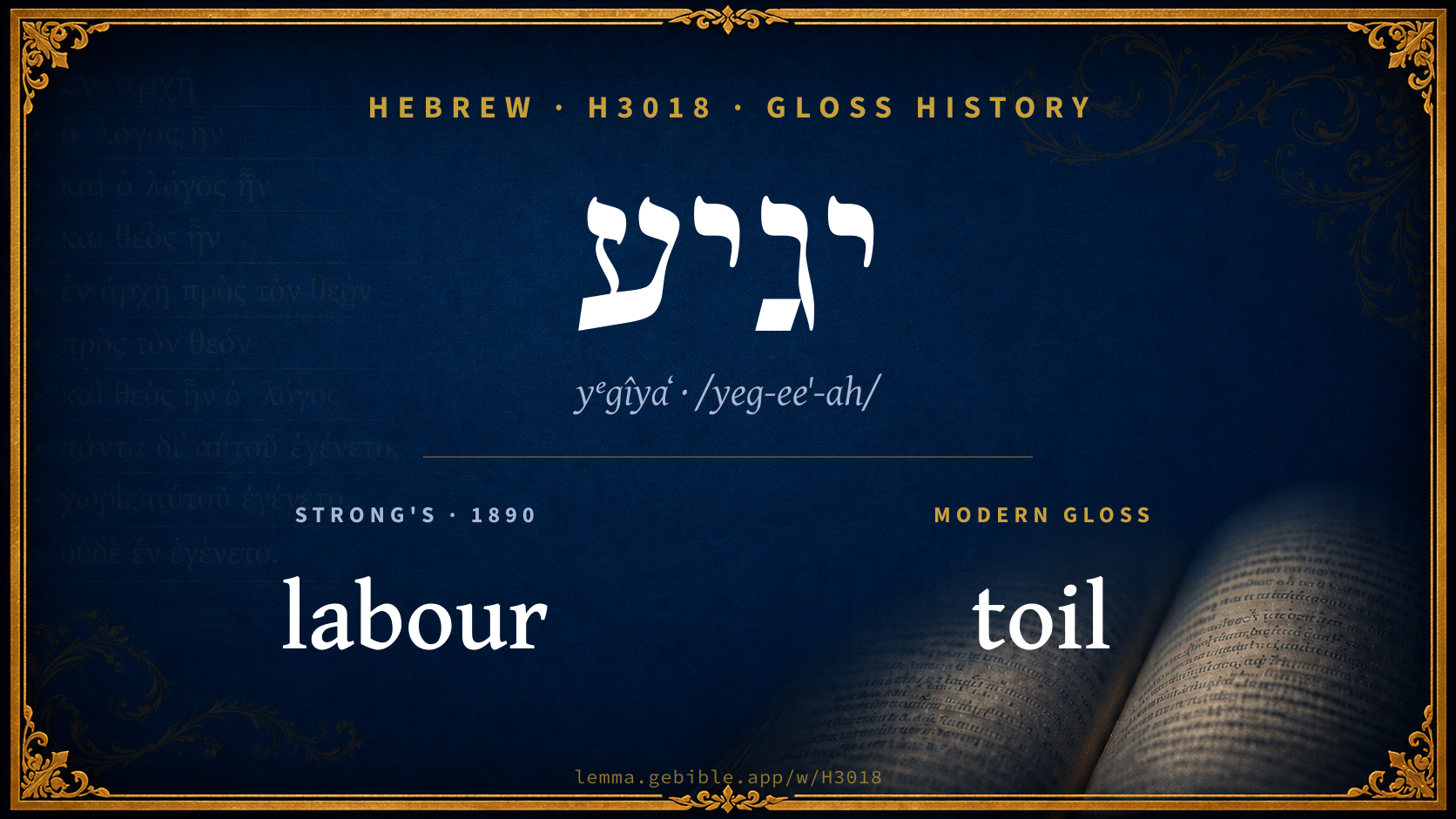
Gloss history
Strong's 1890 vs modern scholarship
About this word
Strong's H3018 catalogs a Hebrew word from the Hebrew Old Testament.
These counts are not copied from any lexicon or concordance. They are computed here, from the morphology-tagged Hebrew Old Testament. What Lemma adds →
- 16
- distinct verses
- The word appears in 16 distinct verses.
- 10 / 39
- OT books
- The word appears in 10 of 39 Old Testament books.
- #1,752
- by frequency
- Top 2500 most frequent Hebrew words (rank 1,752 of 8,640 Hebrew words by occurrence).
View all 16 occurrences in the concordance →
By section of the Old Testament
By traditional corpus
Conventional, traditional groupings — biblical authorship is debated, so this is a traditional corpus grouping, not an authorship claim. Each share is this word’s portion of its verses in that division of the Hebrew canon. Each figure is a share of the word’s 16 distinct verses.
- Prophets (Nevi'im) 7 verses · 44%
- Writings (Ketuvim) 7 verses · 44%
- Torah (Pentateuch) 2 verses · 13%
How translations render this word
Counts come from each version’s own published word-to-Strong’s tagging or interlinear alignment — an approximate guide to how each version renders this word, not a word-level alignment the data otherwise carries. Because each total is that version’s own tagged count, the per-version totals vary from one another and need not match the appearance or distinct-verse counts above. These counts may also differ from a printed concordance because Lemma counts each distinctly tagged rendering and does not collapse phrase taggings into a single head-word total. This is a fixed set of word-tagged versions (KJV, ASV, BSB, ULT) and does not change with the reading translation you choose elsewhere. Each version’s license is shown beside its name below (and on Sources).
- King James Version: Labour 9×
- American Standard Version: Labor 9×
- Berean Standard Bible: Labor 4×, Products 2×, Toil 2×
- unfoldingWord Literal Text: Labor 6×, Labor of 2×, Toil of 2×
King James Version Public Domain
Renders H3018 across 16 tagged occurrences — most commonly:
Plus 7 renderings that appear only once — usually multi-word phrases or single function words the recovered tagging swept in, not distinct renderings.
American Standard Version Public Domain
Renders H3018 across 16 tagged occurrences — most commonly:
Plus 7 renderings that appear only once — usually multi-word phrases or single function words the recovered tagging swept in, not distinct renderings.
Berean Standard Bible Public Domain
Renders H3018 across 16 tagged occurrences — most commonly:
Plus 8 renderings that appear only once — usually multi-word phrases or single function words the recovered tagging swept in, not distinct renderings.
unfoldingWord Literal Text CC BY-SA 4.0
Renders H3018 across 16 tagged occurrences — most commonly:
Plus 6 renderings that appear only once — usually multi-word phrases or single function words the recovered tagging swept in, not distinct renderings.
Senses in the full BDB
What do BDB’s symbols mean?
BDB uses these scholarly abbreviations:
| Symbol | Meaning |
|---|---|
| 𝔊 | the Septuagint (the ancient Greek translation, LXX) |
| 𝔙 | the Vulgate (the Latin translation) |
| 𝔖 | the Syriac version (the Peshitta) |
| 𝔗 | the Targum (the Aramaic translation) |
| ψ | the Psalms |
| √ | root (the underlying root or stem) |
| ‖ | parallel passage (a synonymous or contrasted parallel) |
| † | the dagger: every passage where the word occurs is cited |
The 2 senses and sub-senses the full Brown-Driver-Briggs lexicon distinguishes for this word, in lexicon order (not ranked by frequency), with BDB’s own verbatim wording and sub-sense lettering. Shown in Hebrew script with BDB’s own scholarly abbreviations. The condensed entry is in the Lexicon Entry tab. See also the Forms in the corpus table below.
- 1. toil, יג׳ כַּפַּיִם Gn 31:42 (E; ‖ עֳנִי), Jb 39:11 (= husbandry), laying of eggs 39:16. e.g. Genesis 31:42
- 2. result of toil, product, produce, acquired property: יְגִיעַי Ho 12:9 (‖ אוֹן, on text v. supr.), Dt 28:33 (‖ פְּרִי אדמתך), ψ 78:46 (‖ יְבוּל); יְגִיעַ כַּפַּיִם 128:2, Hg 1:11 (‖ דָּגָן, תִּירוֹשׁ, יִצְהָר, אֲשֶׁר תּוֹצִיא הָאֲדָמָה, אָדָם, בְּהֵמָה); Ne 5:13 (‖ בית), ψ 109:11 (‖ כל־אשׁר־לוֹ), Is 45:14 (יגיע מצרים, ‖ סַחַר־כּוּשׁ), 55:2 (‖ כֶּסֶף), Je 3:24 (‖ צֹאן, בָּקָר, בָּנִים, בָּנוֹת), 20:5 (‖ חֹסֶן, יָקָר, of city), Ez 23:29; of Job as product of God’s hands (יְג׳ כַּפֶּיךָ) Jb 10:3. e.g. Hosea 12:9
Senses from the full Brown-Driver-Briggs lexicon (Brown, Driver, Briggs; Oxford 1906 — public domain), digitized via Sefaria, supplemented by the OpenScriptures HebrewLexicon (CC BY 4.0). Full attribution on Sources.
Word origin
n.m. toil, product;—cstr. יְגִיעַ Gn 31:42 + 5 times; sf. יְגִיעֲךָ Dt 28:33; יְגִיעֶ֑ךָ Jb 39:11; יְגִיעֵךְ Ez 23:29; יְגִיעוֹ ψ 109:11 Ne 5:13; יְגִיעָהּ Jb 39:16 Je 20:5; וִיגִיעֲכֶם Is 55:2; וִיגִיעָם ψ 78:46; pl. sf. יְגִיעַי Ho 12:9 (but יְגִיעָיו 𝔊 Che);—
— Brown-Driver-Briggs (Oxford 1906, public domain), digitized via Sefaria, supplemented by the OpenScriptures HebrewLexicon (CC BY 4.0). See Sources.
Derived from יגע (yâgaʻ) (H3021) — to toil.
Jastrow Dictionary
A second Hebrew/Aramaic lexicon for comparison, covering Aramaic and post-biblical (Talmudic, Targumic, Midrashic) usage that the biblical-Hebrew BDB does not. Matched by lemma rather than by Strong’s number, so a lemma may carry more than one Jastrow headword (shown separately below), and the entries cover usage well beyond the Bible.
יָגֵיעַ
- v. יָגֵעַ
יְגִיעַ
- painstaking, labor. Ber. 8ᵃ הנהנה מִיגִיעוֹ he who enjoys the fruits of his own labor. Koh. R. to I, 3 כמה צער וכמה י׳ וכ׳ how much trouble and how much weariness does he experience. Midr. Till. to Ps. II וכל יְגִיעָן וכ׳ and all their toil is in vain; a. fr.
A Dictionary of the Targumim, the Talmud Babli and Yerushalmi, and the Midrashic Literature (Marcus Jastrow; London, Luzac, 1903) — Public Domain. Digitized via Sefaria. Digitized via Sefaria. Full attribution on Sources.
Forms in the corpus
The 14 distinct written forms H3018 takes in the Hebrew Bible, most frequent first — each parse links to that state’s occurrences in the concordance. Hebrew forms include their vowel points and cantillation, so a single lemma takes many written forms.
| Form | Parsing | Example | Uses |
|---|---|---|---|
| יְגִ֣יעַ | Noun, Common, Masculine, Singular, Construct | Job 10:3 | 2 |
| יְגִ֥יעַ | Noun, Common, Masculine, Singular, Construct | Haggai 1:11 | 2 |
| וִ/יגִיעֲ/כֶ֖ם | Noun, Common, Masculine, Singular, Construct | Isaiah 55:2 | 1 |
| וִֽ֝/יגִיעָ֗/ם | Noun, Common, Masculine, Singular, Construct | Psalms 78:46 | 1 |
| וּ/מִ֣/יגִיע֔/וֹ | Noun, Common, Masculine, Singular, Construct | Nehemiah 5:13 | 1 |
| יְגִ֣יעֲ/ךָ֔ | Noun, Common, Masculine, Singular, Construct | Deuteronomy 28:33 | 1 |
| יְגִ֧יעַ | Noun, Common, Masculine, Singular, Construct | Genesis 31:42 | 1 |
| יְגִ֨יעַ | Noun, Common, Masculine, Singular, Construct | Isaiah 45:14 | 1 |
| יְגִיעֵ֔/ךְ | Noun, Common, Masculine, Singular, Construct | Ezekiel 23:29 | 1 |
| יְגִיעֶֽ/ךָ | Noun, Common, Masculine, Singular, Construct | Job 39:11 | 1 |
| יְגִיעַ֕/י | Noun, Common, Masculine, Plural, Construct | Hosea 12:8 | 1 |
| יְגִיעָ֖/הּ | Noun, Common, Masculine, Singular, Construct | Jeremiah 20:5 | 1 |
| יְגִיעָ֣/הּ | Noun, Common, Masculine, Singular, Construct | Job 39:16 | 1 |
| יְגִיעֽ/וֹ | Noun, Common, Masculine, Singular, Construct | Psalms 109:11 | 1 |
Same root — word family
Other BDB entries built from the same root as H3018, grouped by Strong’s listed origin. These share a root / origin per the lexicon — not necessarily a shared meaning. Each links to that word’s own entry.
Derives from
Shares the same root
Compare all same-root words → Showing 4 of 5 — not the complete family. They share a root, not necessarily a meaning.
Septuagint verse parallels
This word appears in 13 verses that also exist in the Greek Old Testament (Septuagint), out of the 16 Hebrew verses it occurs in. You can read those verses in Greek by switching the Old Testament edition to the Septuagint.
Read these verses in the Septuagint
- Genesis 31:42
- Deuteronomy 28:33
- Job 10:3
- Psalms 128:2
- Isaiah 45:14
- Jeremiah 3:24
- Ezekiel 23:29
- Hosea 12:8
- Haggai 1:11
This is a verse-level parallel only — the same verses exist in both the Hebrew and Greek Old Testaments. No word-level Hebrew↔Greek correspondence is claimed: the data carries no such alignment, so no Greek word is shown as this Hebrew word’s translation. Coverage is not total — the Septuagint omits the deuterocanon and renumbers the Psalms, so some Hebrew verses have no direct Greek parallel.