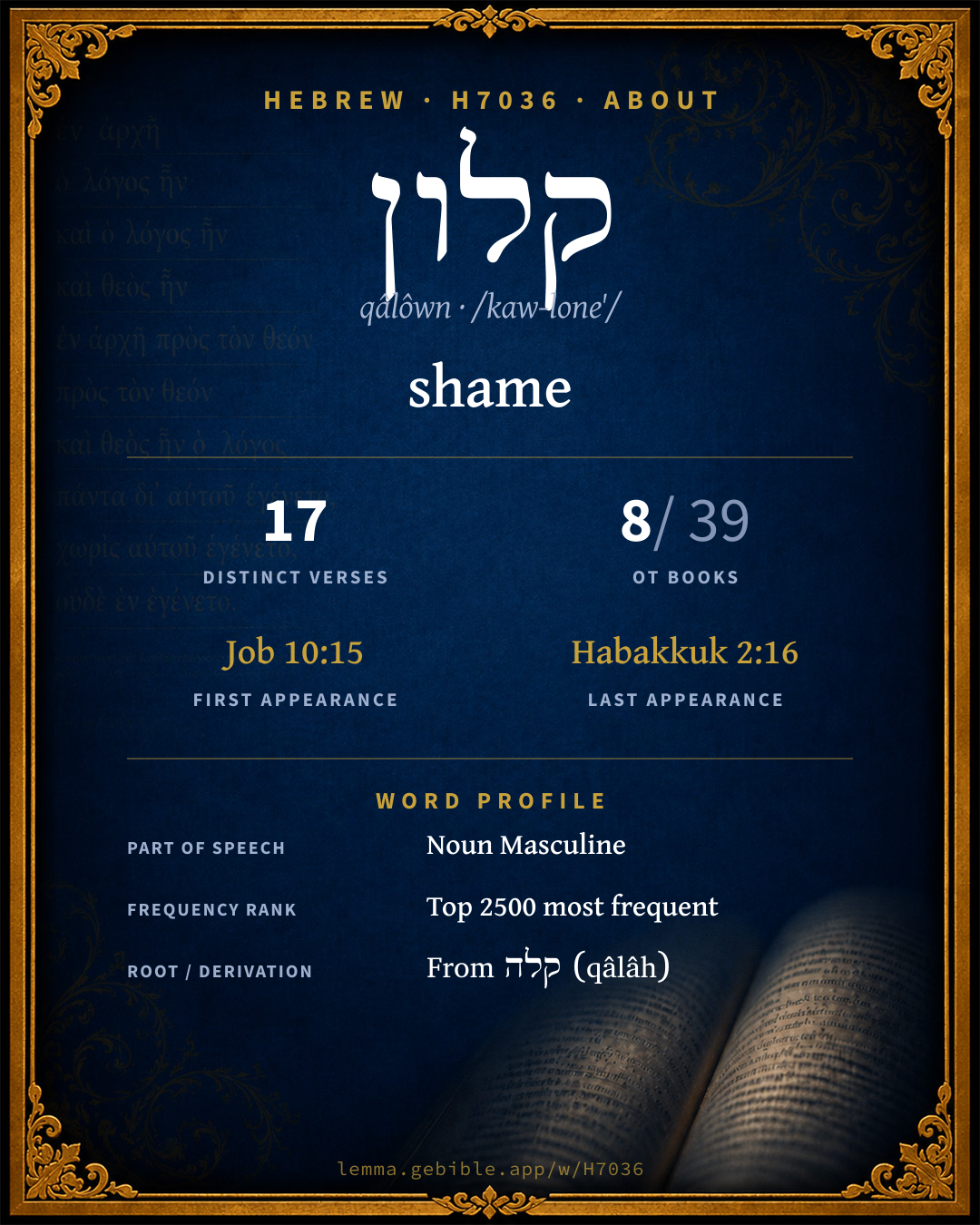
קָלוֹן
shame
also: disgrace, dishonour, ignominy fuller range ↓
Full lexicon entry — Brown-Driver-Briggs (BDB)
From Brown-Driver-Briggs (BDB)
Where this word appears
See every Absolute-state word in the Hebrew Bible →
Grammar key — what these labels mean
Part of speech
- Noun
- A naming word — a person, place, thing, or idea.
Noun type
- Common
- A common noun — a general class of person, place, or thing (“king,” “city,” “water”), not a specific name.
State
- Absolute
- The independent form of a noun, not bound to a following word.
- Construct
- A noun bound to a following noun in a possessive / “of” relationship (the construct chain).
Gender
- Masculine
- Grammatically masculine.
Number
- Singular
- One.
Grammatical forms
- Noun, Common, Masculine, Singular, Absolute 13 times (76%)
- Noun, Common, Masculine, Singular, Construct 4 times (24%)
Parsed forms decoded from the imported morphology (morphhb / Westminster Leningrad Codex — WLC text public domain, morphhb tagging CC BY 4.0), counted across 17 parsed occurrences — not distinct verses.
Every verse where H7036 appears — 17 distinct verses across 8 books. Click any verse to open its interlinear word-by-word view. Verse text shown in the World English Bible for context — . Each verse’s Hebrew form is shown with its reference; the English is not keyword-highlighted, since the data carries no word-level English alignment. Use “Compare translations” on any verse to read it across multiple English versions. This concordance covers the Hebrew Bible; Septuagint (Greek Old Testament) occurrences are not indexed here.
Job 1 verse
Psalms 1 verse
Proverbs 8 verses
- Proverbs 3:35 קָלֽוֹן n c ms The wise will inherit glory, But shame will be the promotion of fools.
- Proverbs 6:33 וְ/קָל֥וֹן conj + n c ms He will get wounds and dishonor. His reproach will not be wiped away.
- Proverbs 9:7 קָל֑וֹן n c ms He who corrects a mocker invites insult. He who reproves a wicked man invites abuse.
- Proverbs 11:2 קָל֑וֹן n c ms When pride comes, then comes shame, But with humility comes wisdom.
- Proverbs 12:16 קָל֣וֹן n c ms A fool shows his annoyance the same day, But one who overlooks an insult is prudent.
- Proverbs 13:18 וְ֭/קָלוֹן conj + n c ms Poverty and shame come to him who refuses discipline, But he who heeds correction shall be honored.
- Proverbs 18:3 קָל֥וֹן n c ms When wickedness comes, contempt also comes, And with shame comes disgrace.
- Proverbs 22:10 וְ/קָלֽוֹן conj + n c ms Drive out the mocker, and strife will go out; Yes, quarrels and insults will stop.
Isaiah 1 verse
Jeremiah 2 verses
- Jeremiah 13:26 קְלוֹנֵֽ/ךְ n c ms cs + sfx pers 2fs Therefore will I also uncover your skirts on your face, and your shame shall appear.
- Jeremiah 46:12 קְלוֹנֵ֔/ךְ n c ms cs + sfx pers 2fs The nations have heard of your shame, and the earth is full of your cry; for the mighty man has stumbled against the mighty, they are fallen both of them together.
Hosea 2 verses
Nahum 1 verse
Habakkuk 1 verse
About this entry
At a glance — auto-summarized from this page’s data, not written by a person. Every figure links to its source below. This summary describes the numbers; it doesn’t interpret them.
קלון (qâlôwn) is a Hebrew noun most often rendered “shame.” Debuting at Job 10:15, it then recurs through the corpus. The Hebrew Bible uses it across 17 verses — uncommon. Proverbs dominates its distribution — 8 of 17 verses. It also covers “disgrace”, “dishonour”, and “ignominy”, alongside “shame” — see its full sense range. The sections below give every sense, occurrence, and version rendering.
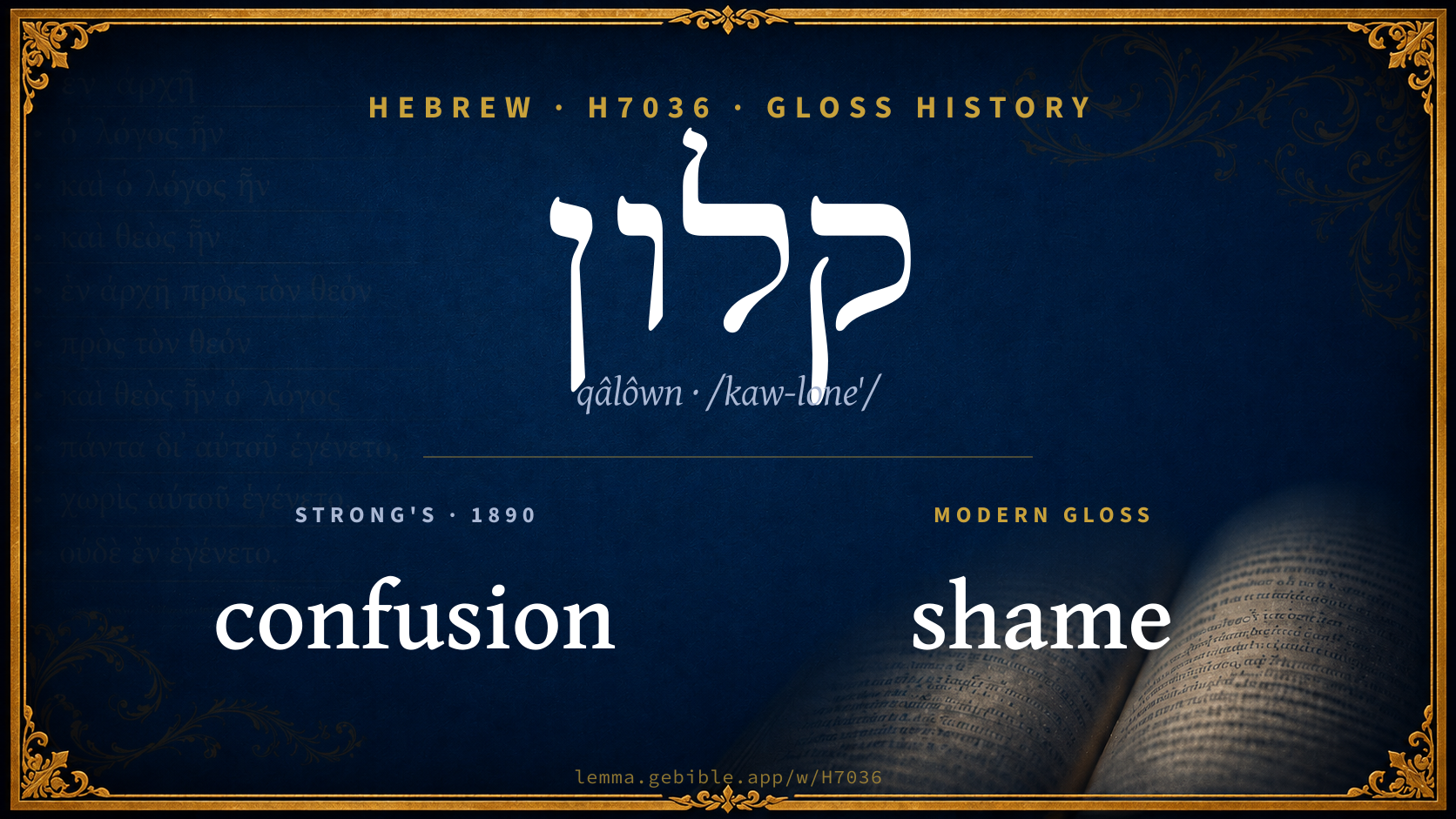
Gloss history
Strong's 1890 vs modern scholarship
About this word
Strong's H7036 catalogs a Hebrew word from the Hebrew Old Testament.
These counts are not copied from any lexicon or concordance. They are computed here, from the morphology-tagged Hebrew Old Testament. What Lemma adds →
- 17
- distinct verses
- The word appears in 17 distinct verses.
- 8 / 39
- OT books
- The word appears in 8 of 39 Old Testament books.
- #1,671
- by frequency
- Top 2500 most frequent Hebrew words (rank 1,671 of 8,640 Hebrew words by occurrence).
View all 17 occurrences in the concordance →
By section of the Old Testament
By traditional corpus
Conventional, traditional groupings — biblical authorship is debated, so this is a traditional corpus grouping, not an authorship claim. Each share is this word’s portion of its verses in that division of the Hebrew canon. Each figure is a share of the word’s 17 distinct verses.
- Writings (Ketuvim) 10 verses · 59%
- Prophets (Nevi'im) 7 verses · 41%
How translations render this word
Counts come from each version’s own published word-to-Strong’s tagging or interlinear alignment — an approximate guide to how each version renders this word, not a word-level alignment the data otherwise carries. Because each total is that version’s own tagged count, the per-version totals vary from one another and need not match the appearance or distinct-verse counts above. These counts may also differ from a printed concordance because Lemma counts each distinctly tagged rendering and does not collapse phrase taggings into a single head-word total. This is a fixed set of word-tagged versions (KJV, ASV, BSB, ULT) and does not change with the reading translation you choose elsewhere. Each version’s license is shown beside its name below (and on Sources).
- King James Version: Shame 11×
- American Standard Version: Shame 10×, Ignominy 2×
- Berean Standard Bible: Shame 10×, Disgrace 3×
- unfoldingWord Literal Text: Shame 6×, Dishonor 5×, Disgrace 4×
King James Version Public Domain
Renders H7036 across 17 tagged occurrences — most commonly:
Plus 6 renderings that appear only once — usually multi-word phrases or single function words the recovered tagging swept in, not distinct renderings.
American Standard Version Public Domain
Renders H7036 across 17 tagged occurrences — most commonly:
Plus 5 renderings that appear only once — usually multi-word phrases or single function words the recovered tagging swept in, not distinct renderings.
Berean Standard Bible Public Domain
Renders H7036 across 17 tagged occurrences — most commonly:
Plus 4 renderings that appear only once — usually multi-word phrases or single function words the recovered tagging swept in, not distinct renderings.
unfoldingWord Literal Text CC BY-SA 4.0
Renders H7036 across 16 tagged occurrences — most commonly:
Plus 1 rendering that appears only once — usually multi-word phrases or single function words the recovered tagging swept in, not distinct renderings.
Senses in the full BDB
What do BDB’s symbols mean?
BDB uses these scholarly abbreviations:
| Symbol | Meaning |
|---|---|
| 𝔊 | the Septuagint (the ancient Greek translation, LXX) |
| 𝔙 | the Vulgate (the Latin translation) |
| 𝔖 | the Syriac version (the Peshitta) |
| 𝔗 | the Targum (the Aramaic translation) |
| ψ | the Psalms |
| √ | root (the underlying root or stem) |
| ‖ | parallel passage (a synonymous or contrasted parallel) |
| † | the dagger: every passage where the word occurs is cited |
The 2 senses and sub-senses the full Brown-Driver-Briggs lexicon distinguishes for this word, in lexicon order (not ranked by frequency), with BDB’s own verbatim wording and sub-sense lettering. Shown in Hebrew script with BDB’s own scholarly abbreviations. The condensed entry is in the Lexicon Entry tab. See also the Forms in the corpus table below.
- 1. of national ignominy Ho 4:7, 18 (dub. line, v. Che Now), Je 46:12 (read prob. קוֹלֵךְ, so 𝔊 Gie CoHpt), Hb 2:16 ψ 83:17 of nation under fig. of woman, = pudenda, Je 13:26 Na 3:5 (‖ מַעְרֵךְ). e.g. Hosea 4:7
- 2. personal dishonour, disgrace, of Shebna, as disgrace to his lord’s house Is 22:18 (opp. כְּבוֹדֶ֑ךָ); individ., Jb 10:15 Pr 3:35 (opp. כָּבוֹד), 6:33; 9:7; 11:2; 12:16; 13:18 (opp. יְכֻבָּ֑ד), 18:3; 22:10. e.g. Isaiah 22:18
Senses from the full Brown-Driver-Briggs lexicon (Brown, Driver, Briggs; Oxford 1906 — public domain), digitized via Sefaria, supplemented by the OpenScriptures HebrewLexicon (CC BY 4.0). Full attribution on Sources.
Word origin
n.m. Pr 11:2 ignominy, dishonour;—abs. ק׳ Ho 4:7 +; cstr. קְלוֹן Is 22:18; sf. קְלוֹנֵךְ Je 13:26 +;—
— Brown-Driver-Briggs (Oxford 1906, public domain), digitized via Sefaria, supplemented by the OpenScriptures HebrewLexicon (CC BY 4.0). See Sources.
Derived from קלה (qâlâh) (H7034) — to disgrace.
Jastrow Dictionary
A second Hebrew/Aramaic lexicon for comparison, covering Aramaic and post-biblical (Talmudic, Targumic, Midrashic) usage that the biblical-Hebrew BDB does not. Matched by lemma rather than by Strong’s number, so a lemma may carry more than one Jastrow headword (shown separately below), and the entries cover usage well beyond the Bible.
קָלוֹן I
- degradation, disgrace, opp. כָּבוֹד. Gen. R. s. 1, a. e. בקְלוֹן חבירו, v. כָּבֵד I. Ab. d’R. N. ch. XXIX המכבד … שנפטר ממנו בק׳ he that honors his fellow-man for the sake of wealth, will finally part with him in disgrace. Snh. 55ᵃ (of an animal that has been carnally abused) תקלה וק׳ בעינן (to condemn it to death) is it necessary that it must have been both a stumbling-block (cause of a scandal) and a disgrace (to the criminal and his survivors)? Ib. זה קָלוֹנוֹ … קלונו מועט in this case (of a Jew being the criminal) his disgrace is great, and in the other (that of a gentile) his disgrace is little (it being not unusual). Ib. והרי אילנות דאין קָלוֹנָן וכ׳ but in the case of trees (that have been worshipped and must be destroyed) the disgrace through them is not great, and yet &c. Esth. R. introd. to Par. 3, v. קוּא; a. fr.—Esp. prostitution, house of prostitution; sodomy. Lam. R. to I, 16 אספסיאנוס … להושיבן בק׳ של רומי Vespasian filled three ships with the nobles of Jerusalem to place them in the Roman houses of prostitution. Ib. to IV, 2 תינוק אחד … בק׳ a Jewish boy is in prison doomed to prostitution; Y. Hor. III, 48ᵇ. Ib. שניהם עומדין בק׳ וכ׳ if a man and a woman are (in prison) threatened with exposure to prostitution, the redemption of the man has the precedence &c.; a. fr.—Trnsf. idolatrous statue or temple. Y. Ab. Zar. III, 42ᶜ top (in Chald. dict.) כד דמך … נפל ק׳ דטיבריא when R. H. died, the idol (or temple) of Tiberias fell in (cmp. טִימִי I).
קָלוֹן II
- (קָלָה II) combustion. Num. R. s. 11 (play on קלין, Prov. III, 35). ירימו בחלקם ק׳ … לאש they shall carry off combustion as their share, because finally they will go into fire; ואין ק׳ אלא שריפה וכ׳ ḳalon means burning (ref. to Jer. XXIX, 22).—[B. Bath. 99ᵇ בית הק׳, v. קִילוֹן.] e.g. Proverbs 3:35
קַלּוֹן
- (calo) I proclaim. Y. Ab. Zar. I, 39ᶜ top, v. דיאו.
A Dictionary of the Targumim, the Talmud Babli and Yerushalmi, and the Midrashic Literature (Marcus Jastrow; London, Luzac, 1903) — Public Domain. Digitized via Sefaria. Digitized via Sefaria. Full attribution on Sources.
Forms in the corpus
The 14 distinct written forms H7036 takes in the Hebrew Bible, most frequent first — each parse links to that state’s occurrences in the concordance. Hebrew forms include their vowel points and cantillation, so a single lemma takes many written forms.
| Form | Parsing | Example | Uses |
|---|---|---|---|
| קָל֑וֹן | Noun, Common, Masculine, Singular, Absolute | Proverbs 9:7 | 3 |
| קְלוֹנֵֽ/ךְ | Noun, Common, Masculine, Singular, Construct | Jeremiah 13:26 | 2 |
| בְּ/קָל֥וֹן | Noun, Common, Masculine, Singular, Absolute | Hosea 4:7 | 1 |
| וְ/קָל֥וֹן | Noun, Common, Masculine, Singular, Absolute | Proverbs 6:33 | 1 |
| וְ/קָלֽוֹן | Noun, Common, Masculine, Singular, Absolute | Proverbs 22:10 | 1 |
| וְ֭/קָלוֹן | Noun, Common, Masculine, Singular, Absolute | Proverbs 13:18 | 1 |
| קְל֖וֹן | Noun, Common, Masculine, Singular, Construct | Isaiah 22:18 | 1 |
| קְלוֹנֵ֔/ךְ | Noun, Common, Masculine, Singular, Construct | Jeremiah 46:12 | 1 |
| קָ֝ל֗וֹן | Noun, Common, Masculine, Singular, Absolute | Job 10:15 | 1 |
| קָל֖וֹן | Noun, Common, Masculine, Singular, Absolute | Hosea 4:18 | 1 |
| קָל֣וֹן | Noun, Common, Masculine, Singular, Absolute | Proverbs 12:16 | 1 |
| קָל֥וֹן | Noun, Common, Masculine, Singular, Absolute | Proverbs 18:3 | 1 |
| קָלֽוֹן | Noun, Common, Masculine, Singular, Absolute | Proverbs 3:35 | 1 |
| קָלוֹן֙ | Noun, Common, Masculine, Singular, Absolute | Habakkuk 2:16 | 1 |
Same root — word family
Other BDB entries built from the same root as H7036, grouped by Strong’s listed origin. These share a root / origin per the lexicon — not necessarily a shared meaning. Each links to that word’s own entry.
Derives from
Shares the same root
Derived from this word
Proper names from this root
People and places named from this root — a name, not an additional meaning of the word.
Compare all same-root words → Showing 4 of 5 — not the complete family. 1 of the same-root words is a proper name (a person or place). They share a root, not necessarily a meaning.
Septuagint verse parallels
This word appears in 15 verses that also exist in the Greek Old Testament (Septuagint), out of the 17 Hebrew verses it occurs in. You can read those verses in Greek by switching the Old Testament edition to the Septuagint.
Read these verses in the Septuagint
This is a verse-level parallel only — the same verses exist in both the Hebrew and Greek Old Testaments. No word-level Hebrew↔Greek correspondence is claimed: the data carries no such alignment, so no Greek word is shown as this Hebrew word’s translation. Coverage is not total — the Septuagint omits the deuterocanon and renumbers the Psalms, so some Hebrew verses have no direct Greek parallel.