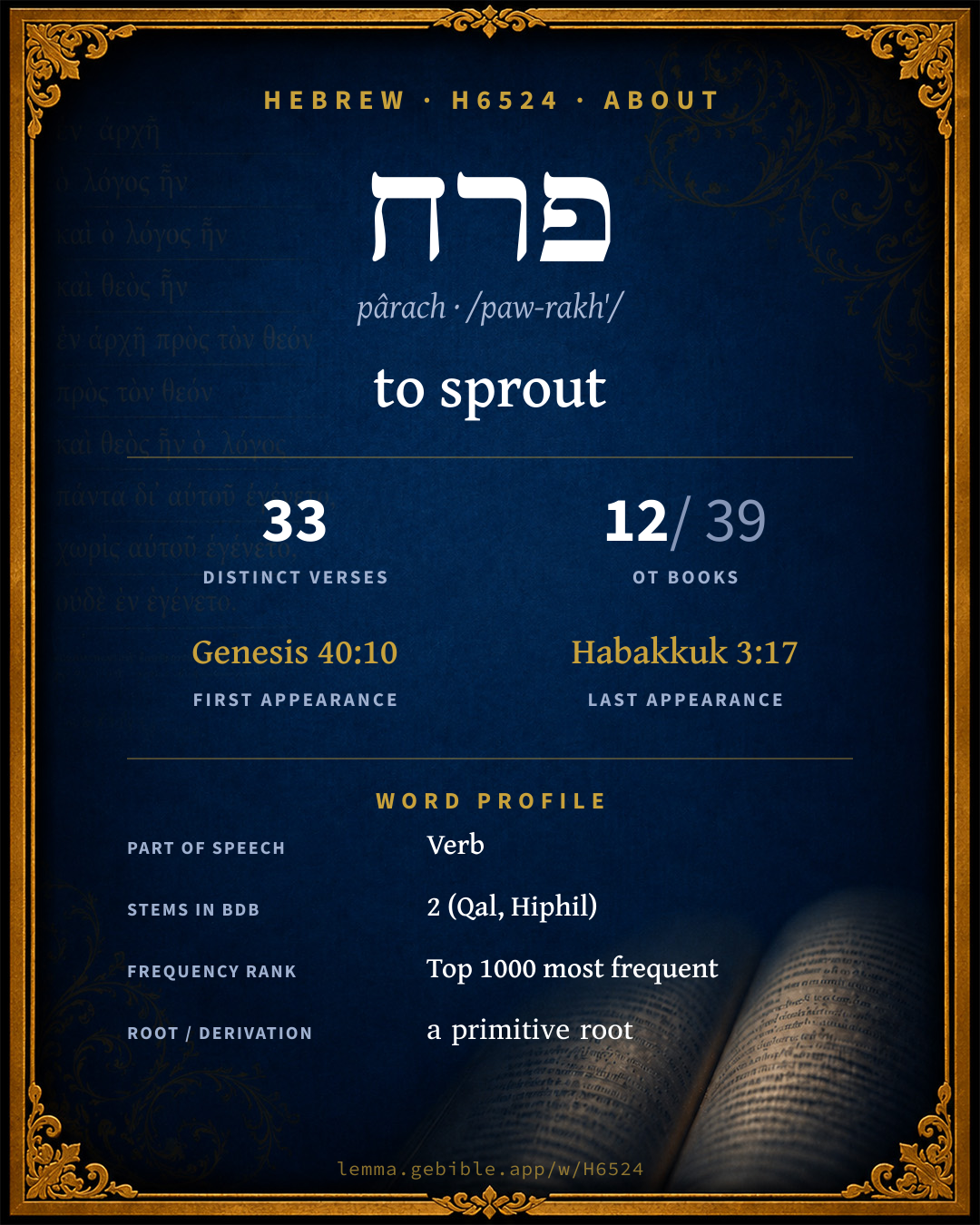
פָּרַח
to sprout
‘to sprout’ is one of 3 main senses fuller range ↓
Full lexicon entry — Brown-Driver-Briggs (BDB)
From Brown-Driver-Briggs (BDB)
Where this word appears
See every Qal verb in the Hebrew Bible →
Grammar key — what these labels mean
Part of speech
- Verb
- An action or state-of-being word.
Stem
- Qal
- The basic, simple active stem — the plain form of the verb (“he wrote”).
- Hiphil
- The causative active stem (“he caused / brought about”). Here: ‘cause to bud or sprout’
Form
- Imperfect
- An incomplete, ongoing, or future action (“he will / would write”).
- Sequential Perfect
- A perfect with prefixed waw continuing a preceding imperfect or command (waw-consecutive perfect).
- Perfect
- A completed action or state — Hebrew marks aspect (completeness) more than strict tense (“he wrote”).
- Participle Active
- A verbal adjective expressing ongoing or characteristic action (“writing / one who writes”).
- Infinitive Absolute
- An unbound verbal noun, often intensifying or standing in for a finite verb.
- Infinitive Construct
- A bound verbal noun, frequently with prepositions (“to write / in writing”).
State
- Absolute
- The independent form of a noun, not bound to a following word.
Person
- 3rd Person
- The one spoken about (“he / she / it / they”).
- 1st Person
- The speaker (“I / we”).
- 2nd Person
- The one addressed (“you”).
Gender
- Masculine
- Grammatically masculine.
- Feminine
- Grammatically feminine.
- Common
- Either gender — not distinguished for this form.
Number
- Singular
- One.
- Plural
- More than one (in Hebrew, generally three or more).
Grammatical forms 16 distinct
- Verb, Qal, Imperfect, 3rd Person, Masculine, Singular 4 times (11%)
- Verb, Qal, Imperfect, 3rd Person, Feminine, Singular 4 times (11%)
- Verb, Qal, Perfect, 3rd Person, Feminine, Singular 4 times (11%)
- Verb, Qal, Sequential Perfect, 3rd Person, Masculine, Singular 3 times (8%)
- Verb, Qal, Perfect, 3rd Person, Masculine, Singular 3 times (8%)
- Verb, Qal, Participle Active, Feminine, Singular, Absolute 3 times (8%)
- Verb, Qal, Participle Active, Feminine, Plural, Absolute 2 times (6%)
- Verb, Hiphil, Imperfect, 3rd Person, Masculine, Singular 2 times (6%)
+8 more forms (11 occurrences)
Parsed forms decoded from the imported morphology (morphhb / Westminster Leningrad Codex — WLC text public domain, morphhb tagging CC BY 4.0), counted across 36 parsed occurrences — not distinct verses.
Every verse where H6524 appears — 33 distinct verses across 12 books. Click any verse to open its interlinear word-by-word view. Verse text shown in the World English Bible for context — . Each verse’s Hebrew form is shown with its reference; the English is not keyword-highlighted, since the data carries no word-level English alignment. Use “Compare translations” on any verse to read it across multiple English versions. This concordance covers the Hebrew Bible; Septuagint (Greek Old Testament) occurrences are not indexed here.
Genesis 1 verse
Exodus 2 verses
- Exodus 9:9 פֹּרֵ֛חַ Qal ptcp.act ms It shall become small dust over all the land of Egypt, and shall be a boil breaking forth with boils on man and on animal, throughout all the land of Egypt."
- Exodus 9:10 פֹּרֵ֕חַ Qal ptcp.act ms They took ashes of the furnace, and stood before Pharaoh; and Moses sprinkled it up toward the sky; and it became a boil breaking forth with boils on man and on animal.
Leviticus 7 verses
- Leviticus 13:12 פָּר֨וֹחַ תִּפְרַ֤ח Qal inf.abs Qal impf 3fs "If the leprosy breaks out all over the skin, and the leprosy covers all the skin of the infected person from his head even to his feet, as far as it appears to the priest;
- Leviticus 13:20 פָּרָֽחָה Qal pf 3fs and the priest shall examine it; and, behold, if the appearance of it is lower than the skin, and the hair of it has turned white, then the priest shall pronounce him unclean. It is the plague of leprosy. It has broken out in the boil.
- Leviticus 13:25 פָּרָ֑חָה Qal pf 3fs then the priest shall examine it; and, behold, if the hair in the bright spot has turned white, and the appearance of it is deeper than the skin; it is leprosy. It has broken out in the burning, and the priest shall pronounce him unclean. It is the plague of leprosy.
- Leviticus 13:39 פָּרַ֥ח Qal pf 3ms then the priest shall examine them; and, behold, if the bright spots on the skin of their body are a dull white, it is a harmless rash, it has broken out in the skin; he is clean.
- Leviticus 13:42 פֹּרַ֨חַת֙ Qal ptcp.act fs But if there is in the bald head, or the bald forehead, a reddish-white plague; it is leprosy breaking out in his bald head, or his bald forehead.
- Leviticus 13:57 פֹּרַ֖חַת Qal ptcp.act fs and if it appears again in the garment, either in the warp, or in the woof, or in anything of skin, it is spreading. You shall burn with fire that in which the plague is.
- Leviticus 14:43 וּ/פָרַ֣ח conj + Qal wpf 3ms "If the plague comes again, and breaks out in the house, after he has taken out the stones, and after he has scraped the house, and after it was plastered;
Numbers 2 verses
- Numbers 17:5 יִפְרָ֑ח Qal impf 3ms It shall happen, that the rod of the man whom I shall choose shall bud: and I will make to cease from me the murmurings of the children of Israel, which they murmur against you.
- Numbers 17:8 פָּרַ֥ח Qal pf 3ms It happened on the next day, that Moses went into the tent of the testimony; and, behold, the rod of Aaron for the house of Levi was budded, and put forth buds, and produced blossoms, and bore ripe almonds.
Job 1 verse
Psalms 4 verses
- Psalms 72:7 יִֽפְרַח Qal impf 3ms In his days, the righteous shall flourish, And abundance of peace, until the moon is no more.
- Psalms 92:7 בִּ/פְרֹ֤חַ prep + Qal inf.cs Though the wicked spring up as the grass, And all the evil-doers flourish, They will be destroyed forever.
- Psalms 92:12 יִפְרָ֑ח Qal impf 3ms The righteous shall flourish like the palm tree. He will grow like a cedar in Lebanon.
- Psalms 92:13 יַפְרִֽיחוּ Hiphil impf 3mp They are planted in Yahweh's house. They will flourish in our God's courts.
Proverbs 2 verses
Song of Solomon 2 verses
- Song of Solomon 6:11 הֲ/פָֽרְחָ֣ה ptcl def.art + Qal pf 3fs I went down into the nut tree grove, To see the green plants of the valley, To see whether the vine budded, And the pomegranates were in flower.
- Song of Solomon 7:12 פָּֽרְחָ֤ה Qal pf 3fs Let's go early up to the vineyards. Let's see whether the vine has budded, Its blossom is open, And the pomegranates are in flower. There I will give you my love.
Isaiah 5 verses
- Isaiah 17:11 תַּפְרִ֑יחִי Hiphil impf 2fs In the day of your planting you hedge it in, and in the morning you make your seed to blossom; but the harvest flees away in the day of grief and of desperate sorrow.
- Isaiah 27:6 וּ/פָרַ֖ח conj + Qal wpf 3ms In days to come shall Jacob take root; Israel shall blossom and bud; and they shall fill the surface of the world with fruit.
- Isaiah 35:1 וְ/תִפְרַ֖ח conj + Qal impf 3fs The wilderness and the dry land shall be glad; and the desert shall rejoice, and blossom as the rose.
- Isaiah 35:2 פָּרֹ֨חַ תִּפְרַ֜ח Qal inf.abs Qal impf 3fs It shall blossom abundantly, and rejoice even with joy and singing; the glory of Lebanon shall be given to it, the excellency of Carmel and Sharon: they shall see the glory of Yahweh, the excellency of our God.
- Isaiah 66:14 תִפְרַ֑חְנָה Qal impf 3fp You shall see [it], and your heart shall rejoice, and your bones shall flourish like the tender grass: and the hand of Yahweh shall be known toward his servants; and he will have indignation against his enemies.
Ezekiel 3 verses
- Ezekiel 7:10 פָּרַ֖ח Qal pf 3ms Behold, the day, behold, it comes: your doom is gone forth; the rod has blossomed, pride has budded.
- Ezekiel 13:20 לְ/פֹ֣רְח֔וֹת לְ/פֹרְחֹֽת prep + Qal ptcp.act fp prep + Qal ptcp.act fp Therefore thus says the Lord Yahweh: Behold, I am against your pillows, with which you there hunt the souls to make [them] fly, and I will tear them from your arms; and I will let the souls go, even the souls who you hunt to make [them] fly.
- Ezekiel 17:24 וְ/הִפְרַ֖חְתִּי conj + Hiphil pf 1cs All the trees of the field shall know that I, Yahweh, have brought down the high tree, have exalted the low tree, have dried up the green tree, and have made the dry tree to flourish; I, Yahweh, have spoken and have done it.
Hosea 3 verses
- Hosea 10:4 וּ/פָרַ֤ח conj + Qal wpf 3ms They make promises, swearing falsely in making covenants. Therefore judgment springs up like poisonous weeds in the furrows of the field.
- Hosea 14:5 יִפְרַ֖ח Qal impf 3ms I will be like the dew to Israel. He will blossom like the lily, And send down his roots like Lebanon.
- Hosea 14:7 וְ/יִפְרְח֣וּ conj + Qal impf 3mp Men will dwell in his shade. They will revive like the grain, And blossom like the vine. Their fragrance will be like the wine of Lebanon.
Habakkuk 1 verse
About this entry
At a glance — auto-summarized from this page’s data, not written by a person. Every figure links to its source below. This summary describes the numbers; it doesn’t interpret them.
פרח (pârach) is a Hebrew verb most often rendered “to sprout.” Scripture first uses it in Genesis 40:10. It turns up in 33 verses across 12 books, a moderately common footprint. Across 2 stems, its meaning turns on the binyan (Qal, Hiphil). It clusters with אפרח, פרח and פרחח under a shared root. The sections below give every sense, occurrence, and version rendering.
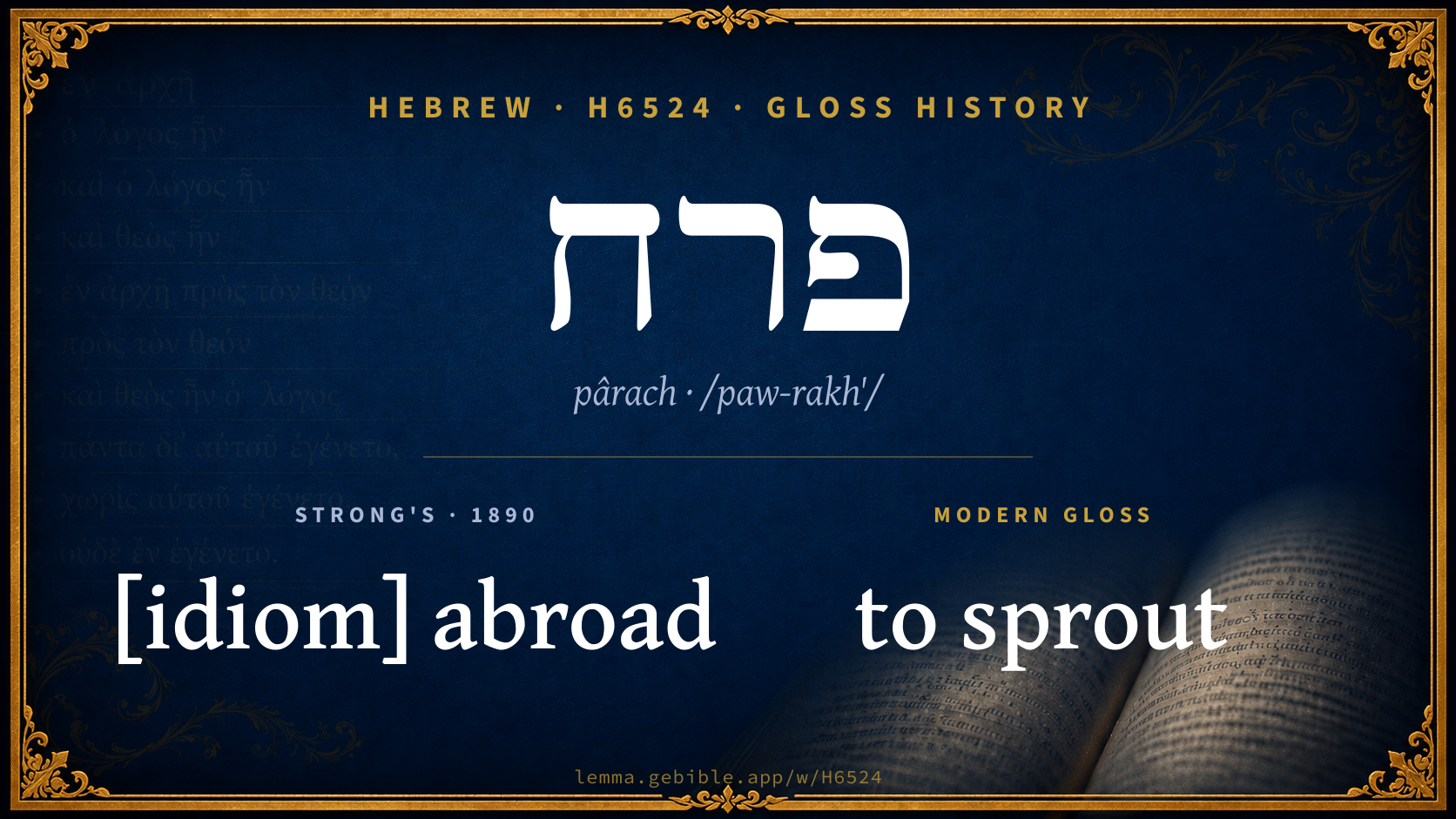
Gloss history
Strong's 1890 vs modern scholarship
About this word
Strong's H6524 catalogs a Hebrew word from the Hebrew Old Testament.
These counts are not copied from any lexicon or concordance. They are computed here, from the morphology-tagged Hebrew Old Testament. What Lemma adds →
- 33
- distinct verses
- The word appears in 33 distinct verses.
- 12 / 39
- OT books
- The word appears in 12 of 39 Old Testament books.
- #990
- by frequency
- Top 1000 most frequent Hebrew words (rank 990 of 8,640 Hebrew words by occurrence).
View all 33 occurrences in the concordance →
By section of the Old Testament
By traditional corpus
Conventional, traditional groupings — biblical authorship is debated, so this is a traditional corpus grouping, not an authorship claim. Each share is this word’s portion of its verses in that division of the Hebrew canon. Each figure is a share of the word’s 33 distinct verses.
- Torah (Pentateuch) 12 verses · 36%
- Prophets (Nevi'im) 12 verses · 36%
- Writings (Ketuvim) 9 verses · 27%
How translations render this word
Counts come from each version’s own published word-to-Strong’s tagging or interlinear alignment — an approximate guide to how each version renders this word, not a word-level alignment the data otherwise carries. Because each total is that version’s own tagged count, the per-version totals vary from one another and need not match the appearance or distinct-verse counts above. These counts may also differ from a printed concordance because Lemma counts each distinctly tagged rendering and does not collapse phrase taggings into a single head-word total. This is a fixed set of word-tagged versions (KJV, ASV, BSB, ULT) and does not change with the reading translation you choose elsewhere. Each version’s license is shown beside its name below (and on Sources).
BDB lists this Strong’s number as 3 distinct words (homographs). Each count above pools all of them and is not split by sense — see the Senses section below. A low-frequency rendering may belong to a different one of those words, not the primary meaning.
- King James Version†: Shall flourish 5×, Flourish 4×, Breaking forth 2×
- American Standard Version†: Blossom 4×, Shall flourish 4×, Hath broken 3×
- Berean Standard Bible†: Has broken out 3×, Will flourish 3×, Blossom 2×
- unfoldingWord Literal Text†: Blossom 4×, Has broken out 3×, Breaking out 2×
King James Version Public Domain
Renders H6524 across 36† tagged occurrences — most commonly:
Plus 19 renderings that appear only once — usually multi-word phrases or single function words the recovered tagging swept in, not distinct renderings.
American Standard Version Public Domain
Renders H6524 across 36† tagged occurrences — most commonly:
Plus 17 renderings that appear only once — usually multi-word phrases or single function words the recovered tagging swept in, not distinct renderings.
Berean Standard Bible Public Domain
Renders H6524 across 33† tagged occurrences — most commonly:
Plus 15 renderings that appear only once — usually multi-word phrases or single function words the recovered tagging swept in, not distinct renderings. Not rendered by a distinct English word in 3 further occurrences.
unfoldingWord Literal Text CC BY-SA 4.0
Renders H6524 across 42† tagged occurrences — most commonly:
Plus 21 renderings that appear only once — usually multi-word phrases or single function words the recovered tagging swept in, not distinct renderings.
Senses in the full BDB
Hebrew verbs can shift meaning by stem (binyan): Qal is the basic action, Niphal is often passive or reflexive, Piel often intensifies or makes it factitive, and Hiphil is typically causative. The senses below are grouped under the stem BDB assigns to each.
What do BDB’s symbols mean?
BDB uses these scholarly abbreviations:
| Symbol | Meaning |
|---|---|
| 𝔊 | the Septuagint (the ancient Greek translation, LXX) |
| 𝔙 | the Vulgate (the Latin translation) |
| 𝔖 | the Syriac version (the Peshitta) |
| 𝔗 | the Targum (the Aramaic translation) |
| ψ | the Psalms |
| √ | root (the underlying root or stem) |
| ‖ | parallel passage (a synonymous or contrasted parallel) |
| † | the dagger: every passage where the word occurs is cited |
The 6 senses and sub-senses the full Brown-Driver-Briggs lexicon distinguishes for this word, in lexicon order (not ranked by frequency), with BDB’s own verbatim wording and sub-sense lettering. Shown in Hebrew script with BDB’s own scholarly abbreviations. The condensed entry is in the Lexicon Entry tab. See also the Forms in the corpus table below.
פרח I bud, sprout, shoot (NH Hiph. = BH Hiph. 2
Qal
- Pf. 3 ms. פ׳ Ez 7:10 +, etc.; Impf. 3 ms. יִפְרַח Ho 14:6 +, 3 fpl. תִּפְרַחְנָה Is 66:14, etc.; Inf. abs. פָּרֹחַ 35:2; cstr. בִּפְרֹחַ ψ 92:8; Pt. f. פֹּרַ֫חַת Gn 40:10;—bud, sprout, send out shoots, of vine Gn 40:10 (E), Ho 14:8 (sim.), Ct 6:11; 7:13; fig-tree Hb 3:17 (תִּפְרֶה); rods Nu 17:20, 23; metaph. of restored Isr. Ho 14:6; Is 27:6, cf. of bones Is 66:14 (כַּדֶּשֶׂא); of righteous ψ 72:7; 92:13 Pr 11:28; of wicked (כְּמוֹ עֵשֶׂב) ψ 92:8; also of steppe (עֲרָבָה) Is 35:1, פָּרֹחַ תִּפְרַח v 2; fig. of judgment Ho 10:4 (כָּרֹאשׁ; but on text v. Now); of זָדוֹן (q.v. p. 268) Ez 7:10. e.g. Ezekiel 7:10
Hiphil
- Pf. 1 s. הִפְרַחְתִּי Ez 17:24; Impf. יַפְרִחַ Jb 14:9, etc.;— e.g. Ezekiel 17:24
- 1. cause to bud or sprout, c. acc. עֵץ Ez 17:24, זֶרַע Is 17:11, both fig. e.g. Ezekiel 17:24
- 2. shew buds, sprouts, of tree Jb 14:9; fig. of righteous ψ 92:14; = flourish, of אֹהֶל יְשָׁרִים, Pr 14:11 (all Qal in—ִ according to BaZMG xliii (1889), 180f.). e.g. Job 14:9
פרח II break out, of leprosy and like eruptions (in P) (usually taken as = I. פ׳. but dub.
Qal
- Pf. 3 ms. פ׳ Lv 13:39 (of פֹּהַק), וּפ׳ consec. 14:43 (of נֶגַע); of צָרַעַת, 3 fs. פָּרָ֑חָה 13:20, 25, also Impf. 3 fs. + Inf. abs. פָּרוֹחַ תִּפְרַח v 12, and Pt. f. פֹּרַחַת v 42, 57; of שְׁחִין Pt. m. פֹּרֵחַ Ex 9:9, 10. e.g. Leviticus 13:39
פרח III fly, Aramaism, si vera l. (NH id., especially fly away
Qal
- Pt. fpl. לְפֹרְחוֹת Ez 13:20(×2) for (like?) flying things, i.e. birds, but del. 𝔊 𝔖 Hi Siegf in v a (where prob. ins. from v b); Co Toy Berthol Krae in v a, b. e.g. Ezekiel 13:20
Senses from the full Brown-Driver-Briggs lexicon (Brown, Driver, Briggs; Oxford 1906 — public domain), digitized via Sefaria, supplemented by the OpenScriptures HebrewLexicon (CC BY 4.0). Full attribution on Sources.
Word origin
I. vb. bud, sprout, shoot (NH Hiph. = BH Hiph. 2; Ecclus פרח Qal = flourish, Hiph. causat., 49:10; 40:19; Arabic فَرِخَ ii. hatch, also sprout, فَرْخٌ young of bird (v. אֶפְרֹחַ infr.), twig, sprout; Assyrian pirḫu, n. sprout;—on meaning cf. GFMJBL x (1891), 57)—
II. vb. break out, of leprosy and like eruptions (in P) (usually taken as = I. פ׳. but dub.; NH id., also decay, ferment VogelstLandwirthschaft 22; Syriac ܦܪܰܚ spread, of leprosy, etc.; NS. ܦܵܪܘ̇ܚܬܵܐ leprous spots)—
III. vb. fly, Aramaism, si vera l. (NH id., especially fly away; Aramaic פְרַח, ܦܪܰܚ fly; ܦܳܪܰܚܬܳܐ insect, bird);—
— Brown-Driver-Briggs (Oxford 1906, public domain), digitized via Sefaria, supplemented by the OpenScriptures HebrewLexicon (CC BY 4.0). See Sources.
Origin: a primitive root
Jastrow Dictionary
A second Hebrew/Aramaic lexicon for comparison, covering Aramaic and post-biblical (Talmudic, Targumic, Midrashic) usage that the biblical-Hebrew BDB does not. Matched by lemma rather than by Strong’s number, so a lemma may carry more than one Jastrow headword (shown separately below), and the entries cover usage well beyond the Bible.
פָּרַח
- (b. h.) [to break through,]
- 1. to bloom, sprout. Ber. 47ᵇ, sq. קטן פּוֹרֵחַ a boy developing signs of puberty (before the usual age). Num. R. s. 18, end ומעצמו פ׳ and it (the staff) blossomed of itself (without being planted); a. fr.—Esp. (with ref. to Lev. XIII, 12) to become white, spread all over. Neg. VIII, 1 הפורח מן הטמא טהור a leprosy that ‘blossoms’ after the person has been declared unclean, is clean. Ib. 2 פָּרְחָה בכולו if it spread over the entire body. Ib. VII, 5 עד שתִּפְרַח בכולו until it spreads over &c.; a. fr.—2) to fly, fly off; to swim. Kinn. II, 1, sq. B. Mets. I, 4 גוזלות שלא פרחו unfledged pigeons. Ḥull. III, 7, v. סְנַפִּיר. Y. Taan. IV, 68ᶜ top הלוחות היו מבקשין לִפְרוֹחַ the tablets wanted to fly (off Moses’ hands); הכתב עצמו פ׳ only the letters flew off; כיון שפ׳ הכתב וכ׳ when the letters had flown off, the tablets became too heavy for Moses’ hands. Ab. Zar. 18ᵃ (of a martyr dying on the pyre) גוילין … פּוֹרְחוֹת I see the sheets of the book of the Law burn, and the letters fly off. Ḥag. 15ᵇ; Snh. 106ᵇ מגדל הפורח באויר, v. מִגְדָּל. Ḥag. I, 8 פּוֹרְחִין באויר, v. הֶיתֵּר; a. fr.—Gen. R. s. 93, a. e. פָּרְחָה נשמתן their soul fled, i.e. they were shocked by surprise, fear &c. e.g. Leviticus 13:12
- 1. to bloom, blossom. Num. R. l. c. וה׳ בו בלילה וכ׳ the same night it blossomed and brought forth fruit; Tanḥ. Aḥăré 8 הִפְרִיחוּ ועשו פירות. Lev. R. s. 23; Cant. R. to II, 2 מַפְרחַת, v. כָּמַשׁ; a. fr.
- 2. to cause sprouting, produce. Gen. R. s. 37 אתמול מַפְרִיחַ מצות וכ׳ yesterday producing meritorious and noble deeds, and to-day so selfish!, v. כָּנַן; Yalk. ib. 62; Yalk. Ps. 832.
- 3. to be able to fly, be fledged. Ḥull. XII, 3 (140ᵇ) אפרוחים מַפְרִיחִין full-fledged birds; Ḥull. 141ᵃ. B. Mets. l. c.; a. fr.
- 4. to cause to fly; to chase. Snh. III, 3 מַפְרִיחֵי יונים, v. יוֹנָה II. Gen. R. s. 67; Yalk. Prov. 950 ומַפְרִיחָן and let them fly off, v. סִכְסֵךְ I. Y. Yoma II, 39ᶜ top הִפְרִיחָתוֹ הרוח the wind drove it off (the altar). Y. Erub. I, 19ᵇ bot. ובאת הרוח והִפְרִיחָתָהּ and a wind came and carried it (the Succah) off; a. fr.
- 5. to place beyond due limits, to cause to protrude. B. Kam. 29ᵇ, sq. לא שנו אלא (ב)מַפְרִיחַ this has been taught (that he is responsible for damage) only when he places the thorns on his ground so that they protrude into the public road, opp. מצמצם when he puts them exactly where his limits end. Tosef. ib. II, 5 המפריח גדירו … לרשות הרבים he who causes his fence of thorns or stones to protrude into the public road.
פְּרַח I
- 1. to bloom. [Targ. Y. Gen. XXX, 37 דפָרַח לבן, prob. name of a tree; h. text לבנה; cmp. פֶּרַח.]
- 2. to move swiftly, fly, swim, run. Targ. O. Gen. I, 21. Targ. Y. Deut. XIV, 9 (ed. Amst. למַפְ׳, Af.). Ib. 19; a. fr.—Yalk. Deut. 938, a. e., v. זַחֲלָא. Keth. 105ᵇ, v. גַּדְפָא. Gen. R. s. 22 דין אמר חלוץ ודין אמר פרח the one (Abel) said, take thy dress off (the wool is mine), and the other (Cain) said, fly in the air (the earth is mine). Koh. R. to I, 8 והיה פ׳ ואינון פָּרְחִין בתריה he ran, and they ran after him; a. fr.
- 3. to palpitate. Gitt. 69ᵇ כל שכן דפ׳ ליביה his heart will palpitate still more.
- 4. to cause to flee, keep off. Pes. 111ᵇ פִּירְחִי נפשיך וכ׳ keep thyself off the service-tree.
- to cause to fly, carry off. Ib. 110ᵇ top (in an incantation) פָּרְחֵיה זיקא וכ׳ Ms. M. a. Rashi (ed. פרח׳) let the wind carry off &c.; ib.ᵃ bot. פ׳ פרחייכי, v. פִּרְחָא.
- 1. to produce blossoms, to bloom. Targ. Gen. XL, 10. Targ. Y. II, Num. XVII, 23; a. e.
- 2. to fly, v. supra.
- 3. to cause to fly, carry; to chase off. Targ. O. Gen. XV, 11 (ed. Berl. ואָתֵיב, v. Berl. Targ. O. II, p. 6). Targ. Num. XI, 31 (not וְאֶפְ׳; h. text ויגז). Targ. Is. XXVIII, 28. Targ. Prov. VII, 23 (h. text יפלח); a. fr.—Midr. Sam. ch. XXIII (expl. ויעט, I Sam. XXV, 14) אַפְרְחִין במילין he chased them off with (harsh) words; Y. Snh. II, 20ᵇ top אפחין (corr. acc.). Shebu. 30ᵇ אַפְרַח עלי בר וכ׳ let a duck fly over me; a. e.—Y. Sot. III, beg. 18ᶜ [read:] חמי היך אַפְרְחִית הדין דידך see how I make this thy argument fly off (I refute it). e.g. 1 Samuel 25:14
פֶּרַח
- preced.)
- 1. blossom, flower, an ornament in the shape of a flower. Gen. R. s. 91, end, v. כַּפְתּוֹר. Kel. XI, 7 הפ׳ והבסיס the calyx of a candlestick and the shaft. Esth. R. to I, 6 אני ישנתי על פִּרְחוֹ של וכ׳ I slept on the flower (capital) of one of those columns, and there was room for a body at full length, with outstretched hands and feet. Men. 28ᵇ; a. fr.—Pl. פְּרָחִים. Ib. פְּרָחֶיהָ … כמין פִּרְחֵי וכ׳ what did the flowers of the candlestick look like? Like the blossoms on the capitals of columns; a. e.
- 2. פ׳ לבן White Blossom, name of an aromatic shrub. Deut. R. s. 6, beg. פ׳ לבן הוא שכרו וכ׳ this is a White Blossom, the wages for working at it are half a goldpiece. Y. Shebi. VII, beg. 37ᵇ; Tosef. ib. V, 7 פ׳ לבין ed. Zuck. (Var. פרחבלין, פרחבינ׳, פרחביל׳, corr. acc.).
- 3. youth. — Pl. as ab. Midd. I, 8, a. fr. פִּרְחֵי כהונה, v. כְּהוּנָּה.
- 4. young chicken. —Pl. as ab. Keth. 59ᵇ Ar. (ed. אפרוחים). Y. Ab. Zar. III, 42ᵈ top (expl. סכות בנות, II Kings XVII, 30) תרנגולתא ופְרָחֶיהָ a hen with her chickens. e.g. 2 Kings 17:30
פְּרַח II
- 1. flower. Targ. Y. Gen. XXX, 37 (v. פְּרַח I). [Targ. Job XX, 3, v. פּוּחָא.]—Esp. caper-blossom, also caper-tree. Ber. 40ᵇ (expl. נצפה) פרחה (Ms. F. פירחא). Ib. 36ᵃ אדעתא דפ׳ for the sake of the caper. Ib. 36ᵇ, v. בּוּטִּיתָא; a. e.—Pl. פִּרְחֵי. Pes. 111ᵇ טולי בי פ׳ רוחי (the demons dwelling in) the shade of caper-trees are named ruḥé
- 2. a species of locusts. Targ. Joel I, 4 (h. text ילק).
- 3. palpitation of the heart. Gitt. 69ᵇ
- 4. *that which is blown off, particle, crumb. — Pl. פִּרְחַיָּיא. Pes. 110ᵃ bot. (in an incantation) פרח פִּרְחַיְיכִי let the wind carry off your crumbs (with which you conjure; v., however, Rashi a. l.).
A Dictionary of the Targumim, the Talmud Babli and Yerushalmi, and the Midrashic Literature (Marcus Jastrow; London, Luzac, 1903) — Public Domain. Digitized via Sefaria. Digitized via Sefaria. Full attribution on Sources.
Forms in the corpus
The 34 distinct written forms H6524 takes in the Hebrew Bible, most frequent first — each parse links to that stem’s occurrences in the concordance. Hebrew forms include their vowel points and cantillation, so a single lemma takes many written forms.
Same root — word family
Other BDB entries built from the same root as H6524, grouped by Strong’s listed origin. These share a root / origin per the lexicon — not necessarily a shared meaning. Each links to that word’s own entry.
Derived from this word
Proper names from this root
People and places named from this root — a name, not an additional meaning of the word.
Compare all same-root words → Showing 4 of 5 — not the complete family. 1 of the same-root words is a proper name (a person or place). They share a root, not necessarily a meaning.
Septuagint verse parallels
This word appears in 30 verses that also exist in the Greek Old Testament (Septuagint), out of the 33 Hebrew verses it occurs in. You can read those verses in Greek by switching the Old Testament edition to the Septuagint.
Read these verses in the Septuagint
- Genesis 40:10
- Exodus 9:9
- Leviticus 13:12
- Numbers 17:5
- Job 14:9
- Psalms 72:7
- Proverbs 11:28
- Song of Solomon 6:11
- Isaiah 17:11
- Ezekiel 7:10
- Hosea 10:4
- Habakkuk 3:17
This is a verse-level parallel only — the same verses exist in both the Hebrew and Greek Old Testaments. No word-level Hebrew↔Greek correspondence is claimed: the data carries no such alignment, so no Greek word is shown as this Hebrew word’s translation. Coverage is not total — the Septuagint omits the deuterocanon and renumbers the Psalms, so some Hebrew verses have no direct Greek parallel.