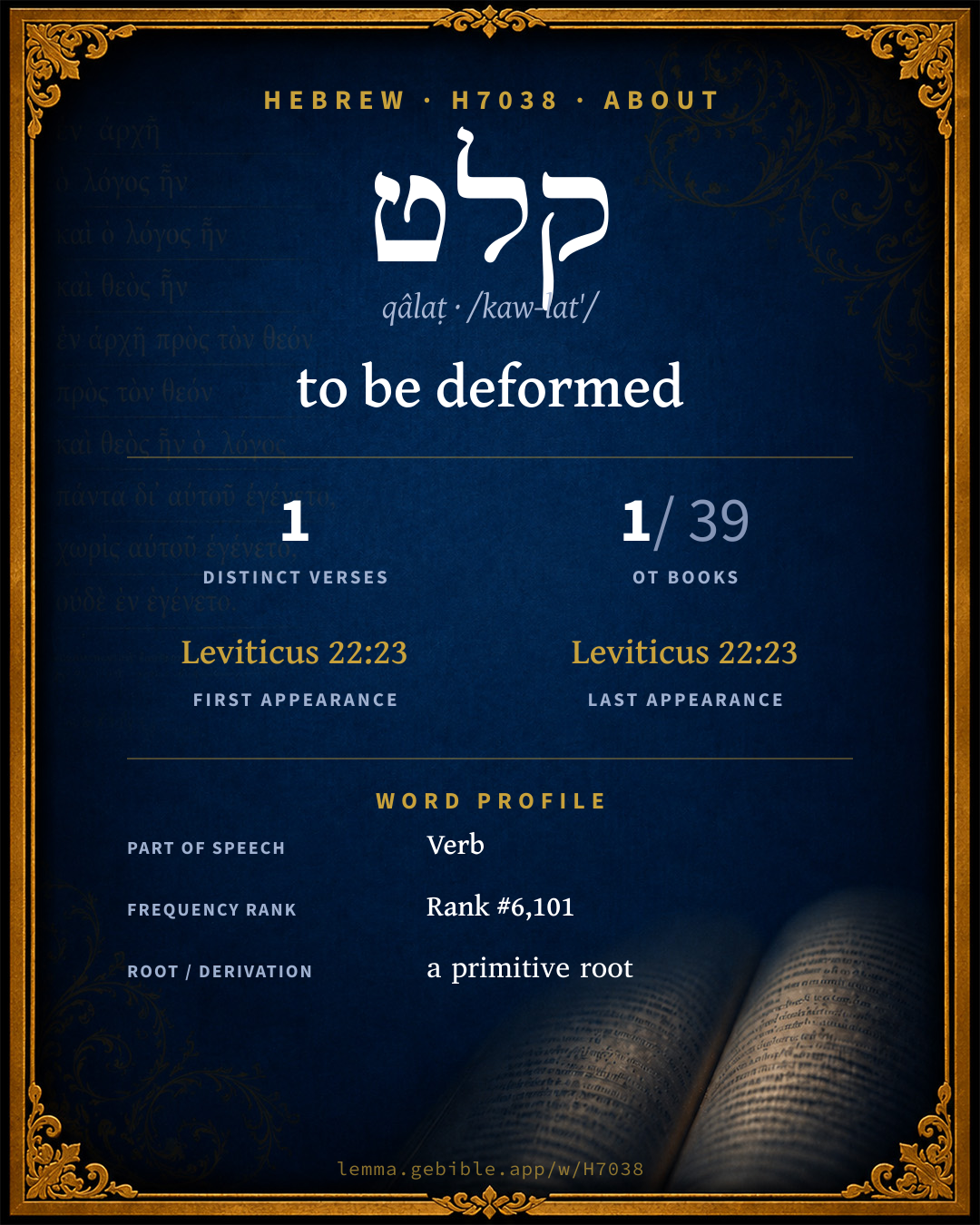
קָלַט
to be deformed
Full lexicon entry — Brown-Driver-Briggs (BDB)
From Brown-Driver-Briggs (BDB)
Where this word appears
Grammar key — what these labels mean
Stem
- Qal
- The basic, simple active stem — the plain form of the verb (“he wrote”).
Form
- Participle Passive
- A verbal adjective expressing action received (“written”).
State
- Absolute
- The independent form of a noun, not bound to a following word.
Gender
- Masculine
- Grammatically masculine.
Number
- Singular
- One.
Every verse where H7038 appears — 1 distinct verse across 1 book. Click any verse to open its interlinear word-by-word view. Verse text shown in the World English Bible for context — . Each verse’s Hebrew form is shown with its reference; the English is not keyword-highlighted, since the data carries no word-level English alignment. Use “Compare translations” on any verse to read it across multiple English versions. This concordance covers the Hebrew Bible; Septuagint (Greek Old Testament) occurrences are not indexed here.
Leviticus 1 verse
About this entry
At a glance — auto-summarized from this page’s data, not written by a person. Every figure links to its source below. This summary describes the numbers; it doesn’t interpret them.
At its core, קלט (qâlaṭ) means “to be deformed.” With only 1 verse it sits in the long tail of Hebrew Bible vocabulary. The word gravitates to Leviticus (100%). Found nowhere else but Leviticus 22:23. It shares a root with מקלט and קליטא. Each statement above links to its evidence; the full detail follows below.
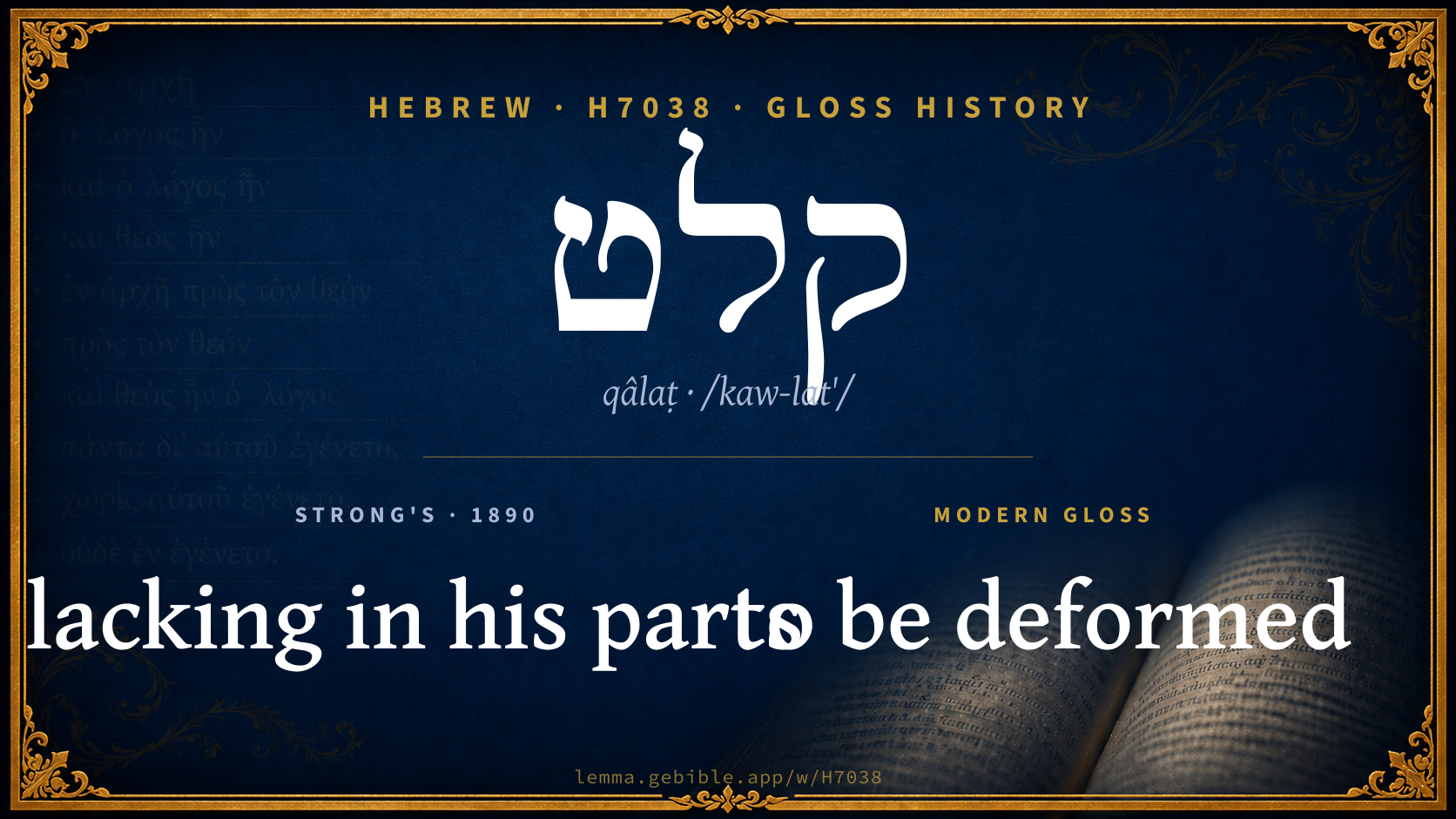
Gloss history
Strong's 1890 vs modern scholarship
About this word
Strong's H7038 catalogs a Hebrew word from the Hebrew Old Testament.
These counts are not copied from any lexicon or concordance. They are computed here, from the morphology-tagged Hebrew Old Testament. What Lemma adds →
- 1
- distinct verses
- The word appears in 1 distinct verse.
- 1 / 39
- OT books
- The word appears in 1 of 39 Old Testament books.
- #6,101
- by frequency
- Rank #6,101 (rank 6,101 of 8,640 Hebrew words by occurrence).
View all 1 occurrence in the concordance →
Most concentrated in
- Leviticus 1 verse 100%
By section of the Old Testament
By traditional corpus
Conventional, traditional groupings — biblical authorship is debated, so this is a traditional corpus grouping, not an authorship claim. Each share is this word’s portion of its verses in that division of the Hebrew canon. Each figure is a share of the word’s 1 distinct verse.
- Torah (Pentateuch) 1 verse · 100%
How translations render this word
Counts come from each version’s own published word-to-Strong’s tagging or interlinear alignment — an approximate guide to how each version renders this word, not a word-level alignment the data otherwise carries. Because each total is that version’s own tagged count, the per-version totals vary from one another and need not match the appearance or distinct-verse counts above. These counts may also differ from a printed concordance because Lemma counts each distinctly tagged rendering and does not collapse phrase taggings into a single head-word total. This is a fixed set of word-tagged versions (KJV, ASV, BSB, ULT) and does not change with the reading translation you choose elsewhere. Each version’s license is shown beside its name below (and on Sources).
- King James Version: Or lacking in his parts 1×
- American Standard Version: Or lacking in his parts 1×
- Berean Standard Bible: Or stunted limb 1×
- unfoldingWord Literal Text: Or stunted 1×
King James Version Public Domain
Renders H7038 across 1 tagged occurrence — most commonly:
American Standard Version Public Domain
Renders H7038 across 1 tagged occurrence — most commonly:
Berean Standard Bible Public Domain
Renders H7038 across 1 tagged occurrence — most commonly:
unfoldingWord Literal Text CC BY-SA 4.0
Renders H7038 across 1 tagged occurrence — most commonly:
Senses in BDB
The 1 sense BDB distinguishes for this word, in lexicon order (not ranked by frequency or importance). The full entry — with sub-senses — is in the Lexicon Entry tab.
- (Qal) to be stunted, be handicapped, be deformed (of a sacrificial animal lacking body parts)
Word origin
[ קָלַט ] vb. be stunted (prop. be drawn in ?);— Qal Lv 22:23
— Brown-Driver-Briggs (Oxford 1906, public domain), digitized via Sefaria, supplemented by the OpenScriptures HebrewLexicon (CC BY 4.0). See Sources.
Origin: a primitive root
Jastrow Dictionary
A second Hebrew/Aramaic lexicon for comparison, covering Aramaic and post-biblical (Talmudic, Targumic, Midrashic) usage that the biblical-Hebrew BDB does not. Matched by lemma rather than by Strong’s number, so a lemma may carry more than one Jastrow headword (shown separately below), and the entries cover usage well beyond the Bible.
קָלַט
- (b. h.) [to surround,]
- 1. to close, press.—Part. pass. קָלוּט; f. קְלוּטָה; pl. קְלוּטִים; קְלוּטיֹת. Sifra Emor, Par. 7, ch. VII (expl. קלוט, Lev. XXII, 23) פרסוֹת וכ׳ an animal whose hoofs resemble those of a horse &c.; Bekh. VI, 7 (40ᵃ) שרגליו ק׳ וכ׳. Bekh. 6ᵃ פרסותיה ק׳ its hoofs are closed, opp. סדוקות cloven. Ib. VII, 6 אצבעותיו … או ק׳ וכ׳ if his fingers lie one above the other or are grown together up to the root (פֶּרֶק). Y. Sot. IX, 23ᵈ; a. e.—In gen. קָלוּט an animal with uncloven hoofs (having the sign of uncleanness) born of a clean animal, monster or hybrid. Bekh. 7ᵃ ק׳ בן פרה a ḳaluṭ born of a cow; Ḥull. 68ᵇ. Ib. ק׳ במעי פרה a ḳaluṭ found in a cow (after ritual slaughtering); ib. 69ᵃ. Sabb. 67ᵃ זרעיך כק׳ וכפרדה וכ׳ thy seed be like a ḳ. and like a mule &c. (Rashi: ‘like one whose semen is locked up’); a. e. e.g. Leviticus 22:23
- 2. to clutch, intercept, receive; to conceive, retain, absorb. Ḥull. 65ᵃ כל עוף הקוֹלֵט מן האויר וכ׳ any bird that snatches in the air (for things thrown to it) is unclean. Gen. R. s. 41 אינה קוֹלֶטֶת, v. פֶּרֶד II. Ker. 5ᵃ וק׳ את הריח and the oil retained (absorbed) the scent. Gen. R. s. 5 קְלָטָן הים the sea absorbed them (the waters of the rivers); Yalk. Ps. 848 קְלָטָם. Ab. V, 15 שמוציאה את היין וקולטת וכ׳ which passes the wine and retains the lees; שמוציאה … וק׳ את הסולת which passes the common flour and retains the fine flour (v. צוּף). Snh. 108ᵇ כל שהתיבה קוֹלַטְתּוֹ whatever animal the ark received. Sabb. I, 6 כדי שיִקְלוֹט העין when there is time enough before the Sabbath for the wool to assume the color of the dye. Lev. R. s. 14 אין האשה קולטת וכ׳ a woman conceives only shortly after menstruation. Shebi. II, 6 כל הרכבה שאינה קולטת וכ׳ a grafting which does not take root within three days, will never do so; a. v. fr.—Ex. R. s. 1 ק׳ דרך וכ׳ he (Moses) adopted the manner of his ancestors (finding wives at the well); Tanḥ. Sh’moth 10 לקח.—Esp. (v. מִקְלָט) to protect, give the shelter of an asylum. Macc. 12ᵃ אינו קולט אלא גגו only the top of the altar protects him that flees to it; אינו קולט … עולמים only the altar of the permanent sanctuary (in Jerusalem) offers protection; אינו קולט אלא כהן וכ׳ protects only the priest while at service &c. Ib. אינה קולטת אלא בצר only Bezer is an asylum (but not Bozrah). Ib.ᵇ פלכו קוֹלְטוֹ his (the Levite’s) district protects him. Ib. עיר שקְלָטַתּוּ כבר a town which has received him once before. Sifré Num. 160 אין לי אלא שקוֹלְטוֹת בארץ this would indicate only that they (these cities) offer asylum for manslaughter committed in Palestine. Ib. לא קָלְטָה אחת מהם עד וכ׳ none of those cities had the right of asylum until all of them had been designated; a. fr.—Macc. 10ᵃ מנין … קוֹלְטִין whence do you learn that the words of the Law offer protection (to its students)?; ib. קולטין ממלאך וכ׳ they protect from the angel of death.
- 3. (of sacred precincts) to retain; to make export illegal. Ib. 19ᵇ קְלָטוּהוּ מחיצות the sacred precincts have retained it (and it cannot be redeemed and taken out of Jerusalem again); ib. 20ᵃ. Ib. מחיצה לִקְלוֹט דרבנן that the precincts have retaining power is merely a rabbinical enactment; Snh. 113ᵃ; B. Mets. 53ᵇ.—Part. pass. as ab. Sabb. 4ᵃ, a. fr. קלוטה כמי שהונחה דמיא, v. נוּחַ.
קְלַט
- 1. to close.—Part. pass. קָלִיט, pl. קְלִיטִין. Targ. Y. Lev. XXI, 20.
- 2. to clutch, intercept, receive; to absorb. Ḥull. 65ᵃ ציפרתי נמי מִקְלַט קָלְטָא the tsipparti, too, snaps at things in the air (and yet it is a clean bird). Y. Pes. III, beg. 29ᵈ דיִקְלוֹט, v. צִבְעָא I; a. fr.—Meïl. 11ᵇ, v. infra.
- 3. to offer an asylum, protect. Targ. Y. Num. XXXV, 6; a. e.
- 4. (of sacred precincts) to retain. Pes. 52ᵃ אטו גבא דחמרא קַלְטִינְהוּ (not אגבא) does the back of the ass (on which the fruit was brought to the place) form a sacred precinct (so that it cannot be exported again)?
- to be received, intercepted. Succ. 49ᵇ בדא׳ when the remnant of the libation poured into the depth was intercepted in a vessel; Meïl. 11ᵇ דאי קְלַט (קתני) it refers to a case when one intercepted the libation (v. Rashi a. Tosaf. for Var. Lect.).
A Dictionary of the Targumim, the Talmud Babli and Yerushalmi, and the Midrashic Literature (Marcus Jastrow; London, Luzac, 1903) — Public Domain. Digitized via Sefaria. Digitized via Sefaria. Full attribution on Sources.
Same root — word family
Other BDB entries built from the same root as H7038, grouped by Strong’s listed origin. These share a root / origin per the lexicon — not necessarily a shared meaning. Each links to that word’s own entry.
Derived from this word
Proper names from this root
People and places named from this root — a name, not an additional meaning of the word.
Compare all same-root words → 1 of the same-root words is a proper name (a person or place). They share a root, not necessarily a meaning.
Septuagint verse parallels
This word appears in 1 verse that also exists in the Greek Old Testament (Septuagint), out of the 1 Hebrew verse it occurs in. You can read those verses in Greek by switching the Old Testament edition to the Septuagint.
Read these verses in the Septuagint
This is a verse-level parallel only — the same verses exist in both the Hebrew and Greek Old Testaments. No word-level Hebrew↔Greek correspondence is claimed: the data carries no such alignment, so no Greek word is shown as this Hebrew word’s translation. Coverage is not total — the Septuagint omits the deuterocanon and renumbers the Psalms, so some Hebrew verses have no direct Greek parallel.