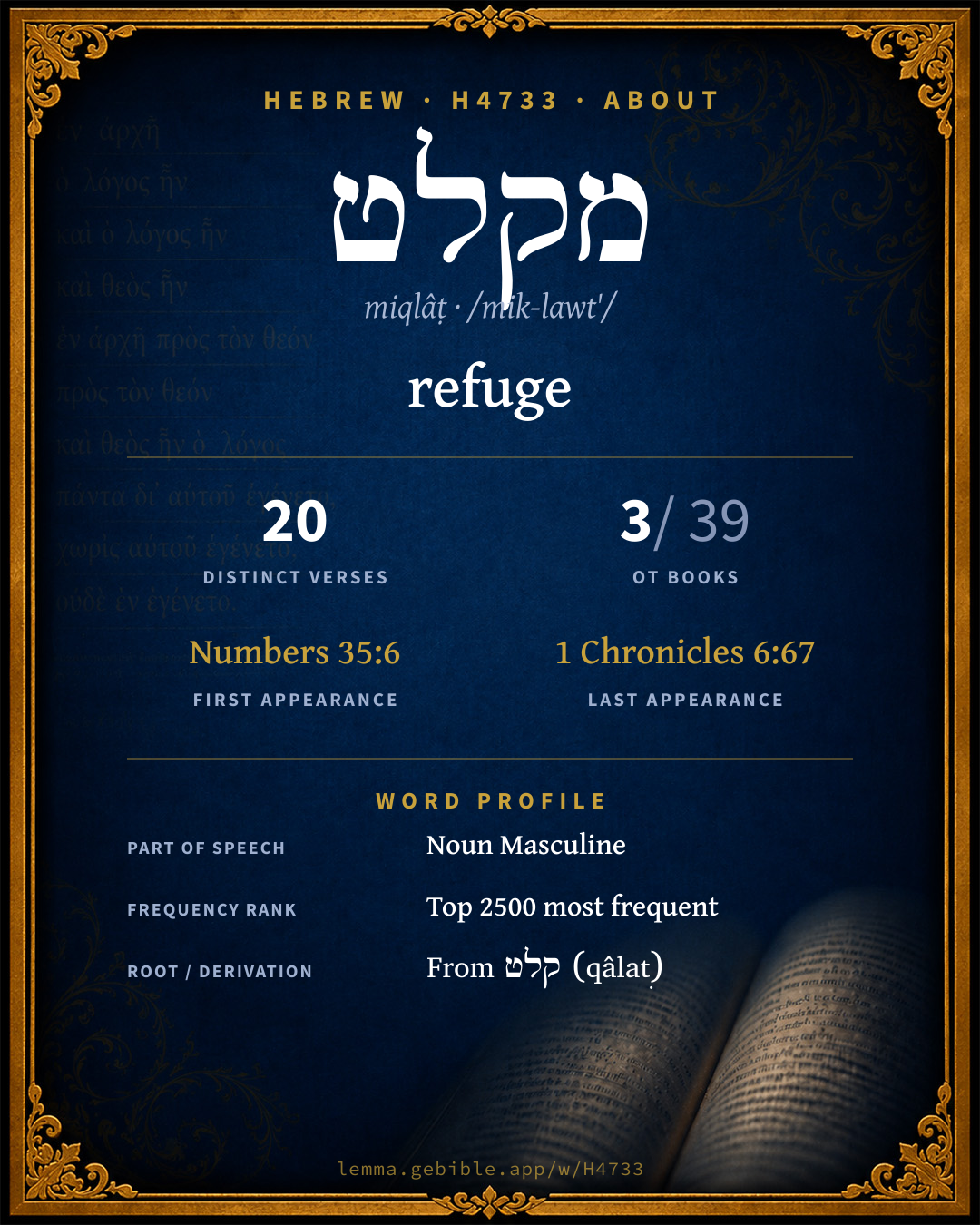
מִקְלָט
refuge
Full lexicon entry — Brown-Driver-Briggs (BDB)
From Brown-Driver-Briggs (BDB)
Where this word appears
See every Absolute-state word in the Hebrew Bible →
Grammar key — what these labels mean
Part of speech
- Noun
- A naming word — a person, place, thing, or idea.
Noun type
- Common
- A common noun — a general class of person, place, or thing (“king,” “city,” “water”), not a specific name.
State
- Construct
- A noun bound to a following noun in a possessive / “of” relationship (the construct chain).
- Absolute
- The independent form of a noun, not bound to a following word.
Gender
- Masculine
- Grammatically masculine.
Number
- Singular
- One.
Grammatical forms
- Noun, Common, Masculine, Singular, Construct 10 times (50%)
- Noun, Common, Masculine, Singular, Absolute 10 times (50%)
Parsed forms decoded from the imported morphology (morphhb / Westminster Leningrad Codex — WLC text public domain, morphhb tagging CC BY 4.0), counted across 20 parsed occurrences — not distinct verses.
Every verse where H4733 appears — 20 distinct verses across 3 books. Click any verse to open its interlinear word-by-word view. Verse text shown in the World English Bible for context — . Each verse’s Hebrew form is shown with its reference; the English is not keyword-highlighted, since the data carries no word-level English alignment. Use “Compare translations” on any verse to read it across multiple English versions. This concordance covers the Hebrew Bible; Septuagint (Greek Old Testament) occurrences are not indexed here.
Numbers 11 verses
- Numbers 35:6 הַ/מִּקְלָ֔ט ptcl def.art + n c ms The cities which you shall give to the Levites, they shall be the six cities of refuge, which you shall give for the manslayer to flee to: and besides them you shall give forty-two cities.
- Numbers 35:11 מִקְלָ֖ט n c ms then you shall appoint you cities to be cities of refuge for you, that the manslayer who kills any person unwittingly may flee there.
- Numbers 35:12 לְ/מִקְלָ֖ט prep + n c ms The cities shall be to you for refuge from the avenger, that the manslayer not die, until he stands before the congregation for judgment.
- Numbers 35:13 מִקְלָ֖ט n c ms The cities which you shall give shall be for you six cities of refuge.
- Numbers 35:14 מִקְלָ֖ט n c ms You shall give three cities beyond the Jordan, and three cities shall you give in the land of Canaan; they shall be cities of refuge.
- Numbers 35:15 לְ/מִקְלָ֑ט prep + n c ms For the children of Israel, and for the stranger and for the foreigner living among them, shall these six cities be for refuge; that everyone who kills any person unwittingly may flee there.
- Numbers 35:25 מִקְלָט֖/וֹ n c ms cs + sfx pers 3ms and the congregation shall deliver the manslayer out of the hand of the avenger of blood, and the congregation shall restore him to his city of refuge, where he was fled: and he shall dwell therein until the death of the high priest, who was anointed with the holy oil.
- Numbers 35:26 מִקְלָט֔/וֹ n c ms cs + sfx pers 3ms But if the manslayer shall at any time go beyond the border of his city of refuge, where he flees,
- Numbers 35:27 מִקְלָט֑/וֹ n c ms cs + sfx pers 3ms and the avenger of blood find him outside of the border of his city of refuge, and the avenger of blood kill the manslayer; he shall not be guilty of blood,
- Numbers 35:28 מִקְלָט/וֹ֙ n c ms cs + sfx pers 3ms because he should have remained in his city of refuge until the death of the high priest: but after the death of the high priest the manslayer shall return into the land of his possession.
- Numbers 35:32 מִקְלָט֑/וֹ n c ms cs + sfx pers 3ms You shall take no ransom for him who is fled to his city of refuge, that he may come again to dwell in the land, until the death of the priest.
Joshua 7 verses
- Joshua 20:2 הַ/מִּקְלָ֔ט ptcl def.art + n c ms Speak to the children of Israel, saying, Assign you the cities of refuge, of which I spoke to you by Moses,
- Joshua 20:3 לְ/מִקְלָ֔ט prep + n c ms that the manslayer who kills any person unwittingly [and] unawares may flee there: and they shall be to you for a refuge from the avenger of blood.
- Joshua 21:13 מִקְלַ֣ט n c ms cs To the children of Aaron the priest they gave Hebron with its suburbs, the city of refuge for the manslayer, and Libnah with its suburbs,
- Joshua 21:21 מִקְלַ֧ט n c ms cs They gave them Shechem with its suburbs in the hill-country of Ephraim, the city of refuge for the manslayer, and Gezer with its suburbs,
- Joshua 21:27 מִקְלַ֣ט n c ms cs To the children of Gershon, of the families of the Levites, out of the half-tribe of Manasseh [they gave] Golan in Bashan with its suburbs, the city of refuge for the manslayer, and Be-eshterah with its suburbs; two cities.
- Joshua 21:32 מִקְלַ֣ט n c ms cs Out of the tribe of Naphtali, Kedesh in Galilee with its suburbs, the city of refuge for the manslayer, and Hammothdor with its suburbs, and Kartan with its suburbs; three cities.
- Joshua 21:38 מִקְלַ֣ט n c ms cs Out of the tribe of Gad, Ramoth in Gilead with its suburbs, the city of refuge for the manslayer, and Mahanaim with its suburbs,
1 Chronicles 2 verses
- 1 Chronicles 6:57 הַ/מִּקְלָ֔ט ptcl def.art + n c ms To the sons of Aaron they gave the cities of refuge, Hebron; Libnah also with its suburbs, and Jattir, and Eshtemoa with its suburbs,
- 1 Chronicles 6:67 הַ/מִּקְלָ֛ט ptcl def.art + n c ms They gave to them the cities of refuge, Shechem in the hill-country of Ephraim with its suburbs; Gezer also with its suburbs,
About this entry
At a glance — auto-summarized from this page’s data, not written by a person. Every figure links to its source below. This summary describes the numbers; it doesn’t interpret them.
The Hebrew noun מקלט centers on the idea of “refuge.” Numbers dominates its distribution — 11 of 20 verses. Spanning 20 verses in 3 books, it ranks among the uncommon words of the Hebrew Bible. Its earliest occurrence is Numbers 35:6. Related forms include קלט and קליטא. For the data behind this summary, explore the sense tree and the renderings breakdown below.
Gloss history
Strong's 1890 vs modern scholarship
About this word
Strong's H4733 catalogs a Hebrew word from the Hebrew Old Testament.
These counts are not copied from any lexicon or concordance. They are computed here, from the morphology-tagged Hebrew Old Testament. What Lemma adds →
- 20
- distinct verses
- The word appears in 20 distinct verses.
- 3 / 39
- OT books
- The word appears in 3 of 39 Old Testament books.
- #1,513
- by frequency
- Top 2500 most frequent Hebrew words (rank 1,513 of 8,640 Hebrew words by occurrence).
View all 20 occurrences in the concordance →
Most concentrated in
- Numbers 11 verses 55%
- Joshua 7 verses 35%
- 1 Chronicles 2 verses 10%
By section of the Old Testament
By traditional corpus
Conventional, traditional groupings — biblical authorship is debated, so this is a traditional corpus grouping, not an authorship claim. Each share is this word’s portion of its verses in that division of the Hebrew canon. Each figure is a share of the word’s 20 distinct verses.
- Torah (Pentateuch) 11 verses · 55%
- Prophets (Nevi'im) 7 verses · 35%
- Writings (Ketuvim) 2 verses · 10%
How translations render this word
Counts come from each version’s own published word-to-Strong’s tagging or interlinear alignment — an approximate guide to how each version renders this word, not a word-level alignment the data otherwise carries. Because each total is that version’s own tagged count, the per-version totals vary from one another and need not match the appearance or distinct-verse counts above. These counts may also differ from a printed concordance because Lemma counts each distinctly tagged rendering and does not collapse phrase taggings into a single head-word total. This is a fixed set of word-tagged versions (KJV, ASV, BSB, ULT) and does not change with the reading translation you choose elsewhere. Each version’s license is shown beside its name below (and on Sources).
- King James Version: Refuge 16×
- American Standard Version: Refuge 17×
- Berean Standard Bible: Refuge 20×
- unfoldingWord Literal Text: Refuge 15×, Refuge of 5×
King James Version Public Domain
Renders H4733 across 20 tagged occurrences — most commonly:
Plus 4 renderings that appear only once — usually multi-word phrases or single function words the recovered tagging swept in, not distinct renderings.
American Standard Version Public Domain
Renders H4733 across 20 tagged occurrences — most commonly:
Plus 3 renderings that appear only once — usually multi-word phrases or single function words the recovered tagging swept in, not distinct renderings.
Berean Standard Bible Public Domain
Renders H4733 across 20 tagged occurrences — most commonly:
unfoldingWord Literal Text CC BY-SA 4.0
Renders H4733 across 20 tagged occurrences — most commonly:
Senses in BDB
The 1 sense BDB distinguishes for this word, in lexicon order (not ranked by frequency or importance). The full entry — with sub-senses — is in the Lexicon Entry tab.
- refuge, asylum
Word origin
n.[m.] refuge, asylum (P Ch);—עָרֵי מ׳ asylum-cities Nu 35:11, 13, 14, עָרֵי הַמּ׳ Nu 35:6; Jos 20:2, so 1 Ch 6:42, 52 (but read עִיר הַמּ׳, according to ‖ Jos 21:13, 21, so Be Kau Kit), לְמ׳ (after הָיָה) Nu 35:12, 15; Jos 20:3; cstr. in phr. עִיר מִקְלַט הָרֹצֵחַ Jos 21:13, 21, 27, 32, 38 (Gi; v 36 van d. H. Baer); sf. of refugee, עִיר מִקְלָטוֹ Nu 35:25, 26, 27, 28, 32.
— Brown-Driver-Briggs (Oxford 1906, public domain), digitized via Sefaria, supplemented by the OpenScriptures HebrewLexicon (CC BY 4.0). See Sources.
Derived from קלט (qâlaṭ) (H7038) — to be deformed.
Jastrow Dictionary
A second Hebrew/Aramaic lexicon for comparison, covering Aramaic and post-biblical (Talmudic, Targumic, Midrashic) usage that the biblical-Hebrew BDB does not. Matched by lemma rather than by Strong’s number, so a lemma may carry more than one Jastrow headword (shown separately below), and the entries cover usage well beyond the Bible.
מִקְלָט
- refuge, esp. for the unintentional man-slayer. Macc. II, 4. Ib. 6 אחד שוגג … מקדימין לערי מ׳ both the innocent and the willful slayers go temporarily to the place of refuge; Sifré Num. 160. Macc. II, 8 רוצח שגלה לעיר מִקְלָטוֹ a man-slayer who arrives at his place of refuge; a. fr.
A Dictionary of the Targumim, the Talmud Babli and Yerushalmi, and the Midrashic Literature (Marcus Jastrow; London, Luzac, 1903) — Public Domain. Digitized via Sefaria. Digitized via Sefaria. Full attribution on Sources.
Forms in the corpus
The 12 distinct written forms H4733 takes in the Hebrew Bible, most frequent first — each parse links to that state’s occurrences in the concordance. Hebrew forms include their vowel points and cantillation, so a single lemma takes many written forms.
| Form | Parsing | Example | Uses |
|---|---|---|---|
| מִקְלַ֣ט | Noun, Common, Masculine, Singular, Construct | Joshua 21:13 | 4 |
| הַ/מִּקְלָ֔ט | Noun, Common, Masculine, Singular, Absolute | 1 Chronicles 6:57 | 3 |
| מִקְלָ֖ט | Noun, Common, Masculine, Singular, Absolute | Numbers 35:11 | 3 |
| מִקְלָט֑/וֹ | Noun, Common, Masculine, Singular, Construct | Numbers 35:27 | 2 |
| הַ/מִּקְלָ֛ט | Noun, Common, Masculine, Singular, Absolute | 1 Chronicles 6:67 | 1 |
| לְ/מִקְלָ֑ט | Noun, Common, Masculine, Singular, Absolute | Numbers 35:15 | 1 |
| לְ/מִקְלָ֔ט | Noun, Common, Masculine, Singular, Absolute | Joshua 20:3 | 1 |
| לְ/מִקְלָ֖ט | Noun, Common, Masculine, Singular, Absolute | Numbers 35:12 | 1 |
| מִקְלַ֧ט | Noun, Common, Masculine, Singular, Construct | Joshua 21:21 | 1 |
| מִקְלָט/וֹ֙ | Noun, Common, Masculine, Singular, Construct | Numbers 35:28 | 1 |
| מִקְלָט֔/וֹ | Noun, Common, Masculine, Singular, Construct | Numbers 35:26 | 1 |
| מִקְלָט֖/וֹ | Noun, Common, Masculine, Singular, Construct | Numbers 35:25 | 1 |
Same root — word family
Other BDB entries built from the same root as H4733, grouped by Strong’s listed origin. These share a root / origin per the lexicon — not necessarily a shared meaning. Each links to that word’s own entry.
Derives from
Proper names from this root
People and places named from this root — a name, not an additional meaning of the word.
Compare all same-root words → 1 of the same-root words is a proper name (a person or place). They share a root, not necessarily a meaning.
Septuagint verse parallels
This word appears in 19 verses that also exist in the Greek Old Testament (Septuagint), out of the 20 Hebrew verses it occurs in. You can read those verses in Greek by switching the Old Testament edition to the Septuagint.
Read these verses in the Septuagint
This is a verse-level parallel only — the same verses exist in both the Hebrew and Greek Old Testaments. No word-level Hebrew↔Greek correspondence is claimed: the data carries no such alignment, so no Greek word is shown as this Hebrew word’s translation. Coverage is not total — the Septuagint omits the deuterocanon and renumbers the Psalms, so some Hebrew verses have no direct Greek parallel.