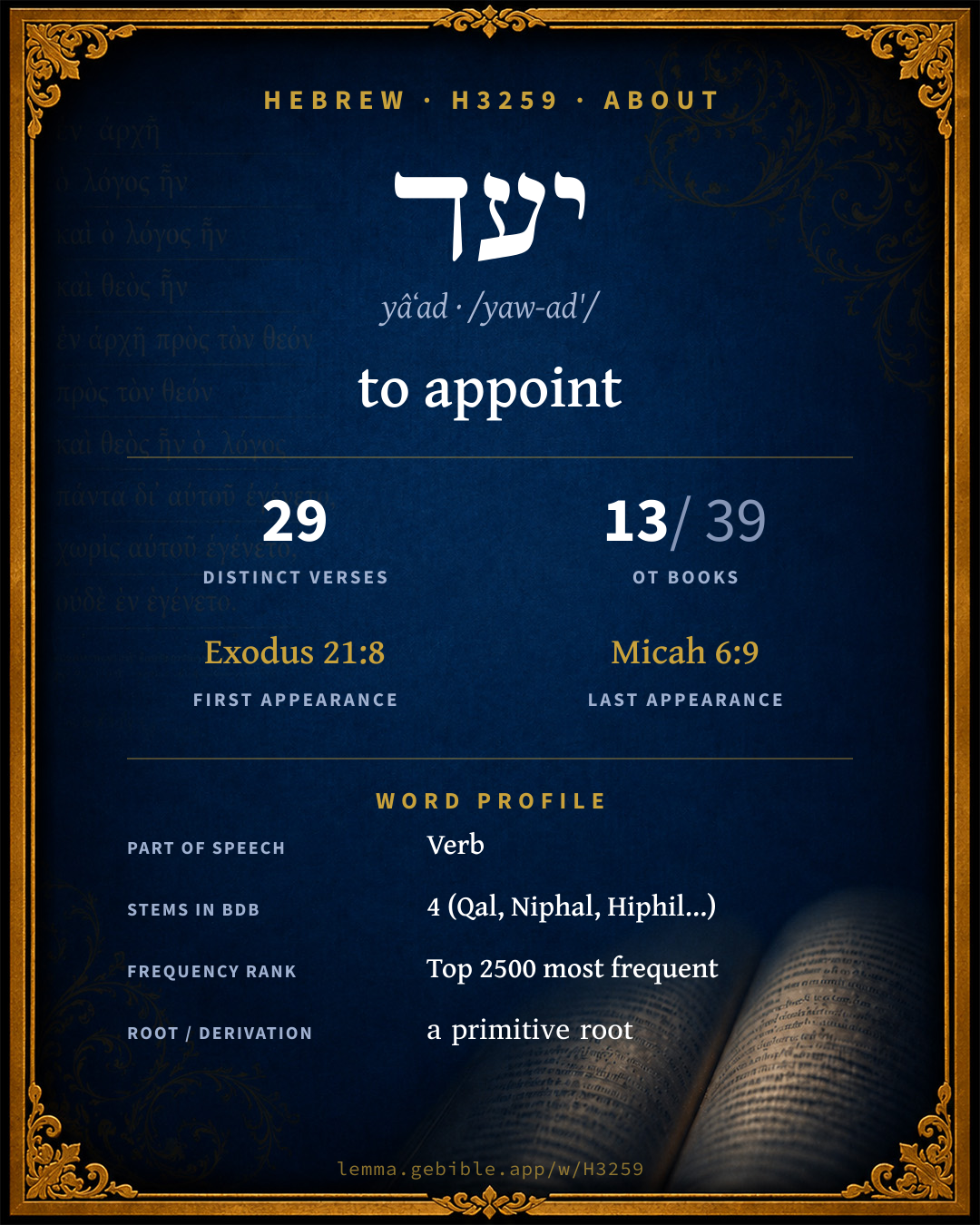
יָעַד
to appoint
‘to appoint’ is one of 4 main senses fuller range ↓
Full lexicon entry — Brown-Driver-Briggs (BDB)
From Brown-Driver-Briggs (BDB)
Where this word appears
See every Niphal verb in the Hebrew Bible →
Grammar key — what these labels mean
Part of speech
- Verb
- An action or state-of-being word.
Stem
- Niphal
- Usually the simple passive or reflexive of the Qal (“he was written”). Here: ‘reflexive’
- Hiphil
- The causative active stem (“he caused / brought about”).
- Qal
- The basic, simple active stem — the plain form of the verb (“he wrote”).
- Hophal
- The passive counterpart of the Hiphil (“he was caused to…”).
Form
- Participle Active
- A verbal adjective expressing ongoing or characteristic action (“writing / one who writes”).
- Imperfect
- An incomplete, ongoing, or future action (“he will / would write”).
- Perfect
- A completed action or state — Hebrew marks aspect (completeness) more than strict tense (“he wrote”).
- Sequential Perfect
- A perfect with prefixed waw continuing a preceding imperfect or command (waw-consecutive perfect).
- Sequential Imperfect
- An imperfect with prefixed waw — the standard past-narrative form (waw-consecutive imperfect).
- Cohortative
- A first-person volitional form expressing wish or resolve (“let me / let us write”).
- Participle Passive
- A verbal adjective expressing action received (“written”).
State
- Absolute
- The independent form of a noun, not bound to a following word.
Person
- 1st Person
- The speaker (“I / we”).
- 3rd Person
- The one spoken about (“he / she / it / they”).
Gender
- Masculine
- Grammatically masculine.
- Common
- Either gender — not distinguished for this form.
- Feminine
- Grammatically feminine.
Number
- Plural
- More than one (in Hebrew, generally three or more).
- Singular
- One.
Grammatical forms 13 distinct
- Verb, Niphal, Participle Active, Masculine, Plural, Absolute 5 times (17%)
- Verb, Niphal, Imperfect, 1st Person, Common, Singular 4 times (14%)
- Verb, Qal, Perfect, 3rd Person, Masculine, Singular 4 times (14%)
- Verb, Hiphil, Imperfect, 3rd Person, Masculine, Singular 3 times (10%)
- Verb, Niphal, Sequential Perfect, 1st Person, Common, Singular 2 times (7%)
- Verb, Niphal, Sequential Perfect, 3rd Person, Common, Plural 2 times (7%)
- Verb, Niphal, Sequential Imperfect, 3rd Person, Masculine, Plural 2 times (7%)
- Verb, Niphal, Perfect, 3rd Person, Common, Plural 2 times (7%)
+5 more forms (5 occurrences)
Parsed forms decoded from the imported morphology (morphhb / Westminster Leningrad Codex — WLC text public domain, morphhb tagging CC BY 4.0), counted across 29 parsed occurrences — not distinct verses.
Every verse where H3259 appears — 29 distinct verses across 13 books. Click any verse to open its interlinear word-by-word view. Verse text shown in the World English Bible for context — . Each verse’s Hebrew form is shown with its reference; the English is not keyword-highlighted, since the data carries no word-level English alignment. Use “Compare translations” on any verse to read it across multiple English versions. This concordance covers the Hebrew Bible; Septuagint (Greek Old Testament) occurrences are not indexed here.
Exodus 7 verses
- Exodus 21:8 יְעָדָ֖/הּ Qal pf 3ms + sfx pers 3fs If she doesn't please her master, who has married her to himself, then he shall let her be redeemed. He shall have no right to sell her to a foreign people, seeing he has dealt deceitfully with her.
- Exodus 21:9 יִֽיעָדֶ֑/נָּה Qal impf 3ms + sfx pers 3fs If he marries her to his son, he shall deal with her after the manner of daughters.
- Exodus 25:22 וְ/נוֹעַדְתִּ֣י conj + Niphal wpf 1cs There I will meet with you, and I will tell you from above the mercy seat, from between the two cherubim which are on the ark of the testimony, all that I command you for the children of Israel.
- Exodus 29:42 אִוָּעֵ֤ד Niphal impf 1cs It shall be a continual burnt offering throughout your generations at the door of the tent of meeting before Yahweh, where I will meet with you, to speak there to you.
- Exodus 29:43 וְ/נֹעַדְתִּ֥י conj + Niphal wpf 1cs There I will meet with the children of Israel; and the place shall be sanctified by my glory.
- Exodus 30:6 אִוָּעֵ֥ד Niphal impf 1cs You shall put it before the veil that is by the ark of the testimony, before the mercy seat that is over the testimony, where I will meet with you.
- Exodus 30:36 אִוָּעֵ֥ד Niphal impf 1cs and you shall beat some of it very small, and put some of it before the testimony in the tent of meeting, where I will meet with you. It shall be to you most holy.
Numbers 6 verses
- Numbers 10:3 וְ/נֽוֹעֲד֤וּ conj + Niphal wpf 3cp When they shall blow them, all the congregation shall gather themselves to you at the door of the tent of meeting.
- Numbers 10:4 וְ/נוֹעֲד֤וּ conj + Niphal wpf 3cp If they blow but one, then the princes, the heads of the thousands of Israel, shall gather themselves to you.
- Numbers 14:35 הַ/נּוֹעָדִ֖ים ptcl def.art + Niphal ptcp.act mp I, Yahweh, have spoken, surely this will I do to all this evil congregation, who are gathered together against me: in this wilderness they shall be consumed, and there they shall die.
- Numbers 16:11 הַ/נֹּעָדִ֖ים ptcl def.art + Niphal ptcp.act mp Therefore you and all your company are gathered together against Yahweh: and Aaron, what is he who you murmur against him?
- Numbers 17:4 אִוָּעֵ֥ד Niphal impf 1cs You shall lay them up in the tent of meeting before the testimony, where I meet with you.
- Numbers 27:3 הַ/נּוֹעָדִ֛ים ptcl def.art + Niphal ptcp.act mp Our father died in the wilderness, and he was not among the company of those who gathered themselves together against Yahweh in the company of Korah: but he died in his own sin; and he had no sons.
Joshua 1 verse
2 Samuel 1 verse
1 Kings 1 verse
2 Chronicles 1 verse
Nehemiah 2 verses
- Nehemiah 6:2 וְ/נִֽוָּעֲדָ֥ה conj + Niphal coh 1cp that Sanballat and Geshem sent to me, saying, Come, let us meet together in [one of] the villages in the plain of Ono. But they thought to do me mischief.
- Nehemiah 6:10 נִוָּעֵד֩ Niphal impf 1cp I went to the house of Shemaiah the son of Delaiah the son of Mehetabel, who was shut up; and he said, Let us meet together in the house of God, within the temple, and let us shut the doors of the temple: for they will come to kill you; yes, in the night will they come to kill you.
Job 2 verses
- Job 2:11 וַ/יִּוָּעֲד֣וּ conj + Niphal wimpf 3mp Now when Job's three friends heard of all this evil that had come on him, they each came from his own place: Eliphaz the Temanite, Bildad the Shuhite, and Zophar the Naamathite, and they made an appointment together to come to sympathize with him and to comfort him.
- Job 9:19 יוֹעִידֵֽ/נִי Hiphil impf 3ms + sfx pers 1cs If it is a matter of strength, behold, he is mighty! If of justice, 'Who,' says he, 'will summon me?'
Psalms 1 verse
Jeremiah 4 verses
- Jeremiah 24:1 מוּעָדִ֕ים Hophal ptcp.pass mp Yahweh shown me, and, behold, two baskets of figs set before the temple of Yahweh, after that Nebuchadrezzar king of Babylon had carried away captive Jeconiah the son of Jehoiakim, king of Judah, and the princes of Judah, with the craftsmen and smiths, from Jerusalem, and had brought them to Babylon.
- Jeremiah 47:7 יְעָדָֽ/הּ Qal pf 3ms + sfx pers 3fs How can you be quiet, seeing Yahweh has given you a charge? Against Ashkelon, and against the sea-shore, there has he appointed it.
- Jeremiah 49:19 יֹעִידֶ֔/נִּי Hiphil impf 3ms + sfx pers 1cs Behold, he shall come up like a lion from the pride of the Jordan against the strong habitation: for I will suddenly make them run away from it; and whoever is chosen, him will I appoint over it: for who is like me? and who will appoint me a time? and who is the shepherd who will stand before me?
- Jeremiah 50:44 יוֹעִדֶ֔/נִּי Hiphil impf 3ms + sfx pers 1cs Behold, [the enemy] shall come up like a lion from the pride of the Jordan against the strong habitation: for I will suddenly make them run away from it; and whoever is chosen, him will I appoint over it: for who is like me? and who will appoint me a time? and who is the shepherd who can stand before me?
Ezekiel 1 verse
Amos 1 verse
Micah 1 verse
About this entry
At a glance — auto-summarized from this page’s data, not written by a person. Every figure links to its source below. This summary describes the numbers; it doesn’t interpret them.
At its core, יעד (yâʻad) means “to appoint.” Read the stem: it spans 4 stems, including Qal and Niphal. It appears 29 verses across 13 books of the Hebrew Bible, among its moderately common vocabulary. First canonically at Exodus 21:8, it enters the text early. It shares a root with מועד, מועד and מועדה. Dig into 29-verse concordance and the renderings breakdown below.
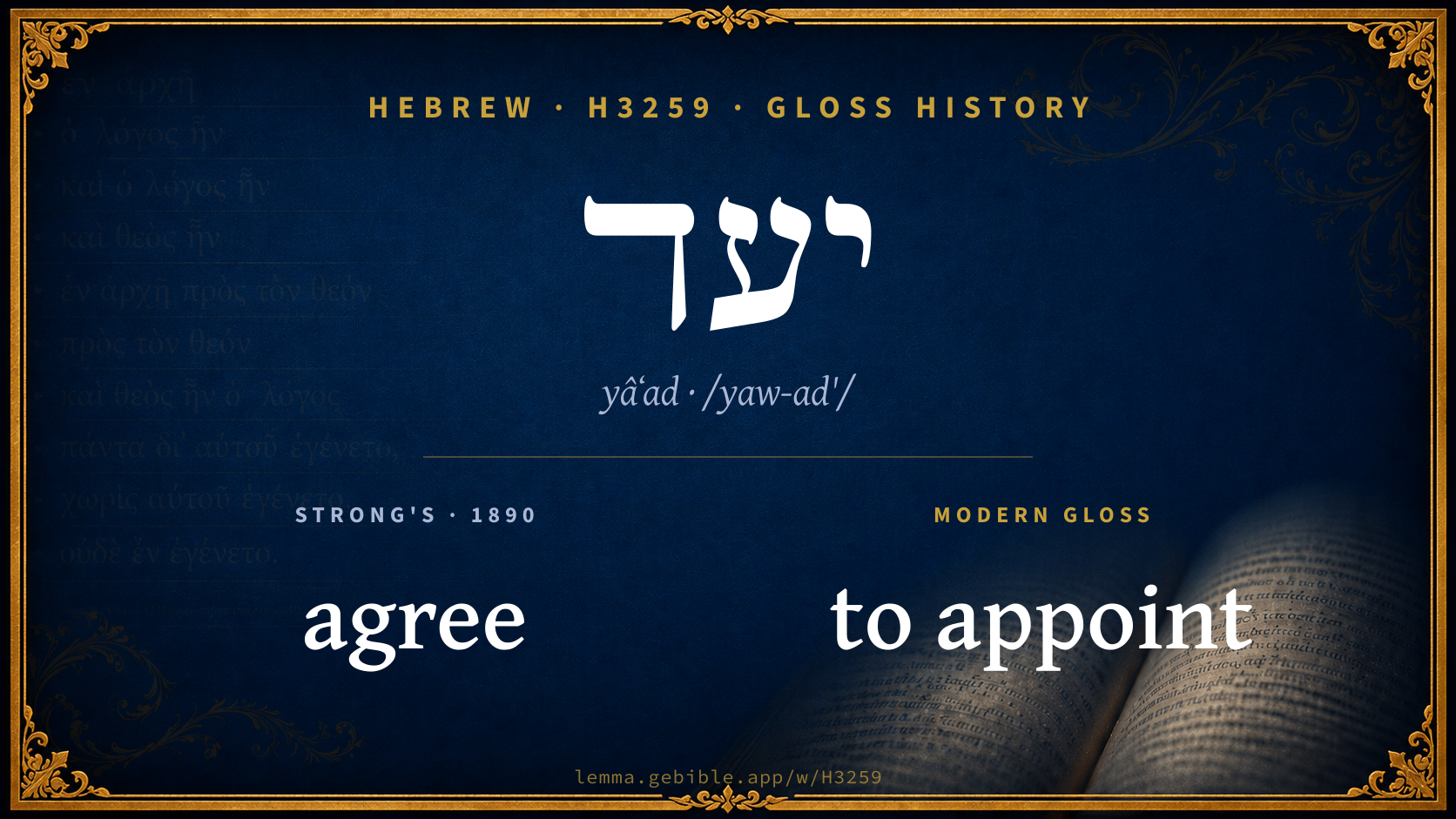
Gloss history
Strong's 1890 vs modern scholarship
About this word
Strong's H3259 catalogs a Hebrew word from the Hebrew Old Testament.
These counts are not copied from any lexicon or concordance. They are computed here, from the morphology-tagged Hebrew Old Testament. What Lemma adds →
- 29
- distinct verses
- The word appears in 29 distinct verses.
- 13 / 39
- OT books
- The word appears in 13 of 39 Old Testament books.
- #1,160
- by frequency
- Top 2500 most frequent Hebrew words (rank 1,160 of 8,640 Hebrew words by occurrence).
View all 29 occurrences in the concordance →
By section of the Old Testament
By traditional corpus
Conventional, traditional groupings — biblical authorship is debated, so this is a traditional corpus grouping, not an authorship claim. Each share is this word’s portion of its verses in that division of the Hebrew canon. Each figure is a share of the word’s 29 distinct verses.
- Torah (Pentateuch) 13 verses · 45%
- Prophets (Nevi'im) 10 verses · 34%
- Writings (Ketuvim) 6 verses · 21%
How translations render this word
Counts come from each version’s own published word-to-Strong’s tagging or interlinear alignment — an approximate guide to how each version renders this word, not a word-level alignment the data otherwise carries. Because each total is that version’s own tagged count, the per-version totals vary from one another and need not match the appearance or distinct-verse counts above. These counts may also differ from a printed concordance because Lemma counts each distinctly tagged rendering and does not collapse phrase taggings into a single head-word total. This is a fixed set of word-tagged versions (KJV, ASV, BSB, ULT) and does not change with the reading translation you choose elsewhere. Each version’s license is shown beside its name below (and on Sources).
- King James Version: I will meet 6×, Were assembled 3×, Are gathered together 2×
- American Standard Version: I will meet 4×, Are gathered together 2×, Over it 2×
- Berean Standard Bible: I will meet 4×, Can challenge me 2×, Had assembled 2×
- unfoldingWord Literal Text: I will meet 4×, And 2×, Let us appoint a time to meet 2×
King James Version Public Domain
Renders H3259 across 29 tagged occurrences — most commonly:
Plus 16 renderings that appear only once — usually multi-word phrases or single function words the recovered tagging swept in, not distinct renderings.
American Standard Version Public Domain
Renders H3259 across 30 tagged occurrences — most commonly:
Plus 20 renderings that appear only once — usually multi-word phrases or single function words the recovered tagging swept in, not distinct renderings.
Berean Standard Bible Public Domain
Renders H3259 across 29 tagged occurrences — most commonly:
Plus 19 renderings that appear only once — usually multi-word phrases or single function words the recovered tagging swept in, not distinct renderings.
unfoldingWord Literal Text CC BY-SA 4.0
Renders H3259 across 29 tagged occurrences — most commonly:
Plus 19 renderings that appear only once — usually multi-word phrases or single function words the recovered tagging swept in, not distinct renderings.
7 senses and sub-senses in the full BDB
Hebrew verbs can shift meaning by stem (binyan): Qal is the basic action, Niphal is often passive or reflexive, Piel often intensifies or makes it factitive, and Hiphil is typically causative. The senses below are grouped under the stem BDB assigns to each. This entry also uses Hophal (the passive of Hiphil).
What do BDB’s symbols mean?
BDB uses these scholarly abbreviations:
| Symbol | Meaning |
|---|---|
| 𝔊 | the Septuagint (the ancient Greek translation, LXX) |
| 𝔙 | the Vulgate (the Latin translation) |
| 𝔖 | the Syriac version (the Peshitta) |
| 𝔗 | the Targum (the Aramaic translation) |
| ψ | the Psalms |
| √ | root (the underlying root or stem) |
| ‖ | parallel passage (a synonymous or contrasted parallel) |
| † | the dagger: every passage where the word occurs is cited |
The 7 senses and sub-senses the full Brown-Driver-Briggs lexicon distinguishes for this word, in lexicon order (not ranked by frequency), with BDB’s own verbatim wording and sub-sense lettering. Shown in Hebrew script with BDB’s own scholarly abbreviations. The condensed entry is in the Lexicon Entry tab. See also the Forms in the corpus table below.
Qal
- Pf. sf. יְעָדוֹ 2 S 20:5; יְעָרָהּ Ex 21:8 + 2 times; Impf. 3 m. sf. יִיעָדֶנָּה Ex 21:9;—appoint, a time 2 S 20:5; place Je 47:7; a rod Mi 6:9; assign or designate as concubine Ex 21:8, 9 (JE). e.g. 2 Samuel 20:5
Niphal
- Pf. נוֹעַדְתִּי Ex 25:22; נֹעַדְתִּי Ex 29:43; pl. נוֹעֲדוּ ψ 48:5; Nu 10:3, 4; נוֹעָ֑דוּ Am 3:3; Impf. אִוָּעֵד Ex 29:42 + 3 times; 3 pl. וַיִּוָּעֲדוּ Jos 11:5; Jb 2:11; 1 pl. נִוָּעֵד Ne 6:10; וְנִוָּעֲדָה v 2; Pt. pl. נוֹעָדִים Nu 14:35 + 3 times; נֹעָדִים 16:11;— e.g. Exodus 25:22
- 1. reflexive, meet at an appointed place, with לְ, of Yahweh meeting Moses at the Tent of ‘Meeting’ Ex 29:42, 43; 30:36 (P); at the throne of the Kapporeth 25:22; 30:6; Nu 17:19 (P). e.g. Exodus 29:42
- 2. meet by appointment Am 3:3 Jb 2:11; with בְּ of place Ne 6:2; אֶל of place v 10. e.g. Amos 3:3
- 3. gather, assemble by appointment, kings for a campaign (abs.) Jos 11:5 (D), ψ 48:5; with אֶל, unto Moses Nu 10:4 (P); to the door of the tent of meeting v 3 (P); with עַל, unto Solomon 1 K 8:5 = 2 Ch 5:6; against Yahweh Nu 14:35; 16:11; 27:3 (P). Poʿēl; Pf. 1 s. יוֹעַדְתִּי (for MT יוֹדַעְתִּי) 1 S 21:3 sq. acc. pers. + אֶל of place, according to 𝔊 We Dr Kit Bu. e.g. Joshua 11:5
Hiphil
- Impf. מִי יוֹעִדֶנִּי Je 50:44 = מִי יֹעִידֶנִּי 49:19 = מִי יוֹעִידֵנִי Jb 9:19 who will make me meet him at the appointed place (of judgment)? i.e. who will summon or arraign me? e.g. Jeremiah 50:44
Hophal
- Pt. מוּעָדִים לִפְנֵי Je 24:1 be set, placed before; אָנָה פָנַיִךְ מֻעָדוֹת Ez 21:21 whither thy face is set. e.g. Jeremiah 24:1
Senses from the full Brown-Driver-Briggs lexicon (Brown, Driver, Briggs; Oxford 1906 — public domain), digitized via Sefaria, supplemented by the OpenScriptures HebrewLexicon (CC BY 4.0). Full attribution on Sources.
Word origin
vb. appoint (NH id., appoint, assign, especially of acquiring or designating as wife; Aramaic id.; Arabic وَعَدَ promise, threaten, predict, iii. appoint a time or place; perhaps Assyrian ādu, decide, M-A17 DlHWB 230; Ph. n.pr. אשמניעד)—
— Brown-Driver-Briggs (Oxford 1906, public domain), digitized via Sefaria, supplemented by the OpenScriptures HebrewLexicon (CC BY 4.0). See Sources.
Origin: a primitive root
Jastrow Dictionary
A second Hebrew/Aramaic lexicon for comparison, covering Aramaic and post-biblical (Talmudic, Targumic, Midrashic) usage that the biblical-Hebrew BDB does not. Matched by lemma rather than by Strong’s number, so a lemma may carry more than one Jastrow headword (shown separately below), and the entries cover usage well beyond the Bible.
יָעַד
- v. עוד) to appoint; denom. מוֹעֵד.
- to designate, esp. to designate a Hebrew handmaid to be a freeman’s wife (Ex. XXI, 8, sq.). Kidd. 19ᵃ צריך ליַעֲדָהּ he must express to her her designation, i.e. בקדושי יעוד by betrothal through designation, v. יִעוּד. Ib. מהו שמְיַיעֵד אדם וכ׳ may a man designate (a handmaid) for his minor son? Ib.ᵇ אם רצה לייעד מייעד if he chooses to betroth her, he may do so. Mekh. Mishp. s. 3 לבנו יְיַעֵד וכ׳ he may give her to his son, but not to his brother. Ib. יַעֵד לך או לבנך וכ׳ betroth her to thyself or to thy son or redeem her; a. fr.—Part. pass. f. מְיוּעֶדֶת designated, betrothed. Y. Kidd. I, 59ᵇ bot. he tells her in the presence of witnesses הרי את מי׳ לי thou art designated for me (as my wife). Bab. Kidd. 6ᵃ מי׳ לי מהו if one says to a free woman, Thou art &c. (using מיועדת for מקודשת), is it a valid betrothal? e.g. Exodus 21:8
- to make an appointment, to meet. Lam. R. to II, 13, a. e., v. וִיעוּד.
- to appoint; part. pass. מוּעָד designated, invited. Ex. R. s. 19 מ׳ לדיבור appointed to receive the revelation; ib. מוּעָדִין לדבור (Yeb. 62ᵃ מיוחד, v. יָחַד; Ab. d’R. N. ch. II מזומן).—[V. מוּעָד forewarned.]
- , Nithpa. הִתְוַעֵד to be appointed, engaged; to meet. Num. R. s. 14, end שלא נִתְוַועֲדוּ בדבור עם משה who were not invited with Moses for the reception of the revealed word. Ib. עתיד אני להִתְוַועֵד להם I shall meet them (appear to them); Sifra Vayikra Par. I, ch. II להיות ועד (corr. acc.); Yalk. Lev. 430 להתוו׳ בהם (corr. acc.).
יְעַד
- Pa. יַעֵד
- 1. as preced. Pi., to designate. Kidd. 18ᵇ הא יַעוּדֵי מְיַיעֵד לה but betroth her he may?
- 2. (v. עוּד, מוּעָד)to forewarn the owner of a noxious beast. B. Kam. 84ᵇ ויַעֲדוּהָ and declared the beast noxious. Ib. 24ᵃ שלשה … ליַיעוּדִי תורא וכ׳ the three days mentioned—are they required for declaring the ox noxious (making the owner responsible, if the ox gored three days in succession) or for warning the owner (i.e. that the owner must have three notices in three consecutive days)?; ib. 41ᵃ; a. e.
- to be forewarned, to be declared noxious (מוּעָד). Ib. 84ᵇ דא׳ התם וכ׳ he was declared noxious there (in Palestine) and was brought to Babylonia. Ib. 24ᵃ מִיָּיעֵד he stands forewarned. Ib. 37ᵇ לשוורים הוא דא׳ he stands forewarned with reference to damage done to oxen only; א׳ ליה לכולהו מיני he stands forewarned with reference to all kinds (oxen, asses and camels); a. e.
A Dictionary of the Targumim, the Talmud Babli and Yerushalmi, and the Midrashic Literature (Marcus Jastrow; London, Luzac, 1903) — Public Domain. Digitized via Sefaria. Digitized via Sefaria. Full attribution on Sources.
Forms in the corpus
The 26 distinct written forms H3259 takes in the Hebrew Bible, most frequent first — each parse links to that stem’s occurrences in the concordance. Hebrew forms include their vowel points and cantillation, so a single lemma takes many written forms.
Same root — word family
Other BDB entries built from the same root as H3259, grouped by Strong’s listed origin. These share a root / origin per the lexicon — not necessarily a shared meaning. Each links to that word’s own entry.
Derived from this word
- מועד môwʻêd H4150 appointed time
- מועד môwʻâd H4151 appointed place
- מועדה mûwʻâdâh H4152 cities of refuge
Proper names from this root
People and places named from this root — a name, not an additional meaning of the word.
Compare all same-root words → Showing 4 of 7 — not the complete family. 3 of the same-root words are proper names (people or places). They share a root, not necessarily a meaning.
Septuagint verse parallels
This word appears in 26 verses that also exist in the Greek Old Testament (Septuagint), out of the 29 Hebrew verses it occurs in. You can read those verses in Greek by switching the Old Testament edition to the Septuagint.
Read these verses in the Septuagint
- Exodus 21:8
- Numbers 10:3
- Joshua 11:5
- 2 Samuel 20:5
- 1 Kings 8:5
- 2 Chronicles 5:6
- Job 2:11
- Psalms 48:4
- Jeremiah 24:1
- Ezekiel 21:16
- Amos 3:3
- Micah 6:9
This is a verse-level parallel only — the same verses exist in both the Hebrew and Greek Old Testaments. No word-level Hebrew↔Greek correspondence is claimed: the data carries no such alignment, so no Greek word is shown as this Hebrew word’s translation. Coverage is not total — the Septuagint omits the deuterocanon and renumbers the Psalms, so some Hebrew verses have no direct Greek parallel.