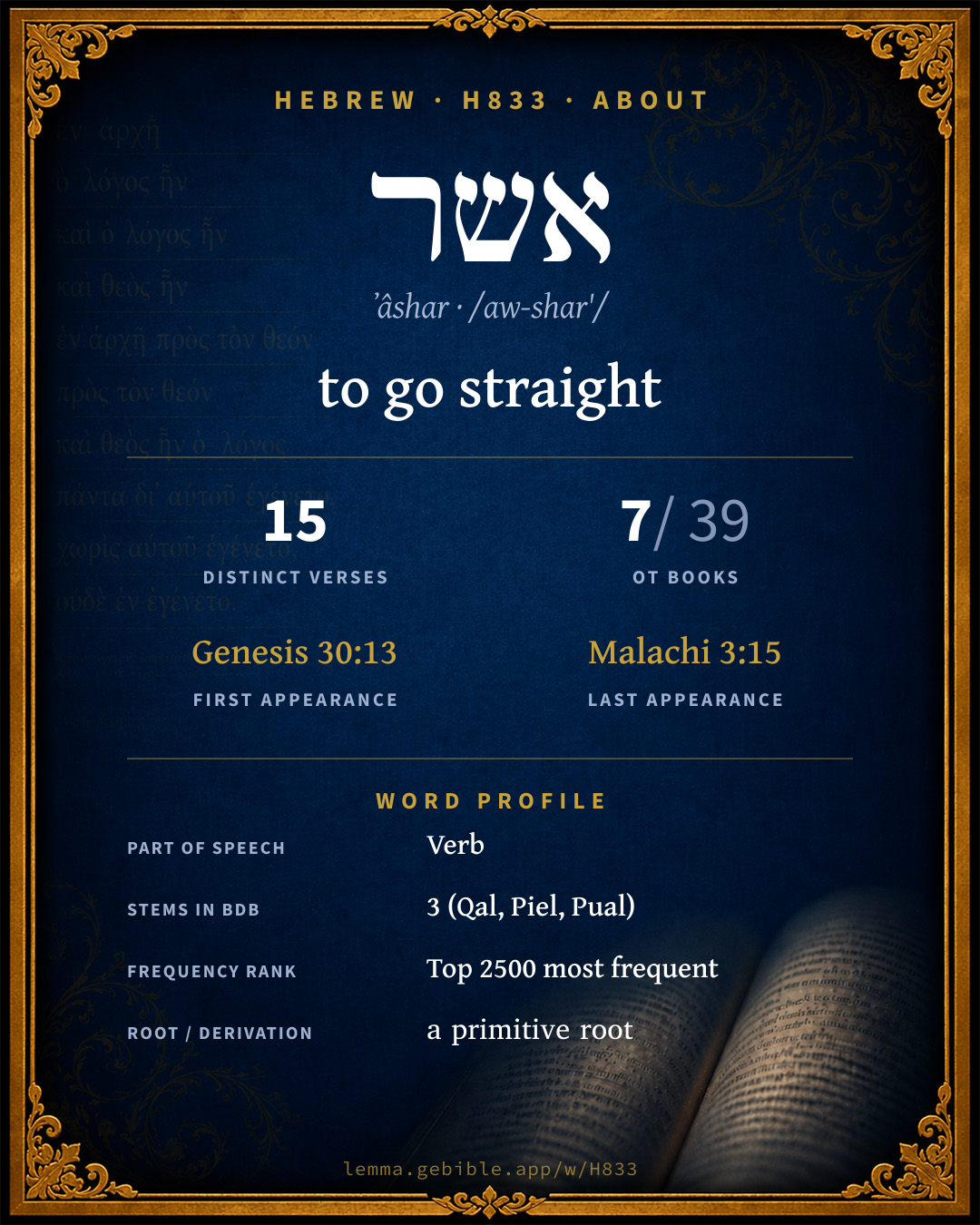
אָשַׁר
to go straight
also: walk, go on, advance, make progress fuller range ↓
Full lexicon entry — Brown-Driver-Briggs (BDB)
From Brown-Driver-Briggs (BDB)
Where this word appears
See every Piel verb in the Hebrew Bible →
Grammar key — what these labels mean
Part of speech
- Particle
- A short function word — article, negation, interrogative, the sign of the direct object, and the like.
- Verb
- An action or state-of-being word.
Stem
- Piel
- An intensive or resultative active stem. Here: ‘intensive go straight on’
- Pual
- The passive counterpart of the Piel. Here: ‘be led on’
- Qal
- The basic, simple active stem — the plain form of the verb (“he wrote”). Here: ‘go straight on in the way of understanding’
Form
- Sequential Imperfect
- An imperfect with prefixed waw — the standard past-narrative form (waw-consecutive imperfect).
- Sequential Perfect
- A perfect with prefixed waw continuing a preceding imperfect or command (waw-consecutive perfect).
- Participle Passive
- A verbal adjective expressing action received (“written”).
- Imperative
- A direct command (“write!”).
- Imperfect
- An incomplete, ongoing, or future action (“he will / would write”).
- Jussive
- A third- or second-person volitional form expressing wish or command (“let him write”).
- Perfect
- A completed action or state — Hebrew marks aspect (completeness) more than strict tense (“he wrote”).
- Participle Active
- A verbal adjective expressing ongoing or characteristic action (“writing / one who writes”).
State
- Construct
- A noun bound to a following noun in a possessive / “of” relationship (the construct chain).
- Absolute
- The independent form of a noun, not bound to a following word.
Person
- 3rd Person
- The one spoken about (“he / she / it / they”).
- 2nd Person
- The one addressed (“you”).
Gender
- Masculine
- Grammatically masculine.
- Common
- Either gender — not distinguished for this form.
- Feminine
- Grammatically feminine.
Number
- Plural
- More than one (in Hebrew, generally three or more).
- Singular
- One.
Grammatical forms 15 distinct
- Verb, Piel, Sequential Imperfect, 3rd Person, Masculine, Plural 2 times (12%)
- Verb, Piel, Participle Active, Masculine, Plural, Construct 2 times (12%)
- Verb, Pual, Sequential Perfect, 3rd Person, Masculine, Singular 1 time (6%)
- Verb, Pual, Participle Passive, Masculine, Plural, Construct 1 time (6%)
- Verb, Piel, Sequential Perfect, 3rd Person, Common, Plural 1 time (6%)
- Verb, Piel, Imperative, 2nd Person, Masculine, Singular 1 time (6%)
- Verb, Piel, Sequential Imperfect, 3rd Person, Feminine, Singular 1 time (6%)
- Verb, Qal, Imperative, 2nd Person, Masculine, Plural 1 time (6%)
+7 more forms (7 occurrences)
Parsed forms decoded from the imported morphology (morphhb / Westminster Leningrad Codex — WLC text public domain, morphhb tagging CC BY 4.0), counted across 17 parsed occurrences — not distinct verses.
Every verse where H833 appears — 15 distinct verses across 7 books. Click any verse to open its interlinear word-by-word view. Verse text shown in the World English Bible for context — . Each verse’s Hebrew form is shown with its reference; the English is not keyword-highlighted, since the data carries no word-level English alignment. Use “Compare translations” on any verse to read it across multiple English versions. This concordance covers the Hebrew Bible; Septuagint (Greek Old Testament) occurrences are not indexed here.
Genesis 1 verse
Job 1 verse
Psalms 2 verses
- Psalms 41:2 יאשר וְ/אֻשַּׁ֣ר ptcl inter conj + Pual wpf 3ms Yahweh will preserve him, and keep him alive, He shall be blessed on the earth, And he will not surrender him to the will of his enemies.
- Psalms 72:17 יְאַשְּׁרֽוּ/הוּ Piel impf 3mp + sfx pers 3ms His name endures forever. His name continues as long as the sun. Men shall be blessed by him. All nations will call him blessed.
Proverbs 5 verses
- Proverbs 3:18 מְאֻשָּֽׁר Pual ptcp.pass ms She is a tree of life to those who lay hold of her. Happy is everyone who retains her.
- Proverbs 4:14 תְּ֝אַשֵּׁ֗ר Piel juss 2ms Don't enter into the path of the wicked. Don't walk in the way of evil men.
- Proverbs 9:6 וְ֝/אִשְׁר֗וּ conj + Qal impv 2mp Leave your simple ways, and live. Walk in the way of understanding."
- Proverbs 23:19 וְ/אַשֵּׁ֖ר conj + Piel impv 2ms Listen, my son, and be wise, And keep your heart on the right path!
- Proverbs 31:28 וַֽ/יְאַשְּׁר֑וּ/הָ conj + Piel wimpf 3mp + sfx pers 3fs Her children rise up and call her blessed. Her husband also praises her:
Song of Solomon 1 verse
Isaiah 3 verses
- Isaiah 1:17 אַשְּׁר֣וּ Piel impv 2mp Learn to do well. Seek justice, Relieve the oppressed, Judge the fatherless, Plead for the widow."
- Isaiah 3:12 מְאַשְּׁרֶ֣י/ךָ Piel ptcp.act mp cs + sfx pers 2ms As for my people, children are their oppressors, And women rule over them. My people, those who lead you cause you to err, And destroy the way of your paths.
- Isaiah 9:16 מְאַשְּׁרֵ֥י וּ/מְאֻשָּׁרָ֖י/ו Piel ptcp.act mp cs conj + Pual ptcp.pass mp cs + sfx pers 3ms For those who lead this people cause them to err; and those who are led of them are destroyed.
Malachi 2 verses
About this entry
At a glance — auto-summarized from this page’s data, not written by a person. Every figure links to its source below. This summary describes the numbers; it doesn’t interpret them.
“to go straight” is the headline sense of the Hebrew verb אשר (ʼâshar). First canonically at Genesis 30:13, it enters the text early. It appears 15 verses across 7 books of the Hebrew Bible, among its uncommon vocabulary. More than a third of its appearances fall in Proverbs. Different stems carry different senses — BDB groups them under 3 stems, among them Qal and Piel. See the sense tree, 15-verse concordance, and the renderings breakdown below.
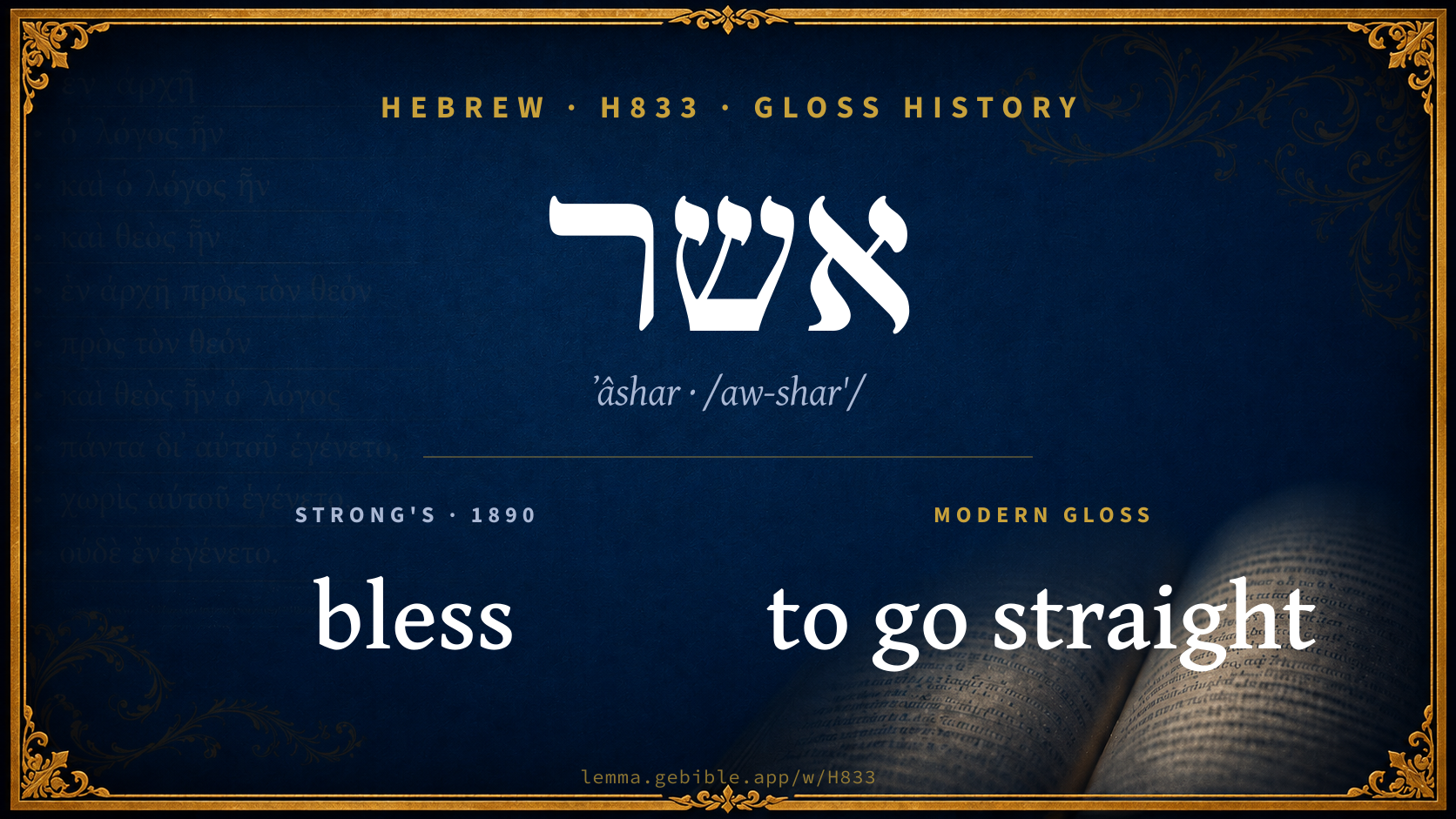
Gloss history
Strong's 1890 vs modern scholarship
About this word
Strong's H833 catalogs a Hebrew word from the Hebrew Old Testament.
These counts are not copied from any lexicon or concordance. They are computed here, from the morphology-tagged Hebrew Old Testament. What Lemma adds →
- 15
- distinct verses
- The word appears in 15 distinct verses.
- 7 / 39
- OT books
- The word appears in 7 of 39 Old Testament books.
- #1,671
- by frequency
- Top 2500 most frequent Hebrew words (rank 1,671 of 8,640 Hebrew words by occurrence).
View all 15 occurrences in the concordance →
By section of the Old Testament
By traditional corpus
Conventional, traditional groupings — biblical authorship is debated, so this is a traditional corpus grouping, not an authorship claim. Each share is this word’s portion of its verses in that division of the Hebrew canon. Each figure is a share of the word’s 15 distinct verses.
- Writings (Ketuvim) 9 verses · 60%
- Prophets (Nevi'im) 5 verses · 33%
- Torah (Pentateuch) 1 verse · 7%
How translations render this word
Counts come from each version’s own published word-to-Strong’s tagging or interlinear alignment — an approximate guide to how each version renders this word, not a word-level alignment the data otherwise carries. Because each total is that version’s own tagged count, the per-version totals vary from one another and need not match the appearance or distinct-verse counts above. These counts may also differ from a printed concordance because Lemma counts each distinctly tagged rendering and does not collapse phrase taggings into a single head-word total. This is a fixed set of word-tagged versions (KJV, ASV, BSB, ULT) and does not change with the reading translation you choose elsewhere. Each version’s license is shown beside its name below (and on Sources).
- King James Version: Blessed 2×, Go 2×, Happy 2×
- American Standard Version: Her 2×
- Berean Standard Bible: Call her blessed 2×, Guide 2×, Walk 2×
- unfoldingWord Literal Text: Acclaim him 1×, Advance 1×, And 1×
King James Version Public Domain
Renders H833 across 17 tagged occurrences — most commonly:
Plus 11 renderings that appear only once — usually multi-word phrases or single function words the recovered tagging swept in, not distinct renderings.
American Standard Version Public Domain
Renders H833 across 17 tagged occurrences — most commonly:
Plus 15 renderings that appear only once — usually multi-word phrases or single function words the recovered tagging swept in, not distinct renderings.
Berean Standard Bible Public Domain
Renders H833 across 16 tagged occurrences — most commonly:
Plus 10 renderings that appear only once — usually multi-word phrases or single function words the recovered tagging swept in, not distinct renderings.
unfoldingWord Literal Text CC BY-SA 4.0
Renders H833 across 19 tagged occurrences — most commonly:
Plus other, less common renderings.
7 senses and sub-senses in the full BDB
Hebrew verbs can shift meaning by stem (binyan): Qal is the basic action, Niphal is often passive or reflexive, Piel often intensifies or makes it factitive, and Hiphil is typically causative. The senses below are grouped under the stem BDB assigns to each. This entry also uses Pual (the passive of Piel).
What do BDB’s symbols mean?
BDB uses these scholarly abbreviations:
| Symbol | Meaning |
|---|---|
| 𝔊 | the Septuagint (the ancient Greek translation, LXX) |
| 𝔙 | the Vulgate (the Latin translation) |
| 𝔖 | the Syriac version (the Peshitta) |
| 𝔗 | the Targum (the Aramaic translation) |
| ψ | the Psalms |
| √ | root (the underlying root or stem) |
| ‖ | parallel passage (a synonymous or contrasted parallel) |
| † | the dagger: every passage where the word occurs is cited |
The 7 senses and sub-senses the full Brown-Driver-Briggs lexicon distinguishes for this word, in lexicon order (not ranked by frequency), with BDB’s own verbatim wording and sub-sense lettering. Shown in Hebrew script with BDB’s own scholarly abbreviations. The condensed entry is in the Lexicon Entry tab. See also the Forms in the corpus table below.
Qal
- go straight on in the way of understanding
Piel
- 1. intensive go straight on, advance
- 2. causative lead on
- 3. set right, righten
- 4. pronounce happy, call blessed
Pual
- 1. be led on
- 2. be made happy, blessed
Senses from the full Brown-Driver-Briggs lexicon (Brown, Driver, Briggs; Oxford 1906 — public domain), digitized via Sefaria, supplemented by the OpenScriptures HebrewLexicon (CC BY 4.0). Full attribution on Sources.
Word origin
[ אָשַׁר ] vb. go straight, go on, advance
— Brown-Driver-Briggs (Oxford 1906, public domain), digitized via Sefaria, supplemented by the OpenScriptures HebrewLexicon (CC BY 4.0). See Sources.
Origin: a primitive root
Jastrow Dictionary
A second Hebrew/Aramaic lexicon for comparison, covering Aramaic and post-biblical (Talmudic, Targumic, Midrashic) usage that the biblical-Hebrew BDB does not. Matched by lemma rather than by Strong’s number, so a lemma may carry more than one Jastrow headword (shown separately below), and the entries cover usage well beyond the Bible.
אֲשֶׁר
- ; v. Ges. H. Dict. s. v., as to opinions on etymol.) [being,] who, which. Ber. 11ᵇ א׳ בחר וכ׳ who hast chosen us; a. v. fr. (in prayer formulas).—In Talm. mostly prefix-שֶׁ.
אָשַׁר
- , v. אשש) to exist, be strong, happy; v. יָשַׁר.
- (b. h.)
- 1. to exalt, praise, declare happy. Pesik. R. s. 45 התחיל מְאַשְּׁרֵם he commenced by declaring them happy; v. אַשְׁרֵי.
- 2. to substantiate; to verify, attest to. Num. R. s. 14 לאַשֵּׁר את הדין to give strength to the legal decision Y. Gitt. IX, 50ᶜ bot. (אישרניהי) אִישַּׁרְנוּהוּ we have verified it in the presence of &c.—Part. pass. מְאוּשָּׁר 1) firm, strong. Gen. R. s. 15, beg. the bux-tree is called תְּאַשּׁוּר because it is מא׳ וכ׳ the strongest of all (cmp. אֵשֶׁל). Y. Succ. III, 54ᵃ top; Y. Meg. I, 72ᵃ top המא׳ שבכלן וכ׳ the strongest (expression) of all, is Hallelujah.—2) substantial, good, rich. Gen. R. s. 90, end (ref. to את כל אֲשֶׁר Gen. XLI, 56) המְאוּשָּׁרִין שבהם the best stores of all. Gen. R. s. 28.—Snh. 22ᵃ is called Ashurith שמְאוּשֶּׁרֶת בכתב because its characters are substantial (Ar. שמאושר); Y. Meg. I, 71ᵇ bot.; Y. Sot. VII, 21ᶜ top. e.g. Genesis 41:56
- to be set up, be erected. Sifra K’dosh. beg. (play on אֲשֵׁרִים) על שם שהם מִתְאַשְּׁרִים מאחרים because they are put up by others.
אֲשַׁר
- [Ithpe. אִיתְּשַׁר to be strengthened. Targ. Y. Deut. X, 2 יַיתְשַׁר, prob. to be read יִתְיַשַּׁר, v. ישר.]
- 1. to make strong. Keth. 10ᵇ; Gitt. 70ᵃ (dates) מְאַשְּׁרָן give strength.
- 2. to confirm, verify; also to credit, (consider true). Keth. 21ᵃ אַשַּׁרְנוּהִי וכ׳ we verified it &c., v. preced.—Gitt. 30ᵇ (prov.) חברך מית א׳ וכ׳ if you are told, ‘your friend is dead’, believe it; ‘your friend has grown rich’ לא תְאַשַּׁר don’t trust.
אֶשֶׁר
- (b. h.), only in plur. constr. אַשְׁרֵי the happiness of!, happy is he, are they &c. Pes. 117ᵃ; a. fr.—Midr. Till. to Ps. LXXXIV אַשְׁרַאי happy am I.—Yoma VIII, 9 אַשְׁרֵיכֶם happy are ye. Ib. 87ᵃ אַשְׁרֵיהֶם לצדיקים happy are the righteous; a. fr.
שֵׁר
- Tower of Sher (or Shed), Straton’s Tower (v. Hildesh. Beitr. p. 4 sq.). Sifré Deut. 51 מדבר שרשך דור, read: מגדל שר שן דור; Yalk. ib. 874 מגדל שרשן דירו (corr. acc.); Y. Shebi. VI, 36ᶜ top מגדל שיד.
שַׂר
- prince, chief.; שר (של מעלה) guardian angel, genius. Zeb. 116ᵇ שר ונגיד a prince or a nobleman. Yeb. 16ᵇ שר העולם the genius of the universe; Ḥull. 60ᵃ. Ex. R. s. 22 נטל הקב"ה שר שלהם וכ׳ the Lord took first their (the Egyptians’) guardian angel and drowned him. Pes. 118ᵃ שר הברד, v. יוּרְקָמִי. Ib. אני שר של אש I (Gabriel) am the angel of fire. B. Bath. 74ᵇ שר של ים the angel of the sea. Mekh. B’shall., Shir., s. 2 כיון שראו שָׂרָהּ של מלכות נופל (not נופלת) when they saw the genius of the (Egyptian) empire fallen; Yalk. Ex. 243; a. v. fr.—Pl. שָׂרִים. Ib. אין … משָׂרֵיהֶן תחלה the Lord will not punish governments, unless he have punished their guardian angels first. Gen. R. s. 78, beg. מיכאל … שהם ש׳ של מעלה Michael and Gabriel who are the princes on high. Yalk. l. c. קרא … לכל שָׂרֵי האומות the Lord summoned all the tutelary angels of the nations. Cant. R. to VIII, 14 ש׳ של מעלה the princes on high (angels); ש׳ של מטה the earthly (human) governors. Ib. (play on הרי בשמים, ib.) המתינו לי … על הריהם שהם שָׂרֵיהֶם שנתונים אצלי בַּשָּׁמַיִם (not שנתונות) wait until I shall have sat in judgment over their mounts, that is, their chiefs that are placed with me in heaven; a. fr.—Gen. R. s. 98 גני ש׳, v. גִּינֵּיסַר.—Fem. שָׂרָה. Tosef. Ber. I, 12 (ref. to Gen. XVII, 15) בתחלה הרי היא ש׳ על עמה ועכשיו הרי היא ש׳ על אומות העולם ed. Zuck. (Var. שָׂרַי על עמה … על כל באי העולם, v. ed. Zuck. note) at first she was a princess of her own people, and now she is a princess for the nations of the world (for all that enter into the world); Ber. 13ᵃ שרי לאומתה … ש׳ לכל העולם. e.g. Genesis 17:15
A Dictionary of the Targumim, the Talmud Babli and Yerushalmi, and the Midrashic Literature (Marcus Jastrow; London, Luzac, 1903) — Public Domain. Digitized via Sefaria. Digitized via Sefaria. Full attribution on Sources.
Forms in the corpus
The 17 distinct written forms H833 takes in the Hebrew Bible, most frequent first — each parse links to that stem’s occurrences in the concordance. Hebrew forms include their vowel points and cantillation, so a single lemma takes many written forms.
Same root — word family
Other BDB entries built from the same root as H833, grouped by Strong’s listed origin. These share a root / origin per the lexicon — not necessarily a shared meaning. Each links to that word’s own entry.
Derived from this word
- אשר ʼesher H835 blessed
- אשר ʼôsher H837 happiness
- אשר ʼâshur H838 step
- אשרנא ʼushsharnâʼ H846 wall
- תאשור tᵉʼashshûwr H8391 box tree
Proper names from this root
People and places named from this root — a name, not an additional meaning of the word.
- אשור ʼAshshûwr H804 Assyria
- אשר ʼÂshêr H836 Asher
- אשראל ʼĂsarʼêl H840 Asareel
- אשרה ʼăshêrâh H842 Asherah
Compare all same-root words → Showing 4 of 10 — not the complete family. 4 of the same-root words are proper names (people or places). They share a root, not necessarily a meaning.
Septuagint verse parallels
This word appears in 15 verses that also exist in the Greek Old Testament (Septuagint), out of the 15 Hebrew verses it occurs in. You can read those verses in Greek by switching the Old Testament edition to the Septuagint.
Read these verses in the Septuagint
This is a verse-level parallel only — the same verses exist in both the Hebrew and Greek Old Testaments. No word-level Hebrew↔Greek correspondence is claimed: the data carries no such alignment, so no Greek word is shown as this Hebrew word’s translation. Coverage is not total — the Septuagint omits the deuterocanon and renumbers the Psalms, so some Hebrew verses have no direct Greek parallel.