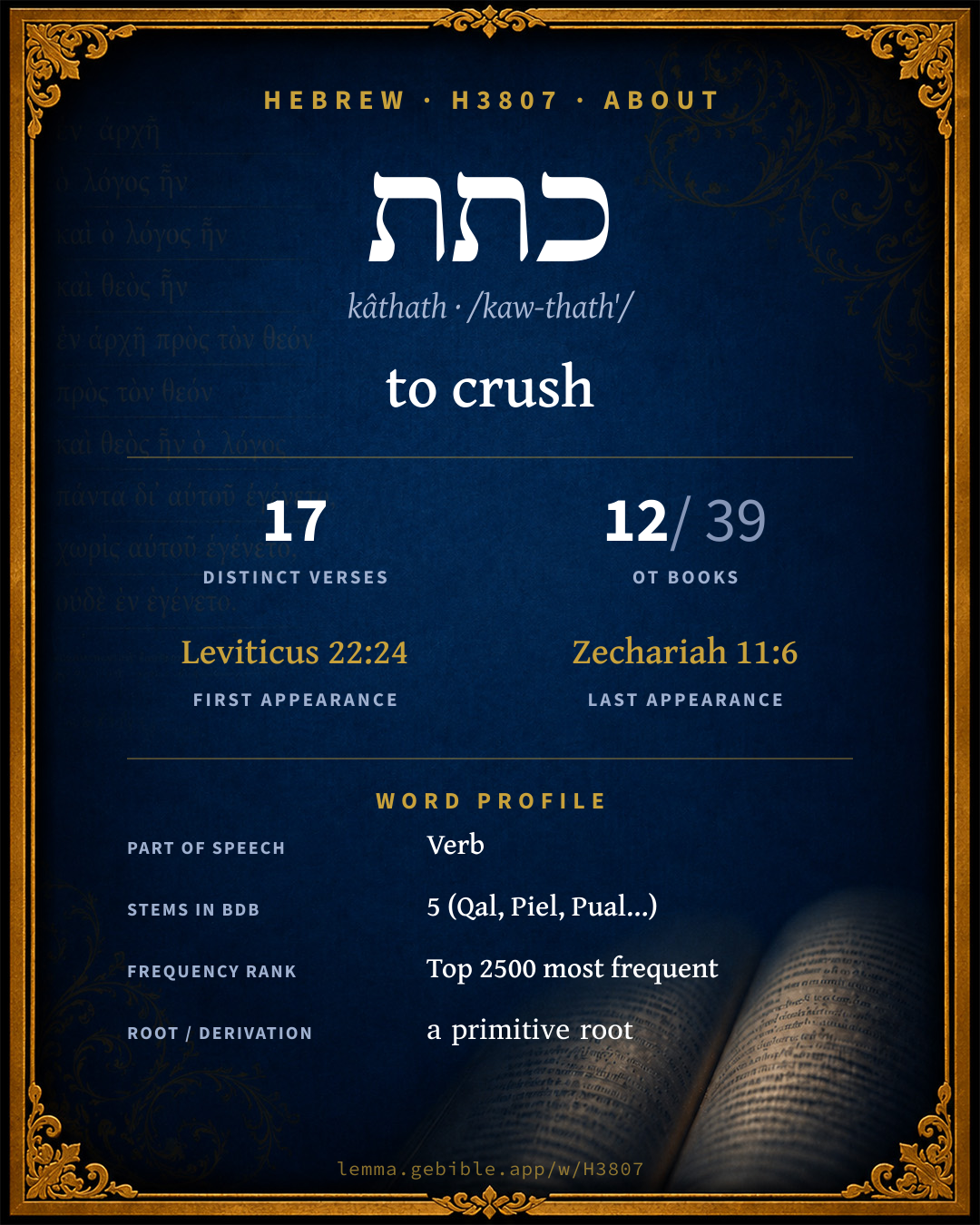
כָּתַת
to crush
‘to crush’ is one of 4 main senses fuller range ↓
Full lexicon entry — Brown-Driver-Briggs (BDB)
From Brown-Driver-Briggs (BDB)
Where this word appears
See every Piel verb in the Hebrew Bible →
Grammar key — what these labels mean
Part of speech
- Verb
- An action or state-of-being word.
Stem
- Piel
- An intensive or resultative active stem. Here: ‘beat or crush fine 2 K 18’
- Hophal
- The passive counterpart of the Hiphil (“he was caused to…”).
- Pual
- The passive counterpart of the Piel.
- Hiphil
- The causative active stem (“he caused / brought about”).
- Qal
- The basic, simple active stem — the plain form of the verb (“he wrote”). Here: ‘beat or crush fine’
Form
- Sequential Perfect
- A perfect with prefixed waw continuing a preceding imperfect or command (waw-consecutive perfect).
- Imperfect
- An incomplete, ongoing, or future action (“he will / would write”).
- Perfect
- A completed action or state — Hebrew marks aspect (completeness) more than strict tense (“he wrote”).
- Sequential Imperfect
- An imperfect with prefixed waw — the standard past-narrative form (waw-consecutive imperfect).
- Participle Passive
- A verbal adjective expressing action received (“written”).
- Imperative
- A direct command (“write!”).
State
- Absolute
- The independent form of a noun, not bound to a following word.
Person
- 3rd Person
- The one spoken about (“he / she / it / they”).
- 1st Person
- The speaker (“I / we”).
- 2nd Person
- The one addressed (“you”).
Gender
- Common
- Either gender — not distinguished for this form.
- Masculine
- Grammatically masculine.
Number
- Plural
- More than one (in Hebrew, generally three or more).
- Singular
- One.
Grammatical forms 10 distinct
- Verb, Piel, Sequential Perfect, 3rd Person, Common, Plural 3 times (18%)
- Verb, Hophal, Imperfect, 3rd Person, Masculine, Plural 3 times (18%)
- Verb, Hiphil, Sequential Imperfect, 3rd Person, Masculine, Plural 2 times (12%)
- Verb, Piel, Perfect, 3rd Person, Masculine, Singular 2 times (12%)
- Verb, Qal, Participle Passive, Masculine, Singular, Absolute 2 times (12%)
- Verb, Pual, Perfect, 3rd Person, Common, Plural 1 time (6%)
- Verb, Qal, Perfect, 1st Person, Common, Singular 1 time (6%)
- Verb, Qal, Sequential Imperfect, 1st Person, Common, Singular 1 time (6%)
+2 more forms (2 occurrences)
Parsed forms decoded from the imported morphology (morphhb / Westminster Leningrad Codex — WLC text public domain, morphhb tagging CC BY 4.0), counted across 17 parsed occurrences — not distinct verses.
Every verse where H3807 appears — 17 distinct verses across 12 books. Click any verse to open its interlinear word-by-word view. Verse text shown in the World English Bible for context — . Each verse’s Hebrew form is shown with its reference; the English is not keyword-highlighted, since the data carries no word-level English alignment. Use “Compare translations” on any verse to read it across multiple English versions. This concordance covers the Hebrew Bible; Septuagint (Greek Old Testament) occurrences are not indexed here.
Leviticus 1 verse
Numbers 1 verse
Deuteronomy 2 verses
- Deuteronomy 1:44 וַֽ/יַּכְּת֥וּ conj + Hiphil wimpf 3mp The Amorites, who lived in that hill-country, came out against you, and chased you, as bees do, and beat you down in Seir, even to Hormah.
- Deuteronomy 9:21 וָ/אֶכֹּ֨ת conj + Qal wimpf 1cs I took your sin, the calf which you had made, and burnt it with fire, and stamped it, grinding it very small, until it was as fine as dust: and I cast the dust of it into the brook that descended out of the mountain.
2 Kings 1 verse
2 Chronicles 2 verses
- 2 Chronicles 15:6 וְ/כֻתְּת֥וּ conj + Pual pf 3cp They were broken in pieces, nation against nation, and city against city; for God did vex them with all adversity.
- 2 Chronicles 34:7 כִּתַּ֣ת Piel pf 3ms He broke down the altars, and beat the Asherim and the engraved images into powder, and hewed down all the sun-images throughout all the land of Israel, and returned to Jerusalem.
Job 1 verse
Psalms 1 verse
Isaiah 3 verses
- Isaiah 2:4 וְ/כִתְּת֨וּ conj + Piel wpf 3cp He will judge between the nations, And will decide concerning many peoples; And they shall beat their swords into plowshares, And their spears into pruning-hooks. Nation shall not lift up sword against nation, Neither shall they learn war any more.
- Isaiah 24:12 יֻכַּת Hophal impf 3ms In the city is left desolation, and the gate is struck with destruction.
- Isaiah 30:14 כָּת֖וּת Qal ptcp.pass ms He shall break it as a potter's vessel is broken, breaking it in pieces without sparing; so that there shall not be found among the pieces of it a broken piece with which to take fire from the hearth, or to dip up water out of the cistern."
Jeremiah 1 verse
Joel 1 verse
Micah 2 verses
- Micah 1:7 יֻכַּ֗תּוּ Hophal impf 3mp All her idols will be beaten to pieces, And all her temple gifts will be burned with fire, And all her images I will destroy; For of the hire of a prostitute has she gathered them, And to the hire of a prostitute shall they return."
- Micah 4:3 וְ/כִתְּת֨וּ conj + Piel wpf 3cp And he will judge between many peoples, And will decide concerning strong nations afar off. They will beat their swords into plowshares, And their spears into pruning hooks. Nation will not lift up sword against nation, Neither will they learn war any more.
Zechariah 1 verse
About this entry
At a glance — auto-summarized from this page’s data, not written by a person. Every figure links to its source below. This summary describes the numbers; it doesn’t interpret them.
At its core, כתת (kâthath) means “to crush.” Across 5 stems, its meaning turns on the binyan (Qal, Piel). Spanning 17 verses in 12 books, it ranks among the uncommon words of the Hebrew Bible. Scripture first uses it in Leviticus 22:24. From the same root come כתית and מכתה. Each statement above links to its evidence; the full detail follows below.
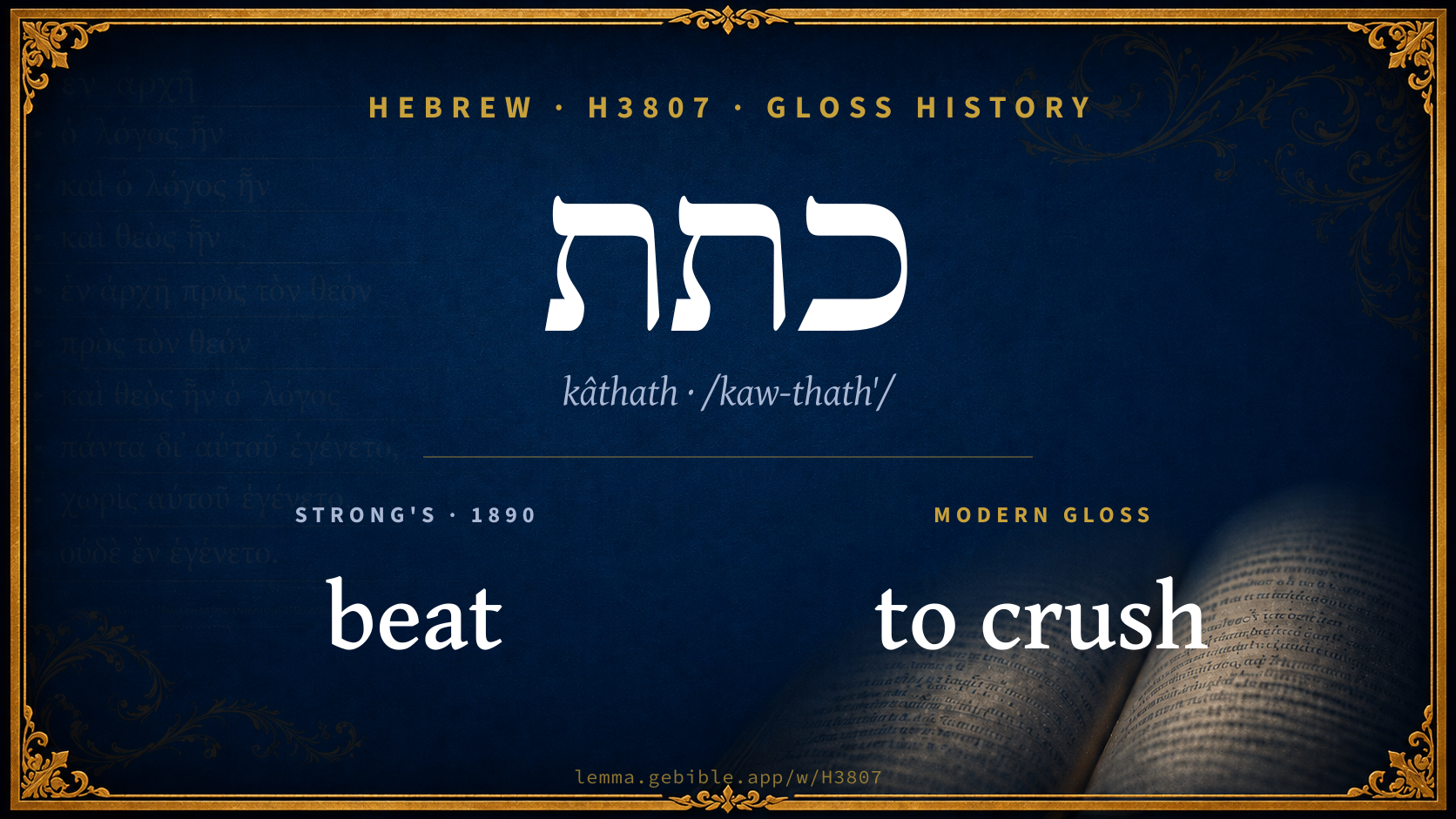
Gloss history
Strong's 1890 vs modern scholarship
About this word
Strong's H3807 catalogs a Hebrew word from the Hebrew Old Testament.
These counts are not copied from any lexicon or concordance. They are computed here, from the morphology-tagged Hebrew Old Testament. What Lemma adds →
- 17
- distinct verses
- The word appears in 17 distinct verses.
- 12 / 39
- OT books
- The word appears in 12 of 39 Old Testament books.
- #1,671
- by frequency
- Top 2500 most frequent Hebrew words (rank 1,671 of 8,640 Hebrew words by occurrence).
View all 17 occurrences in the concordance →
Most concentrated in
- Isaiah 3 verses 18%
- Deuteronomy 2 verses 12%
- 2 Chronicles 2 verses 12%
By section of the Old Testament
By traditional corpus
Conventional, traditional groupings — biblical authorship is debated, so this is a traditional corpus grouping, not an authorship claim. Each share is this word’s portion of its verses in that division of the Hebrew canon. Each figure is a share of the word’s 17 distinct verses.
- Prophets (Nevi'im) 9 verses · 53%
- Torah (Pentateuch) 4 verses · 24%
- Writings (Ketuvim) 4 verses · 24%
How translations render this word
Counts come from each version’s own published word-to-Strong’s tagging or interlinear alignment — an approximate guide to how each version renders this word, not a word-level alignment the data otherwise carries. Because each total is that version’s own tagged count, the per-version totals vary from one another and need not match the appearance or distinct-verse counts above. These counts may also differ from a printed concordance because Lemma counts each distinctly tagged rendering and does not collapse phrase taggings into a single head-word total. This is a fixed set of word-tagged versions (KJV, ASV, BSB, ULT) and does not change with the reading translation you choose elsewhere. Each version’s license is shown beside its name below (and on Sources).
- King James Version: They shall beat 2×
- American Standard Version: Beat 4×, They shall beat 2×
- Berean Standard Bible: Crushed 2×, They will beat 2×
- unfoldingWord Literal Text: Crushed 2×, They will beat 2×
King James Version Public Domain
Renders H3807 across 17 tagged occurrences — most commonly:
Plus 15 renderings that appear only once — usually multi-word phrases or single function words the recovered tagging swept in, not distinct renderings.
American Standard Version Public Domain
Renders H3807 across 17 tagged occurrences — most commonly:
Plus 11 renderings that appear only once — usually multi-word phrases or single function words the recovered tagging swept in, not distinct renderings.
Berean Standard Bible Public Domain
Renders H3807 across 17 tagged occurrences — most commonly:
Plus 13 renderings that appear only once — usually multi-word phrases or single function words the recovered tagging swept in, not distinct renderings.
unfoldingWord Literal Text CC BY-SA 4.0
Renders H3807 across 17 tagged occurrences — most commonly:
Plus 13 renderings that appear only once — usually multi-word phrases or single function words the recovered tagging swept in, not distinct renderings.
9 senses and sub-senses in the full BDB
Hebrew verbs can shift meaning by stem (binyan): Qal is the basic action, Niphal is often passive or reflexive, Piel often intensifies or makes it factitive, and Hiphil is typically causative. The senses below are grouped under the stem BDB assigns to each. This entry also uses Pual (the passive of Piel) and Hophal (the passive of Hiphil).
What do BDB’s symbols mean?
BDB uses these scholarly abbreviations:
| Symbol | Meaning |
|---|---|
| 𝔊 | the Septuagint (the ancient Greek translation, LXX) |
| 𝔙 | the Vulgate (the Latin translation) |
| 𝔖 | the Syriac version (the Peshitta) |
| 𝔗 | the Targum (the Aramaic translation) |
| ψ | the Psalms |
| √ | root (the underlying root or stem) |
| ‖ | parallel passage (a synonymous or contrasted parallel) |
| † | the dagger: every passage where the word occurs is cited |
The 9 senses and sub-senses the full Brown-Driver-Briggs lexicon distinguishes for this word, in lexicon order (not ranked by frequency), with BDB’s own verbatim wording and sub-sense lettering. Shown in Hebrew script with BDB’s own scholarly abbreviations. The condensed entry is in the Lexicon Entry tab. See also the Forms in the corpus table below.
Qal
- Pf. 1 s. וְכַתּוֹתִ֫י ψ 89:24; Impf. i s. וָאֶכֹּת Dt 9:21; Imv. mpl. כֹּ֫תּוּ Jo 4:10; Pt. pass. כָּתוּת Is 30:14 Lv 22:24;— e.g. Psalms 89:24
- 1. beat or crush fine, of a potter’s vessel Is 30:14, the golden calf Dt 9:21 (+ טָחוֹן הֵיטֵב); a sacrificial victim Lv 22:24 (i.e. its testicles; + מָעוּךְ, נָתוּק, כָּרוּת); fig. of enemies ψ 89:24. e.g. Isaiah 30:14
- 2. beat, hammer (ploughshares into swords, cf. Pi. 2) Jo 4:10. e.g. Joel 4:10
Piel
- Pf. 3 ms. כִּתַּת 2 K 18:4 2 Ch 34:7; 3 mpl. וְכִּתְּתוּ consec. Is 2:4 + 2 times;—as Qal e.g. 2 Kings 18:4
- 1. beat or crush fine 2 K 18:4 2 Ch 34:7 (of images); fig. of devastating the land Zc 11:6. e.g. 2 Kings 18:4
- 2. beat, hammer (swords into ploughshares, cf. Qal 2) Is 2:4 = Mi 4:3. e.g. Isaiah 2:4
Pual
- Pf. 3 mpl. וְכֻתְּתוּ 2 Ch 15:6 and they were beaten in pieces, one nation against another. e.g. 2 Chronicles 15:6
Hiphil
- Impf. 3 mpl. וַיַּכְּתוּ Dt 1:44 beat in pieces an enemy, sf. וַיַּכּוּם וַיַּכְּתוּם Nu 14:45. e.g. Deuteronomy 1:44
Hophal
- Impf. 3 ms. וּשְׁאִיָּה יֻכַּת־שָׁ֑עַר Is 24:12 and to ruins is the gate crushed; 3 mpl. יֻכַּתּוּ Mi 1:7 (of idol-images); fig. of warriors Je 46:5; of frail man Jb 4:20. e.g. Isaiah 24:12
Senses from the full Brown-Driver-Briggs lexicon (Brown, Driver, Briggs; Oxford 1906 — public domain), digitized via Sefaria, supplemented by the OpenScriptures HebrewLexicon (CC BY 4.0). Full attribution on Sources.
Word origin
vb. beat, crush by beating (NH id.; Aramaic כְּתַת);—
— Brown-Driver-Briggs (Oxford 1906, public domain), digitized via Sefaria, supplemented by the OpenScriptures HebrewLexicon (CC BY 4.0). See Sources.
Origin: a primitive root
Jastrow Dictionary
A second Hebrew/Aramaic lexicon for comparison, covering Aramaic and post-biblical (Talmudic, Targumic, Midrashic) usage that the biblical-Hebrew BDB does not. Matched by lemma rather than by Strong’s number, so a lemma may carry more than one Jastrow headword (shown separately below), and the entries cover usage well beyond the Bible.
כָּתַת
- (b. h.) [to join closely (in a friendly or hostile sense);—Denom. כַּתְּ;] to press, crush. Part. pass. כָּתוּת, one whose parts are crushed. Sifra Emor Par. 7, ch. VII; Kidd. 25ᵇ; Bekh. 39ᵇ
- 1. to strike. Gen. R. s. 22 (with ref. to Ps. LXXXIX, 24) התחיל מְכַתְּתוֹ he began to strike him; Yalk. ib. 36; Yalk. Ps. 840. Midr. Till. to Ps. XXIII היה מה"מ מְכַתֵּת וכ׳ the angel of death smote fifteen thousand and some of them. Ber. 63ᵇ (play on ה̇ס̇כ̇ת̇, Deut. XXVII, 9) כַּתְּתוּ עצמיכם וכ׳ expose yourselves to being smitten (by death) over the study of the Law. e.g. Psalms 89:24
- 2. to pound, pulverize. Ab. Zar. 44ᵃ כִּיתְּתוֹ ground it (the bronze serpent) to powder.—Trnsf. (cmp. גרס) to discuss, argue. Ber. l. c. הֹסֹ ואח"כ כַֹּתֵֹּת first listen (and receive) and then discuss.—Part. pass. מְכוּתָּת, f. מְכוּתֶּתֶת, pl. מְכוּתָּתִין, v. כָּתַשׁ.D
כְּתַת
- 1. to join closely, be grouped. Targ. Job XXX, 7 בתתין Ms. Var., read: כָּתְתִין (ed. מתחברין, h. text יְסֻפָּחוּ).—Denom. כָּתָא, כִּתָּא.
- 2. to strike, v. infra.
- 1. to pound, crush. Ab. Zar. 44ᵃ בדין הוא דכַתּוּתֵי לא וכ׳ by law it was necessary to grind it (the bronze serpent) to powder, v. preced.
- 2. to ally, form into factions. Targ. Y. I Num. XXIV, 23 (play on כִּתִּים, ib. 24) מְכַתֵּת וכ׳ causes nations … to form alliances and incites them against one another.—Part. pass. מְכַתַּת, v. infra.
- 1. to be powdered, crushed. Succ. 31ᵇ כַּתּוּתֵי מִיכַּתַּת שיעוריה the size which the Lulab must have, is (in the eyes of the law) crushed to powder (as an object of idolatry); Ḥull. 89ᵇ כתותי מִכַּתַּת שיעורא (or מְכַתַּת. v. supra). Ib. כל מה דמכ׳ וכ׳ the more it is crushed to powder, the better it is fitted (for covering the blood). Yeb. 103ᵇ כִּדְמִכַּתֵּת דמי (or כִּדְמְכַתַּת) the house doomed to destruction (Lev. XIV, 45) is to be considered as crushed to powder. e.g. Leviticus 14:45
- 2. to come in contact (hostile or friendly, cmp. זווג). Gen. R. s. 78 (ref. to פגש, Gen. XXXIII, 8) א"ל מִיכַּתֵּת אנא גביהון א"ל וכ׳ said he (Esau), I had a meeting with them. Said he (Jacob) they came to find grace &c. Said he, I have had enough blows; Yalk. ib. 133. e.g. Genesis 33:8
A Dictionary of the Targumim, the Talmud Babli and Yerushalmi, and the Midrashic Literature (Marcus Jastrow; London, Luzac, 1903) — Public Domain. Digitized via Sefaria. Digitized via Sefaria. Full attribution on Sources.
Forms in the corpus
The 16 distinct written forms H3807 takes in the Hebrew Bible, most frequent first — each parse links to that stem’s occurrences in the concordance. Hebrew forms include their vowel points and cantillation, so a single lemma takes many written forms.
Same root — word family
Other BDB entries built from the same root as H3807, grouped by Strong’s listed origin. These share a root / origin per the lexicon — not necessarily a shared meaning. Each links to that word’s own entry.
Derived from this word
Compare all same-root words → They share a root, not necessarily a meaning.
Septuagint verse parallels
This word appears in 15 verses that also exist in the Greek Old Testament (Septuagint), out of the 17 Hebrew verses it occurs in. You can read those verses in Greek by switching the Old Testament edition to the Septuagint.
Read these verses in the Septuagint
- Leviticus 22:24
- Numbers 14:45
- Deuteronomy 1:44
- 2 Kings 18:4
- 2 Chronicles 15:6
- Job 4:20
- Isaiah 2:4
- Jeremiah 46:5
- Micah 1:7
- Zechariah 11:6
This is a verse-level parallel only — the same verses exist in both the Hebrew and Greek Old Testaments. No word-level Hebrew↔Greek correspondence is claimed: the data carries no such alignment, so no Greek word is shown as this Hebrew word’s translation. Coverage is not total — the Septuagint omits the deuterocanon and renumbers the Psalms, so some Hebrew verses have no direct Greek parallel.