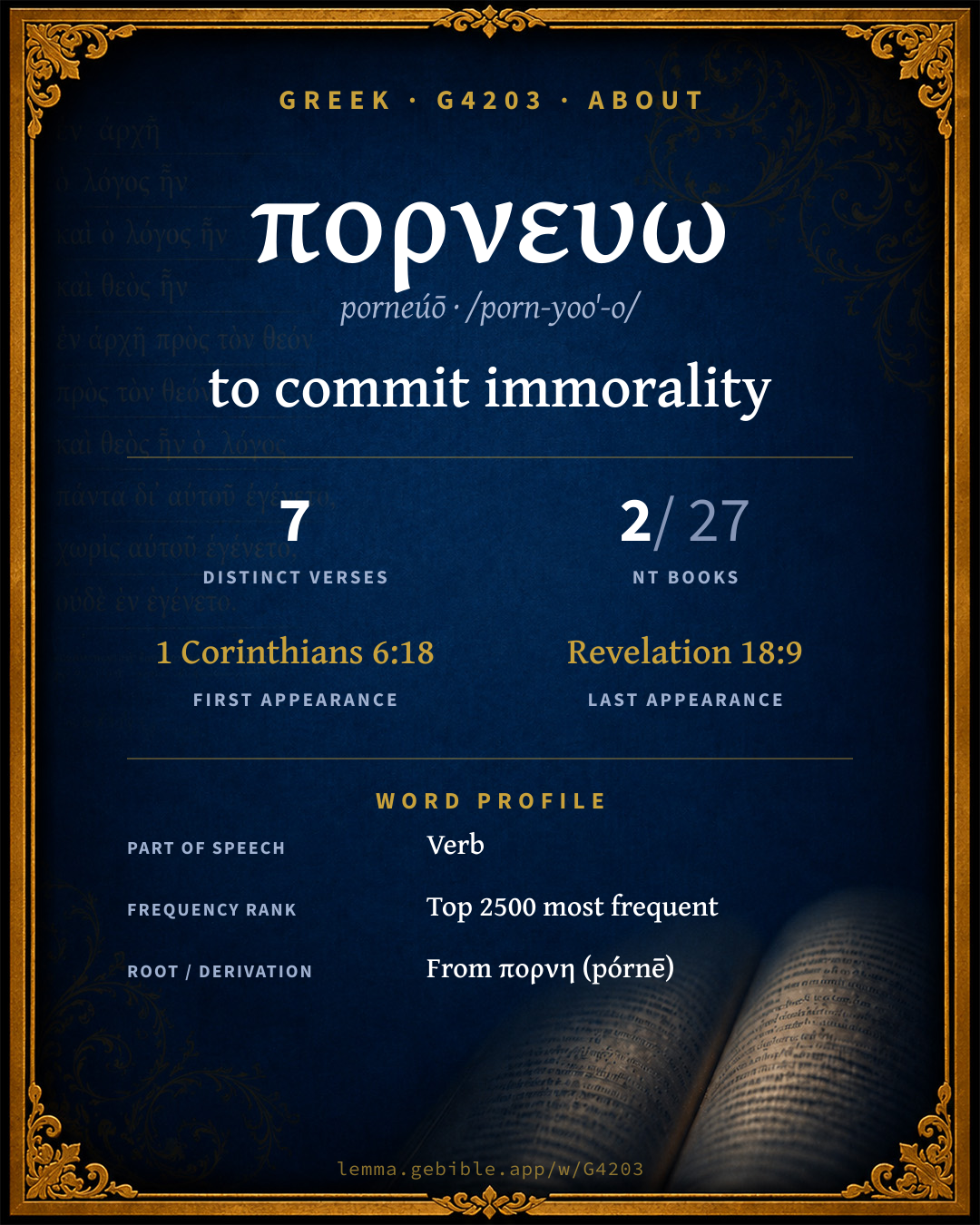
πορνεύω
to commit immorality
‘to commit immorality’ is one of 3 main senses fuller range ↓
Full lexicon entry — Thayer's Greek Lexicon
From Thayer's Greek Lexicon
Where this word appears
See every Aorist-tense verb in the Greek New Testament →
Grammar key — what these labels mean
Part of speech
- Verb
- An action or state-of-being word.
Tense
- Aorist
- Action viewed as a simple whole, without regard to duration — often past (perfective aspect).
- Present
- Ongoing or general action in present time (imperfective aspect).
Voice
- Active
- The subject performs the action.
Mood
- Indicative
- States a fact or asks a factual question (the mood of reality).
- Infinitive
- A verbal noun (“to write”), unmarked for person or number.
- Participle
- A verbal adjective (“writing,” “having written”).
- Subjunctive
- Expresses probability, purpose, or possibility (the mood of contingency).
Case
- Nominative
- The case of the subject (and the predicate nominative).
Person
- 3rd person
- The one spoken about (“he / she / it / they”).
- 1st person
- The speaker (“I / we”).
Gender
- Masculine
- Grammatically masculine.
Number
- Plural
- More than one.
- Singular
- One.
Grammatical forms
- Verb, Aorist, Active, Indicative, 3rd person, Plural 3 times (38%)
- Verb, Aorist, Active, Infinitive 2 times (25%)
- Verb, Aorist, Active, Participle, Nominative, Plural, Masculine 1 time (13%)
- Verb, Present, Active, Participle, Nominative, Singular, Masculine 1 time (13%)
- Verb, Present, Active, Subjunctive, 1st person, Plural 1 time (13%)
Parsed forms decoded from the imported morphology (Robinson–Tischendorf, public domain), counted across 8 parsed occurrences — not distinct verses.
Every verse where G4203 appears — 7 distinct verses across 2 books. Click any verse to open its interlinear word-by-word view. Verse text shown in the World English Bible for context — . Each verse’s Greek form is shown with its reference; the English is not keyword-highlighted, since the data carries no word-level English alignment. Use “Compare translations” on any verse to read it across multiple English versions. This concordance covers the Greek New Testament; Septuagint (Greek Old Testament) occurrences of this word are not indexed here.
1 Corinthians 2 verses
- 1 Corinthians 6:18 πορνεύων pres act ptcp nom sg masc Flee sexual immorality! "Every sin that a man does is outside the body," but he who commits sexual immorality sins against his own body.
- 1 Corinthians 10:8 πορνεύωμεν ἐπόρνευσαν pres act subj 1pl aor act ind 3pl Neither let us commit sexual immorality, as some of them committed, and in one day twenty-three thousand fell.
Revelation 5 verses
- Revelation 2:14 πορνεῦσαι aor act inf But I have a few things against you, because you have there some who hold the teaching of Balaam, who taught Balak to throw a stumbling block before the children of Israel, to eat things sacrificed to idols, and to commit sexual immorality.
- Revelation 2:20 πορνεῦσαι aor act inf But I have this against you, that you tolerate your woman, Jezebel, who calls herself a prophetess. She teaches and seduces my servants to commit sexual immorality, and to eat things sacrificed to idols.
- Revelation 17:2 ἐπόρνευσαν aor act ind 3pl with whom the kings of the earth committed sexual immorality, and those who dwell in the earth were made drunken with the wine of her sexual immorality."
- Revelation 18:3 ἐπόρνευσαν aor act ind 3pl For all the nations have drunk of the wine of the wrath of her sexual immorality, the kings of the earth committed sexual immorality with her, and the merchants of the earth grew rich from the abundance of her luxury."
- Revelation 18:9 πορνεύσαντες aor act ptcp nom pl masc The kings of the earth, who committed sexual immorality and lived wantonly with her, will weep and wail over her, when they look at the smoke of her burning,
About this entry
At a glance — auto-summarized from this page’s data, not written by a person. Every figure links to its source below. This summary describes the numbers; it doesn’t interpret them.
The Greek verb πορνευω centers on the idea of “to commit immorality.” The word gravitates to Revelation (71%), then 1 Corinthians. It turns up in 7 verses across 2 books, an uncommon footprint. First canonically at 1 Corinthians 6:18, it enters the text early. Lexicons map it across 3 senses. Dig into 7-verse concordance and the renderings breakdown below.
Gloss history
Strong's 1890 vs modern scholarship

About this word
Strong's G4203 catalogs a Greek word from the Greek New Testament.
These counts are not copied from any lexicon or concordance. They are computed here, from the morphology-tagged Greek New Testament. What Lemma adds →
- 7
- distinct verses
- The word appears in 7 distinct verses.
- 2 / 27
- NT books
- The word appears in 2 of 27 New Testament books.
- #1,240
- by frequency
- Top 2500 most frequent Greek words (rank 1,240 of 5,347 Greek words by occurrence).
View all 7 occurrences in the concordance →
Most concentrated in
- Revelation 5 verses 71%
- 1 Corinthians 2 verses 29%
By section of the New Testament
By traditional corpus
Conventional, traditional groupings — biblical authorship is debated, so this is a traditional corpus grouping, not an authorship claim. Some books belong to more than one corpus (Luke is in both the Gospels and the Lukan corpus, and so on), so these shares overlap and need not total 100%. Each figure is a share of the word’s 7 distinct verses.
- Johannine 5 verses · 71%
- Revelation 5 verses · 71%
- Pauline corpus 2 verses · 29%
How translations render this word
Counts come from each version’s own published word-to-Strong’s tagging or interlinear alignment — an approximate guide to how each version renders this word, not a word-level alignment the data otherwise carries. Because each total is that version’s own tagged count, the per-version totals vary from one another and need not match the appearance or distinct-verse counts above. These counts may also differ from a printed concordance because Lemma counts each distinctly tagged rendering and does not collapse phrase taggings into a single head-word total. This is a fixed set of word-tagged versions (KJV, ASV, BSB, ULT) and does not change with the reading translation you choose elsewhere. Each version’s license is shown beside its name below (and on Sources).
- King James Version: Have committed fornication 3×, Commit fornication 2×
- American Standard Version: Committed fornication 3×, Commit fornication 2×
- Berean Standard Bible: Were immoral 2×
- unfoldingWord Literal Text: Be sexually immoral 2×, Committed sexual immorality 2×
King James Version Public Domain
Renders G4203 across 8 tagged occurrences — most commonly:
Plus 3 renderings that appear only once — usually multi-word phrases or single function words the recovered tagging swept in, not distinct renderings.
American Standard Version Public Domain
Renders G4203 across 8 tagged occurrences — most commonly:
Plus 3 renderings that appear only once — usually multi-word phrases or single function words the recovered tagging swept in, not distinct renderings.
Berean Standard Bible Public Domain
Renders G4203 across 7 tagged occurrences — most commonly:
Plus 5 renderings that appear only once — usually multi-word phrases or single function words the recovered tagging swept in, not distinct renderings. Not rendered by a distinct English word in 1 further occurrence.
unfoldingWord Literal Text CC BY-SA 4.0
Renders G4203 across 8 tagged occurrences — most commonly:
Plus 4 renderings that appear only once — usually multi-word phrases or single function words the recovered tagging swept in, not distinct renderings.
Senses in Thayer's
The 3 senses Thayer's distinguishes for this word, in lexicon order (not ranked by frequency or importance). The full entry — with sub-senses — is in the Lexicon Entry tab.
- to prostitute one's body to the lust of another
- to give one's self to unlawful sexual intercourse
- metaph. to be given to idolatry, to worship idols
Word origin
Derived from πορνη (pórnē) (G4204) — prostitute.
From G4204 ; to act the harlot that is (literally) indulge unlawful lust (of either sex) or (figuratively) practise idolatry : - commit (fornication).
— Strong’s Exhaustive Concordance (1890), public domain.
Forms in the corpus
The 5 distinct written forms G4203 takes in the Greek New Testament, most frequent first — each parse links to that tense’s occurrences in the concordance.
| Form | Parsing | Example | Uses |
|---|---|---|---|
| ἐπόρνευσαν epórneusan | Verb, Aorist, Active, Indicative, 3rd person, Plural | 1 Corinthians 10:8 | 3 |
| πορνεῦσαι porneûsai | Verb, Aorist, Active, Infinitive | Revelation 2:14 | 2 |
| πορνεύσαντες porneúsantes | Verb, Aorist, Active, Participle, Nominative, Plural, Masculine | Revelation 18:9 | 1 |
| πορνεύωμεν porneúōmen | Verb, Present, Active, Subjunctive, 1st person, Plural | 1 Corinthians 10:8 | 1 |
| πορνεύων porneúōn | Verb, Present, Active, Participle, Nominative, Singular, Masculine | 1 Corinthians 6:18 | 1 |
Same root — word family
Other Thayer's entries built from the same root as G4203, grouped by Strong’s listed origin. These share a root / origin per the lexicon — not necessarily a shared meaning. Each links to that word’s own entry.
Derives from
Derived from this word
Compare all same-root words → They share a root, not necessarily a meaning.
Septuagint usage
The same Greek word πορνευω appears 17 times in the Greek Old Testament (Septuagint), across 17 verses in 7 books.
- 17
- LXX occurrences
- Tagged occurrences of this Greek word in the Septuagint.
- 17
- verses
- Distinct Septuagint verses containing this word.
- 7 / 39
- OT books
- The word appears in 7 of the 39 Old Testament books.
Sample Septuagint occurrences
- Deuteronomy 23:18 πορνεύω
- 1 Chronicles 5:25 πορνεύω
- Psalms 72:27 πορνεύω
- Jeremiah 3:6 πορνεύω
- Ezekiel 6:9 πορνεύω
- Hosea 3:3 πορνεύω
- Amos 7:17 πορνεύω
Septuagint occurrences (same lexeme)
Every verse where the same Strong’s number (G4203) appears in the Greek Septuagint. Verse text shown in the World English Bible for context; the Greek form is the matched word — the English is not keyword-highlighted.
- Deuteronomy 23:18 πορνεύω You shall not bring the hire of a prostitute, or the wages of a dog, into the house of Yahweh your God for any vow: for even both these are an abomination to Yahweh your God.
- 1 Chronicles 5:25 πορνεύω They trespassed against the God of their fathers, and played the prostitute after the gods of the peoples of the land, whom God destroyed before them.
- Psalms 72:27 πορνεύω
- Psalms 105:39 πορνεύω He spread a cloud for a covering, Fire to give light in the night.
- Jeremiah 3:6 πορνεύω Moreover Yahweh said to me in the days of Josiah the king, Have you seen that which backsliding Israel has done? she is gone up on every high mountain and under every green tree, and there has played the prostitute.
- Jeremiah 3:7 πορνεύω I said after she had done all these things, She will return to me; but she didn't return: and her treacherous sister Judah saw it.
- Jeremiah 3:8 πορνεύω I saw, when, for this very cause that backsliding Israel had committed adultery, I had put her away and given her a bill of divorce, yet treacherous Judah, her sister, didn't fear; but she also went and played the prostitute.
- Ezekiel 6:9 πορνεύω Those of you that escape shall remember me among the nations where they shall be carried captive, how that I have been broken with their lewd heart, which has departed from me, and with they eyes, which play the prostitute after their idols: and they shall loathe themselves in their own sight for the evils which they have committed in all their abominations.
- Ezekiel 16:15 πορνεύω But you did trust in your beauty, and played the prostitute because of your renown, and poured out your prostitution on everyone who passed by; his it was.
- Ezekiel 16:34 πορνεύω You are different from [other] women in your prostitution, in that none follows you to play the prostitute; and whereas you give hire, and no hire is given to you, therefore you are different.
- Ezekiel 23:19 πορνεύω Yet she multiplied her prostitution, remembering the days of her youth, in which she had played the prostitute in the land of Egypt.
- Hosea 3:3 πορνεύω I said to her, "You shall stay with me many days. You shall not play the prostitute, and you shall not be with any other man. I will also be so toward you."
- Hosea 4:10 πορνεύω They will eat, and not have enough. They will play the prostitute, and will not increase; Because they have abandoned giving to Yahweh.
- Hosea 4:14 πορνεύω I will not punish your daughters when they play the prostitute, Nor your brides when they commit adultery; Because the men consort with prostitutes, And they sacrifice with the shrine prostitutes; And the people that does not understand will come to ruin.
- Hosea 4:18 πορνεύω Their drink has become sour. They play the prostitute continually. Her rulers dearly love their shameful way.
- Hosea 9:1 πορνεύω Don't rejoice, Israel, to jubilation like the nations; For you were unfaithful to your God. You love the wages of a prostitute at every grain threshing floor.
- Amos 7:17 πορνεύω Therefore thus says Yahweh: 'Your wife shall be a prostitute in the city, and your sons and your daughters shall fall by the sword, and your land shall be divided by line; and you yourself shall die in a land that is unclean, and Israel shall surely be led away captive out of his land.'"
These are occurrences of the same Greek lexeme (G4203) in the Septuagint — not a translation of any one Hebrew word. The store carries no word-level Hebrew↔Greek alignment, so no Hebrew original is asserted here. Counts come from the recovered LXX Strong's tagging — high-frequency vocabulary is well covered, while rare or late forms may be untagged — so they reflect tagged occurrences and may slightly undercount.