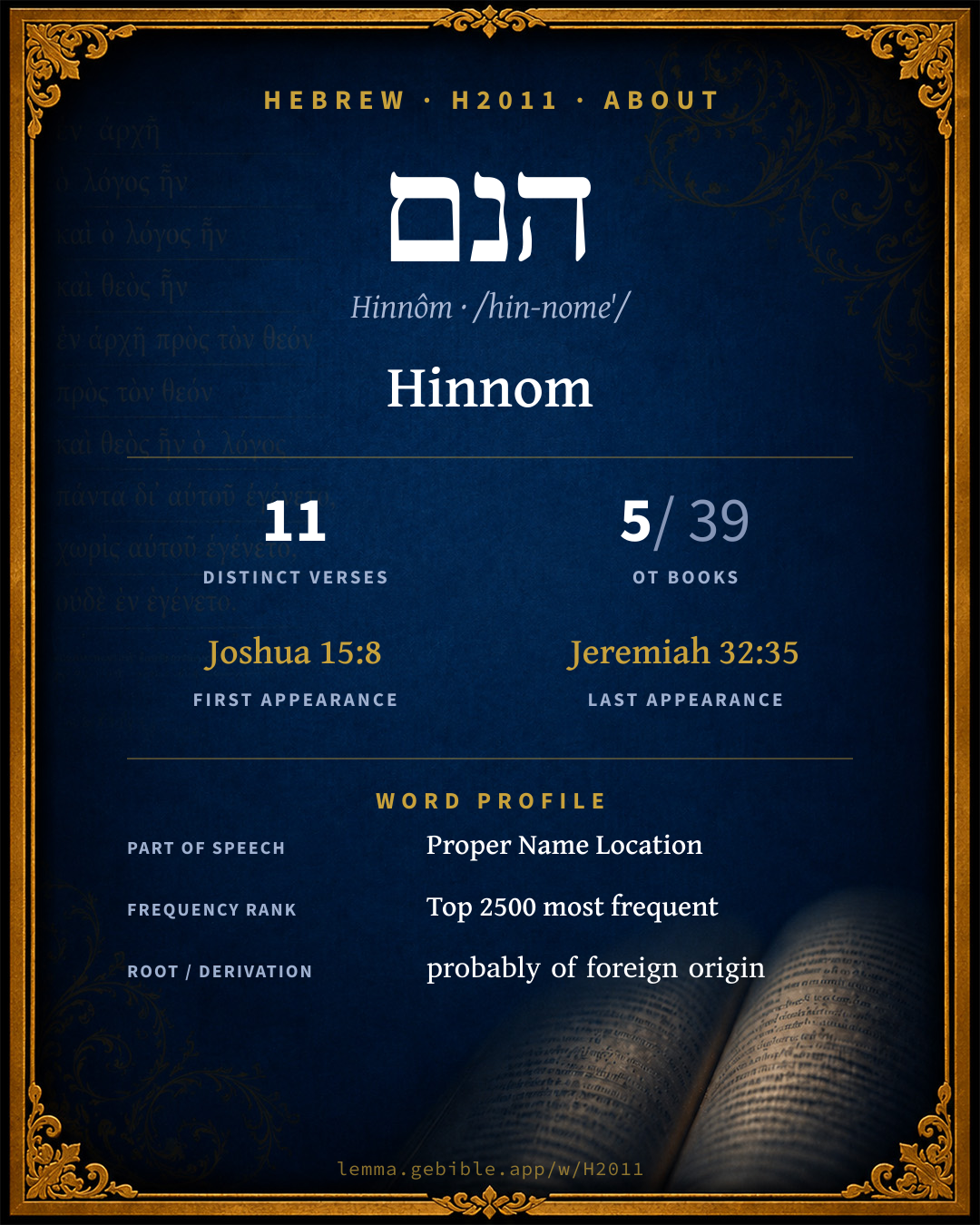
הִנֹּם
Hinnom
BDB lists 2 entries for ‘Hinnom’ fuller range ↓
Full lexicon entry — Brown-Driver-Briggs (BDB)
From Brown-Driver-Briggs (BDB)
Where this word appears
Grammar key — what these labels mean
Part of speech
- Noun
- A naming word — a person, place, thing, or idea.
Noun type
- Proper
- A name of a specific person, place, or people (e.g. Abraham, Zion, Israel).
Every verse where H2011 appears — 11 distinct verses across 5 books. Click any verse to open its interlinear word-by-word view. Verse text shown in the World English Bible for context — . Each verse’s Hebrew form is shown with its reference; the English is not keyword-highlighted, since the data carries no word-level English alignment. Use “Compare translations” on any verse to read it across multiple English versions. This concordance covers the Hebrew Bible; Septuagint (Greek Old Testament) occurrences are not indexed here.
Joshua 2 verses
- Joshua 15:8 הִנֹּ֗ם הִנֹּם֙ n Proper n Proper and the border went up by the valley of the son of Hinnom to the side of the Jebusite southward (the same is Jerusalem); and the border went up to the top of the mountain that lies before the valley of Hinnom westward, which is at the uttermost part of the valley of Rephaim northward;
- Joshua 18:16 הִנֹּ֔ם הִנֹּ֜ם n Proper n Proper and the border went down to the uttermost part of the mountain that lies before the valley of the son of Hinnom, which is in the valley of Rephaim northward; and it went down to the valley of Hinnom, to the side of the Jebusite southward, and went down to En Rogel;
2 Kings 1 verse
2 Chronicles 2 verses
- 2 Chronicles 28:3 הִנֹּ֑ם n Proper Moreover he burnt incense in the valley of the son of Hinnom, and burnt his children in the fire, according to the abominations of the nations whom Yahweh cast out before the children of Israel.
- 2 Chronicles 33:6 הִנֹּ֔ם n Proper He also made his children to pass through the fire in the valley of the son of Hinnom; and he practiced sorcery, and used enchantments, and practiced sorcery, and dealt with those who had familiar spirits, and with wizards: he worked much evil in the sight of Yahweh, to provoke him to anger.
Nehemiah 1 verse
Jeremiah 5 verses
- Jeremiah 7:31 הִנֹּ֔ם n Proper They have built the high places of Topheth, which is in the valley of the son of Hinnom, to burn their sons and their daughters in the fire; which I didn't command, neither came it into my mind.
- Jeremiah 7:32 הִנֹּ֔ם n Proper Therefore, behold, the days come, says Yahweh, that it shall no more be called Topheth, nor The valley of the son of Hinnom, but The valley of Slaughter: for they shall bury in Topheth, until there be no place [to bury].
- Jeremiah 19:2 הִנֹּ֔ם n Proper and go forth to the valley of the son of Hinnom, which is by the entry of the gate Harsith, and proclaim there the words that I shall tell you;
- Jeremiah 19:6 הִנֹּ֑ם n Proper therefore, behold, the days come, says Yahweh, that this place shall no more be called Topheth, nor The valley of the son of Hinnom, but The valley of Slaughter.
- Jeremiah 32:35 הִנֹּ֗ם n Proper They built the high places of Baal, which are in the valley of the son of Hinnom, to cause their sons and their daughters to pass through [the fire] to Molech; which I didn't command them, neither did it come into my mind, that they should do this abomination, to cause Judah to sin.
About this entry
At a glance — auto-summarized from this page’s data, not written by a person. Every figure links to its source below. This summary describes the numbers; it doesn’t interpret them.
הנם — transliterated Hinnôm — is a Hebrew name carrying the sense “Hinnom.” Its earliest occurrence is Joshua 15:8. Spanning 11 verses in 5 books, it ranks among the uncommon words of the Hebrew Bible. Its uses concentrate in Jeremiah (45% of all occurrences). See 11-verse concordance and the renderings breakdown below.
Gloss history
Strong's 1890 vs modern scholarship
About this word
Strong's H2011 catalogs a Hebrew word from the Hebrew Old Testament.
These counts are not copied from any lexicon or concordance. They are computed here, from the morphology-tagged Hebrew Old Testament. What Lemma adds →
- 11
- distinct verses
- The word appears in 11 distinct verses.
- 5 / 39
- OT books
- The word appears in 5 of 39 Old Testament books.
- #2,001
- by frequency
- Top 2500 most frequent Hebrew words (rank 2,001 of 8,640 Hebrew words by occurrence).
View all 11 occurrences in the concordance →
Most concentrated in
- Jeremiah 5 verses 45%
- Joshua 2 verses 18%
- 2 Chronicles 2 verses 18%
By section of the Old Testament
By traditional corpus
Conventional, traditional groupings — biblical authorship is debated, so this is a traditional corpus grouping, not an authorship claim. Each share is this word’s portion of its verses in that division of the Hebrew canon. Each figure is a share of the word’s 11 distinct verses.
- Prophets (Nevi'im) 8 verses · 73%
- Writings (Ketuvim) 3 verses · 27%
How translations render this word
Counts come from each version’s own published word-to-Strong’s tagging or interlinear alignment — an approximate guide to how each version renders this word, not a word-level alignment the data otherwise carries. Because each total is that version’s own tagged count, the per-version totals vary from one another and need not match the appearance or distinct-verse counts above. These counts may also differ from a printed concordance because Lemma counts each distinctly tagged rendering and does not collapse phrase taggings into a single head-word total. This is a fixed set of word-tagged versions (KJV, ASV, BSB, ULT) and does not change with the reading translation you choose elsewhere. Each version’s license is shown beside its name below (and on Sources).
- King James Version: Hinnom 13×
- American Standard Version: Hinnom 13×
- Berean Standard Bible: Ben-hinnom 3×
- unfoldingWord Literal Text: Hinnom 11×
King James Version Public Domain
Renders H2011 across 13 tagged occurrences — most commonly:
American Standard Version Public Domain
Renders H2011 across 13 tagged occurrences — most commonly:
Berean Standard Bible Public Domain
Renders H2011 across 4 tagged occurrences — most commonly:
Plus 1 rendering that appears only once — usually multi-word phrases or single function words the recovered tagging swept in, not distinct renderings. Not rendered by a distinct English word in 9 further occurrences.
unfoldingWord Literal Text CC BY-SA 4.0
Renders H2011 across 12 tagged occurrences — most commonly:
Plus 1 rendering that appears only once — usually multi-word phrases or single function words the recovered tagging swept in, not distinct renderings.
Senses in BDB
The 2 senses BDB distinguishes for this word, in lexicon order (not ranked by frequency or importance). The full entry — with sub-senses — is in the Lexicon Entry tab.
- Hinnom = "lamentation"
- a valley (deep and narrow ravine) with steep…
Word origin
n.pr.m. (deriv. & meaning dub.; according to Sim Bö Gf al. = wailing, Arabic هَنَّ, from cries of children (v. infr.), but this improbable)—only in גֵּי(גֵּיא)בֶן־ה׳, & abbrev. ג׳ ה׳, n.pr.loc. of valley S. of Jerusalem, (𝔊 φάραγγα Ὀνομ Jos 15:8(×2) Σονναμ 18:16; Γαιεννα v 16; Γαιβενθομ 2 Ch 28:3, 𝔊L φάρ. Βενεννομ; γὲ βανὲ Ἑννομ 33:6, 𝔊L γῇ Βενεννομ; elsewhere usually φάρ. (υἱοῦ) Ἑννομ)—cf. sub גַּיְא;—as mere topographical term גֵּי בֶן־הִנֹּם, boundary between Judah & Benjamin Jos 15:8; 18:16; also גֵּי ה׳ 15:8; 18:16 (all P) cf. Ne 11:30; elsewhere always גּ׳ בֶן־ה׳ (2 K 23:10 Kt has גי בני הנם, Qr & 𝔊 𝔙 sing.), & always with ref. to the sacrifice of children by fire, 2 K 23:10 2 Ch 28:3; 33:6 Je 7:31, 32; 19:2, 6; 32:35; on account of this inhuman & idolatrous practice it was abhorred by priest & prophet, & defiled by Josiah; this conception afterward developed, through Is 66:24, into Jewish Gehinnom (cf. WeberSynagog. Theol. 326 ff. DiBuch Henoch. 131 f.) & NT γέεννα. On locality cf. RobBR ii. 273 f. ToblerTopogr. ii 39 ff. BdPal. 103; mod. name (of lower half of valley, toward SE.) Wady er-Rabâbi.
— Brown-Driver-Briggs (Oxford 1906, public domain), digitized via Sefaria, supplemented by the OpenScriptures HebrewLexicon (CC BY 4.0). See Sources.
Origin: probably of foreign origin
Jastrow Dictionary
A second Hebrew/Aramaic lexicon for comparison, covering Aramaic and post-biblical (Talmudic, Targumic, Midrashic) usage that the biblical-Hebrew BDB does not. Matched by lemma rather than by Strong’s number, so a lemma may carry more than one Jastrow headword (shown separately below), and the entries cover usage well beyond the Bible.
הִנָּם
- (homiletically = חִנָּם; v. ה"א) gratuitous, purposeless act, vanity. Erub. 19ᵃ (play on גיהנם) גיא … שהכל יורדין בה על עסקי ה׳ (v. Rabb. D. S. a. l. note 50) the valley which all enter for affairs of vanity (worldly lusts).
A Dictionary of the Targumim, the Talmud Babli and Yerushalmi, and the Midrashic Literature (Marcus Jastrow; London, Luzac, 1903) — Public Domain. Digitized via Sefaria. Digitized via Sefaria. Full attribution on Sources.
Forms in the corpus
The 6 distinct written forms H2011 takes in the Hebrew Bible, most frequent first — each parse links to that state’s occurrences in the concordance. Hebrew forms include their vowel points and cantillation, so a single lemma takes many written forms.
| Form | Parsing | Example | Uses |
|---|---|---|---|
| הִנֹּ֔ם | Noun, Proper | 2 Chronicles 33:6 | 5 |
| הִנֹּ֑ם | Noun, Proper | 2 Chronicles 28:3 | 3 |
| הִנֹּ֗ם | Noun, Proper | Jeremiah 32:35 | 2 |
| הִנֹּ֜ם | Noun, Proper | Joshua 18:16 | 1 |
| הִנֹּֽם | Noun, Proper | Nehemiah 11:30 | 1 |
| הִנֹּם֙ | Noun, Proper | Joshua 15:8 | 1 |
Bible dictionary
Public-domain dictionary articles matched to this entry by name (Hinnom). A biblical name can be shared by more than one person or place, so an article may treat several.
Easton's Bible Dictionary · M. G. Easton, 1897
A deep, narrow ravine separating Mount Zion from the so-called "Hill of Evil Counsel." It took its name from "some ancient hero, the son of Hinnom." It is first mentioned in Josh. 15:8. It had been the place where the idolatrous Jews burned their children alive to Moloch and Baal. A particular part of the valley was called Tophet, or the "fire-stove," where the children were burned. After the Exile, in order to show their abhorrence of the locality, the Jews made this valley the receptacle of the offal of the city, for the destruction of which a fire was, as is supposed, kept constantly burning there.
The Jews associated with this valley these two ideas, (1) that of the sufferings of the victims that had there been sacrificed; and (2) that of filth and corruption. It became thus to the popular mind a symbol of the abode of the wicked hereafter. It came to signify hell as the place of the wicked. "It might be shown by infinite examples that the Jews expressed hell, or the place of the damned, by this word. The word Gehenna [the Greek contraction of Hinnom] was never used in the time of Christ in any other sense than to denote the place of future punishment." About this fact there can be no question. In this sense the word is used eleven times in our Lord's discourses (Matt. 23:33; Luke 12:5; Matt. 5:22, etc.).
Smith's Bible Dictionary · William Smith, 1863
(lamentation), Valley of, otherwise called "the valley of the son" or "children of Hinnom," a deep and narrow ravine, with steep, rocky sides, to the south and west of Jerusalem, separating Mount Zion to the north from the "hill of evil counsel," and the sloping rocky plateau of the "plain of Rephaim" to the south. The earliest mention of the valley of Hinnom is in (Joshua 15:8; 18:16) where the boundary line between the tribes of Judah and Benjamin is described as passing along the bed of the ravine. On the southern brow, overlooking the valley at its eastern extremity Solomon erected high places for Molech, (1 Kings 11:7) whose horrid rites were revived from time to time in the same vicinity the later idolatrous kings. Ahaz and Manasseh made their children "pass through the fire" in this valley, (2 Kings 16:3; 2 Chronicles 28:3; 33:6) and the fiendish custom of infant sacrifice to the fire-gods seems to have been kept up in Tophet, which was another name for this place. To put an end to these abominations the place was polluted by Josiah, who renders it ceremonially unclean by spreading over it human bones and other corruptions, (2 Kings 23:10,13,14; 2 Chronicles 34:4,5) from which time it appears to have become the common cesspool of the city, into which sewage was conducted, to be carried off by the waters of the Kidron. From its ceremonial defilement, and from the detested and abominable fire of Molech, if not from the supposed ever-burning funeral piles, the later Jews applied the name of this valley--Ge Hinnom, Gehenna (land of Hinnom)--to denote the place of eternal torment. In this sense the word is used by our Lord. (Matthew 5:29; 10:28; 23:15; Mark 9:43; Luke 12:5)
Hitchcock's Bible Names Dictionary · Roswell D. Hitchcock, 1869
there they are; their riches
Classic public-domain reference works; full attribution on Sources.
Septuagint verse parallels
This word appears in 9 verses that also exist in the Greek Old Testament (Septuagint), out of the 11 Hebrew verses it occurs in. You can read those verses in Greek by switching the Old Testament edition to the Septuagint.
Read these verses in the Septuagint
This is a verse-level parallel only — the same verses exist in both the Hebrew and Greek Old Testaments. No word-level Hebrew↔Greek correspondence is claimed: the data carries no such alignment, so no Greek word is shown as this Hebrew word’s translation. Coverage is not total — the Septuagint omits the deuterocanon and renumbers the Psalms, so some Hebrew verses have no direct Greek parallel.