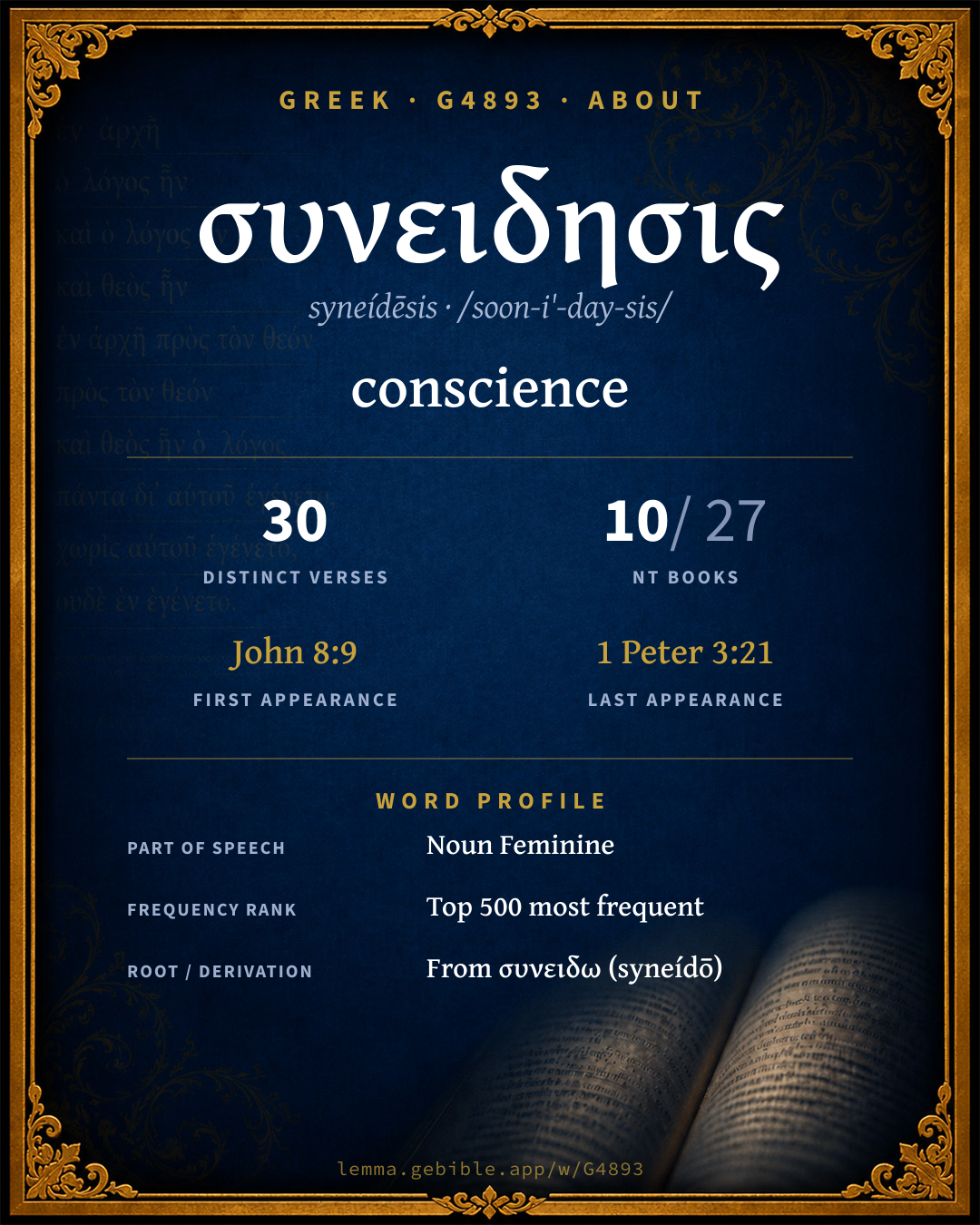
συνείδησις
conscience
‘conscience’ is one of 2 main senses fuller range ↓
Full lexicon entry — Thayer's Greek Lexicon
From Thayer's Greek Lexicon
Where this word appears
See every Accusative-case word in the Greek New Testament →
Grammar key — what these labels mean
Part of speech
- Noun
- A naming word — a person, place, thing, or idea.
Case
- Accusative
- The case of the direct object and of extent.
- Genitive
- The case of source, possession, or “of” — answers “whose / from what.”
- Dative
- The case of the indirect object, means, or location — “to / for / with / in.”
- Nominative
- The case of the subject (and the predicate nominative).
Gender
- Feminine
- Grammatically feminine.
Number
- Singular
- One.
- Plural
- More than one.
Grammatical forms
- Noun, Accusative, Singular, Feminine 16 times (52%)
- Noun, Genitive, Singular, Feminine 8 times (26%)
- Noun, Dative, Singular, Feminine 3 times (10%)
- Noun, Nominative, Singular, Feminine 3 times (10%)
- Noun, Dative, Plural, Feminine 1 time (3%)
Parsed forms decoded from the imported morphology (Robinson–Tischendorf, public domain), counted across 31 parsed occurrences — not distinct verses.
Every verse where G4893 appears — 30 distinct verses across 10 books. Click any verse to open its interlinear word-by-word view. Verse text shown in the World English Bible for context — . Each verse’s Greek form is shown with its reference; the English is not keyword-highlighted, since the data carries no word-level English alignment. Use “Compare translations” on any verse to read it across multiple English versions. This concordance covers the Greek New Testament; Septuagint (Greek Old Testament) occurrences of this word are not indexed here.
John 1 verse
Acts 2 verses
Romans 3 verses
- Romans 2:15 συνειδήσεως n gen sg fem in that they show the work of the law written in their hearts, their conscience testifying with them, and their thoughts among themselves accusing or else excusing them)
- Romans 9:1 συνειδήσεώς n gen sg fem I tell the truth in Christ. I am not lying, my conscience testifying with me in the Holy Spirit,
- Romans 13:5 συνείδησιν n acc sg fem Therefore you need to be in subjection, not only because of the wrath, but also for conscience' sake.
1 Corinthians 7 verses
- 1 Corinthians 8:7 συνείδησις n nom sg fem However, that knowledge isn't in all men. But some, with consciousness of the idol until now, eat as of a thing sacrificed to an idol, and their conscience, being weak, is defiled.
- 1 Corinthians 8:10 συνείδησις n nom sg fem For if a man sees you who have knowledge sitting in an idol's temple, won't his conscience, if he is weak, be emboldened to eat things sacrificed to idols?
- 1 Corinthians 8:12 συνείδησιν n acc sg fem Thus, sinning against the brothers, and wounding their conscience when it is weak, you sin against Christ.
- 1 Corinthians 10:25 συνείδησιν n acc sg fem Whatever is sold in the butcher shop, eat, asking no question for the sake of conscience,
- 1 Corinthians 10:27 συνείδησιν n acc sg fem But if one of those who don't believe invites you to a meal, and you are inclined to go, eat whatever is set before you, asking no questions for the sake of conscience.
- 1 Corinthians 10:28 συνείδησιν n acc sg fem But if anyone says to you, "This was offered to idols," don't eat it for the sake of the one who told you, and for the sake of conscience. For "the earth is the Lord's, and all its fullness."
- 1 Corinthians 10:29 συνείδησιν συνειδήσεως n acc sg fem n gen sg fem Conscience, I say, not your own, but the other's conscience. For why is my liberty judged by another conscience?
2 Corinthians 3 verses
- 2 Corinthians 1:12 συνειδήσεως n gen sg fem For our boasting is this: the testimony of our conscience, that in holiness and sincerity of God, not in fleshly wisdom but in the grace of God we behaved ourselves in the world, and more abundantly toward you.
- 2 Corinthians 4:2 συνείδησιν n acc sg fem But we have renounced the hidden things of shame, not walking in craftiness, nor handling the word of God deceitfully; but by the manifestation of the truth commending ourselves to every man's conscience in the sight of God.
- 2 Corinthians 5:11 συνειδήσεσιν n dat pl fem Knowing therefore the fear of the Lord, we persuade men, but we are revealed to God; and I hope that we are revealed also in your consciences.
1 Timothy 4 verses
- 1 Timothy 1:5 συνειδήσεως n gen sg fem but the end of the charge is love, out of a pure heart and a good conscience and unfeigned faith;
- 1 Timothy 1:19 συνείδησιν n acc sg fem holding faith and a good conscience; which some having thrust away made a shipwreck concerning the faith;
- 1 Timothy 3:9 συνειδήσει n dat sg fem holding the mystery of the faith in a pure conscience.
- 1 Timothy 4:2 συνείδησιν n acc sg fem through the hypocrisy of men who speak lies, branded in their own conscience as with a hot iron;
2 Timothy 1 verse
Titus 1 verse
Hebrews 5 verses
- Hebrews 9:9 συνείδησιν n acc sg fem which is a symbol of the present age, where gifts and sacrifices are offered that are incapable, concerning the conscience, of making the worshipper perfect;
- Hebrews 9:14 συνείδησιν n acc sg fem how much more will the blood of Christ, who through the eternal Spirit offered himself without blemish to God, cleanse your conscience from dead works to serve the living God?
- Hebrews 10:2 συνείδησιν n acc sg fem Or else wouldn't they have ceased to be offered, because the worshippers, having been once cleansed, would have had no more consciousness of sins?
- Hebrews 10:22 συνειδήσεως n gen sg fem let's draw near with a true heart in fullness of faith, having our hearts sprinkled from an evil conscience, and having our body washed with pure water,
- Hebrews 13:18 συνείδησιν n acc sg fem Pray for us, for we are persuaded that we have a good conscience, desiring to live honorably in all things.
1 Peter 3 verses
- 1 Peter 2:19 συνείδησιν n acc sg fem For it is commendable if someone endures pain, suffering unjustly, because of conscience toward God.
- 1 Peter 3:16 συνείδησιν n acc sg fem having a good conscience; that, while you are spoken against as evildoers, they may be disappointed who curse your good manner of life in Christ.
- 1 Peter 3:21 συνειδήσεως n gen sg fem This is a symbol of baptism, which now saves you-- not the putting away of the filth of the flesh, but the answer of a good conscience toward God, through the resurrection of Jesus Christ,
About this entry
At a glance — auto-summarized from this page’s data, not written by a person. Every figure links to its source below. This summary describes the numbers; it doesn’t interpret them.
συνειδησις — transliterated syneídēsis — is a Greek noun carrying the sense “conscience.” Debuting at John 8:9, it then recurs through the corpus. The Greek New Testament uses it across 30 verses — moderately common. Thayer's distinguishes 2 senses for it. See the sense tree, 30-verse concordance, and the renderings breakdown below.
Gloss history
Strong's 1890 vs modern scholarship
About this word
Strong's G4893 catalogs a Greek word from the Greek New Testament.
These counts are not copied from any lexicon or concordance. They are computed here, from the morphology-tagged Greek New Testament. What Lemma adds →
- 30
- distinct verses
- The word appears in 30 distinct verses.
- 10 / 27
- NT books
- The word appears in 10 of 27 New Testament books.
- #448
- by frequency
- Top 500 most frequent Greek words (rank 448 of 5,347 Greek words by occurrence).
View all 30 occurrences in the concordance →
Most concentrated in
- 1 Corinthians 7 verses 23%
- Hebrews 5 verses 17%
- 1 Timothy 4 verses 13%
By section of the New Testament
By traditional corpus
Conventional, traditional groupings — biblical authorship is debated, so this is a traditional corpus grouping, not an authorship claim. Some books belong to more than one corpus (Luke is in both the Gospels and the Lukan corpus, and so on), so these shares overlap and need not total 100%. Each figure is a share of the word’s 30 distinct verses.
- Pauline corpus 19 verses · 63%
- Hebrews 5 verses · 17%
- General (Catholic) Epistles 3 verses · 10%
- Lukan (Luke–Acts) 2 verses · 7%
- Gospels 1 verse · 3%
- Johannine 1 verse · 3%
How translations render this word
Counts come from each version’s own published word-to-Strong’s tagging or interlinear alignment — an approximate guide to how each version renders this word, not a word-level alignment the data otherwise carries. Because each total is that version’s own tagged count, the per-version totals vary from one another and need not match the appearance or distinct-verse counts above. These counts may also differ from a printed concordance because Lemma counts each distinctly tagged rendering and does not collapse phrase taggings into a single head-word total. This is a fixed set of word-tagged versions (KJV, ASV, BSB, ULT) and does not change with the reading translation you choose elsewhere. Each version’s license is shown beside its name below (and on Sources).
- King James Version: Conscience 28×
- American Standard Version: Conscience 25×
- Berean Standard Bible: Conscience 22×, Consciences 4×
- unfoldingWord Literal Text: Conscience 25×, A 9×, Consciences 3×
King James Version Public Domain
Renders G4893 across 32 tagged occurrences — most commonly:
Plus 4 renderings that appear only once — usually multi-word phrases or single function words the recovered tagging swept in, not distinct renderings.
American Standard Version Public Domain
Renders G4893 across 33 tagged occurrences — most commonly:
Plus 8 renderings that appear only once — usually multi-word phrases or single function words the recovered tagging swept in, not distinct renderings.
Berean Standard Bible Public Domain
Renders G4893 across 29 tagged occurrences — most commonly:
Plus 3 renderings that appear only once — usually multi-word phrases or single function words the recovered tagging swept in, not distinct renderings. Not rendered by a distinct English word in 1 further occurrence.
unfoldingWord Literal Text CC BY-SA 4.0
Renders G4893 across 42 tagged occurrences — most commonly:
Plus 1 rendering that appears only once — usually multi-word phrases or single function words the recovered tagging swept in, not distinct renderings.
Senses in Thayer's
The 2 senses Thayer's distinguishes for this word, in lexicon order (not ranked by frequency or importance). The full entry — with sub-senses — is in the Lexicon Entry tab.
- the consciousness of anything
- the soul as distinguishing between what is morally good and bad…
Word origin
Derived from συνειδω (syneídō) (G4894) — to know with.
From a prolonged form of G4894 ; co-perception that is moral consciousness : - conscience.
— Strong’s Exhaustive Concordance (1890), public domain.
Forms in the corpus
The 6 distinct written forms G4893 takes in the Greek New Testament, most frequent first — each parse links to that case’s occurrences in the concordance.
| Form | Parsing | Example | Uses |
|---|---|---|---|
| συνείδησιν syneídēsin | Noun, Accusative, Singular, Feminine | Acts 24:16 | 16 |
| συνειδήσεως syneidḗseōs | Noun, Genitive, Singular, Feminine | John 8:9 | 7 |
| συνείδησις syneídēsis | Noun, Nominative, Singular, Feminine | 1 Corinthians 8:7 | 3 |
| συνειδήσει syneidḗsei | Noun, Dative, Singular, Feminine | Acts 23:1 | 3 |
| συνειδήσεσιν syneidḗsesin | Noun, Dative, Plural, Feminine | 2 Corinthians 5:11 | 1 |
| συνειδήσεώς syneidḗseṓs | Noun, Genitive, Singular, Feminine | Romans 9:1 | 1 |
Septuagint usage
The same Greek word συνειδησις appears 1 time in the Greek Old Testament (Septuagint), across 1 verse in 1 book.
- 1
- LXX occurrences
- Tagged occurrences of this Greek word in the Septuagint.
- 1
- verse
- Distinct Septuagint verses containing this word.
- 1 / 39
- OT books
- The word appears in 1 of the 39 Old Testament books.
Sample Septuagint occurrences
- Ecclesiastes 10:20 συνείδησις
Septuagint occurrences (same lexeme)
Every verse where the same Strong’s number (G4893) appears in the Greek Septuagint. Verse text shown in the World English Bible for context; the Greek form is the matched word — the English is not keyword-highlighted.
These are occurrences of the same Greek lexeme (G4893) in the Septuagint — not a translation of any one Hebrew word. The store carries no word-level Hebrew↔Greek alignment, so no Hebrew original is asserted here. Counts come from the recovered LXX Strong's tagging — high-frequency vocabulary is well covered, while rare or late forms may be untagged — so they reflect tagged occurrences and may slightly undercount.