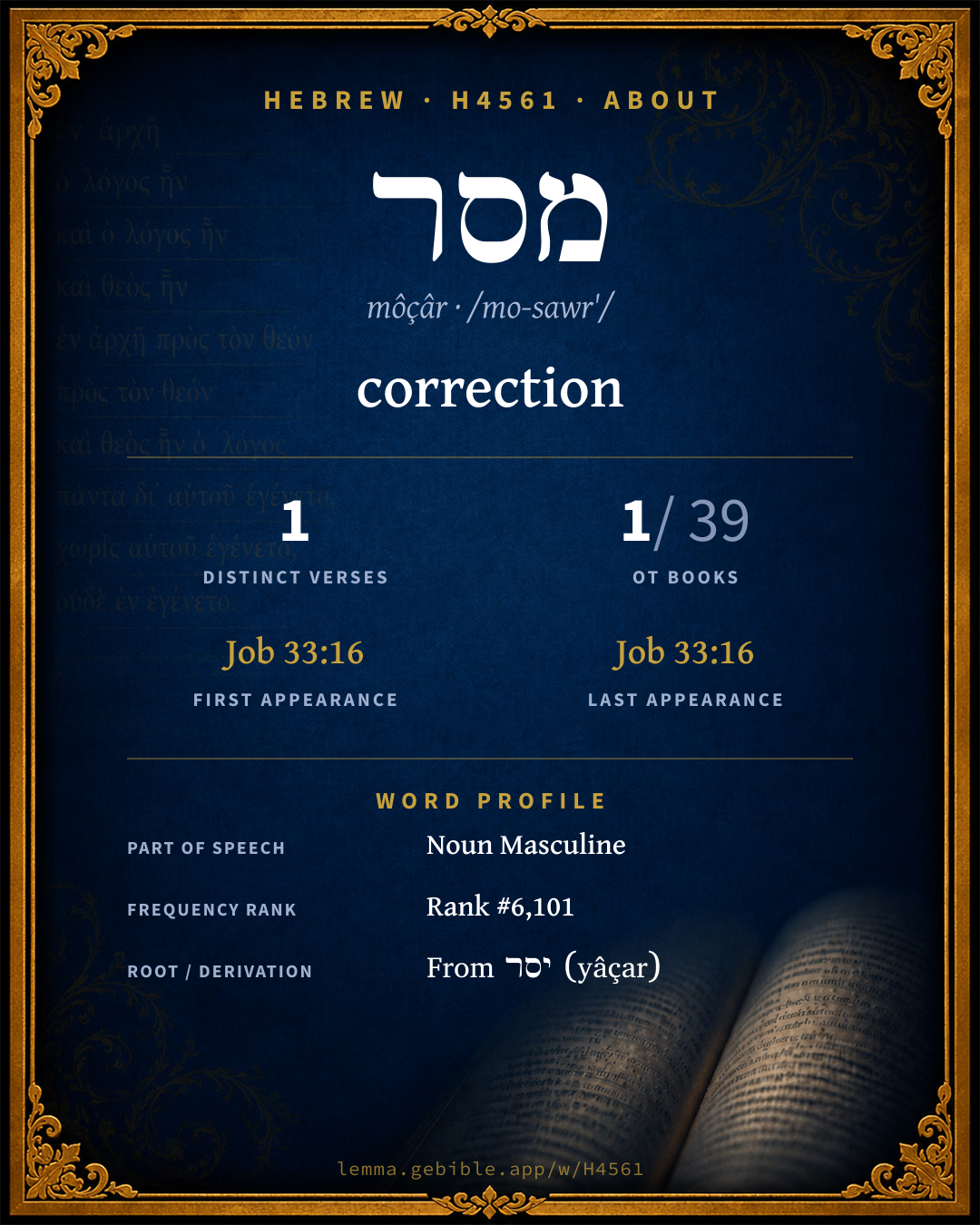
מֹסָר
correction
Full lexicon entry — Brown-Driver-Briggs (BDB)
From Brown-Driver-Briggs (BDB)
Where this word appears
Grammar key — what these labels mean
Noun type
- Common
- A common noun — a general class of person, place, or thing (“king,” “city,” “water”), not a specific name.
State
- Construct
- A noun bound to a following noun in a possessive / “of” relationship (the construct chain).
Gender
- Masculine
- Grammatically masculine.
Number
- Singular
- One.
Every verse where H4561 appears — 1 distinct verse across 1 book. Click any verse to open its interlinear word-by-word view. Verse text shown in the World English Bible for context — . Each verse’s Hebrew form is shown with its reference; the English is not keyword-highlighted, since the data carries no word-level English alignment. Use “Compare translations” on any verse to read it across multiple English versions. This concordance covers the Hebrew Bible; Septuagint (Greek Old Testament) occurrences are not indexed here.
Job 1 verse
About this entry
At a glance — auto-summarized from this page’s data, not written by a person. Every figure links to its source below. This summary describes the numbers; it doesn’t interpret them.
מסר (môçâr) is a Hebrew noun most often rendered “correction.” With only 1 verse it sits in the long tail of Hebrew Bible vocabulary. Job dominates its distribution — 1 of 1 verses. A true hapax — its single appearance is Job 33:16. Related forms include יסר, יסור and מוסר. For the data behind this summary, explore the sense tree and the renderings breakdown below.
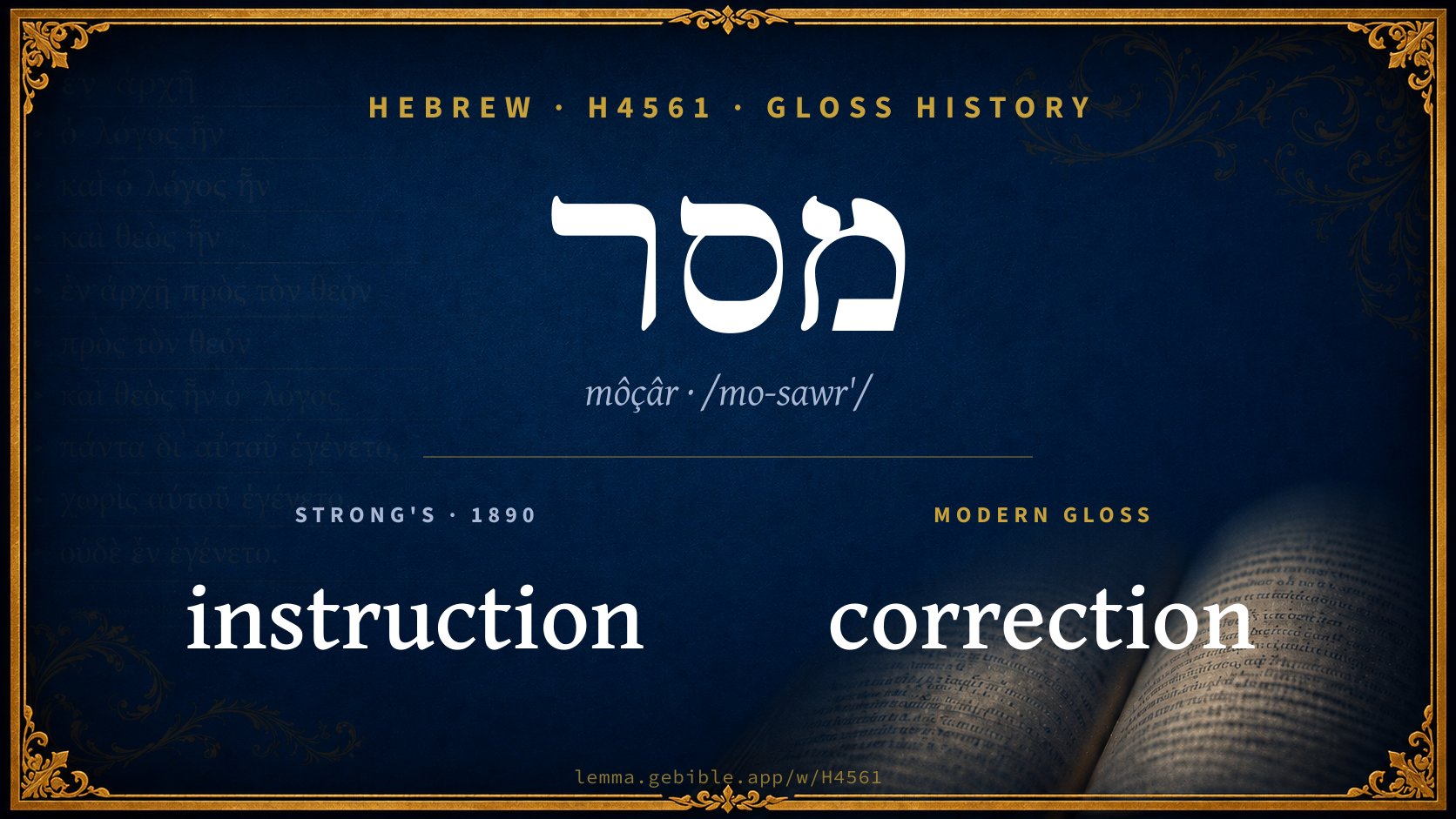
Gloss history
Strong's 1890 vs modern scholarship
About this word
Strong's H4561 catalogs a Hebrew word from the Hebrew Old Testament.
These counts are not copied from any lexicon or concordance. They are computed here, from the morphology-tagged Hebrew Old Testament. What Lemma adds →
- 1
- distinct verses
- The word appears in 1 distinct verse.
- 1 / 39
- OT books
- The word appears in 1 of 39 Old Testament books.
- #6,101
- by frequency
- Rank #6,101 (rank 6,101 of 8,640 Hebrew words by occurrence).
View all 1 occurrence in the concordance →
Most concentrated in
- Job 1 verse 100%
By section of the Old Testament
By traditional corpus
Conventional, traditional groupings — biblical authorship is debated, so this is a traditional corpus grouping, not an authorship claim. Each share is this word’s portion of its verses in that division of the Hebrew canon. Each figure is a share of the word’s 1 distinct verse.
- Writings (Ketuvim) 1 verse · 100%
How translations render this word
Counts come from each version’s own published word-to-Strong’s tagging or interlinear alignment — an approximate guide to how each version renders this word, not a word-level alignment the data otherwise carries. Because each total is that version’s own tagged count, the per-version totals vary from one another and need not match the appearance or distinct-verse counts above. These counts may also differ from a printed concordance because Lemma counts each distinctly tagged rendering and does not collapse phrase taggings into a single head-word total. This is a fixed set of word-tagged versions (KJV, ASV, BSB, ULT) and does not change with the reading translation you choose elsewhere. Each version’s license is shown beside its name below (and on Sources).
- King James Version: Instruction 1×
- American Standard Version: Instruction 1×
- Berean Standard Bible: Warnings 1×
- unfoldingWord Literal Text: And 1×, Correction 1×
King James Version Public Domain
Renders H4561 across 1 tagged occurrence — most commonly:
American Standard Version Public Domain
Renders H4561 across 1 tagged occurrence — most commonly:
Berean Standard Bible Public Domain
Renders H4561 across 1 tagged occurrence — most commonly:
unfoldingWord Literal Text CC BY-SA 4.0
Renders H4561 across 2 tagged occurrences — most commonly:
6 senses and sub-senses in the full BDB
What do BDB’s symbols mean?
BDB uses these scholarly abbreviations:
| Symbol | Meaning |
|---|---|
| 𝔊 | the Septuagint (the ancient Greek translation, LXX) |
| 𝔙 | the Vulgate (the Latin translation) |
| 𝔖 | the Syriac version (the Peshitta) |
| 𝔗 | the Targum (the Aramaic translation) |
| ψ | the Psalms |
| √ | root (the underlying root or stem) |
| ‖ | parallel passage (a synonymous or contrasted parallel) |
| † | the dagger: every passage where the word occurs is cited |
The 6 senses and sub-senses the full Brown-Driver-Briggs lexicon distinguishes for this word, in lexicon order (not ranked by frequency), with BDB’s own verbatim wording and sub-sense lettering. Shown in Hebrew script with BDB’s own scholarly abbreviations. The condensed entry is in the Lexicon Entry tab.
- 1.
- a. discipline, correction, of God, Dt 11:2 מוּסַר י׳ the discipline of י׳ (of Y.’s wonders, as exercising a disciplinary, educating influence upon Israel, cf. Dr); לקח מ׳ Je 17:23; 32:33; 35:13 Zp 3:2, 7; ψ 50:17 Jb 33:16; 36:10; מ׳ כְּלִמָּתִי the correction of (i.e. which leadeth to) my shame Jb 20:3. e.g. Deuteronomy 11:2
- b. מ׳ הבלים עֵץ הוּא the discipline of unreal gods is wood (is like themselves, destitute of true moral force) Je 10:8; Ez 5:15 = warning example (?) Ew Sm (‖ שְׁמָמָה; del. 𝔊 Co). e.g. Jeremiah 10:8
- c. in Proverbs, discipline in the school of wisdom: חכמה ומ׳ 1:2, 7; 23:23; מ׳ חכמה discipline of wisdom 15:33; מ׳ הַשְׂכֵּל 1:3; תוכחות מ׳ 6:23; הָבִיאָה לַמּ׳ לִבֶּ֑ךָ 23:12 apply thy mind to discipline; קבּל מ׳ 19:20; לקח מ׳ 1:3; 8:10; 24:32 (cf. Je supr.); קנה מ׳ 23:23; שׁמע מ׳ 8:33; 19:27; שׁמר מ׳ 10:17; אהב מ׳ 12:1; החזק במ׳ 4:13; the reverse שׂנא מ׳ 5:12; פרע מ׳ 13:18; 15:32; בזה מ׳ 1:7; באין מ׳ for lack of discipline 5:23 (‖ בְּרֹב אִיַּלְתּוֹ); מ׳ אֱוִלִים אִוֶּלֶת 16:22 the discipline of fools is folly; of paternal discipline, correction, Pr. 1:8; 4:1; 13:1. e.g. Proverbs 1:2
- 2. more severely, chastening, chastisement:
- a. of God, מ׳ יהוה Pr 3:11 chastening of Yahweh; מ׳ שׁדַּי Jb 5:17; מוּסָֽרְךָ Is 26:16 מ׳ שְׁלוֹמֵנוּ עָלָיו Is 53:5 chastisement of (i.e. leading to) our peace was upon him; לקח מ׳ Je 2:30; 5:3; 7:28; מ׳ אַכְזָרִי Je 30:14 chastisement of a cruel one, MT, but read מוּסָר א׳ cruel chastisement, Gf and especially Gie; אני מ׳ לְכֻלָּם Ho 5:2 I am a chastisement for them all. e.g. Proverbs 3:11
- b. of man, Pr 15:5; 23:13; שִׁחֲרוֹ מ׳ 13:24; שֵׁבֶט מ׳ 22:15; מ׳ אויל 7:22 chastisement of a fool; מוּסָר רָע 15:10 grievous chastisement. e.g. Proverbs 15:5
Senses from the full Brown-Driver-Briggs lexicon (Brown, Driver, Briggs; Oxford 1906 — public domain), digitized via Sefaria, supplemented by the OpenScriptures HebrewLexicon (CC BY 4.0). Full attribution on Sources.
Word origin
n.m. Pr 15:10 discipline (of the moral nature), chastening, correction;—מ׳ Je 2:30 + 31 times (Ez 5:15 del. Co); cstr. מוּסַר Dt 11:2 + 14 times (for Jb 12:18 see אסר); sf. מוּסָרִי Pr 8:10; מוּסָֽרְךָ Is 26:16; מֹסָרָם Jb 33:16 (for מֻסָרָם Di);—
— Brown-Driver-Briggs (Oxford 1906, public domain), digitized via Sefaria, supplemented by the OpenScriptures HebrewLexicon (CC BY 4.0). See Sources.
Derived from יסר (yâçar) (H3256) — to discipline.
Jastrow Dictionary
A second Hebrew/Aramaic lexicon for comparison, covering Aramaic and post-biblical (Talmudic, Targumic, Midrashic) usage that the biblical-Hebrew BDB does not. Matched by lemma rather than by Strong’s number, so a lemma may carry more than one Jastrow headword (shown separately below), and the entries cover usage well beyond the Bible.
מָסַר
- 1. to seize (v. Num. XXXI, 5).—Denom. מְסִירָה 1. e.g. Numbers 31:5
- 2. to hand over; to deliver, transmit. Ab. I, 1 ומְסָרָהּ וכ׳ and handed it (the Law) over to &c. (in the chain of tradition). B. Mets. 8ᵇ (expl. מוֹסֵירָה) כאדם המוֹסֵר דבר וכ׳ like one handing over (giving possession) &c. Ib. 111ᵇ bot. (expl. נשא את נפשו, Deut. XXIV, 15) דבר שמסר את נפשו עליו Ms. M. (ed. המוסר, v. Rabb. D. S. a. l. note) a labor for which he binds (obligates) himself; [oth. explan.] ib. 112ᵃ מ׳ את עצמו למיתה (Ms. M. מ׳ לו נפשו עליו) he delivered himself to death, i.e. risked his life; (Ms. M. for which he surrendered his life to the employer); Sifré Deut. 279 מ׳ לך את נפשו he surrendered his life to thee (the employer); a. v. fr.—מ׳ דין על to surrender one’s case against a man (to Providence); v. דִּין. B. Kam. 93ᵃ; R. Hash. 16ᵇ; a. e.—Esp. a) to surrender a person to the authorities, to inform against. Gitt. 7ᵃ ובידי למָסְרָם למלכות it is in my power to bring them to judgment through the (Roman) government. Tosef. Ter. VII, 20 יהרגו כולם ולא יִמְסְרוּ וכ׳ let them all suffer death rather than surrender one Israelite &c.; a. fr.—V. מָסוֹר.—b) מ׳ עצמו (sub. למיתה) to suffer martyrdom. Pes. 53ᵇ שמָסְרוּ עצמן על קדושת וכ׳ who were ready to suffer death for the sanctification of the Name (of the Lord). Yalk. Ex. 182 אומה המוֹסֶרֶת עצמה וכ׳ a people that is ready to die for the unity of my Name; a. fr.—Part. pass. מָסוּר; f. מְסוּרָה; pl. מְסוּרִים, מְסוּרִין; מְסוּרוֹת. Kidd. 32ᵇ; B. Mets. 58ᵇ דבר המ׳ ללב וכ׳ to an injunction which is entrusted to the heart (over which human authorities have no control), the Text adds, ‘and thou shalt be afraid of thy God.’ Mekh. Ki Thissa (ref. to לכם, Ex. XXXI, 14) לכם שבת מ׳ ואי אתם מ׳ לשבת the Sabbath is given in your charge, but you are not surrendered to the Sabbath, i.e., there are higher objects for which the Sabbath law must eventually be violated; Yoma 85ᵇ; a. fr. e.g. Deuteronomy 24:15
- to be delivered, transmitted. Num. R. s. 4 נִמְסְרָה לו בכורה the birth-right (priesthood) was transferred to him. B. Kam. 82ᵇ אין נִמְסָרִים בידכם they will not be given into your hands, you will have no power over them; Men. 64ᵇ. Y. Yoma III, 40ᵈ bot. לא היה נִמְסָר וכ׳ it (the pronunciation of the Tetragrammaton) was not communicated to any but &c.; a. fr.
מְסַר
- Targ. Gen. XXXIX, 8. Targ. Am. I, 6. Targ. O. Deut. XXIV, 15; a. fr.—Part. pass. מָסִיר; f. מְסִירָא; pl. מְסִירִין; מְסִירָן. Targ. Num. III, 9; a. fr.—[Targ. Y. II, Gen. XVI, 5 מְסָרִין בידך, a corrupt., prob. to be read: מַסְרִית עלך; cmp. B. Kam. 93ᵃ.]—B. Mets. 8ᵇ מאן קא מ׳ ליה דליקני who is there to deliver it to him, that he might take possession? Y. Yoma III, 40ᵈ bot. אנא מָסֵר יתיה לך I will transmit it (the pronunciation of the Tetragrammaton) to you. Koh. R. to III, 11 [read:] אית הכי בר נש דאִימְסוֹר ליה is there a person here to whom I might communicate it?; כד אתי מִימְסַר when he was about to communicate it. Kidd. 12ᵇ דמ׳ מודעא וכ׳ who enters a protest against his own letter of divorce. Ber. 20ᵃ הוו קא מָסְרֵי נפשייהו וכ׳ were ready to suffer martyrdom for the sanctification of the Name; אנן לא מַסְרִינָן וכ׳ we are not ready to suffer &c.; a. fr.
- to be surrendered, transmitted; to surrender one’s self. Targ. Lev. XXVI, 25. Targ. Ps. LXXIX, 11; a. e.—Gitt. 66ᵇ מִימַּסְרָן; 29ᵃ מִמַּסְרָן, v. מִילָּא II. Snh. 26ᵃ מִימַּסְרֵי have decided to surrender (to capitulate). Koh. R. l. c. ולא קבל עליה מִימְּסֵר ליה מימסר (some ed. למימסר ליה) he declined to have the Tetragrammaton transmitted to him (v. Y. Yoma l. c.).
מְסַר II
- (denom. of מְסָרָא) to saw. Targ. Is. XLIV, 13. Targ. II Sam. XII, 31 (ed. Wil. מְסַר); Targ. I Chr. XX, 3 (ed. Rahm. מסאר).—Part. pass. מְמַסַּר. Targ. I Kings VII, 9.
מַסָּר
- a tool with rough edges or teeth, file, saw. Sabb. XVII, 4 מ׳ הגדול saw for cutting wood. Kel. XXI, 3; Tosef. Kel. B. Bath. I, 8 מלבן של מ׳ הגדול the frame of the saw. Y. Succ. III, 53ᶜ bot. כמין מ׳ leaves serrated like a saw, v. מַגָּל; Tosef. Succ. II, 7; Bab. Succ. 34ᵃ דומה למ׳. Gen. R. s. 6; Midr. Sam. ch. IX, v. נָסַר; Ex. R. s. 5 כס׳ (Var. כמַסְמָר); a. e.
A Dictionary of the Targumim, the Talmud Babli and Yerushalmi, and the Midrashic Literature (Marcus Jastrow; London, Luzac, 1903) — Public Domain. Digitized via Sefaria. Digitized via Sefaria. Full attribution on Sources.
Same root — word family
Other BDB entries built from the same root as H4561, grouped by Strong’s listed origin. These share a root / origin per the lexicon — not necessarily a shared meaning. Each links to that word’s own entry.
Derives from
Shares the same root
Compare all same-root words → Showing 4 of 5 — not the complete family. They share a root, not necessarily a meaning.
Septuagint verse parallels
This word appears in 1 verse that also exists in the Greek Old Testament (Septuagint), out of the 1 Hebrew verse it occurs in. You can read those verses in Greek by switching the Old Testament edition to the Septuagint.
Read these verses in the Septuagint
This is a verse-level parallel only — the same verses exist in both the Hebrew and Greek Old Testaments. No word-level Hebrew↔Greek correspondence is claimed: the data carries no such alignment, so no Greek word is shown as this Hebrew word’s translation. Coverage is not total — the Septuagint omits the deuterocanon and renumbers the Psalms, so some Hebrew verses have no direct Greek parallel.