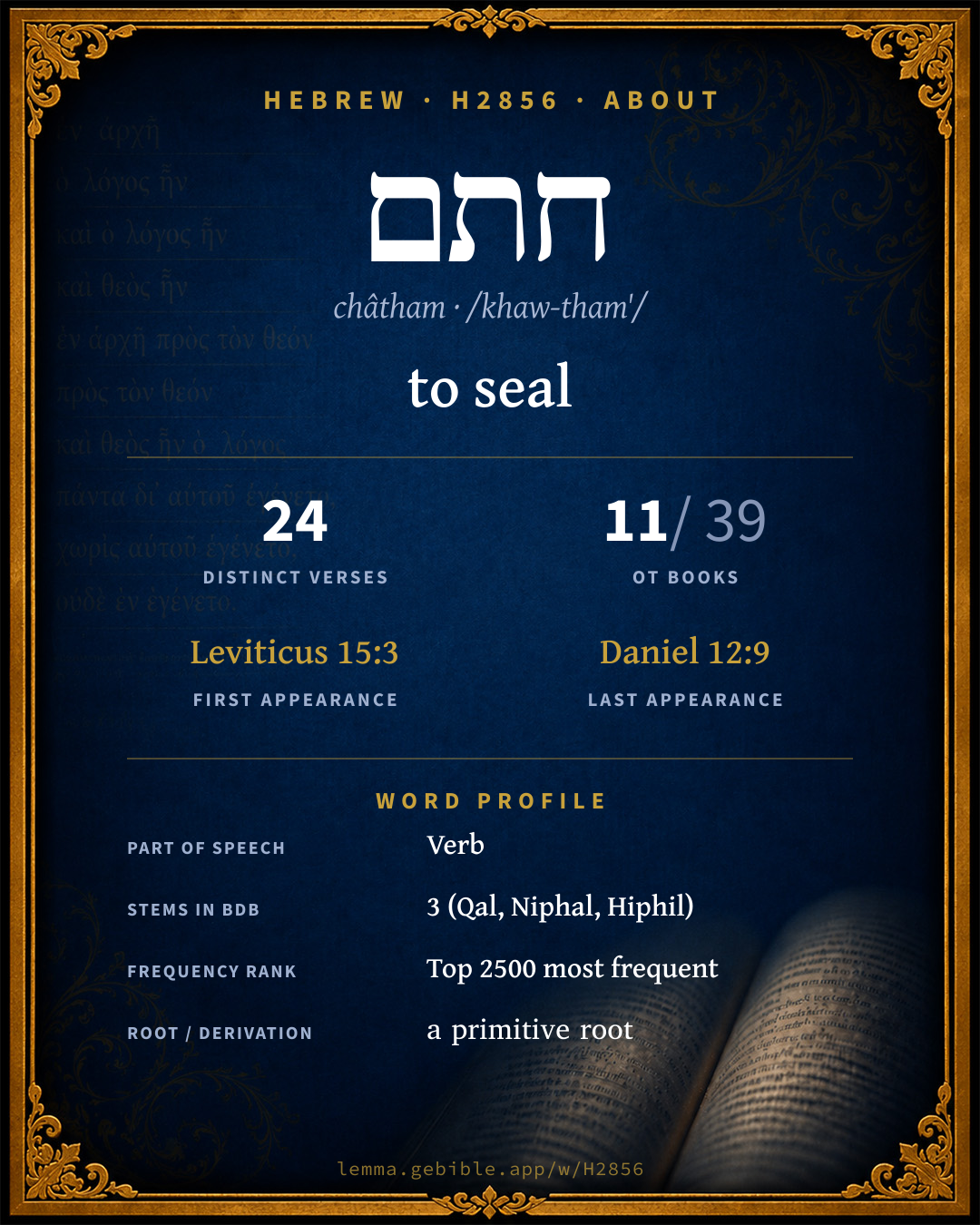
חָתַם
to seal
also: seal up, affix a seal fuller range ↓
Full lexicon entry — Brown-Driver-Briggs (BDB)
From Brown-Driver-Briggs (BDB)
Where this word appears
See every Qal verb in the Hebrew Bible →
Grammar key — what these labels mean
Part of speech
- Verb
- An action or state-of-being word.
Stem
- Qal
- The basic, simple active stem — the plain form of the verb (“he wrote”). Here: ‘seal’
- Niphal
- Usually the simple passive or reflexive of the Qal (“he was written”).
- Hiphil
- The causative active stem (“he caused / brought about”).
- Piel
- An intensive or resultative active stem.
Form
- Participle Passive
- A verbal adjective expressing action received (“written”).
- Imperfect
- An incomplete, ongoing, or future action (“he will / would write”).
- Infinitive Construct
- A bound verbal noun, frequently with prepositions (“to write / in writing”).
- Infinitive Absolute
- An unbound verbal noun, often intensifying or standing in for a finite verb.
- Imperative
- A direct command (“write!”).
- Sequential Imperfect
- An imperfect with prefixed waw — the standard past-narrative form (waw-consecutive imperfect).
- Perfect
- A completed action or state — Hebrew marks aspect (completeness) more than strict tense (“he wrote”).
- Participle Active
- A verbal adjective expressing ongoing or characteristic action (“writing / one who writes”).
State
- Absolute
- The independent form of a noun, not bound to a following word.
- Construct
- A noun bound to a following noun in a possessive / “of” relationship (the construct chain).
Person
- 3rd Person
- The one spoken about (“he / she / it / they”).
- 2nd Person
- The one addressed (“you”).
- 1st Person
- The speaker (“I / we”).
Gender
- Masculine
- Grammatically masculine.
- Common
- Either gender — not distinguished for this form.
- Feminine
- Grammatically feminine.
Number
- Singular
- One.
- Plural
- More than one (in Hebrew, generally three or more).
Grammatical forms 15 distinct
- Verb, Qal, Participle Passive, Masculine, Singular, Absolute 8 times (30%)
- Verb, Qal, Imperfect, 3rd Person, Masculine, Singular 3 times (11%)
- Verb, Qal, Infinitive Construct 2 times (7%)
- Verb, Qal, Participle Passive, Masculine, Plural, Absolute 2 times (7%)
- Verb, Qal, Imperative, 2nd Person, Masculine, Singular 2 times (7%)
- Verb, Niphal, Infinitive Absolute 1 time (4%)
- Verb, Niphal, Participle Passive, Masculine, Singular, Absolute 1 time (4%)
- Verb, Qal, Infinitive Absolute 1 time (4%)
+7 more forms (7 occurrences)
Parsed forms decoded from the imported morphology (morphhb / Westminster Leningrad Codex — WLC text public domain, morphhb tagging CC BY 4.0), counted across 27 parsed occurrences — not distinct verses.
Every verse where H2856 appears — 24 distinct verses across 11 books. Click any verse to open its interlinear word-by-word view. Verse text shown in the World English Bible for context — . Each verse’s Hebrew form is shown with its reference; the English is not keyword-highlighted, since the data carries no word-level English alignment. Use “Compare translations” on any verse to read it across multiple English versions. This concordance covers the Hebrew Bible; Septuagint (Greek Old Testament) occurrences are not indexed here.
Leviticus 1 verse
Deuteronomy 1 verse
1 Kings 1 verse
Nehemiah 2 verses
- Nehemiah 9:38 הֶֽ/חָת֔וּם ptcl def.art + Qal ptcp.pass ms Yet for all this we make a sure covenant, and write it; and our princes, our Levites, [and] our priests, seal to it.
- Nehemiah 10:1 הַ/חֲתוּמִ֑ים ptcl def.art + Qal ptcp.pass mp Now those who sealed were: Nehemiah the governor, the son of Hacaliah, and Zedekiah,
Esther 3 verses
- Esther 3:12 וְ/נֶחְתָּ֖ם conj + Niphal ptcp.pass ms Then were the king's scribes called in the first month, on the thirteenth day of it; and there was written according to all that Haman commanded to the king's satraps, and to the governors who were over every province, and to the princes of every people, to every province according to the writing of it, and to every people after their language; in the name of king Ahasuerus was it written, and it was sealed with the king's ring.
- Esther 8:8 וְ/חִתְמ֖וּ וְ/נַחְתּ֛וֹם conj + Qal impv 2mp conj + Niphal inf.abs Write you also to the Jews, as it pleases you, in the king's name, and seal it with the king's ring; for the writing which is written in the king's name, and sealed with the king's ring, may no man reverse.
- Esther 8:10 וַ/יַּחְתֹּ֖ם conj + Qal wimpf 3ms He wrote the name of king Ahasuerus, and sealed it with the king's ring, and sent letters by post on horseback, riding on swift steeds that were used in the king's service, bred of the stud:
Job 5 verses
- Job 9:7 יַחְתֹּֽם Qal impf 3ms Who commands the sun, and it doesn't rise, And seals up the stars;
- Job 14:17 חָתֻ֣ם Qal ptcp.pass ms My disobedience is sealed up in a bag. You fasten up my iniquity.
- Job 24:16 חִתְּמוּ Piel pf 3cp In the dark they dig through houses. They shut themselves up in the daytime. They don't know the light.
- Job 33:16 יַחְתֹּֽם Qal impf 3ms Then he opens the ears of men, And seals their instruction,
- Job 37:7 יַחְתּ֑וֹם Qal impf 3ms He seals up the hand of every man, That all men whom he has made may know it.
Song of Solomon 1 verse
Isaiah 2 verses
- Isaiah 8:16 חֲת֥וֹם Qal impv 2ms Bind up the testimony, seal the law among my disciples.
- Isaiah 29:11 הֶֽ/חָתוּם֒ חָת֖וּם ptcl def.art + Qal ptcp.pass ms Qal ptcp.pass ms All vision is become to you as the words of a book that is sealed, which men deliver to one who is learned, saying, Read this, I pray you; and he says, I can't, for it is sealed:
Jeremiah 4 verses
- Jeremiah 32:10 וָֽ/אֶחְתֹּ֔ם conj + Qal wimpf 1cs I subscribed the deed, and sealed it, and called witnesses, and weighed him the money in the balances.
- Jeremiah 32:11 הֶֽ/חָת֛וּם ptcl def.art + Qal ptcp.pass ms So I took the deed of the purchase, both that which was sealed, containing the terms and conditions, and that which was open;
- Jeremiah 32:14 הֶ/חָת֗וּם ptcl def.art + Qal ptcp.pass ms Thus says Yahweh of Hosts, the God of Israel: Take these deeds, this deed of the purchase which is sealed, and this deed which is open, and put them in an earthen vessel; that they may continue many days.
- Jeremiah 32:44 וְ/חָתוֹם֮ conj + Qal inf.abs Men shall buy fields for money, and subscribe the deeds, and seal them, and call witnesses, in the land of Benjamin, and in the places about Jerusalem, and in the cities of Judah, and in the cities of the hill-country, and in the cities of the lowland, and in the cities of the South: for I will cause their captivity to return, says Yahweh.
Ezekiel 1 verse
Daniel 3 verses
- Daniel 9:24 ו/ל/חתם וְ/לַ/חְתֹּם֙ conj + prep + Qal inf.cs conj + prep + Qal inf.cs Seventy weeks are decreed on your people and on your holy city, to finish disobedience, and to make an end of sins, and to make reconciliation for iniquity, and to bring in everlasting righteousness, and to seal up vision and prophecy, and to anoint the most holy.
- Daniel 12:4 וַ/חֲתֹ֥ם conj + Qal impv 2ms But you, Daniel, shut up the words, and seal the book, even to the time of the end: many shall run back and forth, and knowledge shall be increased."
- Daniel 12:9 וַ/חֲתֻמִ֛ים conj + Qal ptcp.pass mp He said, Go your way, Daniel; for the words are shut up and sealed until the time of the end.
About this entry
At a glance — auto-summarized from this page’s data, not written by a person. Every figure links to its source below. This summary describes the numbers; it doesn’t interpret them.
The Hebrew verb חתם centers on the idea of “to seal.” Debuting at Leviticus 15:3, it then recurs through the corpus. It appears 24 verses across 11 books of the Hebrew Bible, among its uncommon vocabulary. Read the stem: it spans 3 stems, including Qal and Niphal. It shares a root with חותם, חתם and חתמת. Dig into 24-verse concordance and the renderings breakdown below.
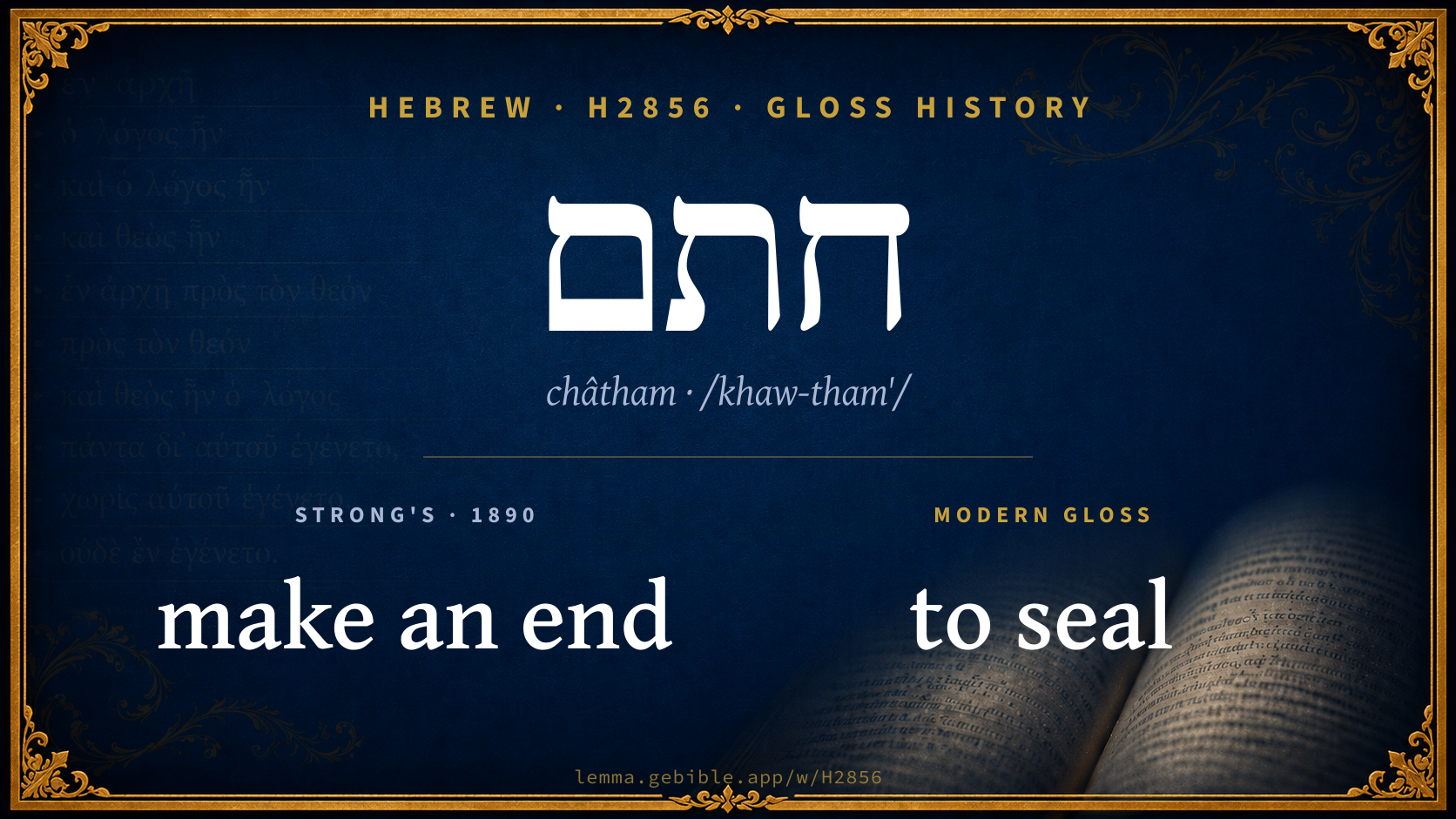
Gloss history
Strong's 1890 vs modern scholarship
About this word
Strong's H2856 catalogs a Hebrew word from the Hebrew Old Testament.
These counts are not copied from any lexicon or concordance. They are computed here, from the morphology-tagged Hebrew Old Testament. What Lemma adds →
- 24
- distinct verses
- The word appears in 24 distinct verses.
- 11 / 39
- OT books
- The word appears in 11 of 39 Old Testament books.
- #1,226
- by frequency
- Top 2500 most frequent Hebrew words (rank 1,226 of 8,640 Hebrew words by occurrence).
View all 24 occurrences in the concordance →
By section of the Old Testament
By traditional corpus
Conventional, traditional groupings — biblical authorship is debated, so this is a traditional corpus grouping, not an authorship claim. Each share is this word’s portion of its verses in that division of the Hebrew canon. Each figure is a share of the word’s 24 distinct verses.
- Writings (Ketuvim) 14 verses · 58%
- Prophets (Nevi'im) 8 verses · 33%
- Torah (Pentateuch) 2 verses · 8%
How translations render this word
Counts come from each version’s own published word-to-Strong’s tagging or interlinear alignment — an approximate guide to how each version renders this word, not a word-level alignment the data otherwise carries. Because each total is that version’s own tagged count, the per-version totals vary from one another and need not match the appearance or distinct-verse counts above. These counts may also differ from a printed concordance because Lemma counts each distinctly tagged rendering and does not collapse phrase taggings into a single head-word total. This is a fixed set of word-tagged versions (KJV, ASV, BSB, ULT) and does not change with the reading translation you choose elsewhere. Each version’s license is shown beside its name below (and on Sources).
- King James Version: Sealed 7×, Seal 5×, Is sealed 2×
- American Standard Version: Sealed 6×, Seal 4×, Is sealed 3×
- Berean Standard Bible: Sealed 9×, Seal 3×
- unfoldingWord Literal Text: Sealed 3×, He seals 2×, Seal up 2×
King James Version Public Domain
Renders H2856 across 26 tagged occurrences — most commonly:
Plus 12 renderings that appear only once — usually multi-word phrases or single function words the recovered tagging swept in, not distinct renderings. Not rendered by a distinct English word in 1 further occurrence.
American Standard Version Public Domain
Renders H2856 across 26 tagged occurrences — most commonly:
Plus 13 renderings that appear only once — usually multi-word phrases or single function words the recovered tagging swept in, not distinct renderings.
Berean Standard Bible Public Domain
Renders H2856 across 26 tagged occurrences — most commonly:
Plus 14 renderings that appear only once — usually multi-word phrases or single function words the recovered tagging swept in, not distinct renderings. Not rendered by a distinct English word in 1 further occurrence.
unfoldingWord Literal Text CC BY-SA 4.0
Renders H2856 across 25 tagged occurrences — most commonly:
Plus 18 renderings that appear only once — usually multi-word phrases or single function words the recovered tagging swept in, not distinct renderings.
Senses in the full BDB
Hebrew verbs can shift meaning by stem (binyan): Qal is the basic action, Niphal is often passive or reflexive, Piel often intensifies or makes it factitive, and Hiphil is typically causative. The senses below are grouped under the stem BDB assigns to each.
What do BDB’s symbols mean?
BDB uses these scholarly abbreviations:
| Symbol | Meaning |
|---|---|
| 𝔊 | the Septuagint (the ancient Greek translation, LXX) |
| 𝔙 | the Vulgate (the Latin translation) |
| 𝔖 | the Syriac version (the Peshitta) |
| 𝔗 | the Targum (the Aramaic translation) |
| ψ | the Psalms |
| √ | root (the underlying root or stem) |
| ‖ | parallel passage (a synonymous or contrasted parallel) |
| † | the dagger: every passage where the word occurs is cited |
The 5 senses and sub-senses the full Brown-Driver-Briggs lexicon distinguishes for this word, in lexicon order (not ranked by frequency), with BDB’s own verbatim wording and sub-sense lettering. Shown in Hebrew script with BDB’s own scholarly abbreviations. The condensed entry is in the Lexicon Entry tab. See also the Forms in the corpus table below.
Qal
- Impf. 3 ms. יַחְתֹּם Jb 9:7; 33:6, יַחְתּוֹם Jb 37:7, וַיַּחְתֹּם Est 8:10, etc.; Imv. חֲתֹם Dn 12:4, חֲתוֹם Is 8:16, חִתְמוּ Est 8:8; Inf. abs. חָתוֹם Je 32:44; cstr. לַחְתֹּם Dn 9:24, + v 24 Kt (Qr לְהָתֵם); Pt. act. חוֹתֵם Ez 28:12; pass. חָתוּם Dt 32:34 + 2 times, etc.;— e.g. Job 9:7
- 1. seal, affix one’s seal, in attestation; seal with king’s seal (בְּחֹתָמוֹ) 1 K 21:8, בְּטַבַּעַת המלך Est 8:8, 10; of covenant with י׳, attested by seal (pass.) Ne 10:1, 2; fig., of י׳ putting his seal upon (בְּ) discipline, i.e. ratifying it, Jb 33:16; perhaps also upon hand of man (that man may know י׳’s ways) 37:7 v. De; Di sub 2. seal up hand of man, so that he cannot work with it (in winter). e.g. 1 Kings 21:8
- 2. seal up, fasten up by sealing, a deed of sale Je 32:10, 11 (opp. הַגָּלוּי that which was left open), v 14, 44, a book of prophecy Dn 12:4 (‖ סְתֹם הַדְּבָרים), cf. v 9 (‖ id.), 9:24b; so in sim. of unintelligible prophecy Is 29:11(×2); חֲתֹם תּוֹרָה בְּלִמֻּדָ֑י Is 8:16 seal up the teaching among my disciples, i.e. keep it securely (‖ צוֹר); of י׳’s remembrance of offences חָתוּם בְּאוֹצְרֹתָ֑י Dt 32:34 (‖ כָּמֻס עִמָּדִי), so חָתוּם בִּצְרוֹר פִּשְׁעִי Jb 14:17 (‖ וַתִּטְפֹּל עַל־עֲוֹנִי); מַעְיָן חָתוּם Ct 4:12 a fountain sealed up, metaph. of chaste woman (‖ נָעוּל (גַּל) גַּן); וּבְעַד כּוֹכָבִים יַח׳ Jb 9:7 and about the stars he putteth a seal (‖ of forbidding sun to rise).—אַתָּה חוֹתֵם תָּכְנִית Ez 28:12 is obscure: thou wast one sealing proportion, i.e. perfection,—wast complete perfection, Ges Sm.; wast a sealer of symmetry v. Da; wast a seal (ring)—i.e. חוֹתַם cstr.—of proportion Codd. 𝔊 𝔙 Hi cf. Ew; text perhaps corrupt, v. suggestions in Co.—Dn 9:24a read Qr לְהָתֵם (v. תמם). Jb 33:16; 37:7 v. sub 1. e.g. Jeremiah 32:10
Niphal
- Pf. 3 ms. [or Pt.?] נִכְתָּ֔ב וְנֶחְתָּ֖ם Est 3:12 (it was) written and sealed בְּטַבַּעַת הַמֶּלֶךְ; Inf. abs. וְנַחְתּוֹם Est 8:8 (continuing pt. נִכְתָּ֣ב) also + בְּטַבַּעַת הַמּ׳; both pass. of Qal 1. Pi. Pf. 3 pl. יוֹמָם הִתְּמוּ־לָמוֹ Jb 24:16 lit. by day they seal up for themselves, i.e. according to most, they shut themselves up, do not shew themselves (‖ לֹא יָדְעוּ אוֹר); 𝔊C has ἡμέρας ἐσφράγισαν ἐαυτοῖς (B al. ἑαυτους), whence Siegf conj. plausibly יָמִים ח׳ ל׳ they seal up the days unto themselves, i.e. daytime is for them sealed up and unused. e.g. Esther 3:12
Hiphil
- Pf. 3 ms. אוֹ־הֶחְתִּים בְּשָׂרוֹ מִזּוֹבוֹ Lv 15:3 or hath his flesh (genital organ) shewn stoppage by reason of his flux. e.g. Leviticus 15:3
Senses from the full Brown-Driver-Briggs lexicon (Brown, Driver, Briggs; Oxford 1906 — public domain), digitized via Sefaria, supplemented by the OpenScriptures HebrewLexicon (CC BY 4.0). Full attribution on Sources.
Word origin
vb. seal, affix seal, seal up (NH id.; Aramaic חֲתַם, ܚܬܰܡ; Ethiopic ኀተመ Arabic خَتَمَ (whence خَاتَمٌ) is loan-word according to Frä252)—
— Brown-Driver-Briggs (Oxford 1906, public domain), digitized via Sefaria, supplemented by the OpenScriptures HebrewLexicon (CC BY 4.0). See Sources.
Origin: a primitive root
Jastrow Dictionary
A second Hebrew/Aramaic lexicon for comparison, covering Aramaic and post-biblical (Talmudic, Targumic, Midrashic) usage that the biblical-Hebrew BDB does not. Matched by lemma rather than by Strong’s number, so a lemma may carry more than one Jastrow headword (shown separately below), and the entries cover usage well beyond the Bible.
חָתַם
- 1. , to tie up, close, lock. Tanḥ. B’resh. 1 ח׳את הים וכ׳ he locked the Ocean up, that it might not go forth &c. e.g. Genesis 1:1
- 2. to seal. Y. Ab. Zar. III, 42ᶜ bot. טבעת שׂחוֹתֵם בה the ring with which he seals. Ib. אסור לַחְתּוֹם בה you dare not use it for a seal; Tosef. ib. V (VI), 2; a. fr.—2) to sign, subscribe (as witness, judge &c.) Gitt. VI, 7 אחד … חוֹתְמִין one writes the document and two sign it as witnesses. Ib. 66ᵇ ח׳ סופר if the scribe signed as one of the witnesses. Ib. 67ᵃ ואתם חֲתוֹמוּ and sign you. Shebi. X, 4 הדיינים חותמין וכ׳ the judges sign under it; a. fr.—Part. pass. חָתוּם, f. חֲתוּמָה; pl. חֲתוּמִים, חֲתוּמִין; חֲתוּמוֹת. Yeb. 25ᵇ, a. e. עדים הח׳ וכ׳ if witnesses are signed &c.; a. fr.
- 3. to close a benediction (v. חֲתִימָה). Pes. X, 6 וחותם בגאולה and he closes with redemption (Blessed be the Lord who redeemed Israel). Ib. לא היה חותם he did not close with a benediction. Ber. I, 4 מקום שאמרו לַחְתּוֹם where the Rabbis ordained to close a benediction with Barukh &c.; a. fr.—Part. pass. as ab. Gitt. 60ᵃ תורה ח׳ ניתנה the Law was given as one complete book, opp. מגילה מגילה in single sheets. [Cant. R. to I, 11, v. next w.]
- to provide with signatures. Y. Gitt. I, beg. 43ᵃ, a. e. מְחַתְּמוֹ בעדים וכ׳ he may have provided it with the signatures of unfit witnesses. Ib. חִתְּמוֹ וכ׳.—Part. pass. מְחוּתָּם. Y. Keth. II, 26ᶜ; Y. Shebu. IV, 35ᶜ מח׳ בארבע וכ׳ provided with four signatures.
- , Nithpa. נִתְחַתֵּם
- 1. to be signed, sealed. Gitt. I, 1 בפני נח׳ (Y. ed. נתח׳) in my presence has it been signed; a. fr.
- 2. to be finally sentenced (by attaching the seal or signature). R. Hash. 16ᵇ נכתבין ונֶחְתָּמִין וכ׳ their verdict is written and sealed at once; Y. ib. I, 57ᵃ מִתְחַתְּמִין. Gen. R. s. 31, beg. נתח׳ גזר דינם their decree was sealed; a. e.
חֲתַם
- 1. to close up. Ber. 6ᵃ ולִיחְתּוֹם פומיה and let him close up its opening. Part. pass. חֲתִים. Targ. O. Lev. XV, 3.
- 2. to seal, sign. Targ. Jer. XXXII, 44; a. fr.—Gitt. 66ᵇ מִחְתַּם וכ׳ to draw their signatures.—Part. pass. as ab. Targ. l. c. 11.—B. Bath. 89ᵇ דלא חֲתִימֵי where they do not stamp measures officially.
- 3. to close a benediction. Meg. 22ᵇ ח׳ ולא בריך he closed his prayer without saying Barukh &c. Cant. R. to I, 11 [read:] מלה חֲתִימָה … מסיימה a closed and finished word (complete in itself).
- to lock up. Targ. Job XXIV, 16 (some ed. Ithpa.).
- 1. to lock one’s self up. V. supra.
- 2. to be sealed, stamped. Targ. Esth. IV, 1. Targ. Is. VIII, 21; a. fr.
- 3. to be closed up. Targ. Y. Lev. XV, 3 ed. pr. (ed. אתסתם).
A Dictionary of the Targumim, the Talmud Babli and Yerushalmi, and the Midrashic Literature (Marcus Jastrow; London, Luzac, 1903) — Public Domain. Digitized via Sefaria. Digitized via Sefaria. Full attribution on Sources.
Forms in the corpus
The 26 distinct written forms H2856 takes in the Hebrew Bible, most frequent first — each parse links to that stem’s occurrences in the concordance. Hebrew forms include their vowel points and cantillation, so a single lemma takes many written forms.
Same root — word family
Other BDB entries built from the same root as H2856, grouped by Strong’s listed origin. These share a root / origin per the lexicon — not necessarily a shared meaning. Each links to that word’s own entry.
Derived from this word
Compare all same-root words → They share a root, not necessarily a meaning.
Septuagint verse parallels
This word appears in 21 verses that also exist in the Greek Old Testament (Septuagint), out of the 24 Hebrew verses it occurs in. You can read those verses in Greek by switching the Old Testament edition to the Septuagint.
Read these verses in the Septuagint
- Leviticus 15:3
- Deuteronomy 32:34
- 1 Kings 21:8
- Esther 3:12
- Job 9:7
- Song of Solomon 4:12
- Isaiah 8:16
- Jeremiah 32:10
- Ezekiel 28:12
- Daniel 9:24
This is a verse-level parallel only — the same verses exist in both the Hebrew and Greek Old Testaments. No word-level Hebrew↔Greek correspondence is claimed: the data carries no such alignment, so no Greek word is shown as this Hebrew word’s translation. Coverage is not total — the Septuagint omits the deuterocanon and renumbers the Psalms, so some Hebrew verses have no direct Greek parallel.