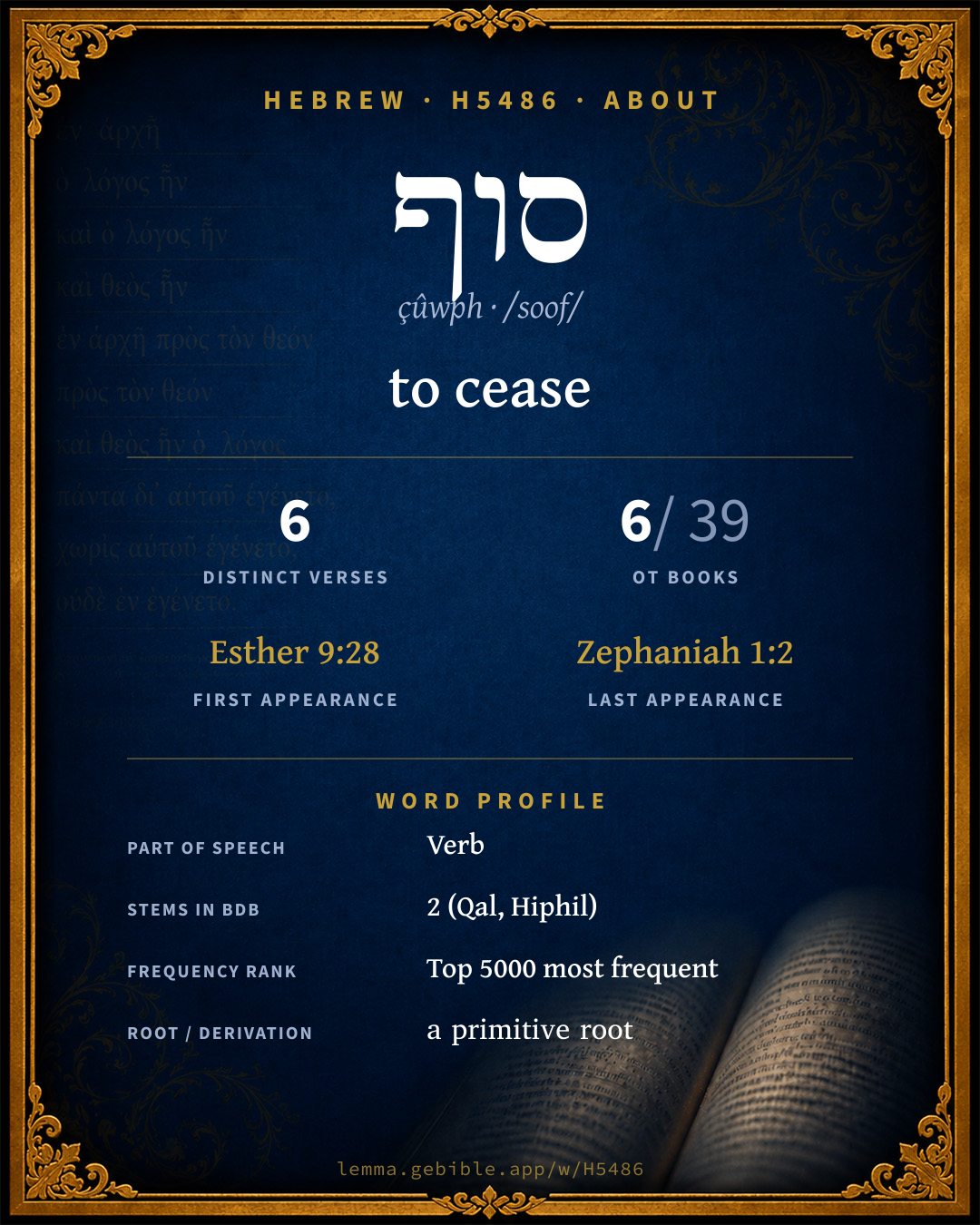
סוּף
to cease
‘to cease’ is one of 3 main senses fuller range ↓
Full lexicon entry — Brown-Driver-Briggs (BDB)
From Brown-Driver-Briggs (BDB)
Where this word appears
See every Qal verb in the Hebrew Bible →
Grammar key — what these labels mean
Part of speech
- Verb
- An action or state-of-being word.
Stem
- Qal
- The basic, simple active stem — the plain form of the verb (“he wrote”).
- Hiphil
- The causative active stem (“he caused / brought about”). Here: ‘make an end of’
Form
- Sequential Perfect
- A perfect with prefixed waw continuing a preceding imperfect or command (waw-consecutive perfect).
- Imperfect
- An incomplete, ongoing, or future action (“he will / would write”).
- Perfect
- A completed action or state — Hebrew marks aspect (completeness) more than strict tense (“he wrote”).
Person
- 3rd Person
- The one spoken about (“he / she / it / they”).
- 1st Person
- The speaker (“I / we”).
Gender
- Common
- Either gender — not distinguished for this form.
- Masculine
- Grammatically masculine.
Number
- Plural
- More than one (in Hebrew, generally three or more).
- Singular
- One.
Grammatical forms
- Verb, Hiphil, Imperfect, 1st Person, Common, Singular 2 times (33%)
- Verb, Qal, Sequential Perfect, 3rd Person, Common, Plural 1 time (17%)
- Verb, Qal, Imperfect, 3rd Person, Masculine, Plural 1 time (17%)
- Verb, Qal, Imperfect, 3rd Person, Masculine, Singular 1 time (17%)
- Verb, Qal, Perfect, 3rd Person, Common, Plural 1 time (17%)
Parsed forms decoded from the imported morphology (morphhb / Westminster Leningrad Codex — WLC text public domain, morphhb tagging CC BY 4.0), counted across 6 parsed occurrences — not distinct verses.
Every verse where H5486 appears — 6 distinct verses across 6 books. Click any verse to open its interlinear word-by-word view. Verse text shown in the World English Bible for context — . Each verse’s Hebrew form is shown with its reference; the English is not keyword-highlighted, since the data carries no word-level English alignment. Use “Compare translations” on any verse to read it across multiple English versions. This concordance covers the Hebrew Bible; Septuagint (Greek Old Testament) occurrences are not indexed here.
Esther 1 verse
Psalms 1 verse
Isaiah 1 verse
Jeremiah 1 verse
Amos 1 verse
Zephaniah 1 verse
About this entry
At a glance — auto-summarized from this page’s data, not written by a person. Every figure links to its source below. This summary describes the numbers; it doesn’t interpret them.
The Hebrew verb סוף centers on the idea of “to cease.” Debuting at Esther 9:28, it then recurs through the corpus. Spanning 6 verses in 6 books, it ranks among the uncommon words of the Hebrew Bible. As a verb its force shifts by stem, across 2 stems (Qal, Hiphil, and more). Sharing its root, it stands alongside סוף, סוף and סופה. Dig into 6-verse concordance and the renderings breakdown below.
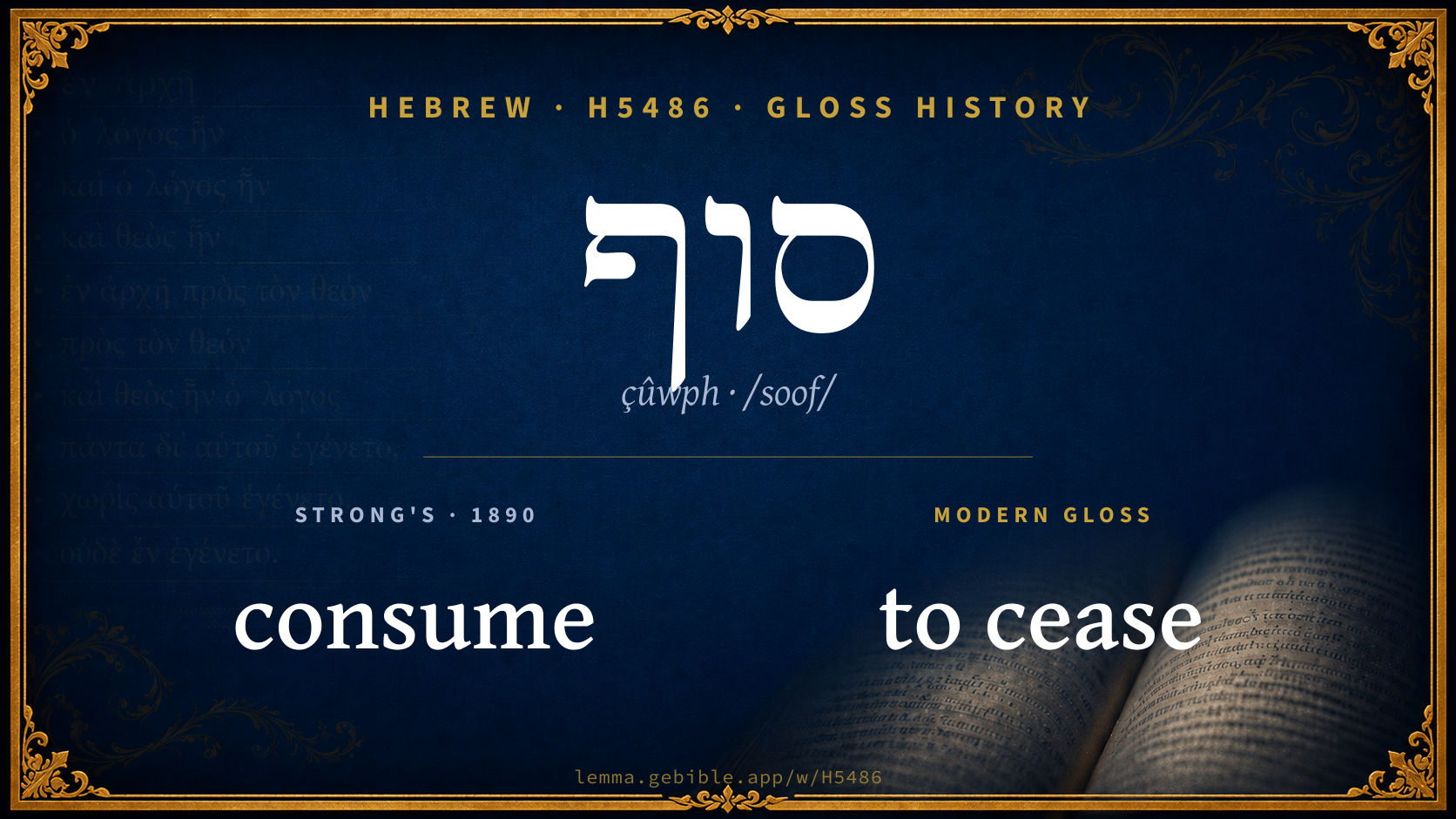
Gloss history
Strong's 1890 vs modern scholarship
About this word
Strong's H5486 catalogs a Hebrew word from the Hebrew Old Testament.
These counts are not copied from any lexicon or concordance. They are computed here, from the morphology-tagged Hebrew Old Testament. What Lemma adds →
- 6
- distinct verses
- The word appears in 6 distinct verses.
- 6 / 39
- OT books
- The word appears in 6 of 39 Old Testament books.
- #3,040
- by frequency
- Top 5000 most frequent Hebrew words (rank 3,040 of 8,640 Hebrew words by occurrence).
View all 6 occurrences in the concordance →
By section of the Old Testament
By traditional corpus
Conventional, traditional groupings — biblical authorship is debated, so this is a traditional corpus grouping, not an authorship claim. Each share is this word’s portion of its verses in that division of the Hebrew canon. Each figure is a share of the word’s 6 distinct verses.
- Prophets (Nevi'im) 4 verses · 67%
- Writings (Ketuvim) 2 verses · 33%
How translations render this word
Counts come from each version’s own published word-to-Strong’s tagging or interlinear alignment — an approximate guide to how each version renders this word, not a word-level alignment the data otherwise carries. Because each total is that version’s own tagged count, the per-version totals vary from one another and need not match the appearance or distinct-verse counts above. These counts may also differ from a printed concordance because Lemma counts each distinctly tagged rendering and does not collapse phrase taggings into a single head-word total. This is a fixed set of word-tagged versions (KJV, ASV, BSB, ULT) and does not change with the reading translation you choose elsewhere. Each version’s license is shown beside its name below (and on Sources).
BDB lists this Strong’s number as 3 distinct words (homographs). Each count above pools all of them and is not split by sense — see the Senses section below. A low-frequency rendering may belong to a different one of those words, not the primary meaning.
- King James Version†: Consume 2×, I will consume 2×
- American Standard Version†: Consume 2×, I will consume 2×
- Berean Standard Bible†: I will sweep away 2×
- unfoldingWord Literal Text†: And 1×, Come to an end 1×, I will exterminate 1×
King James Version Public Domain
Renders H5486 across 8† tagged occurrences — most commonly:
Plus 4 renderings that appear only once — usually multi-word phrases or single function words the recovered tagging swept in, not distinct renderings.
American Standard Version Public Domain
Renders H5486 across 8† tagged occurrences — most commonly:
Plus 4 renderings that appear only once — usually multi-word phrases or single function words the recovered tagging swept in, not distinct renderings.
Berean Standard Bible Public Domain
Renders H5486 across 5† tagged occurrences — most commonly:
Plus 3 renderings that appear only once — usually multi-word phrases or single function words the recovered tagging swept in, not distinct renderings. Not rendered by a distinct English word in 2 further occurrences.
unfoldingWord Literal Text CC BY-SA 4.0
Renders H5486 across 8† tagged occurrences — most commonly:
Senses in the full BDB
Hebrew verbs can shift meaning by stem (binyan): Qal is the basic action, Niphal is often passive or reflexive, Piel often intensifies or makes it factitive, and Hiphil is typically causative. The senses below are grouped under the stem BDB assigns to each.
What do BDB’s symbols mean?
BDB uses these scholarly abbreviations:
| Symbol | Meaning |
|---|---|
| 𝔊 | the Septuagint (the ancient Greek translation, LXX) |
| 𝔙 | the Vulgate (the Latin translation) |
| 𝔖 | the Syriac version (the Peshitta) |
| 𝔗 | the Targum (the Aramaic translation) |
| ψ | the Psalms |
| √ | root (the underlying root or stem) |
| ‖ | parallel passage (a synonymous or contrasted parallel) |
| † | the dagger: every passage where the word occurs is cited |
The 6 senses and sub-senses the full Brown-Driver-Briggs lexicon distinguishes for this word, in lexicon order (not ranked by frequency), with BDB’s own verbatim wording and sub-sense lettering. Shown in Hebrew script with BDB’s own scholarly abbreviations. The condensed entry is in the Lexicon Entry tab. See also the Forms in the corpus table below.
סוף I come to an end, cease (𝔗 סוּף, Syriac (ܣܘܦ) ܣܳܦ, cease, stop (often), 𝔗 סוֹפָא, Syriac ܣܽܘܦܳܐ, NH סוֹף end)
Qal
- Pf. 3 pl. סָ֫פוּ ψ 73:19, וְסָפ֫וּ consec. Am 3:15; Impf. 3 ms. יָסוּף Est 9:28; 3 mpl. יָסֻ֫פוּ Is 66:17;—come to an end Am 3:15 Is 66:17 ψ 73:19 (+ תַּמּוּ), וְזִכְרָם לֹא־יָסוּף מִזַּרְעָם Est 9:28. e.g. Psalms 73:19
Hiphil
- make an end of, only (if text correct) Impf. 1 s. (+ Inf. abs. אָסֹף, chosen for assonance, v. אסף), cohort. = juss. in form, אָסֹף אָסֵף Zp 1:2, אָסֵף v 3, 3, אָסֹף אֲסִיפֵם Je 8:13 (on these forms v. Gf Bö§ 988, 1 Köi. 445, 446); but read perhaps, for אָסֵף, אֶאֱסֹף, We Buhl Lex 13, or אֹסֵף, Ges§§ 72 aa, 113 w n. 3 Now Zp 1:2, and in Je אָסֹף אֹסְפֵם Gesl.c. (against Gie v. Hi). e.g. Zephaniah 1:2
סוף II Jon 2
- 1. rushes, in Nile Ex 2:3, 5 (E); קָנֶהוָסוּף Is 19:6 (of Egypt); Jon 2:6. e.g. Exodus 2:3
- 2. usually in combin. יַם־סוּף prob. = sea of rushes or reeds (> sea of (city) Suph), which Gk. incl. in wider name θάλασσα ἐρυθρά, Red Sea (cf. Di Ex 13:18 and especially WMMAs. u. Eur. 42 f., who expl. as name orig. given to upper end of Gulf of Suez, extending into Bitter Lakes, shallow and marshy, whence reeds (prob. also reddish colour));—name applied only to arms of Red Sea; most often e.g. Exodus 13:18
- a. to Gulf of Suez Ex 10:19 Jos 2:10 (both J), Ex 13:18; 15:4, 22; 23:31 (all E), Dt 11:4 Jos 4:23; 24:6 (D), Nu 33:10, 11 (P), elsewhere late Ne 9:9 ψ 106:7, 9, 22; 136:13, 15. e.g. Exodus 10:19
- b. sometimes to Gulf of Akaba 1 K 9:26, and דֶּרֶךְ יַם־סוּף Nu 21:4 (E), prob. also 14:25 (E), Dt 1:40; 2:1; perhaps Ju 11:16 Je 49:21; poss. read מִיַּם־סוּף for מוֹל ס׳ Dt 1:1 (v. infr.). e.g. 1 Kings 9:26
סוף III loc. (si vera l.) named in defining loc. of Deut. law-giving Dt 1
Senses from the full Brown-Driver-Briggs lexicon (Brown, Driver, Briggs; Oxford 1906 — public domain), digitized via Sefaria, supplemented by the OpenScriptures HebrewLexicon (CC BY 4.0). Full attribution on Sources.
Word origin
I. vb. come to an end, cease (𝔗 סוּף, Syriac (ܣܘܦ) ܣܳܦ, cease, stop (often), 𝔗 סוֹפָא, Syriac ܣܽܘܦܳܐ, NH סוֹף end);—
II. n.m. Jon 2:6 reeds, rushes (coll.) (prob. loan-word from Egyptian ṭwfi, reeds, SteindorffBASi. 603 ErmanZMG xivi (1892), 122; Semitic according to WMMAs. u. Eur. 101);—
III. n.pr.loc. (si vera l.) named in defining loc. of Deut. law-giving Dt 1:1 (מוֹל סוּף, where מוֹל by dissimil. for מוּל); but read perhaps מִיַּם סוּף (𝔊 πλησίον τῆς ἐρυθρᾶς, 𝔊L + θαλάσσης, 𝔙 contra mare rubrum), v. i. סוּף. v. CheEB Red Sea.
— Brown-Driver-Briggs (Oxford 1906, public domain), digitized via Sefaria, supplemented by the OpenScriptures HebrewLexicon (CC BY 4.0). See Sources.
Origin: a primitive root
Jastrow Dictionary
A second Hebrew/Aramaic lexicon for comparison, covering Aramaic and post-biblical (Talmudic, Targumic, Midrashic) usage that the biblical-Hebrew BDB does not. Matched by lemma rather than by Strong’s number, so a lemma may carry more than one Jastrow headword (shown separately below), and the entries cover usage well beyond the Bible.
סוּף I
- v. סוּף II) reed, bulrush.—ים ס׳ the sea of Suf (Red Sea). Sot. 12ᵃ sq. (ref. to בסוף, Ex. II, 3) ר"א אומר ים ס׳ וכ׳ R. E. says, that means the sea; R. S. says, it means ăgam (v. אֲגַם II, 2); Ex. R. s. 1. Ex. R. s. 22 קריעת ים ס׳ the splitting of the Red Sea (for the passage of the Israelites); Y. Ber. I, 3ᵈ bot.; a. fr. e.g. Exodus 2:3
סוּף
- only with יַם, יַמָּא. Targ. Ex. XIII, 18. Targ. Jon. II, 6; a. fr.
סוּף II
- (b. h.) to cut; to be cut off; to end. Tanḥ. B’resh. 12 וסָפָה הטובים וכ׳ and destroys the good and the bad.
- to cut, diminish; to exterminate (corresp. to b. h. כִּלָּה). Gen. R. s. 100 מי יכול לסַיֵּיף וכ׳ who can annihilate the dust?… the beasts of the field? &c. Gen. R. s. 42 מה אתה הולך ומְסַיֵּיף את עצמך וכ׳ Var. in Yalk. ib. 73 for מסרס (ed. מסיים) why wilt thou reduce (weaken) thyself among thy enemies? (v.Tanḥ. Tanḥ. Vayera 3).—Part. pass. מְסוּיָּיף (denom. of סוֹף); f. pl. מְסוּיָּיפוֹת left to the end, ripening late; opp. בַּכִּיר, בִּכּוּרָה. Y. Dem. I, beg. 21ᶜ הבכירות והמס׳ (Tosef. ib. I, 3 הבכורות והסייפות). Y. Shebi. IV, end, 35ᶜ; a. fr.
- to be late in ripening, to be left on the tree beyond cutting time. Y. Dem. I, beg., 21ᶜ נִסְתַּיְּיפוּ וכ׳, v. סוֹף a. סוֹפֶת.
סוּף ²
- 1. to finish; to destroy. Targ. Y. II, Num. XXXIII, 52 תְּסוּפוּן (Y. I תִּסְפּוּן a. תְּסַיְּיפוּן). Targ. Lam. IV, 11; a. e.
- 2. to cease. Targ. Is. XIV, 4. Targ. Lev. XXVI, 20. Targ. Prov. II, 22; a. fr.—Part. סָיֵיף. Ib. XI, 31; a. e.—Koh. R. to X, 15 מביני … סָפַת וכ׳ between the two (disputing) that unfortunate woman (Jephthah’s daughter) perished; Lev. R. s. 37, end בין דין לדין ספת וכ׳ (some ed. נספת, corr. acc.).
- to finish; to consume, ruin. Targ. Y. Gen. XLIV, 12 Ar. (ed. פסק). Targ. Y. Lev. XIX, 9. Ib. XXVI, 16; a. e.—Part. pass. מְסַיַּיף. Targ. I Kings XIV, 10.—Yalk. Gen. 133 סַיְּיפַת, v. סוּב.
- same. Targ. O. Deut. XXXII, 22 (ed. Berl. אַסֵּ׳; ed. Vien. אָסֵ׳; h. text אכלה). Ib. 23 (h. text אספה). Targ. Zeph. I, 3; a. fr.
סוֹף
- preced.)
- 1. end. Yeb. XVI, 4 (121ᵃ) מים … שאין להם ס׳ waters without end (the shores of which you cannot see from all sides). Ned. 62ᵃ וס׳ הכבוד לבא and honor will finally come of itself. Gen. R. s. 71, beg. (ref. to Ps. LXIX, 34) לא ראשו … סוֹפוֹ ולא סופו ראשו the first clause of this verse does not correspond (in syntactical construction) to its final clause &c. Sifra K’dosh. ch. III, Par. 2 אם גנבת סוֹפְךָ לכחש וכ׳ if thou stealest, thou wilt finally deny &c. Kidd. 31ᵃ מס׳ דברך, v. נָכַר. Meg. 7ᵃ בתחלה קבעוה בשושן וְלִבְסוֹף וכ׳ at first they established it (the festival of Purim) in Shushan, and then for the whole (Jewish) world; a. v. fr.—לא ס׳ דבר אלא … this is not the end of it …, but. Gen. R. s. 38 (ref. to Prov. XVII, 13) לא ס׳ ד׳ משיב וכ׳ after all, not only he who requites evil for good, but even he who requites evil for evil &c. Y. Shebi. III, end, 34ᵈ; a. fr. e.g. Psalms 69:34
- 2. remnant, esp. pl. סוֹפִין fruit remaining on the tree after harvest time, late fruit. Y. Yeb. XII, 12ᵈ bot. קידש בגופו של ס׳ (prob. to be read בנוֹפוֹ) if one betrothed a woman, giving as a consideration a branch of a tree of his containing remainders (mostly worthless). Pes. 6ᵇ סוֹפֵי … ומשמר וכ׳ if there are in a man’s field late figs, but he watches his field for the sake of the grapes; v. סוֹפֶת.—[Tosef. Kel. B. Mets. II, 8 סופין ed. Zolk., read: סוֹבִין.]
סוֹף ²
- Targ. Job XXVIII, 3; a. fr.—Y. Snh. X, 29ᵃ bot. יהא סוֹפֵיה וכ׳, v. חֲנַק. Ab. Zar. 41ᵃ מעיקרא … ולבס׳ וכ׳ at first …, but finally &c.; a. fr.
A Dictionary of the Targumim, the Talmud Babli and Yerushalmi, and the Midrashic Literature (Marcus Jastrow; London, Luzac, 1903) — Public Domain. Digitized via Sefaria. Digitized via Sefaria. Full attribution on Sources.
Forms in the corpus
The 6 distinct written forms H5486 takes in the Hebrew Bible, most frequent first — each parse links to that stem’s occurrences in the concordance. Hebrew forms include their vowel points and cantillation, so a single lemma takes many written forms.
| Form | Parsing | Example | Uses |
|---|---|---|---|
| אֲסִיפֵ֖/ם | Verb, Hiphil, Imperfect, 1st Person, Common, Singular | Jeremiah 8:13 | 1 |
| אָסֵ֜ף | Verb, Hiphil, Imperfect, 1st Person, Common, Singular | Zephaniah 1:2 | 1 |
| וְ/סָפ֛וּ | Verb, Qal, Sequential Perfect, 3rd Person, Common, Plural | Amos 3:15 | 1 |
| יָס֥וּף | Verb, Qal, Imperfect, 3rd Person, Masculine, Singular | Esther 9:28 | 1 |
| יָסֻ֖פוּ | Verb, Qal, Imperfect, 3rd Person, Masculine, Plural | Isaiah 66:17 | 1 |
| סָ֥פוּ | Verb, Qal, Perfect, 3rd Person, Common, Plural | Psalms 73:19 | 1 |
Same root — word family
Other BDB entries built from the same root as H5486, grouped by Strong’s listed origin. These share a root / origin per the lexicon — not necessarily a shared meaning. Each links to that word’s own entry.
Derived from this word
Proper names from this root
People and places named from this root — a name, not an additional meaning of the word.
Compare all same-root words → 1 of the same-root words is a proper name (a person or place). They share a root, not necessarily a meaning.
Septuagint verse parallels
This word appears in 6 verses that also exist in the Greek Old Testament (Septuagint), out of the 6 Hebrew verses it occurs in. You can read those verses in Greek by switching the Old Testament edition to the Septuagint.
Read these verses in the Septuagint
This is a verse-level parallel only — the same verses exist in both the Hebrew and Greek Old Testaments. No word-level Hebrew↔Greek correspondence is claimed: the data carries no such alignment, so no Greek word is shown as this Hebrew word’s translation. Coverage is not total — the Septuagint omits the deuterocanon and renumbers the Psalms, so some Hebrew verses have no direct Greek parallel.