Jeremiah 11:2

Hebrew (Westminster Leningrad Codex) Jeremiah 11:2 appears in the Hebrew Old Testament. The text above is from the Westminster Leningrad Codex. Each word links to its Strong’s number, a concise gloss, and parsing drawn from the Open Scriptures Hebrew Bible morphology. Click any word for its full Brown-Driver-Briggs (BDB) entry.
Download image
Cite this verse

Jeremiah 11:2 (World English Bible). Public Domain. Lemma interlinear Bible study tool, https://lemma.gebible.app/v/jeremiah/11/2.

Show BibTeX & RIS
BibTeX
RIS
English Translation
Hear you the words of this covenant, and speak to the men of Judah, and to the inhabitants of Jerusalem;
World English Bible · Public Domain
Download a study sheet

One document with this verse’s original text, its word-by-word gloss line, the meaning frame, cross-references with their text, attributed commentary, and full source and license credits — printable, and it pastes into notes with its structure intact.

This verse Autodidact and up

Study sheet (.html) Plain text (.txt)

A passage Seminary Student

Up to 50 verses in one chapter. A passage sheet keeps up to 6 commentary sources and 12 cross-references per verse, in the order this page ranks them, and says so on the sheet whenever that leaves anything out. Ask for a single verse and you get the Autodidact verse sheet above.

Everything on this page stays free to read, with no account — the sheet is a download of what is already on screen, not access to it.

Want to remove ads? Support Godless Engineer
Compare translations 3

The same verse in 3 English versions, stacked beneath the original-language interlinear above. Click any original word for its lexicon entry.

Each is an independent rendering of the whole verse — the interlinear is not word-aligned to these translations.

Highlighted words mark where these versions differ — a whole-verse word diff, not a word-by-word alignment.

  • World English Bible Public Domain
    Hear you the words of this covenant, and speak to the men of Judah, and to the inhabitants of Jerusalem;
  • King James Version Public Domain
    Hear ye the words of this covenant, and speak unto the men of Judah, and to the inhabitants of Jerusalem;
  • unfoldingWord Literal Text CC BY-SA 4.0
    “Hear the words of this covenant, and speak them to the men of Judah and to the ones who dwell in Jerusalem,

unfoldingWord Literal Text — © unfoldingWord, licensed CC BY-SA 4.0. Word-aligned USFM3 via Door43 (git.door43.org/unfoldingWord/en_ult).

Versions to compare (up to 4)

3 of 4 selected

Show all 18 translations

Every available English version of this verse, each an independent rendering of the whole verse.

  • World English Bible Public Domain
    Hear you the words of this covenant, and speak to the men of Judah, and to the inhabitants of Jerusalem;
  • Berean Standard Bible Public Domain
    “Listen to the words of this covenant and tell them to the men of Judah and the residents of Jerusalem.
  • Majority Standard Bible Public Domain
    “Listen to the words of this covenant and tell them to the men of Judah and the residents of Jerusalem.
  • King James Version Public Domain
    Hear ye the words of this covenant, and speak unto the men of Judah, and to the inhabitants of Jerusalem;
  • American Standard Version (1901) Public Domain
    Hear ye the words of this covenant, and speak unto the men of Judah, and to the inhabitants of Jerusalem;
  • Revised Version (1885) Public Domain
    Hear ye the words of this covenant, and speak unto the men of Judah, and to the inhabitants of Jerusalem;
  • Geneva Bible (1599) Public Domain
    Heare ye the wordes of this couenant, and speake vnto the men of Iudah, and to the inhabitants of Ierusalem,
  • Douay-Rheims (1899) Public Domain
    Hear ye the words of this covenant, and speak to the men of Juda, and to the inhabitants of Jerusalem,
  • Young's Literal Translation Public Domain
    `Hear ye the words of this covenant, and ye have spoken unto the men of Judah, and unto the inhabitants of Jerusalem,
  • Literal Standard Version CC BY-SA 4.0
    “Hear the words of this covenant, and you have spoken to the men of Judah, and to the inhabitants of Jerusalem,
  • Unlocked Literal Bible CC BY-SA 4.0
    “Listen to the words of this covenant, and declare them to each man in Judah and to the inhabitants of Jerusalem.
  • unfoldingWord Literal Text CC BY-SA 4.0
    “Hear the words of this covenant, and speak them to the men of Judah and to the ones who dwell in Jerusalem,
  • Darby Bible Public Domain
    Hear ye the words of this covenant; and speak ye unto the men of Judah, and to the inhabitants of Jerusalem.
  • World Messianic Bible Public Domain
    “Hear the words of this covenant, and speak to the men of Judah, and to the inhabitants of Jerusalem;
  • Webster's Bible Public Domain
    Hear ye the words of this covenant, and speak to the men of Judah, and to the inhabitants of Jerusalem;
  • Free Bible Version CC BY-SA 4.0
    Listen to the terms of this agreement, and then repeat them to the people of Judah and Jerusalem.
  • Bible in Basic English Public Domain
    Give ear to the words of this agreement, and say to the men of Judah and to the people of Jerusalem,
  • JPS Tanakh (1917) Public Domain
    'Hear ye the words of this covenant, and speak unto the men of Judah, and to the inhabitants of Jerusalem;

Literal Standard Version (2020), Covenant Press — licensed CC BY-SA 4.0. Text via the HelloAO Bible API (eBible.org). Unlocked Literal Bible (unfoldingWord) — licensed CC BY-SA 4.0. Text via the HelloAO Bible API (eBible.org). unfoldingWord Literal Text — © unfoldingWord, licensed CC BY-SA 4.0. Word-aligned USFM3 via Door43 (git.door43.org/unfoldingWord/en_ult). Free Bible Version, Dr. Jonathan Gallagher — licensed CC BY-SA 4.0. Text via the HelloAO Bible API (eBible.org).

Word by word

More ways to search: Search by grammar → Find every occurrence → Compare this word →

Practice this passage: Drill this verse → Learn its vocabulary →

הַבְּרִ֣ית
bᵉrîyth
H1285
“the · covenant”
Particle, Definite Article + Noun, Common, Feminine, Singular, Absolute
Part of Speech
Particle + Noun
Type
Common
Gender
Feminine
Number
Singular
State
Absolute
Full BDB Definition

Origin: from H1262 (in the sense of cutting [like H1254 ])

TWOT: 282a

covenant, alliance, pledge - between men - treaty, alliance, league (man to man) - constitution, ordinance (monarch to subjects) - agreement, pledge (man to man) - alliance (of friendship) - alliance (of marriage) - between God and man - alliance (of friendship) - covenant (divine ordinance with signs or pledges) - (phrases) - covenant making - covenant keeping - covenant violation
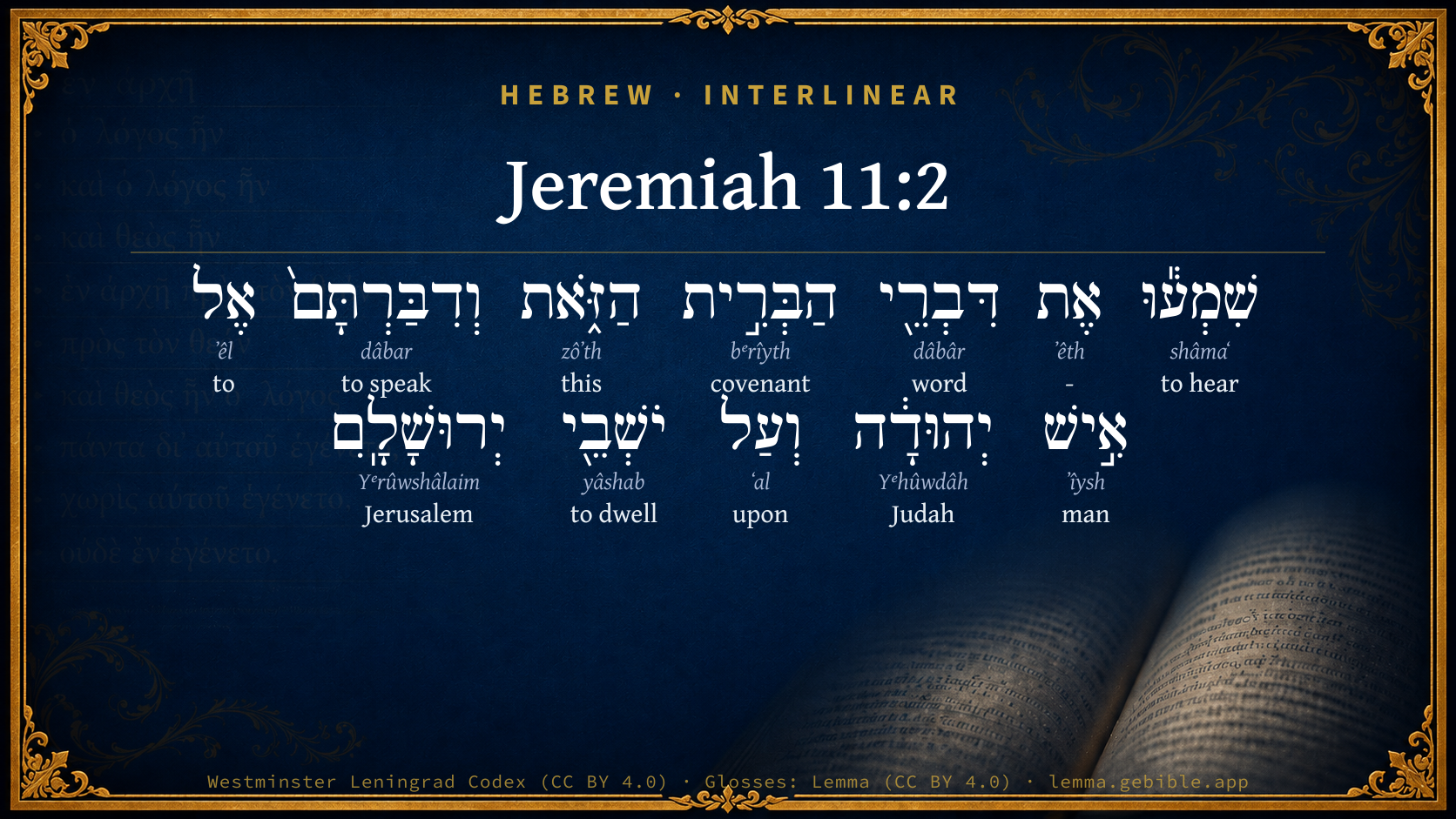
  1. שִׁמְע֕וּ shâmaʻ H8085 “hear” Verb, Qal, Imperative, 2nd Person, Masculine, Plural
  2. אֶת ʼêth H853 “-” Particle, Direct Object
  3. דִּבְרֵ֖י dâbâr H1697 “words of” Noun, Common, Masculine, Plural, Construct
  4. הַזֹּ֑את zôʼth H2063 “the · this” Particle, Definite Article + Pronoun, Demonstrative, Feminine, Singular
  5. וְדִבַּרְתָּם֙ dâbar H1696 “and · to speak · them” Conjunction + Verb, Piel, Sequential Perfect, 2nd Person, Masculine, Singular + Suffix, Personal, 3rd Person, Masculine, Plural
  6. אֶל ʼêl H413 “to” Preposition
  7. אִ֣ישׁ ʼîysh H376 “man of” Noun, Common, Masculine, Singular, Construct
  8. יְהוּדָ֔ה Yᵉhûwdâh H3063 “Judah” Noun, Proper
  9. וְעַל ʻal H5921 “and · upon” Conjunction + Preposition
  10. יֹשְׁבֵ֖י yâshab H3427 “dwelling” Verb, Qal, Participle Active, Masculine, Plural, Construct
  11. יְרוּשָׁלִָֽם Yᵉrûwshâlaim H3389 “Jerusalem” Noun, Proper

About this verse

These counts appear in no published source. They are computed here, from the morphology-tagged text and Lemma’s own curated glosses. What Lemma adds →

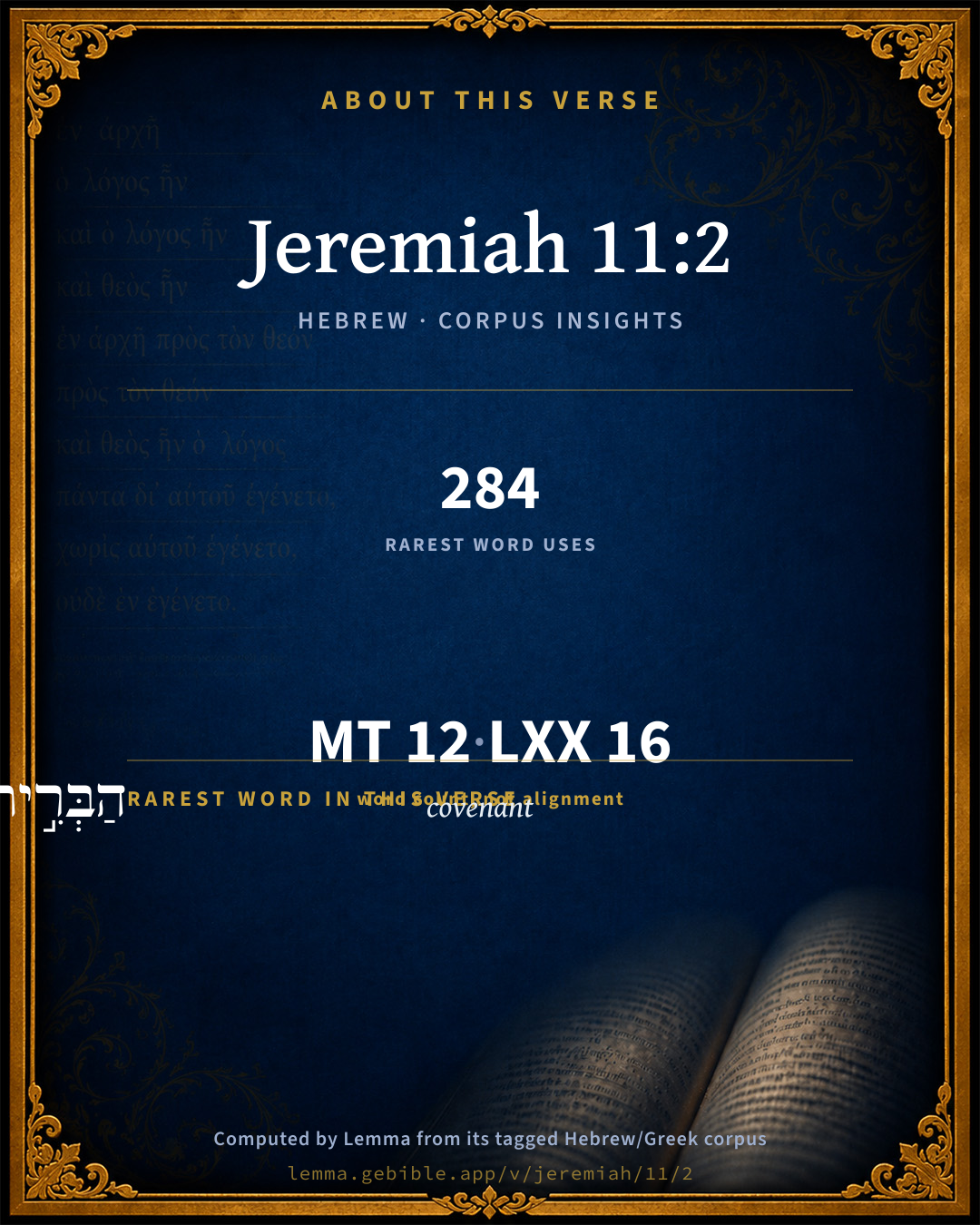
12
words
12
distinct lemmas
Prophets
section

Grammatical profile

  • 3 verbs
  • 5 nouns
  • 1 pronoun
  • 2 prepositions
  • 1 particle

Verb forms

  • שִׁמְע֕וּ Qal · Imperative
  • וְדִבַּרְתָּם֙ Piel · Sequential Perfect
  • יֹשְׁבֵ֖י Qal · Participle Active

Hebrew & Septuagint length

In the original languages it is 12 Hebrew tokens and 16 Greek tokens — but the two are counted differently (Hebrew bundles its prefixes and suffixes into one token; the Greek is in lemma form), so that isn’t a like-for-like length.

Cross-references

8

Topical passages linked to Jeremiah 11:2 in the Treasury of Scripture Knowledge — connected by theme and wording, ordered by reader-vote popularity; previews shown in the World English Bible.

  • Jeremiah 11:6 Yahweh said to me, Proclaim all these words in the cities of Judah, and in the streets of Jerusalem, saying, Hear you the words of this covenant, and do them.
  • Exodus 19:5 Now therefore, if you will indeed obey my voice, and keep my covenant, then you shall be my own possession from among all peoples; for all the earth is mine;
  • 2 Kings 11:17 Jehoiada made a covenant between Yahweh and the king and the people, that they should be Yahweh's people; between the king also and the people.
  • 2 Kings 23:2–3 The king went up to the house of Yahweh, and all the men of Judah and all the inhabitants of Jerusalem with him, and the priests, and the prophets, and all the people, both small and great: and he read in their ears all the words of the book of the covenant which was found in the house of Yahweh.
  • 2 Chronicles 23:16 Jehoiada made a covenant between himself, and all the people, and the king, that they should be Yahweh's people.
  • 2 Chronicles 29:10 Now it is in my heart to make a covenant with Yahweh, the God of Israel, that his fierce anger may turn away from us.
  • 2 Chronicles 34:31 The king stood in his place, and made a covenant before Yahweh, to walk after Yahweh, and to keep his commandments, and his testimonies, and his statutes, with all his heart, and with all his soul, to perform the words of the covenant that were written in this book.
  • Jeremiah 34:13–16 Thus says Yahweh, the God of Israel: I made a covenant with your fathers in the day that I brought them forth out of the land of Egypt, out of the house of bondage, saying,

Cross-references courtesy of OpenBible.info (CC BY 4.0).

Hebrew and Greek witnesses Masoretic Hebrew ↔ Greek Septuagint

The same verse in the two great witnesses to the Old Testament, shown verse-for-verse.

These are two independent witnesses, not word-aligned to each other, and the Septuagint is shown in lemma (dictionary) form.

Hebrew Jeremiah 11:2 Masoretic · Westminster Leningrad Codex

שִׁמְע֕וּ אֶת דִּבְרֵ֖י הַבְּרִ֣ית הַזֹּ֑את וְדִבַּרְתָּם֙ אֶל אִ֣ישׁ יְהוּדָ֔ה וְעַל יֹשְׁבֵ֖י יְרוּשָׁלִָֽם

Hear you the words of this covenant, and speak to the men of Judah, and to the inhabitants of Jerusalem;

World English Bible · Public Domain

Greek LXX Structure differs

In the Septuagint, Jeremiah is about an eighth shorter than the Hebrew and arranges its material differently — the Oracles Against the Nations (Hebrew chapters 46–51) appear in the middle of the Greek book, after 25:13. Because the chapter and verse boundaries do not line up, a verse-for-verse comparison with the Hebrew is not shown.

A verse-for-verse comparison isn’t shown here because the chapters and verses don’t line up. Switch to the LXX edition with the MT / LXX toggle above to read the Greek directly.

On this verse, The Pulpit Commentary discusses the Septuagint’s reading. Read the note in Commentary ↓

Hebrew: Westminster Leningrad Codex (CC BY 4.0). Greek: Septuagint (public domain); English from a public-domain English Septuagint. How the Septuagint differs from the Hebrew →

Targum (Aramaic paraphrase)

1

The Targum is the ancient Jewish Aramaic paraphrase of the Hebrew Scriptures — an interpretive translation, not the Hebrew text itself. Onkelos (literal) and Pseudo-Jonathan (expansive) render the Torah, and Jonathan the Prophets. Coverage is partial: where no permissively-licensed English translation exists for a verse, only the Aramaic is shown. This is verse-level text, not a word-by-word alignment to the Hebrew.

  1. Targum Jonathan Prophets (Joshua–Malachi)
    קַבִּילוּ יַת פִּתְגָמֵי קַיָמָא הָדֵין וּתְמַלְלוּן עִם אֱנַשׁ יְהוּדָה וְעַל יַתְבֵי יְרוּשְׁלֵם:

    (no public-domain English translation for this verse)

    Targum Jonathan — Aramaic: “Mikraot Gedolot” (public domain). English: “Sefaria Community Translation” (CC0 1.0 (public-domain dedication)); “London "Chaldee Paraphrase," 1871” (public domain). Text via Sefaria.

Commentary

Notes on Jeremiah 11:2 from classic Christian and Jewish commentators (each source and its license shown beneath its notes). The classic Christian expositions comment on the surrounding passage and are grouped to its opening verse, so a note may address several verses; the Jewish commentaries on the Tanakh (Rashi and others) are per-verse, so they appear only where the commentator wrote on this verse.

Lemma curates 59 commentaries, every one of them public domain or Creative Commons licensed, each selected and text-cleaned for this edition rather than reprinted as found. About our sources →

Trapp's Complete Commentary

John Trapp

Jer 11:2 Hear ye the words of this covenant, and speak unto the men of Judah, and to the inhabitants of Jerusalem;

Ver. 2. Hear ye the words - and speak ye.] Ye priests, whose ordinary office it is to teach Jacob God’s judgments, and Israel his law. {Deu 33:10}

John Trapp, A Commentary or Exposition upon All the Books of the Old and New Testament (1647–1656) — public domain. Text from a community e-Sword module.

Joseph Benson's Commentary

Jer 11:2-5. Hear ye the words of this covenant — God speaks here chiefly to Jeremiah, but seems, at the same time, to address, together with him, all those pious persons who were like-minded with him, and who reproved the wicked manners of the people. The covenant here spoken of was the covenant of the law of God, delivered by Moses, to which the people had frequently promised obedience. And speak unto the men of Judah, &c. — Lay the tenor of the covenant before them; and say, Cursed be the man that obeyeth not, &c. — Deu 27:26, it is, Cursed be he that confirmeth not all the words of this law to do them: and all the people shall say, Amen. The people’s saying Amen, testified their assent, and made the law a covenant; but they had, besides this, formally and explicitly covenanted with God, Exo 24:3-7, with religious rites and ceremonies, used in stipulations, and afterward consented that God should punish those that violated that covenant, Deu 27:26. Which I commanded, &c. — Which law, (that you by your restipulation made a formal covenant,) I, who am the Lord, and so have a sovereign power to lay laws upon my creatures, commanded your fathers; in the day that I brought them from the iron furnace — And thus obliged them to obedience before I laid my law upon them. The use of the iron furnace being to melt and purify metals, it was a proper representation of that state of sore affliction in which the people of God were for many ages in Egypt. Saying, Obey my voice, &c. — For which kindness I required no more of them but a gentle service to me, in obeying my voice, as to the things of this law which I gave them in charge; so shall ye be my people, &c. — Nor did I only lay my commands upon them, but also encouraged them to obedience, by my gracious promise, that if they would obey they should be a people whom I would peculiarly protect and bless. That I may, or, rather, might (for he refers to the time past) perform the oath, &c. — As if he had said, I required their obedience for their own good: for I had sworn to their fathers, that I would give their posterity a land abounding with plenty of all good things, upon condition of their obedience. I have performed that oath; I have brought them into such a land, and showed myself faithful to them. Then answered I, So be it, O Lord — God having ended his speech, the prophet says, Amen, as God had commanded, Deu 27:26; either asserting the truth of what God had said, or expressing his desire that the people would do according to their covenant, or even assenting to the curse as just and reasonable.

Joseph Benson's Commentary on the Old and New Testaments (1811–1818) — public domain. Text from a community e-Sword module.

Adam Clarke's Commentary

Verse 2. Hear ye the words of this covenant] It is possible that the prophet caused the words of the covenant made with their fathers in the desert (Ex 24:4-8) to be read to them on this occasion; or, at least, the blessings and the cursings which Moses caused to be pronounced to the people as soon as they had set foot in Canaan, De 27:1-28:68.

Adam Clarke's Commentary on the Bible (1810–1826) — public domain. Text from a community e-Sword/MySword module.

John Calvin's Commentaries

Rightly then does Jeremiah begin by saying, that this word was given to him. By using the plural number in the second verse, he no doubt shews that he had a few assistants remaining, whom God addressed in connection with him, that they might unite together in delivering his message. For though there were very few good men, yet Jeremiah was not wholly deprived of colleagues, who assented to and confirmed his doctrine. Baruch was one of them, and there were a few like him. These, then, God addresses in the second verse, when he says, Hear ye the words of this coveant, and say ye to the men of Judah and to the citizens of Jerusalem Jeremiah indeed knew, and also those who were with him, that they brought forward nothing but what was in the law: but however conscious they were of their own sincerity, and could testify before God and his angels that they drew nothing from puddles but from a pure fountain, yet God intended to strengthen them against the contumacy of the people; for they had this objection ready at hand, “Ye indeed boast that whatever it pleases you to bring forward, is the word of God; but this we deny.” Since then the prophets had to undergo such a contest, it seemed good to God to strengthen their hands, that they might first be themselves assured, and then become fit and bold witnesses of his truth to others, having good authority, as it was derived from the law itself, and not from the devices of men.

And we see to whom God intended this to be proclaimed, even to the men of Judah and to the citizens of Jerusalem The ten tribes, as it has elsewhere appeared, were now driven into exile; and here was the flower, as it were, of the chosen people; and having survived so many calamities, they thought that they had been preserved by Divine power, because religion and God’s worship prevailed among them. Thus they were inebriated with false notions and self — flatteries. Hence the Prophet, and those who were with him, are expressly bidden to declare, what we shall hereafter notice, to the citizens of Jerusalem and to the inhabitants of the land who remained, and thought that they were the chosen of God and would continue safe, even if all others were to perish.

John Calvin's Commentaries (1540-1563) — public domain. Text from the Calvin Translation Society English edition (1840s-50s) via the Christian Classics Ethereal Library (ccel.org). Calvin's coverage is partial (roughly two-thirds of the Bible); uncommented books and verses are honest gaps, never fabricated. The 19th-century editor's footnotes and remarks are omitted so the notes are faithfully Calvin's own voice.

Ellicott's Commentary for English Readers

(2) The words of this covenant.—The phrase had obviously acquired a definite and special sense in consequence of the discovery of the lost book of the Law under Josiah, and the covenant into which the people had then entered (comp. 2Ki_23:3). The “curse” under which the people had fallen was practically identical with that in Deu_27:26, the word “obeyeth” being substituted for “confirmeth.”

A Bible Commentary for English Readers, edited by Charles John Ellicott (1878–1897) — public domain. Text from a community e-Sword module.

John Gill's Exposition

And say thou unto them,.... This shows that the command of publishing the law or covenant was, however, principally given to Jeremiah:

thus saith the Lord, the God of Israel; that made them, and brought them out of Egypt, and made a covenant with them, and had taken care of them, and had bestowed many favours upon them:

cursed be the man that obeyeth not the words of this covenant; which the prophet, it may be, had in his hands, even the book of the law, and held it forth unto them, while he was speaking; the language of which is, cursed is everyone that does not constantly and perfectly perform what is contained in it, Deu 27:26.

John Gill's Exposition of the Whole Bible (1746–1763) — public domain (CC PDM 1.0). Text via the HelloAO Bible API.

Albert Barnes' Notes on the Bible

The words of this covenant - The phrase used 2Ki 23:3 to describe the contents of the Book of the Law.

Albert Barnes' Notes on the Bible (1834–1885) — public domain. Text from a community e-Sword/MySword module.

Matthew Poole's English Annotations

Hear ye the words of this covenant: God speaking in the plural number, not hear thou, but hear ye, makes some conjecture that this was a charge given to some other prophets, either, Zephaniah (if it were in Josiah’s time, Zep 1:1) or Uriah (if it were in the time of Jehoiakim). The term

this also manifests that the book of the law was before Jeremiah’s time, for all conclude that the covenant here spoken of was the covenant of the law of God, delivered by Moses, to which the people more than once promised obedience.

Matthew Poole's English Annotations on the Holy Bible (1683–1685) — public domain. Text from a community e-Sword/MySword module.

Whedon's Commentary on the Bible

Daniel D. Whedon

2. The words of this covenant — In 2Ch_34:14, we are told that “when they brought out the money that was brought into the house of the Lord, Hilkiah the priest found a book of the law of the Lord by the hand of Moses.” In 2Ki_23:3, where this same newly-found book of the law is mentioned, the phrase, “the words of this covenant,” is used as in this verse. Numerous other references in 2 Kings 22, 23, and in the corresponding passages in Chronicles, place it beyond reasonable doubt that, the allusion here is specially to this book of the law. See Deu_29:8; 2Ki_23:3; 2Ch_34:30, and Jer_34:18.

Daniel D. Whedon (gen. ed.), Commentary on the Old and New Testaments (1874–1909) — public domain. Text from a community e-Sword module.

The Pulpit Commentary

Hear ye... and speak. To whom is this addressed? To Jeremiah and his disciples. The Septuagint, indeed, followed by Hitzig and Graf, read (instead of "speak ye"), "Thou shalt speak unto them," adopting one different vowel-point. But this involves an inconsistency with the first verb, and is not at all necessary, for why should we suppose Jeremiah to have been completely isolated? If the prophet had well-wishers even among the princes, it stands to reason that he must have had more pronounced adherents in the classes less influenced by the prejudices of society.

The Pulpit Commentary (1880–1919), ed. H.D.M. Spence-Jones & Joseph S. Exell — public domain. Text from a community e-Sword module.

John Wesley's Explanatory Notes

Of this covenant - The covenant here spoken of, was the covenant of the law of God, delivered by Moses, to which the people more than once promised obedience.

John Wesley, Explanatory Notes Upon the Whole Bible (1754–1765) — public domain. Text via the GEBible commentary corpus.

Lesson kit

Teaching starters — assembled from the data on this page, not authored interpretation. Every prompt links to the verse data it draws on. Edit before teaching.

Jeremiah, in the Prophets, opens this verse with 12 words (12 distinct Hebrew lemmas). Its most distinctive word is bᵉrîyth (“covenant”). A historical commentator’s framing appears above. Read the whole chapter for the surrounding context.

Discussion questions

  1. The word bᵉrîyth carries the sense “covenant.” How does it shape the verse?
  2. How does Jeremiah 11:6, which shares this passage’s theme, read alongside this verse?
  3. These translations render this verse differently. What is at stake in choosing one wording over another?
  4. «שִׁמְע֕וּ» is a Qal Imperative verb. How does that grammatical form shape the action described?
  5. Compare how Trapp's Complete Commentary and Joseph Benson's Commentary read this verse. Where do they agree or differ?

Things to notice

Reading settings

Reading text

Shown beneath each verse's original-language words.

Old Testament
Old Testament edition

Read the OT as the Masoretic Hebrew (MT) or the Greek Septuagint (LXX).

English shown for the Greek Septuagint (in the Hebrew ↔ Greek comparison).

Comparing translations? Open the Compare panel on any verse page to stack up to four side by side.