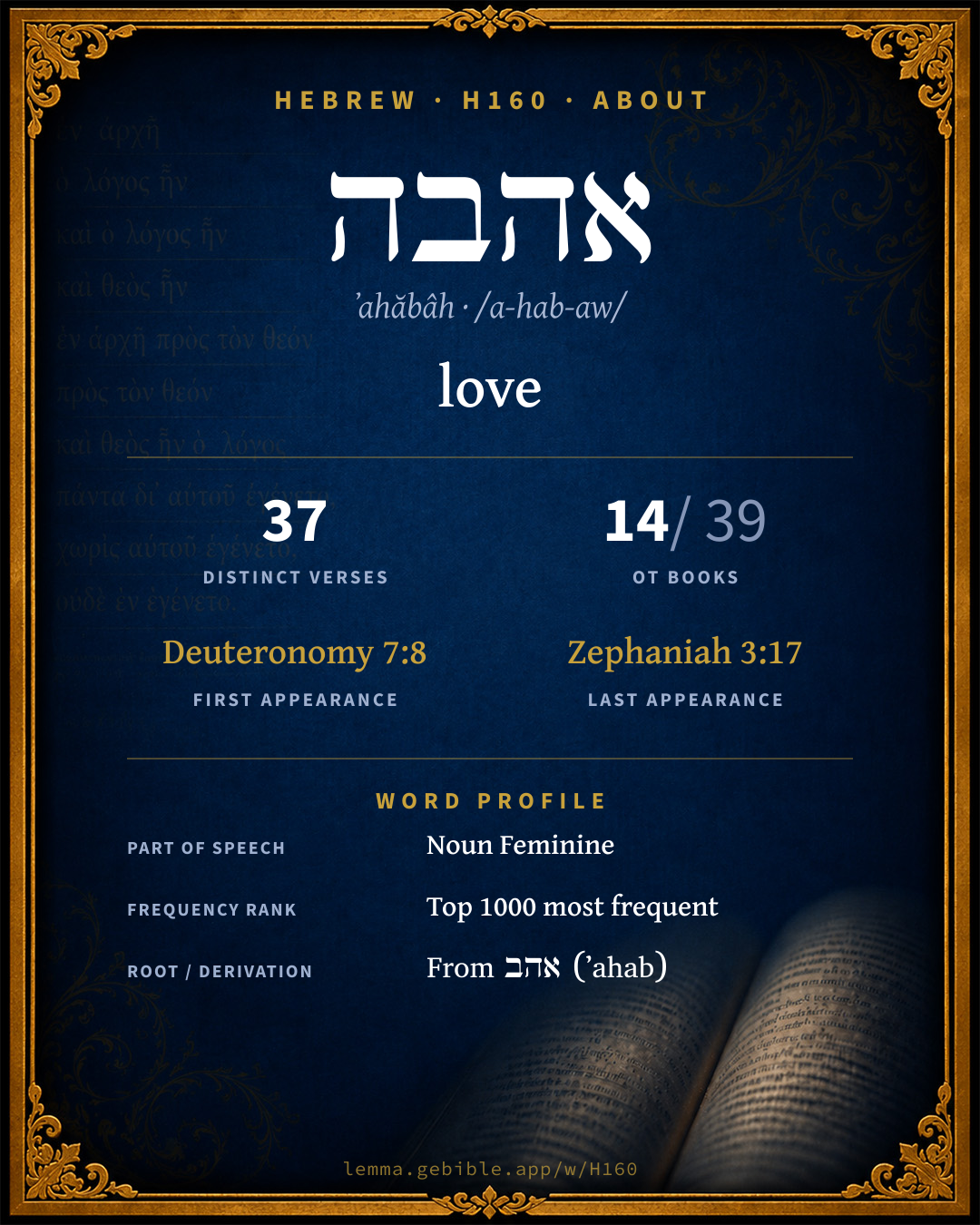
אַהֲבָה
love
‘love’ is one of 2 main senses fuller range ↓
Full lexicon entry — Brown-Driver-Briggs (BDB)
From Brown-Driver-Briggs (BDB)
Where this word appears
See every Absolute-state word in the Hebrew Bible →
Grammar key — what these labels mean
Part of speech
- Noun
- A naming word — a person, place, thing, or idea.
- Verb
- An action or state-of-being word.
Noun type
- Common
- A common noun — a general class of person, place, or thing (“king,” “city,” “water”), not a specific name.
Stem
- Qal
- The basic, simple active stem — the plain form of the verb (“he wrote”).
Form
- Infinitive Construct
- A bound verbal noun, frequently with prepositions (“to write / in writing”).
State
- Absolute
- The independent form of a noun, not bound to a following word.
- Construct
- A noun bound to a following noun in a possessive / “of” relationship (the construct chain).
Gender
- Feminine
- Grammatically feminine.
Number
- Singular
- One.
Grammatical forms
- Noun, Common, Feminine, Singular, Absolute 19 times (48%)
- Noun, Common, Feminine, Singular, Construct 15 times (38%)
- Verb, Qal, Infinitive Construct 6 times (15%)
Parsed forms decoded from the imported morphology (morphhb / Westminster Leningrad Codex — WLC text public domain, morphhb tagging CC BY 4.0), counted across 40 parsed occurrences — not distinct verses.
Every verse where H160 appears — 37 distinct verses across 14 books. Click any verse to open its interlinear word-by-word view. Verse text shown in the World English Bible for context — . Each verse’s Hebrew form is shown with its reference; the English is not keyword-highlighted, since the data carries no word-level English alignment. Use “Compare translations” on any verse to read it across multiple English versions. This concordance covers the Hebrew Bible; Septuagint (Greek Old Testament) occurrences are not indexed here.
Deuteronomy 1 verse
1 Samuel 2 verses
- 1 Samuel 18:3 בְּ/אַהֲבָת֥/וֹ prep + n c fs cs + sfx pers 3ms Then Jonathan and David made a covenant, because he loved him as his own soul.
- 1 Samuel 20:17 בְּ/אַהֲבָת֖/וֹ אַהֲבַ֥ת prep + n c fs cs + sfx pers 3ms n c fs cs Jonathan caused David to swear again, for the love that he had to him; for he loved him as he loved his own soul.
2 Samuel 2 verses
- 2 Samuel 1:26 אַהֲבָֽתְ/ךָ֙ מֵ/אַהֲבַ֖ת n c fs cs + sfx pers 2ms prep + n c fs cs I am distressed for you, my brother Jonathan: Very pleasant have you been to me: Your love to me was wonderful, Passing the love of women.
- 2 Samuel 13:15 מֵ/אַהֲבָ֖ה prep + n c fs Then Amnon hated her with exceeding great hatred; for the hatred with which he hated her was greater than the love with which he had loved her. Amnon said to her, Arise, be gone.
1 Kings 2 verses
- 1 Kings 10:9 בְּ/אַהֲבַ֨ת prep + Qal inf.cs Blessed be Yahweh your God, who delighted in you, to set you on the throne of Israel: because Yahweh loved Israel forever, therefore made he you king, to do justice and righteousness.
- 1 Kings 11:2 לְ/אַהֲבָֽה prep + Qal inf.cs of the nations concerning which Yahweh said to the children of Israel, You shall not go among them, neither shall they come among you; for surely they will turn away your heart after their gods: Solomon joined to these in love.
2 Chronicles 2 verses
- 2 Chronicles 2:11 בְּ/אַהֲבַ֤ת prep + n c fs cs Then Huram the king of Tyre answered in writing, which he sent to Solomon, Because Yahweh loves his people, he has made you king over them.
- 2 Chronicles 9:8 בְּ/אַהֲבַ֨ת prep + Qal inf.cs Blessed be Yahweh your God, who delighted in you, to set you on his throne, to be king for Yahweh your God: because your God loved Israel, to establish them forever, therefore made he you king over them, to do justice and righteousness.
Psalms 2 verses
Proverbs 5 verses
- Proverbs 5:19 בְּ֝/אַהֲבָתָ֗/הּ prep + n c fs cs + sfx pers 3fs A loving doe and a graceful deer-- Let her breasts satisfy you at all times. Be captivated always with her love.
- Proverbs 10:12 אַהֲבָֽה n c fs Hatred stirs up strife, But love covers all wrongs.
- Proverbs 15:17 וְ/אַהֲבָה conj + n c fs Better is a dinner of herbs, where love is, Than a fattened calf with hatred.
- Proverbs 17:9 אַהֲבָ֑ה n c fs He who covers an offense promotes love; But he who repeats a matter separates best friends.
- Proverbs 27:5 מֵֽ/אַהֲבָ֥ה prep + n c fs Better is open rebuke Than hidden love.
Ecclesiastes 2 verses
- Ecclesiastes 9:1 אַהֲבָ֣ה n c fs For all this I laid to my heart, even to explore all this: that the righteous, and the wise, and their works, are in the hand of God; whether it is love or hatred, man doesn't know it; all is before them.
- Ecclesiastes 9:6 אַהֲבָתָ֧/ם n c fs cs + sfx pers 3mp Also their love, their hatred, and their envy has perished long ago; neither have they any more a portion forever in anything that is done under the sun.
Song of Solomon 10 verses
- Song of Solomon 2:4 אַהֲבָֽה n c fs He brought me to the banquet hall. His banner over me is love.
- Song of Solomon 2:5 אַהֲבָ֖ה n c fs Strengthen me with raisins, Refresh me with apples; For I am faint with love.
- Song of Solomon 2:7 הָ/אַהֲבָ֖ה ptcl def.art + n c fs I adjure you, daughters of Jerusalem, By the roes, or by the hinds of the field, That you not stir up, nor awaken love, Until it so desires.
- Song of Solomon 3:5 הָ/אַהֲבָ֖ה ptcl def.art + n c fs I adjure you, daughters of Jerusalem, By the roes, or by the hinds of the field, That you not stir up, nor awaken love, Until it so desires.
- Song of Solomon 3:10 אַהֲבָ֔ה n c fs He made its pillars of silver, Its bottom of gold, its seat of purple, Its midst being paved with love, From the daughters of Jerusalem.
- Song of Solomon 5:8 אַהֲבָ֖ה n c fs I adjure you, daughters of Jerusalem, If you find my beloved, That you tell him that I am faint with love. Friends
- Song of Solomon 7:6 אַהֲבָ֖ה n c fs How beautiful and how pleasant are you, Love, for delights!
- Song of Solomon 8:4 הָ/אַהֲבָ֖ה ptcl def.art + n c fs I adjure you, daughters of Jerusalem, That you not stir up, nor awaken love, Until it so desires. Friends
- Song of Solomon 8:6 אַהֲבָ֔ה n c fs Set me as a seal on your heart, As a seal on your arm; For love is strong as death. Jealousy is as cruel as Sheol; Its flashes are flashes of fire, A very flame of Yahweh.
- Song of Solomon 8:7 הָֽ/אַהֲבָ֔ה בָּ/אַהֲבָ֔ה ptcl def.art + n c fs prep det + n c fs Many waters can't quench love, Neither can floods drown it. If a man would give all the wealth of his house for love, He would be utterly scorned. Friends
Isaiah 1 verse
Jeremiah 3 verses
- Jeremiah 2:2 אַהֲבַ֖ת n c fs cs Go, and cry in the ears of Jerusalem, saying, Thus says Yahweh, I remember for you the kindness of your youth, the love of your weddings; how you went after me in the wilderness, in a land that was not sown.
- Jeremiah 2:33 אַהֲבָ֑ה n c fs How trimmest you your way to seek love! therefore even the wicked women have you taught your ways.
- Jeremiah 31:3 וְ/אַהֲבַ֤ת conj + n c fs cs Yahweh appeared of old to me, [saying], Yes, I have loved you with an everlasting love: therefore with loving kindness have I drawn you.
Hosea 3 verses
- Hosea 3:1 כְּ/אַהֲבַ֤ת prep + Qal inf.cs Yahweh said to me, "Go again, love a woman loved by another, and an adulteress, even as Yahweh loves the children of Israel, though they turn to other gods, and love cakes of raisins."
- Hosea 9:15 אַהֲבָתָ֔/ם Qal inf.cs + sfx pers 3mp "All their wickedness is in Gilgal; For there I hated them. Because of the wickedness of their deeds I will drive them out of my house! I will love them no more. All their princes are rebels.
- Hosea 11:4 אַהֲבָ֔ה n c fs I drew them with cords of a man, with ties of love; And I was to them like those who lift up the yoke on their necks; And I bent down to him and I fed him.
Micah 1 verse
Zephaniah 1 verse
About this entry
At a glance — auto-summarized from this page’s data, not written by a person. Every figure links to its source below. This summary describes the numbers; it doesn’t interpret them.
אהבה — transliterated ʼahăbâh — is a Hebrew noun carrying the sense “love.” It first appears in Deuteronomy 7:8. With 37 verses in 14 books, it is a moderately common word in the Hebrew Bible. Its uses concentrate in Song of Solomon (27% of all occurrences). It is not a single-sense word — see its full sense range. See the sense tree, 37-verse concordance, and the renderings breakdown below.
Gloss history
Strong's 1890 vs modern scholarship
About this word
Strong's H160 catalogs a Hebrew word from the Hebrew Old Testament.
These counts are not copied from any lexicon or concordance. They are computed here, from the morphology-tagged Hebrew Old Testament. What Lemma adds →
- 37
- distinct verses
- The word appears in 37 distinct verses.
- 14 / 39
- OT books
- The word appears in 14 of 39 Old Testament books.
- #909
- by frequency
- Top 1000 most frequent Hebrew words (rank 909 of 8,640 Hebrew words by occurrence).
View all 37 occurrences in the concordance →
Most concentrated in
- Song of Solomon 10 verses 27%
- Proverbs 5 verses 14%
- Jeremiah 3 verses 8%
By section of the Old Testament
By traditional corpus
Conventional, traditional groupings — biblical authorship is debated, so this is a traditional corpus grouping, not an authorship claim. Each share is this word’s portion of its verses in that division of the Hebrew canon. Each figure is a share of the word’s 37 distinct verses.
- Writings (Ketuvim) 21 verses · 57%
- Prophets (Nevi'im) 15 verses · 41%
- Torah (Pentateuch) 1 verse · 3%
How translations render this word
Counts come from each version’s own published word-to-Strong’s tagging or interlinear alignment — an approximate guide to how each version renders this word, not a word-level alignment the data otherwise carries. Because each total is that version’s own tagged count, the per-version totals vary from one another and need not match the appearance or distinct-verse counts above. These counts may also differ from a printed concordance because Lemma counts each distinctly tagged rendering and does not collapse phrase taggings into a single head-word total. This is a fixed set of word-tagged versions (KJV, ASV, BSB, ULT) and does not change with the reading translation you choose elsewhere. Each version’s license is shown beside its name below (and on Sources).
- King James Version: Love 25×, He loved 3×, Loved 3×
- American Standard Version: Love 21×, Loved 2×, Loveth 2×
- Berean Standard Bible: Love 29×, He loved 2×
- unfoldingWord Literal Text: Love 26×, Because 3×, Loves 3×
King James Version Public Domain
Renders H160 across 40 tagged occurrences — most commonly:
Plus 9 renderings that appear only once — usually multi-word phrases or single function words the recovered tagging swept in, not distinct renderings.
American Standard Version Public Domain
Renders H160 across 41 tagged occurrences — most commonly:
Plus 16 renderings that appear only once — usually multi-word phrases or single function words the recovered tagging swept in, not distinct renderings.
Berean Standard Bible Public Domain
Renders H160 across 38 tagged occurrences — most commonly:
Plus 7 renderings that appear only once — usually multi-word phrases or single function words the recovered tagging swept in, not distinct renderings.
unfoldingWord Literal Text CC BY-SA 4.0
Renders H160 across 43 tagged occurrences — most commonly:
Plus 11 renderings that appear only once — usually multi-word phrases or single function words the recovered tagging swept in, not distinct renderings.
Senses in the full BDB
What do BDB’s symbols mean?
BDB uses these scholarly abbreviations:
| Symbol | Meaning |
|---|---|
| 𝔊 | the Septuagint (the ancient Greek translation, LXX) |
| 𝔙 | the Vulgate (the Latin translation) |
| 𝔖 | the Syriac version (the Peshitta) |
| 𝔗 | the Targum (the Aramaic translation) |
| ψ | the Psalms |
| √ | root (the underlying root or stem) |
| ‖ | parallel passage (a synonymous or contrasted parallel) |
| † | the dagger: every passage where the word occurs is cited |
The 2 senses and sub-senses the full Brown-Driver-Briggs lexicon distinguishes for this word, in lexicon order (not ranked by frequency), with BDB’s own verbatim wording and sub-sense lettering. Shown in Hebrew script with BDB’s own scholarly abbreviations. The condensed entry is in the Lexicon Entry tab. See also the Forms in the corpus table below.
- 1. human (to human obj.) abs. Ec 9:1, 6 (both ‖ שִׂנְאָה) so Pr 10:12; 15:17 cf. 27:5; v. also 17:9; of man toward man ψ 109:4, 5; love for one’s self (נַפְשׁוֹ) 1 S 20:17; between man & woman Ct 2:4, 5; 5:8; 8:6, 7(×2); Pr 5:19 cf. also 2 S 1:26 (א׳ נָשִׁים); personif. Ct 2:7; 3:5; 7:7; 8:4; cf. fig. use 3:10; of mere sexual desire 2 S 13:15; fig. of Jerusalem’s love to י׳ Je 2:2 (א׳ כַּלוּלֹתַיִךְ), & of love of adulter. Jerus. v 33. e.g. Ecclesiastes 9:1
- 2. God’s love to his people Ho 11:4 (עֲבֹתוֹת א׳) Je 31:3 Is 63:9 Zp 3:17. e.g. Hosea 11:4
Senses from the full Brown-Driver-Briggs lexicon (Brown, Driver, Briggs; Oxford 1906 — public domain), digitized via Sefaria, supplemented by the OpenScriptures HebrewLexicon (CC BY 4.0). Full attribution on Sources.
Word origin
n.f. love (= Inf. of אהב q.v.)—abs. א׳ Pr 10:12 + 18 times; cstr. אַהֲבַת Je 2:2 + 3 times; sf. אַהֲבָתִי ψ 109:4, 5; אַהֲבָֽתְךָ 2 S 1:26; אַהֲבָתוֹ Is 63:9 Zp 3:17; אַהֲבָתָהּ Pr 5:19; אַהֲבָתָם Ec 9:6—love, especially WisdLt & late.
— Brown-Driver-Briggs (Oxford 1906, public domain), digitized via Sefaria, supplemented by the OpenScriptures HebrewLexicon (CC BY 4.0). See Sources.
Derived from אהב (ʼahab) (H158) — love.
Jastrow Dictionary
A second Hebrew/Aramaic lexicon for comparison, covering Aramaic and post-biblical (Talmudic, Targumic, Midrashic) usage that the biblical-Hebrew BDB does not. Matched by lemma rather than by Strong’s number, so a lemma may carry more than one Jastrow headword (shown separately below), and the entries cover usage well beyond the Bible.
אַהֲבָה I
- love, friendship. א׳ שהיא תלויה בדבר love dependent on something extraneous, i.e. sensual, selfish love. Aboth V, 16.—עשה מא׳ (or עבד) to do good (serve the Lord) from pure motives of love. Sot. 31ᵃ; Snh. 61ᵇ; a. fr.—
אַהֲבָה II
- (אַחֲוָוא in Y.) pr. n. m. Ahăbah, Aḥava, son of Zera, and father of R. Adda. R. Hash. 29ᵃ. Ab. Zar. 30ᵃ; a. fr. Y. Yeb. VIII, 9ᵇᶜ
A Dictionary of the Targumim, the Talmud Babli and Yerushalmi, and the Midrashic Literature (Marcus Jastrow; London, Luzac, 1903) — Public Domain. Digitized via Sefaria. Digitized via Sefaria. Full attribution on Sources.
Forms in the corpus
The 30 distinct written forms H160 takes in the Hebrew Bible, most frequent first — each parse links to that state’s occurrences in the concordance. Hebrew forms include their vowel points and cantillation, so a single lemma takes many written forms.
Same root — word family
Other BDB entries built from the same root as H160, grouped by Strong’s listed origin. These share a root / origin per the lexicon — not necessarily a shared meaning. Each links to that word’s own entry.
Derives from
Proper names from this root
People and places named from this root — a name, not an additional meaning of the word.
Compare all same-root words → 1 of the same-root words is a proper name (a person or place). They share a root, not necessarily a meaning.
Septuagint verse parallels
This word appears in 37 verses that also exist in the Greek Old Testament (Septuagint), out of the 37 Hebrew verses it occurs in. You can read those verses in Greek by switching the Old Testament edition to the Septuagint.
Read these verses in the Septuagint
- Deuteronomy 7:8
- 1 Samuel 18:3
- 2 Samuel 1:26
- 1 Kings 10:9
- 2 Chronicles 2:11
- Psalms 109:4
- Proverbs 5:19
- Ecclesiastes 9:1
- Song of Solomon 2:4
- Isaiah 63:9
- Jeremiah 2:2
- Hosea 3:1
This is a verse-level parallel only — the same verses exist in both the Hebrew and Greek Old Testaments. No word-level Hebrew↔Greek correspondence is claimed: the data carries no such alignment, so no Greek word is shown as this Hebrew word’s translation. Coverage is not total — the Septuagint omits the deuterocanon and renumbers the Psalms, so some Hebrew verses have no direct Greek parallel.