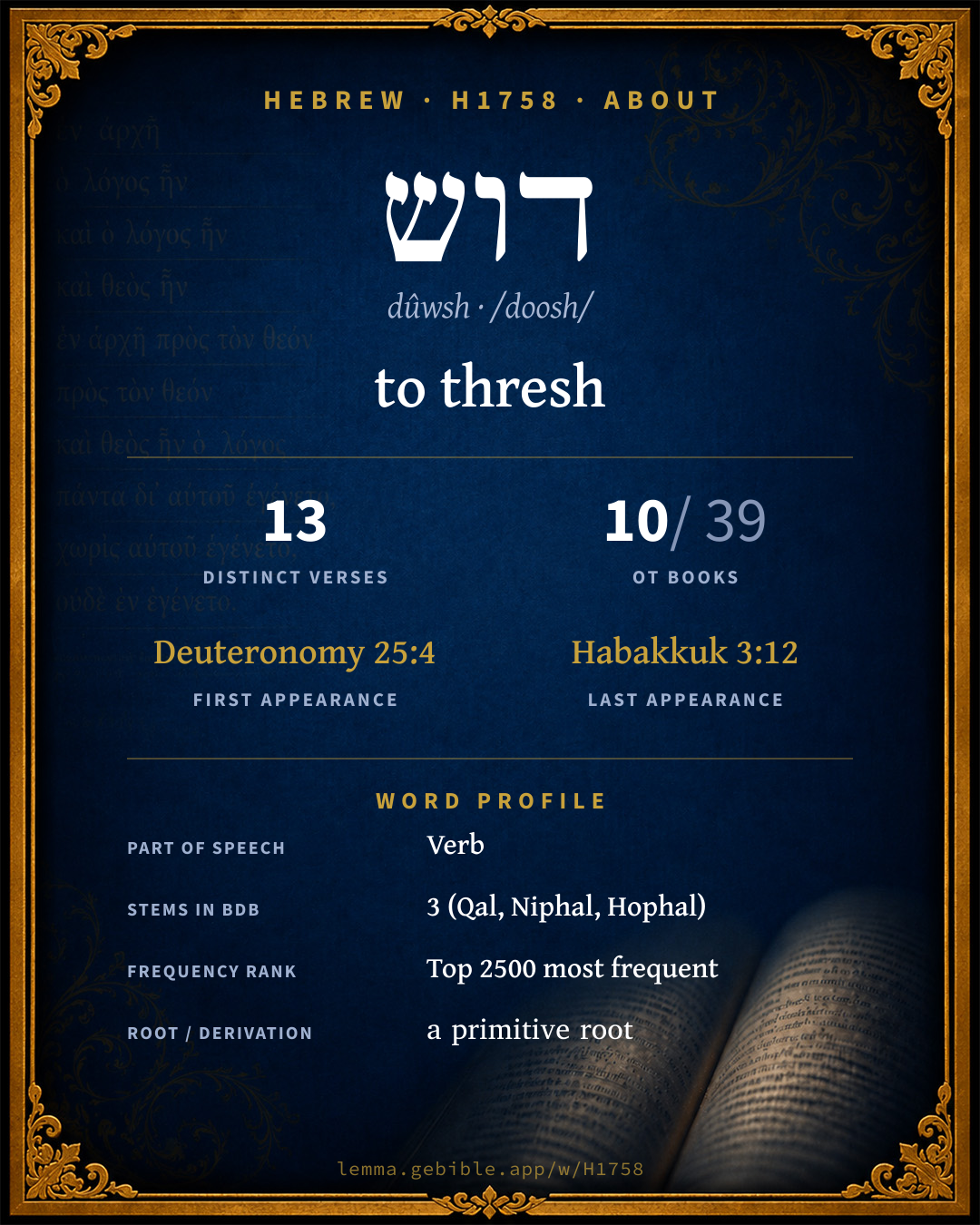
דּוּשׁ
to thresh
‘to thresh’ is one of 4 main senses fuller range ↓
Full lexicon entry — Brown-Driver-Briggs (BDB)
From Brown-Driver-Briggs (BDB)
Where this word appears
See every Qal verb in the Hebrew Bible →
Grammar key — what these labels mean
Part of speech
- Verb
- An action or state-of-being word.
Stem
- Qal
- The basic, simple active stem — the plain form of the verb (“he wrote”). Here: ‘tread on’
- Niphal
- Usually the simple passive or reflexive of the Qal (“he was written”).
- Hophal
- The passive counterpart of the Hiphil (“he was caused to…”).
Form
- Infinitive Construct
- A bound verbal noun, frequently with prepositions (“to write / in writing”).
- Imperfect
- An incomplete, ongoing, or future action (“he will / would write”).
- Sequential Perfect
- A perfect with prefixed waw continuing a preceding imperfect or command (waw-consecutive perfect).
- Imperative
- A direct command (“write!”).
- Participle Active
- A verbal adjective expressing ongoing or characteristic action (“writing / one who writes”).
State
- Absolute
- The independent form of a noun, not bound to a following word.
Person
- 2nd Person
- The one addressed (“you”).
- 3rd Person
- The one spoken about (“he / she / it / they”).
- 1st Person
- The speaker (“I / we”).
Gender
- Masculine
- Grammatically masculine.
- Common
- Either gender — not distinguished for this form.
- Feminine
- Grammatically feminine.
Number
- Singular
- One.
Grammatical forms 10 distinct
- Verb, Qal, Infinitive Construct 4 times (29%)
- Verb, Qal, Imperfect, 2nd Person, Masculine, Singular 2 times (14%)
- Verb, Niphal, Sequential Perfect, 3rd Person, Masculine, Singular 1 time (7%)
- Verb, Qal, Sequential Perfect, 1st Person, Common, Singular 1 time (7%)
- Verb, Qal, Imperative, 2nd Person, Feminine, Singular 1 time (7%)
- Verb, Niphal, Infinitive Construct 1 time (7%)
- Verb, Hophal, Imperfect, 3rd Person, Masculine, Singular 1 time (7%)
- Verb, Qal, Imperfect, 3rd Person, Feminine, Singular 1 time (7%)
+2 more forms (2 occurrences)
Parsed forms decoded from the imported morphology (morphhb / Westminster Leningrad Codex — WLC text public domain, morphhb tagging CC BY 4.0), counted across 14 parsed occurrences — not distinct verses.
Every verse where H1758 appears — 13 distinct verses across 10 books. Click any verse to open its interlinear word-by-word view. Verse text shown in the World English Bible for context — . Each verse’s Hebrew form is shown with its reference; the English is not keyword-highlighted, since the data carries no word-level English alignment. Use “Compare translations” on any verse to read it across multiple English versions. This concordance covers the Hebrew Bible; Septuagint (Greek Old Testament) occurrences are not indexed here.
Deuteronomy 1 verse
Judges 1 verse
2 Kings 1 verse
1 Chronicles 1 verse
Job 1 verse
Isaiah 4 verses
- Isaiah 25:10 וְ/נָ֤דוֹשׁ כְּ/הִדּ֥וּשׁ conj + Niphal wpf 3ms prep + Niphal inf.cs For in this mountain will the hand of Yahweh rest; and Moab shall be trodden down in his place, even as straw is trodden down in the water of the dung-hill.
- Isaiah 28:27 י֣וּדַשׁ Hophal impf 3ms For the dill are not threshed with a sharp [threshing] instrument, neither is a cart wheel turned about on the cumin; but the dill are beaten out with a staff, and the cumin with a rod.
- Isaiah 28:28 יְדוּשֶׁ֑/נּוּ Qal impf 3ms + sfx pers 3ms Bread [grain] is ground; for he will not be always threshing it: and though the wheel of his cart and his horses scatter it, he does not grind it.
- Isaiah 41:15 תָּד֤וּשׁ Qal impf 2ms Behold, I have made you [to be] a new sharp threshing instrument having teeth; you shall thresh the mountains, and beat them small, and shall make the hills as chaff.
Hosea 1 verse
Amos 1 verse
Micah 1 verse
Habakkuk 1 verse
About this entry
At a glance — auto-summarized from this page’s data, not written by a person. Every figure links to its source below. This summary describes the numbers; it doesn’t interpret them.
The Hebrew verb דוש centers on the idea of “to thresh.” Debuting at Deuteronomy 25:4, it then recurs through the corpus. It appears 13 verses across 10 books of the Hebrew Bible, among its uncommon vocabulary. The word gravitates to Isaiah (31%), then Deuteronomy and Judges. Different stems carry different senses — BDB groups them under 3 stems, among them Qal and Niphal. Dig into 13-verse concordance and the renderings breakdown below.
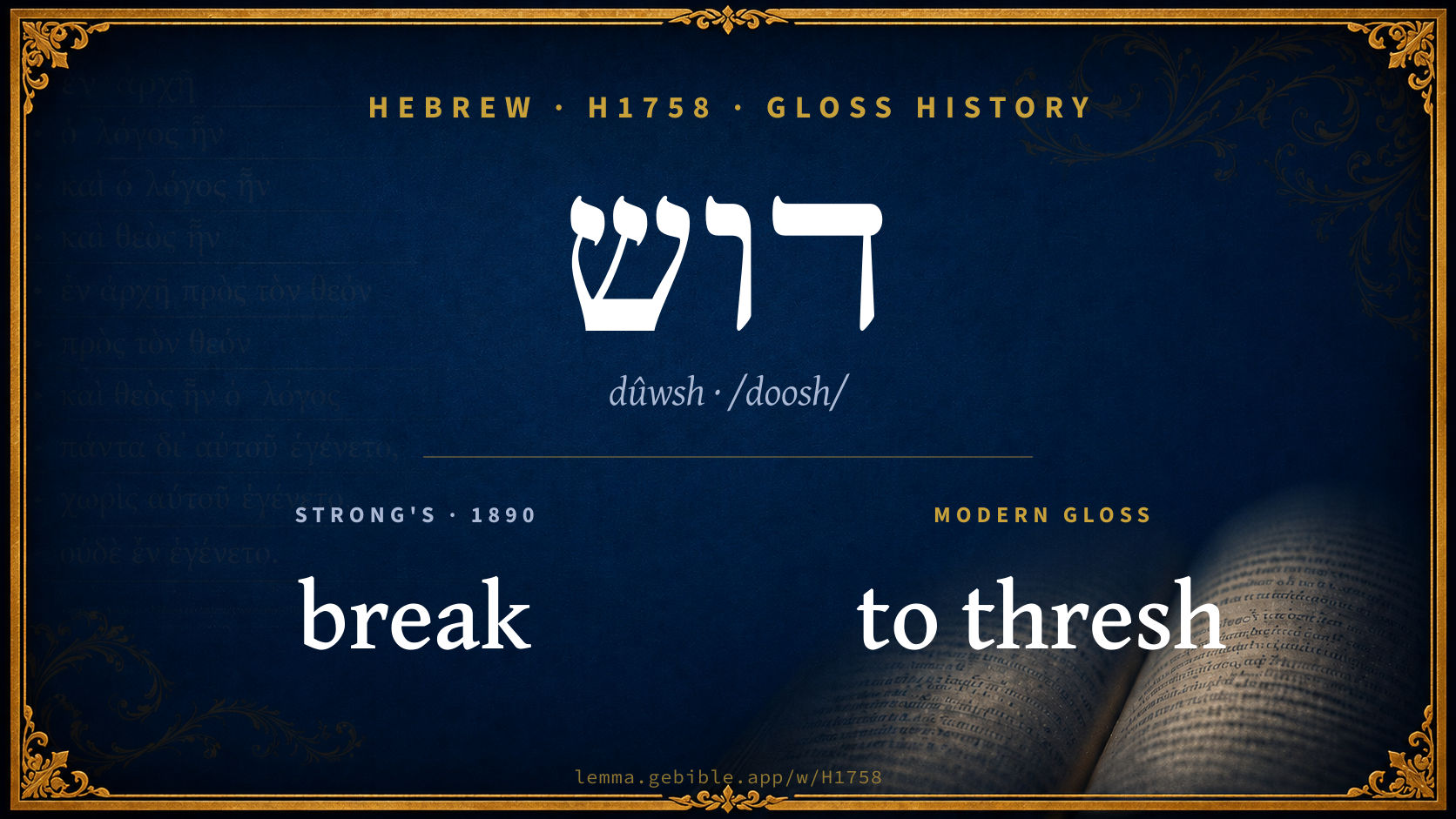
Gloss history
Strong's 1890 vs modern scholarship
About this word
Strong's H1758 catalogs a Hebrew word from the Hebrew Old Testament.
These counts are not copied from any lexicon or concordance. They are computed here, from the morphology-tagged Hebrew Old Testament. What Lemma adds →
- 13
- distinct verses
- The word appears in 13 distinct verses.
- 10 / 39
- OT books
- The word appears in 10 of 39 Old Testament books.
- #1,910
- by frequency
- Top 2500 most frequent Hebrew words (rank 1,910 of 8,640 Hebrew words by occurrence).
View all 13 occurrences in the concordance →
Most concentrated in
- Isaiah 4 verses 31%
- Deuteronomy 1 verse 8%
- Judges 1 verse 8%
By section of the Old Testament
By traditional corpus
Conventional, traditional groupings — biblical authorship is debated, so this is a traditional corpus grouping, not an authorship claim. Each share is this word’s portion of its verses in that division of the Hebrew canon. Each figure is a share of the word’s 13 distinct verses.
- Prophets (Nevi'im) 10 verses · 77%
- Writings (Ketuvim) 2 verses · 15%
- Torah (Pentateuch) 1 verse · 8%
How translations render this word
Counts come from each version’s own published word-to-Strong’s tagging or interlinear alignment — an approximate guide to how each version renders this word, not a word-level alignment the data otherwise carries. Because each total is that version’s own tagged count, the per-version totals vary from one another and need not match the appearance or distinct-verse counts above. These counts may also differ from a printed concordance because Lemma counts each distinctly tagged rendering and does not collapse phrase taggings into a single head-word total. This is a fixed set of word-tagged versions (KJV, ASV, BSB, ULT) and does not change with the reading translation you choose elsewhere. Each version’s license is shown beside its name below (and on Sources).
- King James Version: Are not threshed 1×, I will tear 1×, Is trodden down 1×
- American Standard Version: Are not threshed 1×, I will tear 1×, May trample them 1×
- Berean Standard Bible: Thresh 2×
- unfoldingWord Literal Text: Thresh 2×, Threshed 2×, Threshing 2×
King James Version Public Domain
Renders H1758 across 12 tagged occurrences — most commonly:
Not rendered by a distinct English word in 2 further occurrences.
American Standard Version Public Domain
Renders H1758 across 12 tagged occurrences — most commonly:
Berean Standard Bible Public Domain
Renders H1758 across 15 tagged occurrences — most commonly:
Plus 13 renderings that appear only once — usually multi-word phrases or single function words the recovered tagging swept in, not distinct renderings.
unfoldingWord Literal Text CC BY-SA 4.0
Renders H1758 across 19 tagged occurrences — most commonly:
Plus 13 renderings that appear only once — usually multi-word phrases or single function words the recovered tagging swept in, not distinct renderings.
Senses in the full BDB
Hebrew verbs can shift meaning by stem (binyan): Qal is the basic action, Niphal is often passive or reflexive, Piel often intensifies or makes it factitive, and Hiphil is typically causative. The senses below are grouped under the stem BDB assigns to each. This entry also uses Hophal (the passive of Hiphil).
What do BDB’s symbols mean?
BDB uses these scholarly abbreviations:
| Symbol | Meaning |
|---|---|
| 𝔊 | the Septuagint (the ancient Greek translation, LXX) |
| 𝔙 | the Vulgate (the Latin translation) |
| 𝔖 | the Syriac version (the Peshitta) |
| 𝔗 | the Targum (the Aramaic translation) |
| ψ | the Psalms |
| √ | root (the underlying root or stem) |
| ‖ | parallel passage (a synonymous or contrasted parallel) |
| † | the dagger: every passage where the word occurs is cited |
The 3 senses and sub-senses the full Brown-Driver-Briggs lexicon distinguishes for this word, in lexicon order (not ranked by frequency), with BDB’s own verbatim wording and sub-sense lettering. Shown in Hebrew script with BDB’s own scholarly abbreviations. The condensed entry is in the Lexicon Entry tab. See also the Forms in the corpus table below.
Qal
- tread on, trample on
Niphal
- . be trampled down
Hophal
- . be threshed
Senses from the full Brown-Driver-Briggs lexicon (Brown, Driver, Briggs; Oxford 1906 — public domain), digitized via Sefaria, supplemented by the OpenScriptures HebrewLexicon (CC BY 4.0). Full attribution on Sources.
Word origin
דּוּשׁ, דִּישׁ vb. tread, thresh
— Brown-Driver-Briggs (Oxford 1906, public domain), digitized via Sefaria, supplemented by the OpenScriptures HebrewLexicon (CC BY 4.0). See Sources.
Origin: a primitive root
Jastrow Dictionary
A second Hebrew/Aramaic lexicon for comparison, covering Aramaic and post-biblical (Talmudic, Targumic, Midrashic) usage that the biblical-Hebrew BDB does not. Matched by lemma rather than by Strong’s number, so a lemma may carry more than one Jastrow headword (shown separately below), and the entries cover usage well beyond the Bible.
דּוּשׁ
- (b. h.), part. a. perf. דָּשׁ
- 1. to tread, trample, thresh. Sabb. VII, 2 הדָּשׁ he who threshes (on the Sabbath); a. fr.—Euphem. for sexual contact. Nidd. 41ᵇ. Gen. R. s. 85. Pes. 87ᵇ; a. e.—דוש בעקב to trample with one’s heel, to treat lightly, not to heed. Ab. Zar. 18ᵃ. Lev. R. s. 27.
- 2. to walk about, be familiar, well-known. Meg. 24ᵇ אם היה דש בעירו if he has been a familiar figure in his town (so that people do not mind his bodily disfigurement); Y. Taan. IV, beg. 67ᵇ; a. fr.
- to trample. Ex. R. s. 15 הייתם מְדַיְּישִׁין את העץ וכ׳ you used to tread upon this piece of wood. Midr. Till. to Ps. VIII, 3 מְדַיֵּישׁ עליך כעפר even one who treads upon thee as upon dust. Gen. R. s. 44 דַּיְּישֵׁם tread upon them.
- , v. דָּשַׁשׁ
דּוּשׁ ²
- 1. to thresh. Targ. Ruth II, 17.—Zeb. 116ᵇ; Men. 22ᵃ, v. דַּשְׁתָּאָה.
- 2. to tread upon, trample (to death). Targ. II Kings VII, 17; a. fr.—B. Kam. 9ᵃ דָּיֵישׁ אמצרי he sets his foot upon the landmark (symbol of possession).
- 3. to be used to, not to mind. Sabb. 129ᵇ כיון דדָשוּ ביה רבים since the people are in the habit of doing it. Gitt. 56ᵇ כיון דדש דש being used (to the hammering) the gnat did not heed it. Keth. 62ᵃ דַּשְׁנָן בה we are used to it.—Targ. Prov. VIII, 33 תְדִישׁוּן, v. Af.
- to pass over, to leave unheeded, to be listless. Targ. Prov. IV, 15; XIII, 18; XV, 32 Ar. a. Mss. (ed. Lag. אר׳, מר׳ with ר, h. text פרע); ib. VIII, 33 (v. supra, ed. Lag. תירשון).—Snh. 7ᵃ (prov.) טוביה לדשמע ואדיש (Ms. M. ואריש) happy he who hears (himself abused) and minds it not; he will escape a hundred evils.—Y. Peah I, 15ᶜ bot.; Y. Kidd. I, 61ᵇ אכול ואֲדֵישׁ … ומַדְשִׁין eat and care not (do not share in our conversation), for so do dogs eat and mind not. [Targ. Y. II, Num. XI, 8 אדשין, v. דְּשַׁשׁ.]
- to be trampled upon, threshed. Targ. Is. XXIV, 3. Ib. XXV, 10.—[Targ. Jer. XLVIII, 26, v. דְּשַׁשׁ.]
- Palp. דַּשְׁדֵּשׁ, v. דְּשַׁשׁ.
A Dictionary of the Targumim, the Talmud Babli and Yerushalmi, and the Midrashic Literature (Marcus Jastrow; London, Luzac, 1903) — Public Domain. Digitized via Sefaria. Digitized via Sefaria. Full attribution on Sources.
Forms in the corpus
The 14 distinct written forms H1758 takes in the Hebrew Bible, most frequent first — each parse links to that stem’s occurrences in the concordance. Hebrew forms include their vowel points and cantillation, so a single lemma takes many written forms.
Same root — word family
Other BDB entries built from the same root as H1758, grouped by Strong’s listed origin. These share a root / origin per the lexicon — not necessarily a shared meaning. Each links to that word’s own entry.
Derived from this word
- דוש dûwsh H1759 to tread down
- דיש dayish H1786 threshing
- דישן dîyshôn H1788 pygarg
- מדשה mᵉdushshâh H4098 threshed grain
Compare all same-root words → Showing 4 of 5 — not the complete family. They share a root, not necessarily a meaning.
Septuagint verse parallels
This word appears in 13 verses that also exist in the Greek Old Testament (Septuagint), out of the 13 Hebrew verses it occurs in. You can read those verses in Greek by switching the Old Testament edition to the Septuagint.
Read these verses in the Septuagint
- Deuteronomy 25:4
- Judges 8:7
- 2 Kings 13:7
- 1 Chronicles 21:20
- Job 39:15
- Isaiah 25:10
- Hosea 10:11
- Amos 1:3
- Micah 4:13
- Habakkuk 3:12
This is a verse-level parallel only — the same verses exist in both the Hebrew and Greek Old Testaments. No word-level Hebrew↔Greek correspondence is claimed: the data carries no such alignment, so no Greek word is shown as this Hebrew word’s translation. Coverage is not total — the Septuagint omits the deuterocanon and renumbers the Psalms, so some Hebrew verses have no direct Greek parallel.