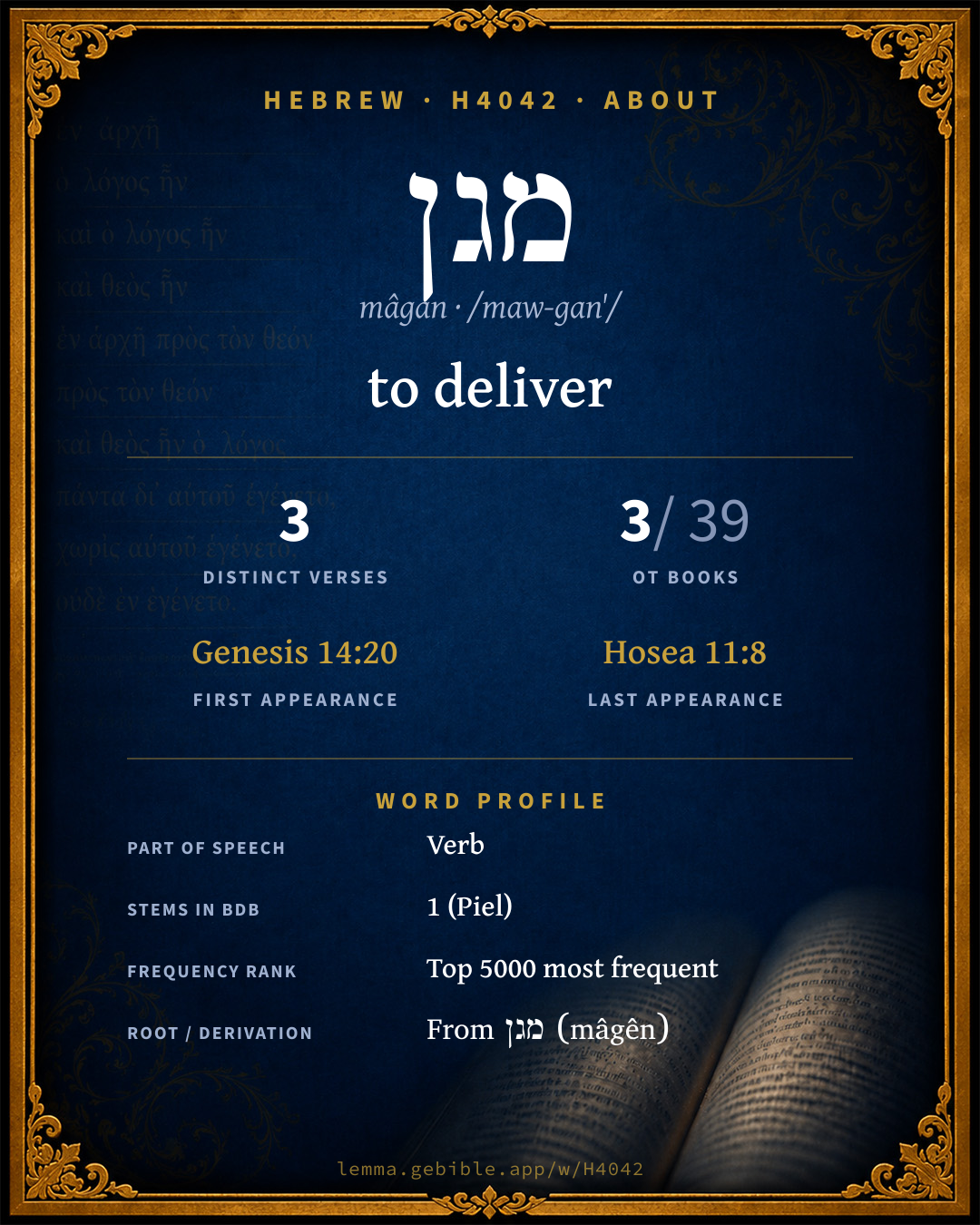
מָגַן
to deliver
Full lexicon entry — Brown-Driver-Briggs (BDB)
From Brown-Driver-Briggs (BDB)
Where this word appears
Grammar key — what these labels mean
Part of speech
- Verb
- An action or state-of-being word.
Stem
- Piel
- An intensive or resultative active stem. Here: ‘deliver up’
Form
- Imperfect
- An incomplete, ongoing, or future action (“he will / would write”).
- Perfect
- A completed action or state — Hebrew marks aspect (completeness) more than strict tense (“he wrote”).
Person
- 1st Person
- The speaker (“I / we”).
- 3rd Person
- The one spoken about (“he / she / it / they”).
Gender
- Common
- Either gender — not distinguished for this form.
- Feminine
- Grammatically feminine.
- Masculine
- Grammatically masculine.
Number
- Singular
- One.
Grammatical forms
- Verb, Piel, Imperfect, 1st Person, Common, Singular 1 time (33%)
- Verb, Piel, Imperfect, 3rd Person, Feminine, Singular 1 time (33%)
- Verb, Piel, Perfect, 3rd Person, Masculine, Singular 1 time (33%)
Parsed forms decoded from the imported morphology (morphhb / Westminster Leningrad Codex — WLC text public domain, morphhb tagging CC BY 4.0), counted across 3 parsed occurrences — not distinct verses.
Every verse where H4042 appears — 3 distinct verses across 3 books. Click any verse to open its interlinear word-by-word view. Verse text shown in the World English Bible for context — . Each verse’s Hebrew form is shown with its reference; the English is not keyword-highlighted, since the data carries no word-level English alignment. Use “Compare translations” on any verse to read it across multiple English versions. This concordance covers the Hebrew Bible; Septuagint (Greek Old Testament) occurrences are not indexed here.
Genesis 1 verse
Proverbs 1 verse
Hosea 1 verse
About this entry
At a glance — auto-summarized from this page’s data, not written by a person. Every figure links to its source below. This summary describes the numbers; it doesn’t interpret them.
The Hebrew verb מגן centers on the idea of “to deliver.” A scarce word — 3 verses in all of the Hebrew Bible. The word gravitates to Genesis (33%), then Proverbs and Hosea. First canonically at Genesis 14:20, it enters the text early. It clusters with מגן and מגנה under a shared root. For the data behind this summary, explore the sense tree and the renderings breakdown below.
Gloss history
Strong's 1890 vs modern scholarship
About this word
Strong's H4042 catalogs a Hebrew word from the Hebrew Old Testament.
These counts are not copied from any lexicon or concordance. They are computed here, from the morphology-tagged Hebrew Old Testament. What Lemma adds →
- 3
- distinct verses
- The word appears in 3 distinct verses.
- 3 / 39
- OT books
- The word appears in 3 of 39 Old Testament books.
- #4,179
- by frequency
- Top 5000 most frequent Hebrew words (rank 4,179 of 8,640 Hebrew words by occurrence).
View all 3 occurrences in the concordance →
By section of the Old Testament
By traditional corpus
Conventional, traditional groupings — biblical authorship is debated, so this is a traditional corpus grouping, not an authorship claim. Each share is this word’s portion of its verses in that division of the Hebrew canon. Each figure is a share of the word’s 3 distinct verses.
- Torah (Pentateuch) 1 verse · 33%
- Prophets (Nevi'im) 1 verse · 33%
- Writings (Ketuvim) 1 verse · 33%
How translations render this word
Counts come from each version’s own published word-to-Strong’s tagging or interlinear alignment — an approximate guide to how each version renders this word, not a word-level alignment the data otherwise carries. Because each total is that version’s own tagged count, the per-version totals vary from one another and need not match the appearance or distinct-verse counts above. These counts may also differ from a printed concordance because Lemma counts each distinctly tagged rendering and does not collapse phrase taggings into a single head-word total. This is a fixed set of word-tagged versions (KJV, ASV, BSB, ULT) and does not change with the reading translation you choose elsewhere. Each version’s license is shown beside its name below (and on Sources).
- King James Version: Hath delivered 1×, How shall i deliver 1×, Shall she deliver 1×
- American Standard Version: Hath delivered 1×, How shall i cast 1×, Will she deliver to thee 1×
- Berean Standard Bible: Has delivered 1×, How could i surrender you 1×, She will present you 1×
- unfoldingWord Literal Text: Delivered 1×, She will cover you 1×, Surrender you 1×
King James Version Public Domain
Renders H4042 across 3 tagged occurrences — most commonly:
American Standard Version Public Domain
Renders H4042 across 3 tagged occurrences — most commonly:
Berean Standard Bible Public Domain
Renders H4042 across 3 tagged occurrences — most commonly:
unfoldingWord Literal Text CC BY-SA 4.0
Renders H4042 across 3 tagged occurrences — most commonly:
Senses in the full BDB
What do BDB’s symbols mean?
BDB uses these scholarly abbreviations:
| Symbol | Meaning |
|---|---|
| 𝔊 | the Septuagint (the ancient Greek translation, LXX) |
| 𝔙 | the Vulgate (the Latin translation) |
| 𝔖 | the Syriac version (the Peshitta) |
| 𝔗 | the Targum (the Aramaic translation) |
| ψ | the Psalms |
| √ | root (the underlying root or stem) |
| ‖ | parallel passage (a synonymous or contrasted parallel) |
| † | the dagger: every passage where the word occurs is cited |
The 1 sense the full Brown-Driver-Briggs lexicon distinguishes for this word, in lexicon order (not ranked by frequency), with BDB’s own verbatim wording and sub-sense lettering. Shown in Hebrew script with BDB’s own scholarly abbreviations. The condensed entry is in the Lexicon Entry tab. See also the Forms in the corpus table below.
Piel
- deliver up, deliver (denom. from מָגֵן; on connex. of meanings cf. סָגַר)—Pf. מִגֵּן Gn 14:20; Impf. 3 fs. sf. תְּמַגְּנֶ֑ךָּ Pr 4:9 אֲמַגֶּנְךָ Ho 11:8;—deliver up to adversary Gn 14:20 Ho 11:8 + Is 64:6 𝔊 𝔖 𝔗 Ew Che al. וַתְּמַגְּנֵנוּ for MT וַתְּמוּגֵנוּ; also deliver, give, c. acc. & sf. of indirect obj. Pr 4:9. e.g. Genesis 14:20
Senses from the full Brown-Driver-Briggs lexicon (Brown, Driver, Briggs; Oxford 1906 — public domain), digitized via Sefaria, supplemented by the OpenScriptures HebrewLexicon (CC BY 4.0). Full attribution on Sources.
Word origin
Derived from מגן (mâgên) (H4043) — shield.
Jastrow Dictionary
A second Hebrew/Aramaic lexicon for comparison, covering Aramaic and post-biblical (Talmudic, Targumic, Midrashic) usage that the biblical-Hebrew BDB does not. Matched by lemma rather than by Strong’s number, so a lemma may carry more than one Jastrow headword (shown separately below), and the entries cover usage well beyond the Bible.
מָגֵן
- shield, defense. Pesik. Haʿomer, p. 70ᵃ; 70ᵇ (ref. to ואל מצנים, Job V, 5) לא בזיין ולא במ׳ not with weapon or with shield (will he prevail); Lev. R. s. 28; Pesik. R. s. 18; Yalk. Job 898.—Cant. R. to IV, 4 end (ref. to אלף המגן, ib.) אלף דור … אותו המ׳ I folded together (skipped over) a thousand generations and brought unto them that shield (the Torah).—Midr. Till. to Ps. I, 5, v. גּוּן; a. fr.—Pl. מָגִנִּים, מָגִינִּים. Lam. R. introd. (R. Joḥ. 1) (ref. to Is. XXII, 5) שהיו מקרקרים … עושין אותן מ׳ they broke down the walls of their houses and made of them defenses. Cant. R. l. c. לבניך אני נעשה מ׳ הרבה unto thy children I shall be many defenses. Gen. R. s. 44 מ׳ של צדיקים shields of the righteous (protectors of their generation by dint of their righteousness); a. e.—Esp. Magen, the first section of the Prayer of Benedictions closing with מָגֵן אַבְרָהָם (usu. called אָבוֹת, v. אָב). Deut. R. s. 11, beg. חוזר לתחלת מ׳ (Ber. 34ᵃ לראש) he must go back to the beginning of the first section. Erub. 65ᵃ, v. פּוּק h.—בֵּית הַמָּגִינִּין, Tosef. Kil. IV, 7, v. מְגִינָּא. e.g. Job 5:5
מְגָן
- v. מַגִּין
מַגָּן
- (גְּנַן; cmp. חִנָּם fr. חָנַן) grace, undeserved gift; (adv. with or without prepos.) for nothing, in vain. Targ. Prov. XV, 27.—Targ. Gen. XXIX, 15. Targ. Ex. XX, 7; Targ. Deut. V, 11; a. e.—Y. Bicc. III, 65ᶜ bot. לא מ׳ מאריך ימים it is not for nothing that he has been allowed a long life. B. Kam. 85ᵃ אסיא דמ׳ a physician (that will cure thee) without pay; אסיא דמ׳ כמ׳ שוי Ms. M. a. oth. (ed. incorr., v. Rabb. D. S. a. l. note) a physician without pay is worth as much as unpaid service can be expected to be, i.e. an unpaid physician is likely to be careless. Y. Snh. X, 29ᵃ bot. אפי׳ על מ׳ even if the curse has been pronounced gratuitously (without cause), cmp. קללת חנם s. v. חִנָּם.
A Dictionary of the Targumim, the Talmud Babli and Yerushalmi, and the Midrashic Literature (Marcus Jastrow; London, Luzac, 1903) — Public Domain. Digitized via Sefaria. Digitized via Sefaria. Full attribution on Sources.
Forms in the corpus
The 3 distinct written forms H4042 takes in the Hebrew Bible, most frequent first — each parse links to that stem’s occurrences in the concordance. Hebrew forms include their vowel points and cantillation, so a single lemma takes many written forms.
| Form | Parsing | Example | Uses |
|---|---|---|---|
| אֲמַגֶּנְ/ךָ֙ | Verb, Piel, Imperfect, 1st Person, Common, Singular | Hosea 11:8 | 1 |
| מִגֵּ֥ן | Verb, Piel, Perfect, 3rd Person, Masculine, Singular | Genesis 14:20 | 1 |
| תְּמַגְּנֶֽ/ךָּ | Verb, Piel, Imperfect, 3rd Person, Feminine, Singular | Proverbs 4:9 | 1 |
Same root — word family
Other BDB entries built from the same root as H4042, grouped by Strong’s listed origin. These share a root / origin per the lexicon — not necessarily a shared meaning. Each links to that word’s own entry.
Derives from
Derived from this word
Compare all same-root words → They share a root, not necessarily a meaning.
Septuagint verse parallels
This word appears in 3 verses that also exist in the Greek Old Testament (Septuagint), out of the 3 Hebrew verses it occurs in. You can read those verses in Greek by switching the Old Testament edition to the Septuagint.
Read these verses in the Septuagint
This is a verse-level parallel only — the same verses exist in both the Hebrew and Greek Old Testaments. No word-level Hebrew↔Greek correspondence is claimed: the data carries no such alignment, so no Greek word is shown as this Hebrew word’s translation. Coverage is not total — the Septuagint omits the deuterocanon and renumbers the Psalms, so some Hebrew verses have no direct Greek parallel.