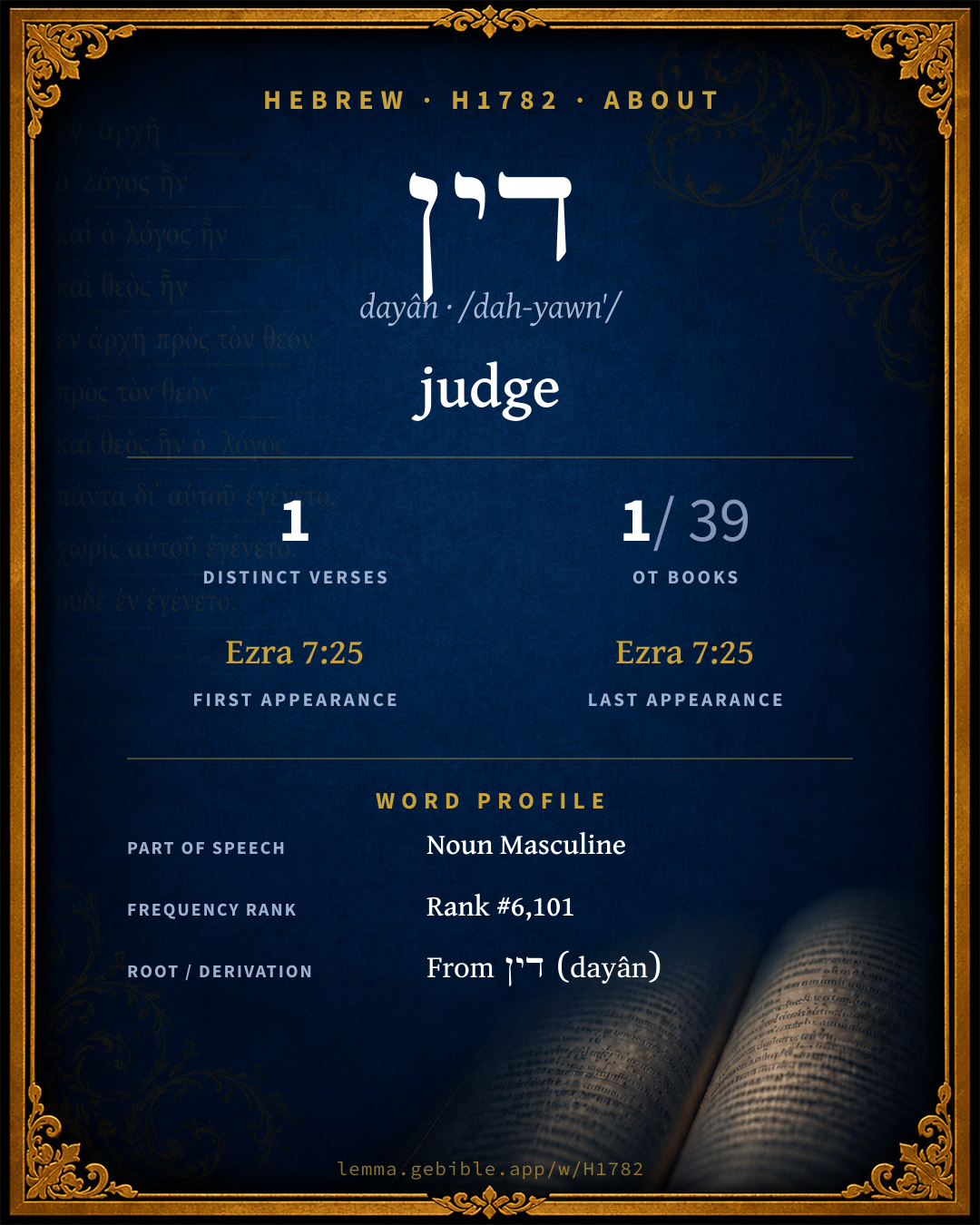
דַּיָּן
judge
Full lexicon entry — Brown-Driver-Briggs (BDB)
From Brown-Driver-Briggs (BDB)
Where this word appears
Grammar key — what these labels mean
Noun type
- Common
- A common noun — a general class of person, place, or thing (“king,” “city,” “water”), not a specific name.
State
- Absolute
- The independent form of a noun, not bound to a following word.
Gender
- Masculine
- Grammatically masculine.
Number
- Plural
- More than one (in Hebrew, generally three or more).
Every verse where H1782 appears — 1 distinct verse across 1 book. Click any verse to open its interlinear word-by-word view. Verse text shown in the World English Bible for context — . Each verse’s Hebrew form is shown with its reference; the English is not keyword-highlighted, since the data carries no word-level English alignment. Use “Compare translations” on any verse to read it across multiple English versions. This concordance covers the Hebrew Bible; Septuagint (Greek Old Testament) occurrences are not indexed here.
Ezra 1 verse
About this entry
At a glance — auto-summarized from this page’s data, not written by a person. Every figure links to its source below. This summary describes the numbers; it doesn’t interpret them.
The Hebrew noun דין centers on the idea of “judge.” With only 1 verse it sits in the long tail of Hebrew Bible vocabulary. The word gravitates to Ezra (100%). Its lone occurrence is Ezra 7:25. Dig into 1-verse concordance and the renderings breakdown below.
Gloss history
Strong's 1890 vs modern scholarship
About this word
Strong's H1782 catalogs a Hebrew word from the Hebrew Old Testament.
These counts are not copied from any lexicon or concordance. They are computed here, from the morphology-tagged Hebrew Old Testament. What Lemma adds →
- 1
- distinct verses
- The word appears in 1 distinct verse.
- 1 / 39
- OT books
- The word appears in 1 of 39 Old Testament books.
- #6,101
- by frequency
- Rank #6,101 (rank 6,101 of 8,640 Hebrew words by occurrence).
View all 1 occurrence in the concordance →
Most concentrated in
- Ezra 1 verse 100%
By section of the Old Testament
By traditional corpus
Conventional, traditional groupings — biblical authorship is debated, so this is a traditional corpus grouping, not an authorship claim. Each share is this word’s portion of its verses in that division of the Hebrew canon. Each figure is a share of the word’s 1 distinct verse.
- Writings (Ketuvim) 1 verse · 100%
How translations render this word
Counts come from each version’s own published word-to-Strong’s tagging or interlinear alignment — an approximate guide to how each version renders this word, not a word-level alignment the data otherwise carries. Because each total is that version’s own tagged count, the per-version totals vary from one another and need not match the appearance or distinct-verse counts above. These counts may also differ from a printed concordance because Lemma counts each distinctly tagged rendering and does not collapse phrase taggings into a single head-word total. This is a fixed set of word-tagged versions (KJV, ASV, BSB, ULT) and does not change with the reading translation you choose elsewhere. Each version’s license is shown beside its name below (and on Sources).
- King James Version: Judges 1×
- American Standard Version: Judges 1×
- Berean Standard Bible: Judges 1×
- unfoldingWord Literal Text: Judges 1×
King James Version Public Domain
Renders H1782 across 1 tagged occurrence — most commonly:
American Standard Version Public Domain
Renders H1782 across 1 tagged occurrence — most commonly:
Berean Standard Bible Public Domain
Renders H1782 across 1 tagged occurrence — most commonly:
unfoldingWord Literal Text CC BY-SA 4.0
Renders H1782 across 1 tagged occurrence — most commonly:
Senses in BDB
The 1 sense BDB distinguishes for this word, in lexicon order (not ranked by frequency or importance). The full entry — with sub-senses — is in the Lexicon Entry tab.
- judge
Word origin
[ דַּיָּן ] n.m. judge;—pl. Ezr 7:25.
— Brown-Driver-Briggs (Oxford 1906, public domain), digitized via Sefaria, supplemented by the OpenScriptures HebrewLexicon (CC BY 4.0). See Sources.
Derived from דין (dayân) (H1781) — judge.
Jastrow Dictionary
A second Hebrew/Aramaic lexicon for comparison, covering Aramaic and post-biblical (Talmudic, Targumic, Midrashic) usage that the biblical-Hebrew BDB does not. Matched by lemma rather than by Strong’s number, so a lemma may carry more than one Jastrow headword (shown separately below), and the entries cover usage well beyond the Bible.
*דֵּין
- (v. דְּוַי)
- 1. faintness, trouble, sickness. Y. Ber. IX, 13ᵃ bot. ד׳ ליה וכ׳ he was in trouble; (so) we let him pass.
- 2. interj. expressive of love-longing (cmp. אוֹי &c.) Oh! Ah! Cant. R. to II, 9 (play on דודי) את אומר לנו ד׳ ד׳ וכ׳ thou (O Lord) sayest to us, Oh! Oh! [strike out the gloss פי׳ דיאו דיאו]. Thou art sighing for us first (instead of our aspiring for thee)! Ib. (twice more; correct slight inaccuracies). Pesik. R. s. 15 [read:] את אתת לגבן קדמאה, דיאו את לגבן, את אמרת לנו דיו; Num. R. s. 11 [read:] את אמרת לנו דיו את אתת וכ׳.
דֵּין
- , v. דֵּן
דִּין I
- v. Ges. H. Dict. s. v.) [to rule,]
- 1. to hold court, pass sentence, punish. Snh. II, 2 המלך לא דָן ולא דָנִין וכ׳ the king must not act as judge, nor be summoned before court. B. Kam. 82ᵃ ודנין בשני וב׳ court is held on Mondays and Thursdays. Snh. VII, 5 דנין את העדים וכ׳ witnesses are examined &c., v. כִּינּוּי. Ib. 5ᵃ ידין ידין dare he hold court? He dare; a. fr.
- 2. to argue, conclude. Pes. 27ᵇ דָּנוּ דִין אחר they argued differently. Maas. Sh. II, 9; Eduy. I, 10 הַדָּנִין לפני חכמים those who argued before the scholars; Snh. 17ᵇ by ‘those who argued &c.’ are meant R. Shimeon &c. Ab. Zar. III, 5 (45ᵃ) אני אובין ואָדוּן (v. Rabb. D. S. a. l. note 8), v. בִּין. R. Hash. 7ᵃ דנין שנה … משנה וכ׳ we compare the word shanah (year), used in connection with months, with shanah used &c. (Num. XXVIII, 14 with Ex. XII, 2); a. fr. e.g. Numbers 28:14
- 3. to judge, form an opinion of. Ab. I, 6, v. זְכוּת; a. fr.
- נָדוֹן) to be judged, be called to account, summoned, punished, sentenced. R. Hash. I, 2 העולם נ׳ sentence is passed upon the world (prosperity or failure decreed). Ib. 16ᵃ נִידֹּונֶת לשעבר sentence has been passed upon it in the previous year (on the Passover, before the seed was sown), נ׳ להבא on the Passover of this same year (after the seed has been planted). Ib. אדם נ׳ בכל יום judgment is passed on man every day. Ib. 12ᵃ ברותחין נִידּוֹנוּ they were punished with (found their death in) hot water. Ab. III, 15 בטוב העולם נ׳ the world is ruled with divine mercy. Ḥull. 45ᵃ נ׳ כמוח is subject to the same law as the brain. B. Kam. II, 5 להיות כנ׳, v. דַּי; a. fr.
- to argue, discuss, dispute. Koh. R. to II, 8 היתה מְדַיֶּינֶת וכ׳ she argued (contended) with him. Ib. שמְדַיְּינִין בהלכה who argue legal questions.—Gen. R. s. 3 היו מדיינין זה עם זה contended with one another; a. fr.
דִּין
- Targ. I Kings XX, 40; a. e.—Part. דָּאֵין, דָּיֵין, דָּיֵן. Targ. Is. XVI, 5. Targ. O. Ex. XVIII, 16 דָּאֵינָא ed. Berl. (Var. דָּאִיְנָא, דָּאִינְנָא, v. Berl. Targ. O. II, p. 25; Y. דָּיֵינָא).—Ib. מִידַן, מֵידוּן. Targ. O. ib. 13 לְמִידַן (ed. Berl. לִמְדַּן, Y. למֵידוּן); a. e.—Y. Snh. I, 18ᵃ bot. יתיב דָּיֵין וכ׳ sat holding court single-handed. Ib. הוו דָּיְינִין קומי וכ׳ had a law-suit before &c. Keth. 27ᵇ דָּאִינְנָא I decide (v. supra). B. Bath. 29ᵃ, v. דַּיָּינָא; a. fr. [Sabb. 67ᵇ, v. דני.]—דּוּן מִינָּהּ ומינה judge from it and (all) from it, i.e. an analogy (v. גְּזֵירָה) must be carried through all points so that the case deduced agrees throughout with the case from which the deduction has started, opp. דון מינה ואוקי באתרה judge from it and place the deduction back on its own basis, i.e. let the deduction won by analogy be regulated by the rules of the original case, e.g. Shebu. 31ᵃ an analogy between testimony and trust with reference to false oaths (Lev. V, 1 sq., a. 21 sq.). Yeb. 78ᵇ; B. Kam. 25ᵇ; a. fr. e.g. Leviticus 5:1
- 1. to dispute, quarrel. Targ. Y. Ex. XV, 12; a. e.
- 2. to decide. Shebu. 32ᵇ היכי לִדַיְּינֵי דַיָּינֵי וכ׳ how shall the judges decide this case?; ib. 47ᵃ לִידַיְּינוּ; a. e.
- , אִי׳ to be judged, decreed upon, punished. Targ. Y. Ex. XVIII, 11. Targ. Is. LIX, 4; a. fr.—R. Hash. 16ᵃ אימת אִיתְּדוּן when were these sentences passed?—Ib. חד דינא מִתְדָּנָא sentence is passed upon it (the grain) once only; תרי דיני מתדנא sentence is … twice.
- 1. same. Targ. Ps. XXXVII, 33; a. e.—2) same.
- to argue, dispute, have a law-suit with. Targ. II Chr. XXII, 8; a. e.—Y. Snh. III, end, 21ᵈ [read:] והוון מידַּיְּינִין וכ and contested before &c.; a. e.
דִּין II
- preced.)
- 1. law-suit, claim; judgment, justice, law. Yeb. 92ᵃ; Snh. 6ᵇ יקוב הד׳ את ההר let the law cut through the mountain (justice under all circumstances). Ib. 2ᵇ אין דִּינֵיהֶם ד׳ their decision is not binding. Keth. IX, 2 אין מרחמין בד׳ compassion must have no influence on the decision of the law. Ib. IX, 1 ד׳ ודברים אין לי וכ׳ I have no claim whatever &c. Snh. l. c. שנים שבאו לד׳ two persons who come before court. Ib. VI, 1, v. גָּמַר.—B. Mets. 30ᵇ, a. fr. ד׳ תורה strict law, opp. לפנים משורת הד׳ inside the line of the law, equity.—Sabb. 33ᵃ עינוי הד׳ vexations of the law, unnecessary delay of sentence, עיוות הד׳ perversion of the law, partiality and sophistry; קילקול הד׳ disregard of the law, wrong sentence through carelessness.—Ab. Zar. 18ᵃ, a. fr. יום הד׳ the day of judgment (in the world to come). Ib., a. fr. הצדיק את הד׳ to declare God’s judgment right, to submit to God’s decree with resignation, צידוק הד׳ resignation.—Ab. IV, 22, a. fr. נתן ד׳ to give an account, to be made responsible.—Gen. R. s. 28 נטלו דִינָם suffered punishment Gen. R. s. 22 לתבוע דִּינוֹ של וכ׳ (Ar. דקיון) to make responsible for &c., cmp. דִּיקְיוֹן; a. fr.—Ib. s. 12 end, a. fr. מידת הד׳ the attribute of justice, Divine Justice, opp. מידת הרחמים Divine Mercy; v. מִדָּה.—בֵּית דִּין (abbr. ב"ד) court, v. בַּיִת.—גְּזַר ד׳ decree, v. גָּזָר.—Kidd. 65ᵇ, a. fr. בעל ד׳ litigant, opponent in court.—Snh. 32ᵇ ד׳ מרומה proceedings in court which bear evidences of fraudulent claims or statements.—Ber. 55ᵃ מוסר ד׳ על חבירו וכ׳ one who appeals to the Lord for judgment on his neighbor.
- 2. argument, analogy. Snh. 4ᵇ; Zeb. 38ᵃ מפני הד׳ by analogy from equal expressions, v. גְּזֵרָה. Ib. והלא ד׳ הוא is not this an analogy?—Esp. conclusion from minor to major (קל וְחוֹמֶר). Y. Kidd. I, beg. 58ᵇ; Bab. Kidd. 4ᵇ, a. fr. ד׳ הוא it is a proper conclusion; מה … אינו ד׳ if a Hebrew hand-maid … is acquired by means of money, אינו ד׳ וכ׳ is it not so much the more proper that a wife &c.—Snh. 54ᵃ, a. fr. אין עונשין מן הד׳ the tresspass of a law derived by conclusion ad majus is not punishable.—לבא מן הד׳ וכ׳, v. דַּי.—Snh. 2ᵇ, a. fr. ובד׳ הוא ד־ and by right &c. Ib. הוא הד׳ דאפי׳ the same applies also to &c.—Pl. דִּינִים, דִּינִין, constr. דִּינֵי. Ḥag. I, 8 הד׳ the interpretations of laws, v. ib. 11ᵃ.—Snh. IV, 1, a. fr. דיני ממונות civil cases, ד׳ נפשות capital cases. R. Hash. 21ᵇ ד׳ שבלב שלא וכ׳ sentences from a mere inner conviction, without witnesses &c.; a. fr.
דִּין ²
- 1. law, decision; cause &c. Targ. Is. LVIII, 6, v. מַסְטֵי. Targ. Prov. XX, 8; a. fr.—Gen. R. s. 45 יבעי דִּינִי גבך may my cause be required at thy hands, i.e. you wronged me, cmp. דִּיקְיוֹן.—Snh. 8ᵃ יומא דד׳ court day. B. Kam. 39ᵃ; B. Mets. 117ᵇ נחית לעומקיה דד׳ he enters into the depth of the case before him. B. Bath. 173ᵇ ד׳ דפרסאי Persian law (arbitrary). B. Kam. 113ᵃ, a. fr. ד׳ דמלכותא ד׳ the law of the (secular) government is law (must supersede the Jewish law in civil affairs). B. Mets. 83ᵃ ד׳ הכי is this the law? Ber. 5ᵇ דעביד ד׳ בלא ד׳ that He will pass sentence without justice (punish without cause). Nidd. 69ᵃ, v. גַּלְחִי. Gitt. 56ᵇ bot. ד׳ דההוא גברא במאי what is this man’s (thy) punishment (in the nether world)? Lev. R. s. 27 אילו הוה הדין ד׳ וכ׳ if such a case would come up in your country. Ib. דִּינְכוֹן אתיתי למחמי (Tanḥ. Emor 6 דיציבון, read: דִּינֵיכוֹן pl.) I came to see your administration of the law; a. fr.
- 2. contest, quarrel. Targ. Prov. XVII, 1; a. fr.—Pl. דִּינִין. Targ. Y. Gen. XIII, 7 [read:] והוו דינין. Targ. Y. Ex. I, 10 בהלין ד׳ by what laws; a. fr.—[Y. Keth. IX, 33ᵇ bot. דין מוגמרין, v. דִּיאֲטַגְמָא.]
דַּיָּן
- , v. דַּיָּין
A Dictionary of the Targumim, the Talmud Babli and Yerushalmi, and the Midrashic Literature (Marcus Jastrow; London, Luzac, 1903) — Public Domain. Digitized via Sefaria. Digitized via Sefaria. Full attribution on Sources.
Septuagint verse parallels
This word appears in 1 verse that also exists in the Greek Old Testament (Septuagint), out of the 1 Hebrew verse it occurs in. You can read those verses in Greek by switching the Old Testament edition to the Septuagint.
Read these verses in the Septuagint
This is a verse-level parallel only — the same verses exist in both the Hebrew and Greek Old Testaments. No word-level Hebrew↔Greek correspondence is claimed: the data carries no such alignment, so no Greek word is shown as this Hebrew word’s translation. Coverage is not total — the Septuagint omits the deuterocanon and renumbers the Psalms, so some Hebrew verses have no direct Greek parallel.