Ezekiel 46:23

Hebrew (Westminster Leningrad Codex) Ezekiel 46:23 appears in the Hebrew Old Testament. The text above is from the Westminster Leningrad Codex. Each word links to its Strong’s number, a concise gloss, and parsing drawn from the Open Scriptures Hebrew Bible morphology. Click any word for its full Brown-Driver-Briggs (BDB) entry.
Download image
Cite this verse

Ezekiel 46:23 (World English Bible). Public Domain. Lemma interlinear Bible study tool, https://lemma.gebible.app/v/ezekiel/46/23.

Show BibTeX & RIS
BibTeX
RIS
English Translation
There was a wall round about in them, round about the four, and boiling-places were made under the walls round about.
World English Bible · Public Domain
Highlights
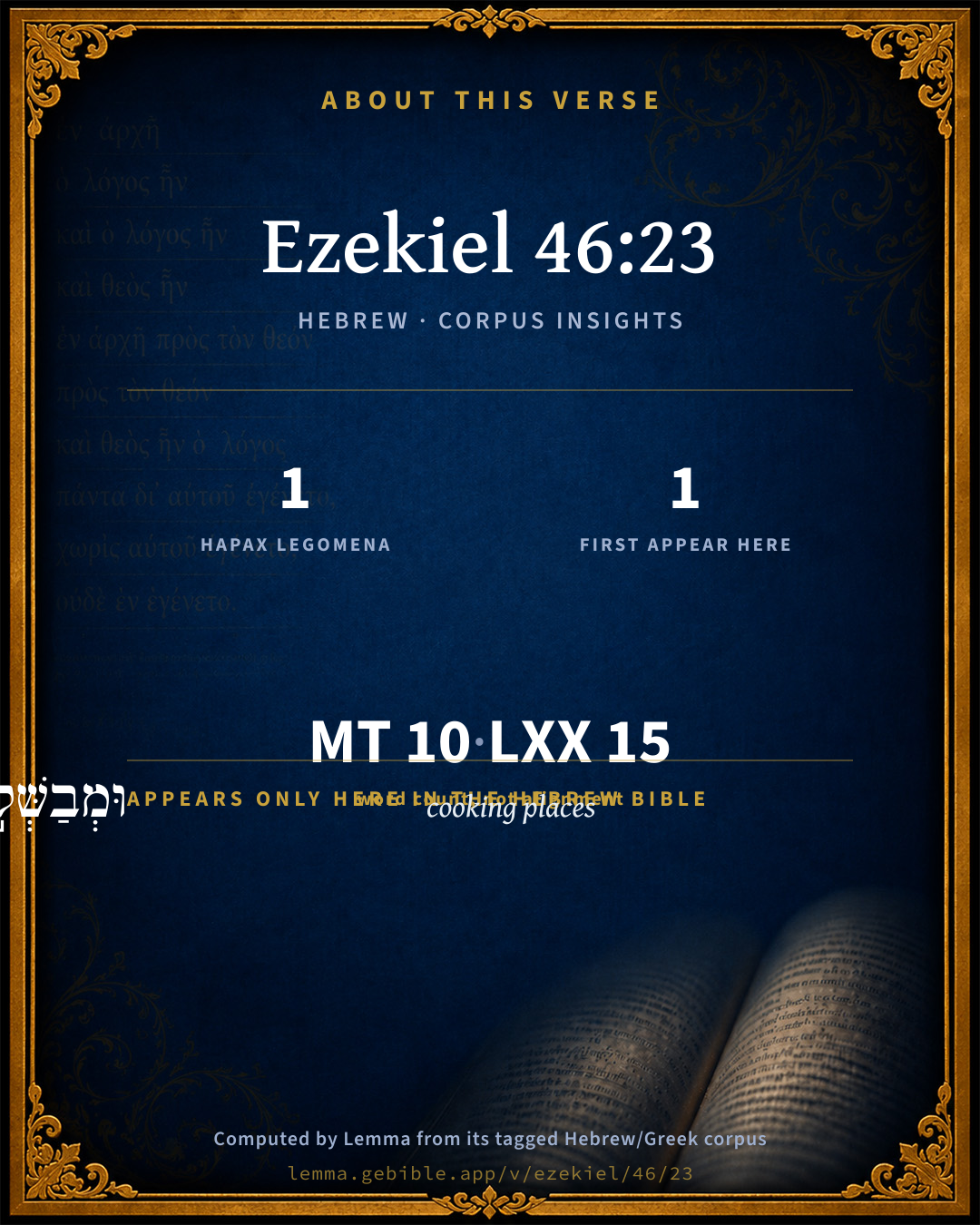
  • 1 hapax legomenon — only here in the Hebrew Bible
  • 1 first appearance in the Hebrew Bible
Full analysis ↓
Download a study sheet

One document with this verse’s original text, its word-by-word gloss line, the meaning frame, cross-references with their text, attributed commentary, and full source and license credits — printable, and it pastes into notes with its structure intact.

This verse Autodidact and up

Study sheet (.html) Plain text (.txt)

A passage Seminary Student

Up to 50 verses in one chapter. A passage sheet keeps up to 6 commentary sources and 12 cross-references per verse, in the order this page ranks them, and says so on the sheet whenever that leaves anything out. Ask for a single verse and you get the Autodidact verse sheet above.

Everything on this page stays free to read, with no account — the sheet is a download of what is already on screen, not access to it.

Want to remove ads? Support Godless Engineer
Compare translations 3

The same verse in 3 English versions, stacked beneath the original-language interlinear above. Click any original word for its lexicon entry.

Each is an independent rendering of the whole verse — the interlinear is not word-aligned to these translations.

Highlighted words mark where these versions differ — a whole-verse word diff, not a word-by-word alignment.

  • World English Bible Public Domain
    There was a wall round about in them, round about the four, and boiling-places were made under the walls round about.
  • King James Version Public Domain
    And there was a row of building round about in them, round about them four, and it was made with boiling places under the rows round about.
  • unfoldingWord Literal Text CC BY-SA 4.0
    There was a row made of stone all around the four of them, and cooking hearths were under the stone row.

unfoldingWord Literal Text — © unfoldingWord, licensed CC BY-SA 4.0. Word-aligned USFM3 via Door43 (git.door43.org/unfoldingWord/en_ult).

Versions to compare (up to 4)

3 of 4 selected

Show all 18 translations

Every available English version of this verse, each an independent rendering of the whole verse.

  • World English Bible Public Domain
    There was a wall round about in them, round about the four, and boiling-places were made under the walls round about.
  • Berean Standard Bible Public Domain
    Around the inside of each of the four courts was a row of masonry with ovens built at the base of the walls on all sides.
  • Majority Standard Bible Public Domain
    Around the inside of each of the four courts was a row of masonry with ovens built at the base of the walls on all sides.
  • King James Version Public Domain
    And there was a row of building round about in them, round about them four, and it was made with boiling places under the rows round about.
  • American Standard Version (1901) Public Domain
    And there was a wall round about in them, round about the four, and boiling-places were made under the walls round about.
  • Revised Version (1885) Public Domain
    And there was a row of building round about in them, round about the four, and it was made with boiling places under the rows round about.
  • Geneva Bible (1599) Public Domain
    And there went a wall about them, euen about those foure, and kitchins were made vnder the walles rounde about.
  • Douay-Rheims (1899) Public Domain
    And there was a wall round about compassing the four little courts, and there were kitchens built under the rows round about.
  • Young's Literal Translation Public Domain
    And a row `is' round about in them, round about to them four, and made with boilers under the rows round about.
  • Literal Standard Version CC BY-SA 4.0
    And a row [is] all around in them—around the four of them—and made with boilers under the rows all around.
  • Unlocked Literal Bible CC BY-SA 4.0
    There was a row made of stone all around the four of them, and cooking hearths were under the stone row.
  • unfoldingWord Literal Text CC BY-SA 4.0
    There was a row made of stone all around the four of them, and cooking hearths were under the stone row.
  • Darby Bible Public Domain
    And there was a row [of building] round about in them, round about those four, and it was made with boiling places under the rows round about.
  • World Messianic Bible Public Domain
    There was a wall around in them, around the four, and boiling places were made under the walls all around.
  • Webster's Bible Public Domain
    And there was a row of building around in them, around them four, and it was made with boiling places under the rows around.
  • Free Bible Version CC BY-SA 4.0
    Each of the four courts had a stone ledge with ovens built into the base of the walls on every side.
  • Bible in Basic English Public Domain
    And there was a line of wall all round inside them, round all four, and boiling-places were made under it all round about.
  • JPS Tanakh (1917) Public Domain
    And there was a row of masonry round about in them, round about the four, and it was made with boiling-places under the rows round about.

Literal Standard Version (2020), Covenant Press — licensed CC BY-SA 4.0. Text via the HelloAO Bible API (eBible.org). Unlocked Literal Bible (unfoldingWord) — licensed CC BY-SA 4.0. Text via the HelloAO Bible API (eBible.org). unfoldingWord Literal Text — © unfoldingWord, licensed CC BY-SA 4.0. Word-aligned USFM3 via Door43 (git.door43.org/unfoldingWord/en_ult). Free Bible Version, Dr. Jonathan Gallagher — licensed CC BY-SA 4.0. Text via the HelloAO Bible API (eBible.org).

Word by word

More ways to search: Search by grammar → Find every occurrence → Compare this word →

Practice this passage: Drill this verse → Learn its vocabulary →

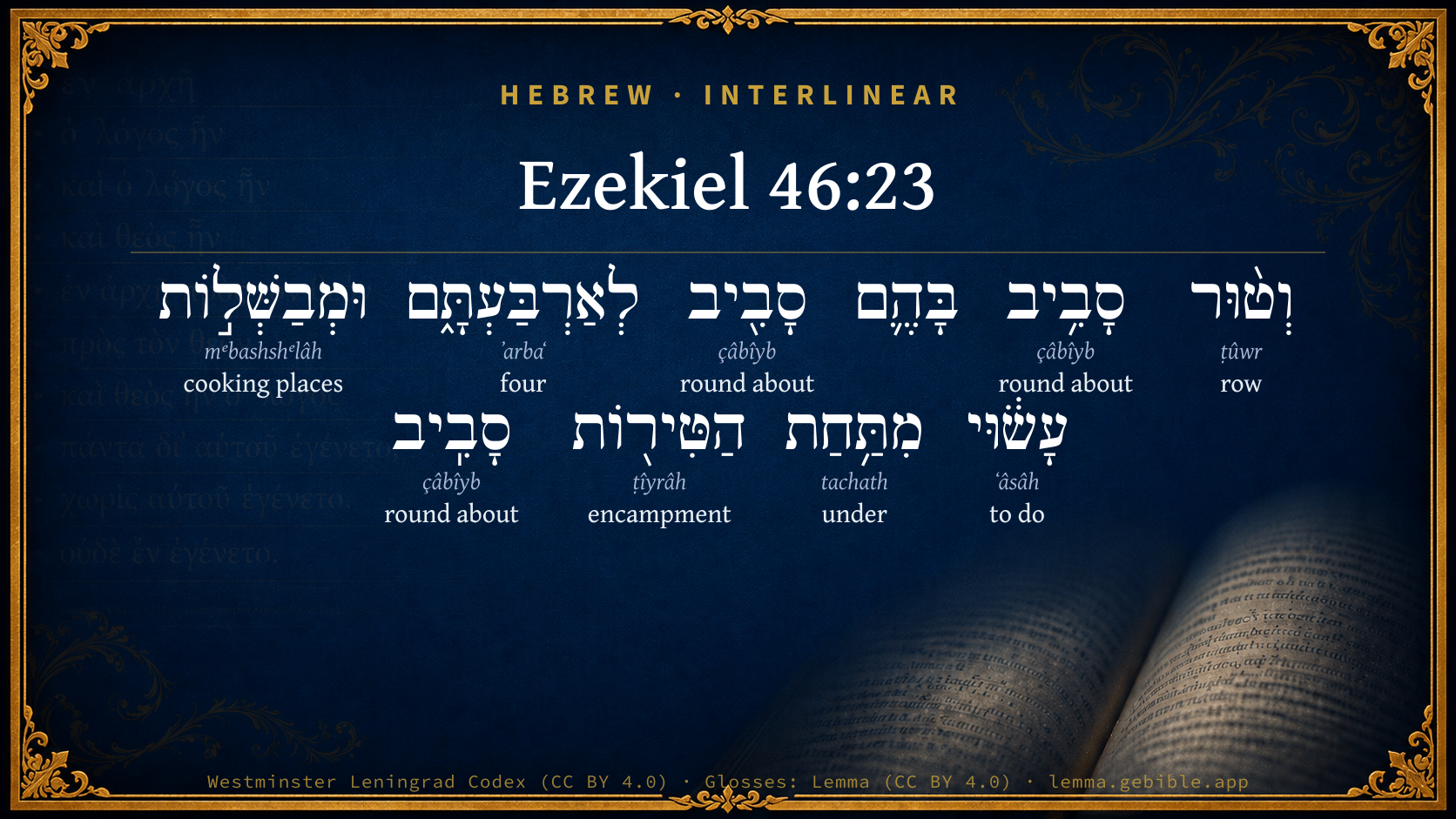
וּמְבַשְּׁל֣וֹת
mᵉbashshᵉlâh
H4018
“and · cooking places”
Conjunction + Noun, Common, Feminine, Plural, Absolute
Part of Speech
Conjunction + Noun
Type
Common
Gender
Feminine
Number
Plural
State
Absolute
Full BDB Definition

Origin: from H1310

TWOT: 292b

cooking places
  1. וְט֨וּר ṭûwr H2905 “and · row of” Conjunction + Noun, Common, Masculine, Singular, Construct
  2. סָבִ֥יב çâbîyb H5439 “round about” Noun, Common, Both, Singular, Absolute
  3. סָבִ֖יב çâbîyb H5439 “round about” Noun, Common, Both, Singular, Absolute
  4. לְאַרְבַּעְתָּ֑ם ʼarbaʻ H702 “to/for · four · their” Preposition + Adjective, Cardinal number, Masculine, Singular, Construct + Suffix, Personal, 3rd Person, Masculine, Plural
  5. עָשׂ֔וּי ʻâsâh H6213 “done” Verb, Qal, Participle Passive, Masculine, Singular, Absolute
  6. מִתַּ֥חַת tachath H8478 “from · under” Preposition + Preposition
  7. הַטִּיר֖וֹת ṭîyrâh H2918 “the · encampments” Particle, Definite Article + Noun, Common, Feminine, Plural, Absolute
  8. סָבִֽיב çâbîyb H5439 “round about” Noun, Common, Both, Singular, Absolute

About this verse

These counts appear in no published source. They are computed here, from the morphology-tagged text and Lemma’s own curated glosses. What Lemma adds →

10
words
7
distinct lemmas
Prophets
section

Notable vocabulary

1 hapax legomenon — a word that appears only here in the entire Hebrew Bible:

  • וּמְבַשְּׁל֣וֹת cooking places H4018

First appearance in Scripture

This word makes its first canonical appearance in the Hebrew Bible here:

  • וּמְבַשְּׁל֣וֹת cooking places H4018

Shared distinctive vocabulary

הַטִּיר֖וֹת encampment H2918 occurs in 7 verses of the Hebrew Bible. Also found in:

Grammatical profile

  • 1 verb
  • 6 nouns
  • 1 adjective
  • 2 prepositions

Verb forms

  • עָשׂ֔וּי Qal · Participle Passive

Repetition

A word recurs within this verse — often emphatic in Hebrew:

  • סָבִ֥יב round about H5439 ×3

Hebrew & Septuagint length

In English translation the verse runs 21 words from the Hebrew and 20 from the Septuagint (LXX English) — closely comparable.

A rough comparison of the two English renderings, which tokenize alike — not a word-level alignment.

Word counts can differ between the Hebrew and the Greek without any difference in meaning — e.g. the Hebrew direct-object marker אֵת has no separate Greek word, and Greek often adds the article ὁ.

In the original languages it is 10 Hebrew tokens and 15 Greek tokens — but the two are counted differently (Hebrew bundles its prefixes and suffixes into one token; the Greek is in lemma form), so that isn’t a like-for-like length.

Hebrew and Greek witnesses Masoretic Hebrew ↔ Greek Septuagint

The same verse in the two great witnesses to the Old Testament, shown verse-for-verse.

These are two independent witnesses, not word-aligned to each other, and the Septuagint is shown in lemma (dictionary) form.

Hebrew Ezekiel 46:23 Masoretic · Westminster Leningrad Codex

וְט֨וּר סָבִ֥יב בָּהֶ֛ם סָבִ֖יב לְאַרְבַּעְתָּ֑ם וּמְבַשְּׁל֣וֹת עָשׂ֔וּי מִתַּ֥חַת הַטִּיר֖וֹת סָבִֽיב

There was a wall round about in them, round about the four, and boiling-places were made under the walls round about.

World English Bible · Public Domain

Greek LXX Ezekiel 46:23 Septuagint · lemma form

καί ἐξέδρα κύκλος ἐν αὐτός κύκλος ὁ τέσσαρες καί μαγειρεῖον γίγνομαι ὑποκάτω ὁ ἐξέδρα κύκλος

And there were chambers in them round about, round about the four, and cooking-places formed under the chambers round about.

LXX2012 (modern English Septuagint) · Public Domain

Hebrew: Westminster Leningrad Codex (CC BY 4.0). Greek: Septuagint (public domain); English from LXX2012 (modern English Septuagint) (Public Domain). How the Septuagint differs from the Hebrew →

Targum (Aramaic paraphrase)

1

The Targum is the ancient Jewish Aramaic paraphrase of the Hebrew Scriptures — an interpretive translation, not the Hebrew text itself. Onkelos (literal) and Pseudo-Jonathan (expansive) render the Torah, and Jonathan the Prophets. Coverage is partial: where no permissively-licensed English translation exists for a verse, only the Aramaic is shown. This is verse-level text, not a word-by-word alignment to the Hebrew.

  1. Targum Jonathan Prophets (Joshua–Malachi)
    וְנִדְבָּכִין עֲבִידִין לְהוֹן סְחוֹר לְאַרְבַּעְתְּהוֹן וַאֲתַר מְתַקֵן לְבַשָׁלָא עֲבִיד מִלְרַע לְנִדְבָּכַיָא סְחוֹר סְחוֹר:

    (no public-domain English translation for this verse)

    Targum Jonathan — Aramaic: “Mikraot Gedolot” (public domain). English: “Sefaria Community Translation” (CC0 1.0 (public-domain dedication)); “London "Chaldee Paraphrase," 1871” (public domain). Text via Sefaria.

Commentary

Notes on Ezekiel 46:23 from classic Christian and Jewish commentators (each source and its license shown beneath its notes). The classic Christian expositions comment on the surrounding passage and are grouped to its opening verse, so a note may address several verses; the Jewish commentaries on the Tanakh (Rashi and others) are per-verse, so they appear only where the commentator wrote on this verse.

Lemma curates 59 commentaries, every one of them public domain or Creative Commons licensed, each selected and text-cleaned for this edition rather than reprinted as found. About our sources →

Trapp's Complete Commentary

John Trapp

Eze 46:23 And [there was] a row [of building] round about in them, round about them four, and [it was] made with boiling places under the rows round about.

Ver. 23. With boiling places.] Such as the ancients called popinas.

“ Nolo ego Florus esse,

Latitare per popinas. ”{ a}

“I do not wish to be Florus,

to hide in the kitchens.”

{a} Adrian. Imp.

John Trapp, A Commentary or Exposition upon All the Books of the Old and New Testament (1647–1656) — public domain. Text from a community e-Sword module.

Jamieson, Fausset & Brown

Robert Jamieson, A. R. Fausset & David Brown

boiling places--boilers.

under the rows--At the foot of the rows, that is, in the lowest part of the walls, were the places for boiling made.

The happy fruit to the earth at large of God's dwelling with Israel in holy fellowship is that the blessing is no longer restricted to the one people and locality, but is to be diffused with comprehensive catholicity through the whole world. So the plant from the cedar of Lebanon is represented as gathering under its shelter "all fowl of every wing" (Eze 17:23). Even the desert places of the earth shall be made fruitful by the healing waters of the Gospel (compare Isa 35:1).

Next: Ezekiel Chapter 47

Jamieson, Fausset & Brown — Commentary Critical and Explanatory on the Whole Bible (1871) — public domain (CC PDM 1.0). Text via the HelloAO Bible API.

Adam Clarke's Commentary

Verse 23. It was made with boiling places] These were uncovered apartments, where they kept fires for dressing those parts of the peace-offerings, which were made in the temple by individuals through a principle of devotion. On these their families and their friends feasted; and portions were sent to the poor, the widows, and the orphans. And thus the spirit of devotion was the means of preserving the spirit of mercy, charity, and benevolence in the land. How true is that word, "Godliness is profitable for all things."

Adam Clarke's Commentary on the Bible (1810–1826) — public domain. Text from a community e-Sword/MySword module.

Ellicott's Commentary for English Readers

(23) A row of building.—Around the walls of these enclosures were fixed tables of masonry with boiling places underneath.

A Bible Commentary for English Readers, edited by Charles John Ellicott (1878–1897) — public domain. Text from a community e-Sword module.

The Cambridge Bible for Schools and Colleges

gen. ed. J. J. S. Perowne

23. The description is brief. The “row” is probably not a series of separate buildings running round the court, but a continuous course of building, in which at the bottom (“under” the row) were recesses in which were the hearths where the pots were set in which the sacrifices were cooked. The hearth usually consisted of some stones within which the fire was put and upon which the pot was set.

The Cambridge Bible for Schools and Colleges (gen. ed. J. J. S. Perowne; Cambridge University Press, 1878–1918) — public domain. Text from a community e-Sword module.

John Gill's Exposition

Then said he unto me, these are the places of them that boil,.... The kitchens, in which those whose business it was to boil the sacrifices did it; and who they were are next declared:

where the ministers of the house shall boil the sacrifice of the people; these seem to be the Levites, as distinct from the priests before mentioned; though in this prophecy they are both used of the same persons; see Eze 44:15, the sacrifice of the people were the peace offerings, which the people might eat of, but were first to be boiled; typical of peace and reconciliation made by Christ, held forth in the ministry of the word, called from thence the word of reconciliation: of the boiling of sacrifices; see Gill on Eze 44:15. The Targum is,

"the holy sacrifices of the people;''

see Rom 12:1.

Next: Ezekiel Chapter 47

John Gill's Exposition of the Whole Bible (1746–1763) — public domain (CC PDM 1.0). Text via the HelloAO Bible API.

Matthew Poole's English Annotations

A row of building; a range of building on the inside of the walls of the lesser courts, or four ranges answerable to the four sides.

Round about in them; added, lest any should think the buildings were on the outside of the walls of these courts.

Four; four courts in the four corners.

Boiling places; places of stone raised on purpose, and framed for the more convenient boiling of that part of the sacrifice which was allowed to the priest, or to the people, to eat before the Lord, and feast with.

Under the rows: these rows of building were so framed, that the caldrons and pots were placed under them; it is likely they might be like cloisters, over which was a roof to cover both the priest or Levite cooks, and the meats they dress, and they were either open as a cloister, or had windows, out of which the smoke of the fire or steam of the meat passed.

Matthew Poole's English Annotations on the Holy Bible (1683–1685) — public domain. Text from a community e-Sword/MySword module.

The Pulpit Commentary

And there was a row of building round about in them; but whether rwOf meant a "wall," "fence," or "enclosure," as Gesenius, Havernick, and Ewald translate, or "row," "series," "a shelf of brickwork which had several separate shelves under which the cooking-hearths were placed," as Keil explains, the obvious intention was to describe the range of boiling places which were built along the inside walls of these corner courts, as the next verse states.

The Pulpit Commentary (1880–1919), ed. H.D.M. Spence-Jones & Joseph S. Exell — public domain. Text from a community e-Sword module.

John Wesley's Explanatory Notes

A row of building - A range of building on the inside of the walls of the lesser courts. Four - Four courts in the four corners.

John Wesley, Explanatory Notes Upon the Whole Bible (1754–1765) — public domain. Text via the GEBible commentary corpus.

Rashi

Rabbi Shlomo Yitzchaki (Rashi)

And a row around in them A row of masonry, a wall of stones protruding from the wall, near the ground, in which there were holes, a place to stand pots. Below the row [of masonry] was a space in which to kindle a fire and the pots [would be heated] above it.

and a place for cooking was made that is the space below the placing of the pots.

Rashi on the Tanakh — English translations: “The Judaica Press complete Tanach with Rashi, translated by A. J. Rosenberg” (CC BY 4.0); “Pentateuch with Rashi's commentary by M. Rosenbaum and A.M. Silbermann, 1929-1934” (public domain); “The Metsudah Tanach series, Lakewood, N.J” (CC BY 4.0); and “The Book of Joshua, Metsudah Publications, 1997” (CC BY 4.0). Text via Sefaria.

Lesson kit

Teaching starters — assembled from the data on this page, not authored interpretation. Every prompt links to the verse data it draws on. Edit before teaching.

Ezekiel, in the Prophets, opens this verse with 10 words (7 distinct Hebrew lemmas). Its most distinctive word is mᵉbashshᵉlâh (“cooking places”). A historical commentator’s framing appears above. Read the whole chapter for the surrounding context.

Discussion questions

  1. What does “cooking places” (mᵉbashshᵉlâh) contribute to the verse as a whole?
  2. This verse holds 1 word here found nowhere else in the Hebrew Bible. What might the rare word draw attention to?
  3. The word “cooking places” first appears here in Scripture. What is being introduced at this debut?
  4. Genesis 25:16 shares the word «encampment» with this verse. How do the two illuminate each other?
  5. “round about” occurs 3× in this one verse. What is the effect of the repetition?
  6. The translations on this page render this verse differently — a whole-verse word diff, not a word-by-word alignment. What might account for the different wordings?
  7. The verb «עָשׂ֔וּי» is Qal Participle Passive. How does its form color the action?
  8. Reading how Trapp's Complete Commentary and Jamieson, Fausset & Brown read this verse, where do the two commentators agree and where do they part?

Things to notice

  • 1 word in this verse appears nowhere else in the Hebrew Bible.
  • 1 word makes its first canonical appearance in Scripture here.
  • This verse counts 10 Hebrew ↔ 15 Greek words.
  • These translations choose different wording for 15 words in this verse.
  • “round about” occurs 3× in this single verse.

Reading settings

Reading text

Shown beneath each verse's original-language words.

Old Testament
Old Testament edition

Read the OT as the Masoretic Hebrew (MT) or the Greek Septuagint (LXX).

English shown for the Greek Septuagint (in the Hebrew ↔ Greek comparison).

Comparing translations? Open the Compare panel on any verse page to stack up to four side by side.